Brand Voice in Email: How to Define It and Make AI Stick to It (2026 Guide)

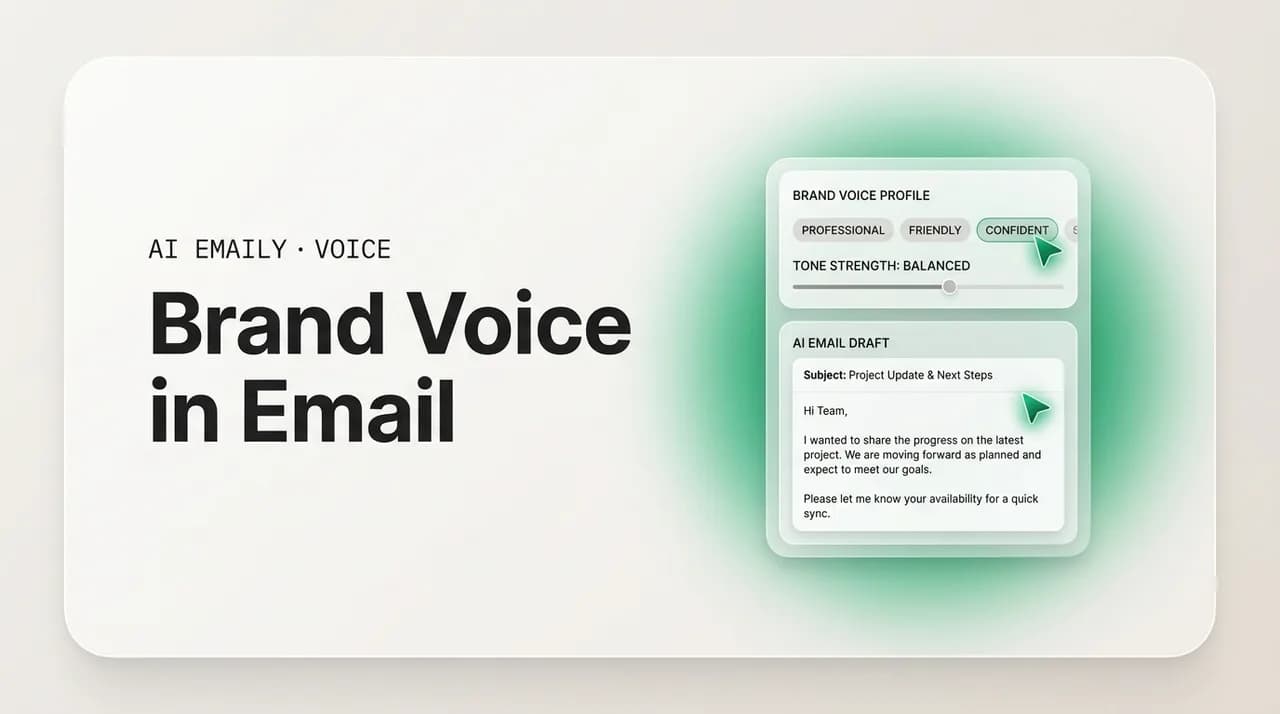
The short answer
Brand voice in email is the consistent personality your company shows in every message — its word choices, rhythm, and attitude. Define it with three or four voice attributes, do/don't word lists, and a tone spectrum, then apply it across transactional, support, and sales mail. Encode it once so AI drafts on-brand instead of generic.
What brand voice in email is, how to define it with voice attributes, do/don't word lists, and a tone spectrum, and how to apply it to transactional, support, and sales mail — plus how to encode it so AI drafts on-brand every time.
On this page
- 01What is brand voice in email, and how is it different from tone?
- 02Why does brand voice break down in email more than anywhere else?
- 03How do you define your brand voice for email?
- 04What are voice attributes, and how do you choose them?
- 05Why do you need do and don't word lists?
- 06What is a tone spectrum, and how does it keep voice consistent?
- 07How do you apply brand voice to transactional email?
- 08How do you apply brand voice to support email?
- 09How do you apply brand voice to sales and outreach email?
- 10What goes in a brand voice guide for email?
- 11What's a quick checklist to keep an email on-brand before you send?
- 12What do distinct brand voices actually sound like?
- 13Why is keeping brand voice consistent so hard in practice?
- 14How does AI Emaily encode your brand voice and keep email on-brand?
- 15The bottom line on brand voice in email
Open three emails from three different companies and you can usually tell, within a sentence or two, who is friendly and who is formal, who is plain-spoken and who is corporate, who treats you like a person and who treats you like a ticket number. You are not reading their logo or their colors — those are nowhere on the screen. You are reading their voice: the word choices, the rhythm of the sentences, the warmth or distance, the way they handle a refund or an apology or a renewal notice. That accumulated personality, carried in language across every message, is the brand's voice in email.
Most companies obsess over voice on their homepage and ad copy, then let it evaporate the moment a real human starts typing in an inbox. The marketing site says "we are warm, direct, a little playful." Then the password-reset email reads like a legal department wrote it, the support reply sounds like a different company, and the sales follow-up could have come from any of ten thousand SaaS startups. Email is where a brand talks to people one-to-one, at the highest volume, in the moments that matter most — and it is also where voice falls apart, because dozens of people send it, under pressure, with no shared definition of what "on-brand" even sounds like.
This guide fixes that. It is a practical reference for brand voice in email: what it is and why it is not the same as tone, how to define your voice with the three building blocks that make it usable (voice attributes, do/don't word lists, and a tone spectrum), and how to apply it to the three places it most often breaks — transactional, support, and sales email. You will get a guide template, a pre-send checklist, and worked examples of distinct brand voices. Then we get honest about the hard part — keeping a voice alive across every message and teammate forever — and what an AI-native email client does about it.
What is brand voice in email, and how is it different from tone?#
Brand voice is the consistent personality your company expresses through language — the recognizable way you sound, message after message, regardless of who is writing or what the email is about. It is the combination of word choice, rhythm, formality, sense of humor (or deliberate lack of one), and attitude toward the reader that makes your email sound like you and not like a competitor. If a customer could read an unsigned email from your company and still guess it was you, that is brand voice doing its job.
Tone is different, and the distinction matters. Voice is constant; tone flexes. Your voice is who you are — it does not change between a celebration and an apology. Tone is the emotional register you adopt for a specific situation: upbeat when a customer hits a milestone, calm when something broke, warm and brief when someone just needs a tracking number. A good brand voice holds steady while the tone shifts to fit the moment. The shorthand: voice is your personality, tone is your mood — a warm, plain-spoken brand stays warm and plain-spoken whether it is congratulating you or refunding you.
Why does this belong in email specifically? Because email is the highest-volume, most personal channel a brand has — thousands or millions of one-to-one conversations with real people, often at a moment of friction or decision. That is enormous surface area for a voice to either compound trust or quietly erode it. A consistent voice makes a company feel like a single, coherent entity; an inconsistent one makes it feel like a building full of strangers who share a logo. Readers judge competence partly from how a message is written, and an inbox that lurches in register — chummy marketing, ice-cold support, robotic billing — creates a dissonance the reader may not name but does feel. Voice consistency is one of the cheapest ways to make a brand feel solid.
Voice vs. tone in one line
Why does brand voice break down in email more than anywhere else?#
If voice matters so much, why is email where it falls apart? Because email has every condition that erodes consistency, all at once. Understanding those forces is the first step to designing a voice that survives them — a definition that ignores how email actually gets written will be ignored.
The first force is volume and speed. Marketing copy is drafted, reviewed, and polished; email is fired off between meetings. A support agent answering their fortieth ticket of the day is not consulting a brand guide — they reach for whatever phrasing gets the reply out, defaulting to the safest, blandest register they know. Speed flattens personality. The second is the number of hands. A blog has one or two authors; company email has everyone — founders, support, sales, billing, marketing, the ops person who set up the receipts two years ago. Each writes in their own natural voice unless told otherwise, so the brand fractures along the org chart and the customer feels the seams.
The third is the split between human and automated mail. A large share of email — receipts, resets, shipping notifications, renewal reminders — is automated, written once and sent forever. These transactional messages have some of the highest open rates a brand sends, yet they are the most neglected, full of system defaults like "Dear Valued Customer" that contradict everything the marketing site claims about being human. The fourth is the absence of a usable definition. Most companies that say they have a brand voice have, in practice, three adjectives in a deck nobody has opened since the rebrand. "We are approachable, innovative, and trustworthy" is not something anyone can write from — every company claims those words, and none of them tell a stressed agent whether to write "Sorry about that!" or "We apologize for the inconvenience." A voice that cannot be applied at the keyboard is not a voice; it is a mood board.
Three adjectives is not a voice guide
How do you define your brand voice for email?#
Defining a brand voice is not an abstract branding exercise — for email, it is a practical spec a person (or an AI) can write from. The most usable definitions are built from three components: voice attributes (the personality), do/don't word lists (the vocabulary), and a tone spectrum (how the voice flexes by situation). Get those three down and you have something you can apply, review against, and hand to anyone who sends mail on your behalf.
Start by discovering the voice rather than inventing it. The strongest brand voices are not made up in a workshop; they are extracted from the best writing the company already produces. Pull together emails and copy that people agree "sound like us at our best" — the founder's reply a customer screenshotted, the support message that turned an angry user around — and ask what they share. Are the sentences short or flowing? Is there humor, and what kind? Do they use contractions, "you" and "we"? Are there words that recur, and words the company instinctively avoids? You are reverse-engineering a voice that already exists in your best moments — far more durable than one invented from nothing, because it is already true. The three components below turn those impressions into a spec.
- 1
Pull your best existing email and copy
Gather 10–20 messages people agree sound like the brand at its best. You are extracting a voice, not inventing one.
- 2
Name three or four voice attributes
Distill what those messages share into a short set of personality traits — enough to be distinctive, few enough to remember.
- 3
Define each attribute and add do/don't word lists
For each attribute, write what it means in practice plus concrete phrases to use and avoid. The word lists make the voice writable.
- 4
Map a tone spectrum across situations
Show how the voice flexes — celebratory, neutral, apologetic, urgent — so the personality stays constant while the mood moves.
- 5
Add three labeled before/after examples
Show the same message off-brand and on-brand. Examples teach a voice faster than any rule.
What are voice attributes, and how do you choose them?#
Voice attributes are the small set of personality traits that define how your brand sounds. But the trait alone is useless; "friendly" means nothing until you say what friendly looks like in a sentence and, just as importantly, what it does not mean. The format that makes attributes usable is three parts each: the trait, what it means (do this), and what it does not mean (not that). The "not that" keeps a trait from sliding into its lazy version — "friendly" tipping into "sloppy," "confident" into "arrogant."
Choose three or four, no more. Two is too thin to be distinctive; five or more is too many to hold in your head while typing. The strongest sets pair an obvious trait with a less obvious one that creates tension — "warm but precise," "playful but trustworthy," "direct but never cold." That tension is what makes a voice specific instead of generic; anyone can be "friendly," but "friendly and refreshingly blunt" is a personality. Pick attributes you can genuinely live up to: if "witty" is on the list but your team is not comfortable writing jokes, it produces strained mail that is worse than plain. Here is the format applied to a sample voice — fictional but realistic. Each "not that" rules out the specific failure mode the trait is prone to.
| Attribute | What it means (do this) | What it does not mean (not that) |
|---|---|---|
| Warm | Write to a person, not a segment. Use "you" and "we," contractions, a genuine opener. Acknowledge feelings when they matter. | Gushing, fake-cheerful, or padded with exclamation points. |
| Clear | Short sentences. One idea per paragraph. The point and the ask up top. Plain words over jargon. | Curt or oversimplified. Clear does not mean dropping the warmth. |
| Honest | Say what is true, including when something went wrong. Own mistakes plainly. No hedging, no corporate fog. | Blunt to the point of cold, or oversharing detail no one asked for. |
| Capable | Sound like you know what you are doing. Give a clear next step. Calm confidence, especially when something broke. | Arrogant, dismissive, or buzzword-laden boasting. |
Use the tension on purpose
Why do you need do and don't word lists?#
Attributes describe the personality; word lists make it writable. A do/don't list is the specific words, phrases, and constructions your brand uses, paired with the ones it avoids and the preferred swap. This is the single most useful part of a voice guide for email, because it operates at the level people actually write: not "be approachable" but "write 'sorry about that,' never 'we apologize for the inconvenience.'" A writer or an AI can apply a word list instantly; an adjective requires interpretation every time.
Build the list from the friction points where voice slips: greetings and sign-offs, apologies (the single biggest tell — "sorry about that" versus "we apologize for any inconvenience"), how you refer to the reader and yourselves ("you/we" versus "the customer/the company"), jargon you ban outright, contractions, and the specific clichés you never want to see. The more concrete and email-specific the list, the more it gets used. Here is a do/don't list for the same sample voice — not about grammar but about the dozens of small phrasing decisions that, in aggregate, are the voice.
| Don't write | Do write | Why |
|---|---|---|
| Dear Valued Customer, | Hi [First name], | A real name is the difference between a person and a mail-merge. |
| We apologize for any inconvenience this may have caused. | Sorry about that — here's what happened and how we'll fix it. | The cliché owns nothing; the plain version is human and addresses the problem. |
| Please do not hesitate to reach out. | Just reply here if anything's unclear. | Stock politeness reads as a script; the plain invitation lowers the bar to replying. |
| At your earliest convenience | By Thursday, if you can | Vague hedging hides the real ask; a concrete time is clearer and more honest. |
| We are committed to delivering best-in-class solutions. | Here's what we built and why it helps. | Buzzwords say nothing and sound like every competitor. |
| The customer should be aware that… | You'll want to know that… | Third-person distance is cold; second person talks to a human. |
| Kindly be advised that your payment failed. | Heads up — your last payment didn't go through. | "Kindly be advised" is bureaucratic; the plain version is direct. |
| This email is to inform you that… | Quick update: | Throat-clearing wastes the first line — the line everyone reads. |
Mine your own outbox for the don't list
What is a tone spectrum, and how does it keep voice consistent?#
A voice is constant, but the situations email handles are not — a milestone celebration and a service-outage apology are different moments. A tone spectrum shows how your one voice flexes across those situations without becoming a different brand: it maps common scenarios to the tone the voice should take, so writers know the personality stays put while the mood shifts. Without it, people either write everything in the same flat register (cheerful refund notices, breezy outage apologies — both wrong) or abandon the voice entirely when things get serious.
The cleanest way to express it is a short table of scenario, tone to strike, and a one-line example showing the voice still present underneath. The goal is continuity: a reader should see that the celebratory message and the apologetic one came from the same company, just in different moods. Here is the spectrum for the sample voice — warm, clear, honest, capable.
| Situation | Tone to strike | Voice still showing through (example) |
|---|---|---|
| Good news / milestone | Genuinely upbeat, not manic | "You hit 10,000 sends this month — nicely done. Here's what that unlocks." |
| Routine / informational | Calm, brief, helpful | "Quick update: your report for May is ready. Here's the link." |
| Asking for something | Warm, direct, low-pressure | "Could you confirm the shipping address by Thursday? Just reply here." |
| Something went wrong (our fault) | Honest, accountable, calm | "Sorry about that — the export failed on our end. We've fixed it and re-run yours; here's the file." |
| Bad news / a no | Respectful, clear, no fog | "We can't extend the trial this time, and I want to be straight about why." |
| Urgent / time-sensitive | Direct and reassuring, not alarmist | "Heads up — your card on file expires Friday. Two minutes to update it and nothing changes." |
| Saying thank you | Specific and sincere | "Thanks for flagging that bug — it was a real one, and you saved other people the headache." |
Same voice, different mood
How do you apply brand voice to transactional email?#
Transactional email is the most overlooked and most valuable place to express brand voice — the automated, triggered messages sent in response to something the user did: order confirmations, receipts, password resets, shipping updates, payment failures, renewal notices. They matter for a reason most teams underestimate: transactional emails have far higher open rates than marketing email, often well above half, because the reader is expecting them and they carry information the reader actually wants. That is a captive, attentive audience reading at the exact moment they are using your product — and it is almost always written by whoever set up the system, in pure system-default voice, then left untouched for years.
The opportunity is to treat these as brand moments, not plumbing. A receipt can confirm the charge in your voice and reassure the customer; a shipping notice can carry warmth instead of reading like a logistics printout; a reset can be plain and human instead of vaguely threatening. None of this means stuffing transactional email with marketing — the reader came for information and you must deliver it fast — it means the information arrives in your voice rather than the system's. The bar is simply: would a human at your company have written it this way? Start with the defaults that betray the brand: "Dear Valued Customer" when you know their name; "Do not reply to this email" from a brand that claims to love hearing from customers; "Your transaction has been processed successfully" instead of "You're all set — here's your receipt." These lines quietly contradict everything your homepage promises, and they are read by more people than almost anything else you send. Here is a before/after on the messages that leak the most voice.
Audit your transactional mail first
How do you apply brand voice to support email?#
Support is where brand voice is tested hardest: the customer is often frustrated, the stakes are real, and the reply is written under time pressure across many tickets. It is also where voice matters most — how you sound when something has gone wrong tells the customer more about who you are than any amount of marketing. A brand that is warm on its homepage but cold and scripted in support is, to the customer, a cold and scripted brand. The support reply is the brand.
The principle for support is that the personality stays constant while the tone flexes to meet the customer's emotional state. The voice stays warm, clear, honest, capable, but the tone leans calm and accountable when something broke, patient when the customer is confused, genuinely glad when you deliver good news. The most important moves: own problems plainly instead of hiding behind passive corporate apology language, acknowledge frustration without being saccharine, and be clear about what happens next. "We apologize for any inconvenience" apologizes for nothing; "That's frustrating, and it was our mistake — here's what we're doing about it" is the same brand being accountable in its own voice. A few rules keep voice intact under pressure: lead with the answer or fix, not the throat-clearing; use the customer's name and natural language, not ticket-system phrasing; and never let canned macros override the voice. Here is the same reply in the failure mode most teams fall into versus the on-brand version.
Macros are fine; generic macros are not
How do you apply brand voice to sales and outreach email?#
Sales email is where voice consistency is hardest to hold, because the pressure points all push the other way. Reps are measured on volume and replies, templates scale the writing across many prospects, and the genre is saturated with a generic "sales voice" — the breezy fake-casual opener, the manufactured urgency, the "just circling back," the "hope this finds you well" — that sounds like every other outreach email and nothing like your brand. The result is that a company with a sharp marketing voice often sends outbound indistinguishable from a thousand competitors, because the rep reached for the default playbook instead of the brand's actual personality.
Applying brand voice to sales does not mean being less persuasive — it means being persuasive as yourselves. The same warm, clear, honest, capable voice works in outbound: a genuine, specific opener instead of "I hope this email finds you well"; a plain statement of why you are reaching out instead of a fake-personal hook; a real ask with a concrete next step instead of manufactured scarcity. Honesty is a strong differentiator in sales precisely because so little outreach is honest — naming the one reason you might not be a fit stands out in an inbox full of hype. The voice that builds trust on your website builds trust in outbound too; abandoning it for generic sales-speak throws away the one thing that makes your email recognizable.
There is also a personalization-versus-voice balance. Genuinely personalized outreach — referencing something true and specific about the recipient — is on-brand for almost any voice, because it signals you did the work and you are talking to a person. The failure mode is the fake-personalized template: "I loved your recent post!" attached to a merge field, which reads as more insincere than no personalization at all. Real personalization in your real voice is the goal; mail-merge dressed up as personal is the trap. Here is a generic outbound email versus the same outreach in a defined brand voice.
Honesty is an outreach advantage
What goes in a brand voice guide for email?#
A brand voice guide for email turns everything above into something a team can use. It does not need to be long — a good one is a few pages, not a fifty-page brand bible — but it must be concrete enough that a new hire, a support agent, or an AI could write an on-brand email from it without asking questions. The test is simple: hand it to someone who has never written for your brand and see whether their first email sounds right. If it does, the guide works; if they have to guess, it is too abstract.
The components below are the ones that make a guide writable rather than decorative. The first three — voice attributes, word lists, and the tone spectrum — are the engine. The rest resolve the hundred small questions that come up at the keyboard: how to open and close, how to apply the voice across email types, and a fast checklist for the final read.
- 1
Voice attributes (3–4) with do/not-that definitions
The core personality. Each attribute gets a sentence on what it means and one on what it does not, so it can't slide into its lazy version.
- 2
Do/don't word lists
The phrases to use and avoid — greetings, sign-offs, apologies, banned clichés, how you refer to the reader. The most-used page; make it long and specific.
- 3
Tone spectrum across situations
How the voice flexes for good news, asks, problems, bad news, and urgency — with a one-line example each, showing it holding steady under different moods.
- 4
Email-type notes (transactional, support, sales)
Short guidance for each category, since each has its own pressure points. Include the system defaults to kill in transactional mail.
- 5
Greetings and sign-offs
Standard openers and closings by formality, so the bookends of every email are consistent.
- 6
Before/after examples and a final checklist
Three to five labeled off-brand → on-brand rewrites, plus a short pre-send checklist (below) for the final read.
Short and specific beats long and abstract
What's a quick checklist to keep an email on-brand before you send?#
Most voice slips happen in the last thirty seconds, when a writer is about to hit send and has stopped thinking about voice at all. A short pre-send checklist catches them — a five-second read of the draft against the few things that most reliably break the voice. Run it on anything that matters until it becomes automatic, then trust the instinct it builds. The checklist below is built from the failure modes this guide has covered: if a draft passes all five it is on-brand; if it fails one, you know exactly what to fix.
- Greeting and sign-off: real name where you have it, opener and closing that match the brand and the relationship — no "Dear Valued Customer," no register mismatch top to bottom.
- Clichés killed: no "we apologize for any inconvenience," "please don't hesitate to reach out," "per my last email," "hope this finds you well," "best-in-class," or other banned-list filler.
- Voice recognizable: read it blind — could a customer tell this came from you and not a generic competitor? The attributes (e.g., warm, clear, honest, capable) should be visible.
- Tone fits the moment: celebratory for good news, calm and accountable for problems, direct for urgency — the mood matches the situation while the voice stays constant.
- Talks to a person: "you" and "we," plain words over jargon, the point and the ask in the first line or two, no throat-clearing or third-person distance.
The blind-read test
What do distinct brand voices actually sound like?#
It is easier to define your own voice once you have heard a few very different ones doing the same job. The point of the examples below is not to copy any of them but to demonstrate range — there is no single "correct" email voice, only the one true to a given brand. Each handles the exact same situation (a failed-payment notice) in a personality that is internally consistent and recognizably its own.
What makes each a voice rather than a random tone is consistency: a real brand would handle a receipt, a support reply, and an outage notice with the same personality you hear here, only in different moods. The playful brand stays playful but gets serious when it needs to; the precise brand stays precise but is not cold to a confused customer. Distinctiveness without consistency is noise; consistency without distinctiveness is generic. A strong brand voice has both. Here are four distinct voices handling the same failed-payment moment.
There is no single correct voice
Why is keeping brand voice consistent so hard in practice?#
Here is the honest problem the rest of this guide leads to. Defining a brand voice is the easy part — a focused week or two, a document, a workshop. Keeping it alive in every email, sent by every person, on every busy day, forever, is the hard part, and it is where almost every voice effort quietly dies. The guide gets written, circulated once, and then never opened again, while real email keeps getting fired off in whatever voice the sender defaults to under pressure. A definition that lives in a document is a definition that does not affect the email that goes out.
The structural reasons are the same forces that broke voice in the first place. Email is high-volume and written fast, so nobody pauses to consult a guide; it is written by many people with different natural voices; a large share is automated and set-and-forget; and attention to voice fades exactly when it is needed most. The guide cannot enforce itself; new hires never fully absorb it; the automated emails written years ago keep sending in their original off-brand voice. Voice drifts not because anyone decided to abandon it but because consistency requires constant effort and email gives you none to spare.
The newer wrinkle is AI drafting. A growing share of email is now drafted by AI assistants — and generic AI is a voice problem, not a solution. A general chatbot writes in a recognizable model voice: over-explained, weirdly formal, full of "I hope this email finds you well," "I wanted to reach out," and tidy three-point structures nobody actually talks like. If you draft with AI and do nothing about voice, you have not solved inconsistency; you have replaced your team's varied human voices with one bland robotic one. To use AI without losing your brand, the AI has to know your voice and apply it automatically — a specific capability, not something a chat window does by default. That is the gap the next section is about.
A guide nobody opens changes nothing
How does AI Emaily encode your brand voice and keep email on-brand?#
This is the part that closes the gap between a voice guide and the email that actually goes out. AI Emaily is an AI-native email client built so your brand voice is encoded once and applied automatically — not re-explained to a chatbot on every message, and not left to whether each sender remembers the guide. It starts by learning your voice from real email rather than a paste-in of adjectives: AI Emaily builds a voice profile from the messages you and your team have actually sent, so a draft comes back sounding like your brand at its best, not like a model. That is the difference between voice-matched drafting and a chatbot: one knows how you write because it learned from your sent mail; the other guesses from a prompt and produces the same bland output for everyone. The result is email that passes the blind-read test by default.
On top of the learned voice, you encode the explicit rules — the part of your guide a human would consult. AI Emaily's Rules & Context engine lets you set your brand voice instructions, do/don't word lists, banned clichés, greetings and sign-offs, and tone preferences, and applies them to every draft automatically. Ban "we apologize for the inconvenience" once and it stays gone; set "open with the first name, close with a warm sign-off" and it holds across the inbox. This is your voice guide turned into something that enforces itself at the keyboard. And because drafts are grounded in your actual mailbox context — the real thread, the real person, the real facts — the voice arrives on a relevant, personal message rather than a generic one.
It also solves the consistency-at-scale problem. Because the voice and rules live in the client, every draft is on-brand regardless of who is sending — the same voice across a whole team and every connected account (Gmail, Outlook, and any IMAP provider), so the customer experiences one coherent brand. You stay in control: in its default Copilot mode, AI Emaily drafts the on-brand reply and waits — nothing sends until you approve it. And it is private by design — your mail drafts for you, not to train models for anyone else. You can start free at app.aiemaily.com/signup: the Free plan is $0 and connects your inbox with AI drafting, and Pro is $12.42/month billed annually. The point is not that a machine invents your brand's personality — it is that the voice you defined lands on every email, automatically, without anyone reopening the guide.
Turn your voice guide into rules
The bottom line on brand voice in email#
Brand voice in email is the consistent personality your company shows in every message — the word choices, rhythm, and attitude that make your email sound like you and not a competitor. It is not the same as tone: voice is your constant personality, tone is the mood you flex for each situation. Email is where voice matters most and breaks most often, because it is high-volume, written fast, sent by everyone, and full of set-and-forget automated messages that contradict what your marketing promises. To make it usable, define it concretely: three or four voice attributes with do/not-that definitions, do/don't word lists at the level people actually write, and a tone spectrum. Apply it to the three places it leaks — transactional email (highest open rates, worst defaults), support email (the moment of truth), and sales outreach (where generic sales-speak buries your personality) — write it into a short, specific guide, and run a five-second checklist before you send.
Then face the real challenge: keeping all of that consistent across every person and every busy day is harder than defining it, and a guide nobody opens changes nothing. That is exactly what AI Emaily is built for — encoding your brand voice once, learning how you actually write, and applying your rules and tone to every draft automatically, on-brand across your team and every inbox, with you approving before anything sends. Define the voice well, then put it somewhere it enforces itself. The brand that sounds like one coherent person in every email is the brand customers trust.
Frequently asked
See it in AI Emaily
Keep reading
Sources

Written by
Nafiul HasanNafiul Hasan is an entrepreneur and AI automation system builder with 10+ years of experience turning messy, manual workflows into reliable automated systems. He designs and ships AI enterprise solutions end-to-end — the agent logic, the data plumbing, and the product people actually use — and founded AI Emaily to give busy professionals their attention back. He writes here from the builder's seat: what works, what breaks, and how to put AI to work without giving up control.