AI Email Personalization at Scale: Sound Personal to 1,000 People at Once

The short answer
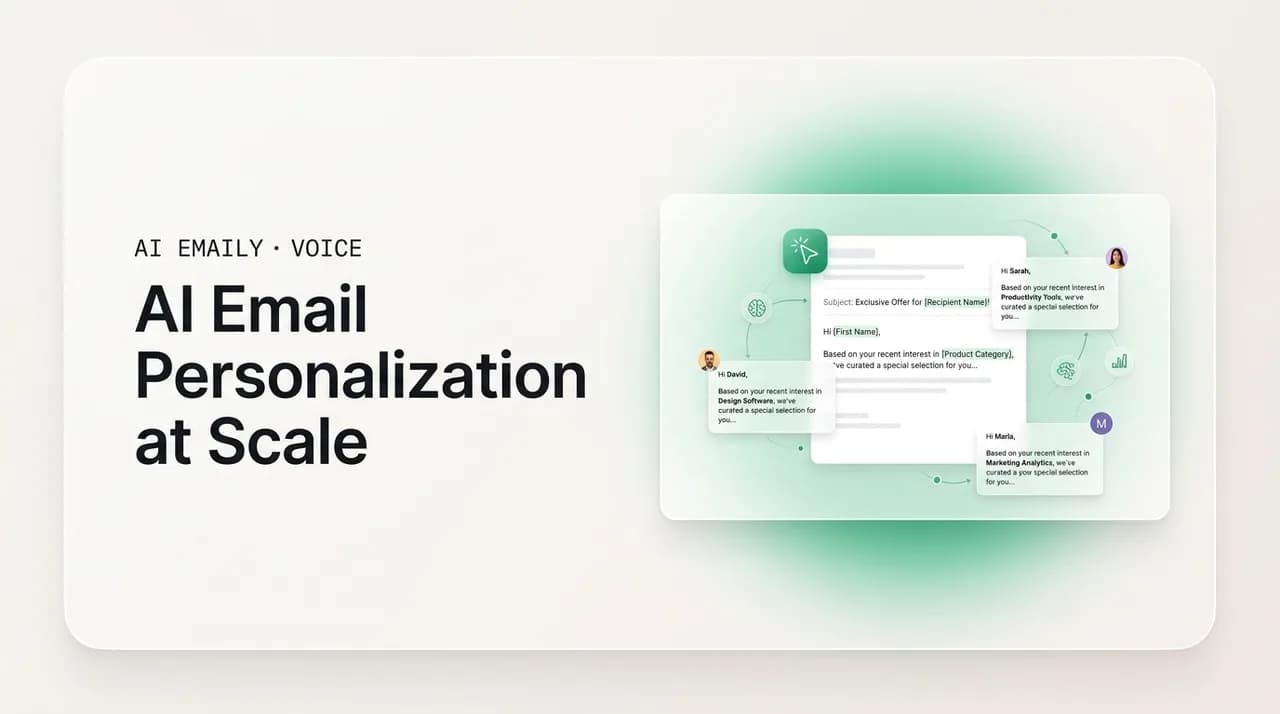
AI email personalization at scale means sending email that reads as if you wrote it to one person — even across hundreds — by grounding each message in real context, not swapping a {first_name} token. The honest split: bulk blasts belong in a dedicated ESP; high-value 1:1 and 1:few relationship email is where AI personalization earns its keep.
AI email personalization at scale means writing genuinely context-aware email to many people without the generic feel of mail merge. This guide covers the personalization spectrum, the data that drives it, where over-personalization gets creepy, deliverability, and when to use a 1:1 tool vs a bulk ESP.
On this page
- 01What does AI email personalization at scale actually mean?
- 02What is the difference between true personalization and mail-merge token swapping?
- 03What is the personalization spectrum — one-to-one, one-to-few, and bulk?
- 04What data actually drives personalization that feels personal?
- 05How do you personalize at scale without being creepy?
- 06Does personalization help or hurt email deliverability?
- 07When should you use a dedicated ESP instead of an AI email client?
- 08How does AI Emaily personalize one-to-one email at scale?
- 09The bottom line on AI email personalization at scale
Everyone says they personalize email. Almost nobody does. What most teams call personalization is a merge field — "Hi {first_name}," stitched onto a template that is otherwise identical for ten thousand recipients. It feels personal to the sender, who set up the variable, and reads as a form letter to the recipient, who has seen the exact trick a hundred times. The gap between those two experiences is the entire subject of this guide.
The promise of AI changed the conversation. For the first time it is genuinely possible to write email that knows who it is going to — what the recipient does, what you last talked about, why this message matters to them specifically — and to do that across a list rather than one painstaking draft at a time. That is real personalization at scale, and it is a different thing from faster mail merge. The question is not "can a machine fill in a blank faster" but "can each message actually be about the person receiving it."
This is also where most marketing copy gets dishonest, so we will not. There is a hard line between two jobs that the word "scale" tends to blur. One job is blasting one near-identical message to a large list — a newsletter, a product announcement, a promotion. That is a bulk-email problem, and the right tool for it is a dedicated email service provider (ESP) built for deliverability, list management, and compliance at volume. The other job is writing high-value, relationship email — to prospects, customers, candidates, partners — where each message is meaningfully different because each relationship is. That second job is where AI personalization is transformative, and it is the job AI Emaily is built for.
So this guide does two things. It teaches the craft of personalization at scale properly — the spectrum from one-to-one to bulk, the data that actually makes a message feel personal, the line where personalization tips into creepy, and the deliverability realities of personalized sending. And it is honest about the tool boundary: when to reach for a mass-email platform, and when to reach for an AI email client that writes one-to-one at scale in your voice. By the end you will know which problem you actually have and how to solve it without pretending a token swap is personalization.
What does AI email personalization at scale actually mean?#
Personalization at scale is the ability to send email that each recipient experiences as written for them, across a volume too large to draft by hand one message at a time. The two halves matter equally. "Written for them" is the quality bar — the message reflects something true and specific about that person. "At scale" is the volume bar — you are doing it for dozens, hundreds, or thousands, not crafting a single artisanal note. The art is holding both at once, because they pull against each other: the easiest way to scale is to stop personalizing, and the easiest way to personalize is to stop scaling.
AI is what makes holding both possible, but only a specific kind of AI. A model that generates a fresh template faster has not solved personalization; it has solved typing. The version that matters can read context — the recipient's role, your history with them, the thread you are replying to, facts pulled from a CRM or your own past email — and write a message grounded in that context, then do it again for the next person with their context. The output is not one template with variables; it is many genuinely different messages that happen to share a purpose and a voice.
It helps to name what personalization is not, because the market is full of impostors. It is not putting someone's first name in the subject line. It is not detecting their company and inserting the company name three times. It is not the "I see you're in {industry}" line that every recipient now recognizes as automated. Those are token substitutions — the mechanics of mail merge wearing a personalization costume. Real personalization changes what the message says and why it is being sent, not just which nouns are slotted into a fixed sentence. A personalized email could be reworded entirely for a different recipient; a tokenized one is the same email with different blanks filled.
The reason this distinction is sharper in 2026 than it was even two years ago is that recipients have been trained to spot the fake version. After a wave of AI-generated outreach, the generic-but-templated email is not just ineffective — it is a negative signal. It tells the reader you ran them through a machine and could not be bothered to know anything real about them. Genuine personalization has the opposite effect: it signals attention, and attention is the scarce resource email is actually competing for.
The one-line definition
What is the difference between true personalization and mail-merge token swapping?#
Picture two emails that both contain the recipient's name. The first reads: "Hi Sarah, I thought your team at Acme would love our solution — companies in SaaS like yours see great results." The second reads: "Hi Sarah, your post last week about cutting onboarding time from three weeks to four days caught my attention — we hit the same wall and the thing that finally moved it was killing the manual data-entry step." Both are addressed to Sarah at a SaaS company. Only one of them could not have been sent to anyone else. That is the whole difference, and it is not subtle to the person reading it.
Mail-merge personalization works by holding a template constant and varying a small set of fields. The sentence structure is fixed; only the values change. This is mechanically efficient — you write once and the system fills the blanks for every row in a spreadsheet — which is exactly why it scales and exactly why it feels generic. Because the sentences are identical across recipients, the message can only ever be as specific as a database column. "Industry: SaaS" produces "companies like yours in SaaS," which is true of thousands of companies and therefore about none of them.
True personalization inverts the relationship between template and content. Instead of fixed sentences with variable nouns, it produces variable sentences grounded in what is actually known about the recipient and the relationship. The message draws on context — a specific thing they said, a specific event, the actual state of your relationship, the real reason you are writing now — and composes around it. Two recipients in the same industry can get two structurally different emails because the relevant fact about each is different. The personalization lives in the substance, not the slots.
The table below lays the two approaches side by side across the dimensions that decide whether an email lands as personal or as processed. Read it as a spectrum, not a binary — most real programs sit somewhere in between, and the goal is usually to move rightward without losing the volume you need.
| Dimension | Mail-merge / token swap | True AI personalization |
|---|---|---|
| What varies | A few field values (name, company) | The actual content and angle of the message |
| Source of "personal" | Spreadsheet columns | Context: history, thread, CRM facts, real events |
| Could it be sent to someone else? | Yes, with different blanks | No — it is specific to this recipient |
| Reader's reaction | "This is a blast" | "They actually know who I am" |
| Failure mode | Empty token, wrong field, obvious template | Costs more effort per message; needs real data |
| Best fit | Newsletters, announcements, bulk promos | Outreach, replies, relationship and account email |
| Right tool | Dedicated ESP (Mailchimp, SendGrid, etc.) | AI email client for 1:1 / 1:few (AI Emaily) |
Notice the last two rows, because they carry the honest part of this guide. The two columns are not better and worse versions of the same task — they are different tasks. Mail merge is the right answer for genuinely bulk, near-identical sends, and the column is not an insult; it is a job. True personalization is the right answer for relationship email, where each message is meaningfully different. Trying to do the first job with a one-to-one personalization tool wastes effort, and trying to do the second job with a bulk ESP produces exactly the generic email everyone is tired of. Most disappointment with "personalization" comes from using the wrong column for the job.
The test that settles it
What is the personalization spectrum — one-to-one, one-to-few, and bulk?#
Personalization is not one decision; it is a spectrum, and where a given email sits on it should drive both how you write it and which tool you use. The spectrum runs from one-to-one — a single message composed for a single person — through one-to-few — a small, segmented group who share enough context that one carefully grounded message fits all of them — to bulk, where one message goes to a large list and personalization is, at most, a name and a segment. Confusing these three is the single most common mistake in email programs.
One-to-one is the highest-value, lowest-volume end. Think a reply to a customer's specific question, a follow-up to a prospect referencing your last call, a note to a candidate about the exact role and their exact background, a check-in with a partner about the deal you are both working. These emails carry the most weight per message and reward the most context. Historically they did not "scale" at all — you wrote each one by hand — which is why busy people send fewer of them than they should and let relationships go cold. This is precisely the end AI personalization transforms: it lets you send one-to-one-quality email at a volume that used to be impossible, because the context-gathering and drafting that ate your time is done for you while the judgment stays with you.
One-to-few is the pragmatic middle. You have a small segment — twenty enterprise accounts in the same vertical, the fifteen attendees from one event, the handful of customers on a specific plan hitting a specific limit — who genuinely share a situation. Here, one message grounded in that shared, real context can fit the whole group without going generic, because the context is specific even if the recipients are several. The risk in the middle is sliding into bulk thinking: the moment the "few" stops sharing real context, you are writing a blast and calling it a segment. Done honestly, one-to-few is where personalization and scale meet most comfortably.
Bulk is the high-volume, low-personalization end — newsletters, launches, promotions, transactional notices. The message is fundamentally one-to-many; everyone gets essentially the same content. Personalization here is genuinely limited to a name, a segment, and maybe a recommended product, and that is fine, because the value of a bulk email is the content itself, not the illusion that it was written for one person. Critically, bulk is a different engineering problem — deliverability at volume, unsubscribe handling, list hygiene, sending reputation — and it belongs in a dedicated ESP, not a personal email client. We will say this plainly more than once.
| Level | Volume | Personalization depth | Examples | Right tool |
|---|---|---|---|---|
| One-to-one | 1 at a time, many over time | Deep — full context per message | Prospect follow-up, customer reply, candidate note | AI email client (AI Emaily) |
| One-to-few | Tens, small segments | Medium-deep — shared real context | Account vertical, event attendees, plan-specific cohort | AI email client (AI Emaily) |
| Bulk | Hundreds to millions | Shallow — name + segment | Newsletter, launch, promo, transactional | Dedicated ESP (Mailchimp, Klaviyo, SendGrid) |
The practical move is to map your own email volume onto this spectrum before choosing any tool. Most people discover their highest-value email — the messages that actually win deals, save accounts, and build relationships — lives at the one-to-one and one-to-few end, and that this is exactly the email they neglect because it does not scale by hand. Meanwhile the bulk end is already handled by a newsletter tool. The opportunity is not to make your newsletters more personal; it is to bring your relationship email up to one-to-one quality at one-to-few volume. That is the gap AI personalization fills, and it is why we draw the tool line where we do.
Position yourself before you pick a tool
What data actually drives personalization that feels personal?#
Personalization is only as good as the context behind it, so the real question is not "how do I word the personal bit" but "what do I know about this person that is worth saying." There are roughly four sources of that context, and the difference between email that feels personal and email that feels processed is usually which sources you are drawing from. The shallow sources produce shallow personalization; the deep ones produce the kind that makes a recipient feel seen.
The first and shallowest source is profile data — name, title, company, location, industry. This is what mail merge runs on. It is necessary (you do need their name) but it is the weakest personalization signal because it is the same for thousands of people and the recipient knows it came from a list. Profile data answers "who are they in a database," which is the least interesting thing about them. Lean on it alone and you get the generic email everyone discounts.
The second, much richer source is relationship history — your actual past interactions with this person. What did you last talk about? What did they ask for? What did you promise? When did you last speak, and what was the open thread? This is the context that turns a cold-feeling message into a warm one, because it proves continuity: you are not starting from zero, you are picking up where you left off. For anyone you have emailed before, history is usually the single highest-value source of personalization, and it is sitting right there in your mailbox.
The third source is CRM and business context — deal stage, plan, usage, support tickets, account notes, the structured facts your systems already track. This is what lets an email be about the recipient's actual situation: the limit they are about to hit, the renewal coming up, the feature they have not adopted, the issue they reported last week. The fourth is timely, external context — a recent event, a public post, a company announcement, a trigger that makes now the right moment to write. Used well, these are powerful; used clumsily, they are where personalization tips into creepy, which is the next section. The example below shows the same opening line built from each layer, so you can feel the difference depth makes.
The order of those layers is also a priority order. If you only have profile data, your personalization will be weak no matter how good your tool is — garbage in, generic out. The leverage is in relationship history and CRM context, because they are specific and because they prove you are paying attention rather than running a play. The practical implication for tooling is significant: a personalization tool that cannot see your relationship history or reach your business context is stuck on the shallowest layer. The whole point of grounding an AI in your actual mailbox and connected data is to write from the layers that matter, not just the name in row 47.
This is exactly where the AI Emaily approach diverges from a mail-merge tool. Its Context and Variables engine does smart search over your real people, threads, and facts — the actual history with this recipient and the real details of your relationship — rather than asking you to define placeholder merge fields against a spreadsheet. The variables are not "{company}"; they are the substance of what you and this person have actually exchanged. That is what makes the draft come back grounded in the second and third layers above, not stranded on the first.
Depth beats cleverness
How do you personalize at scale without being creepy?#
There is a line where personalization stops feeling like attention and starts feeling like surveillance, and crossing it does more damage than no personalization at all. The classic failure is the email that quotes something so specific and so personal that the recipient's first reaction is not "they know me" but "how do they know that, and why are they telling me they know it." Personalization works when it signals reasonable, relationship-appropriate awareness. It backfires when it signals that you have been watching.
The reliable test is the "how would I know this" question. Before you include a personal detail, ask whether the recipient would find it natural that you know it. If the source is obvious and appropriate — you spoke last month, they emailed you, they posted it publicly, you do business together — referencing it reads as continuity. If the source is obscure, scraped, or inferred from data they did not knowingly share with you, referencing it reads as intrusive even when the fact is technically public. The detail being available is not the same as it being appropriate to cite. A good rule: personalize from the relationship, not from the dossier.
Specificity has a sweet spot, not a maximum. More personal detail is not linearly better; past a point it tips into uncanny. "Following up on our call" is warm. "Following up on our call, and I noticed your company's headcount grew 12% last quarter and you personally changed your job title on LinkedIn on Tuesday" is alarming. The first references the relationship; the second performs the research and makes the recipient feel measured. The goal is to sound like a thoughtful human who remembers things, not a system that scrapes everything. When in doubt, reference fewer, more relational facts rather than more, more invasive ones.
There is also a volume-and-honesty dimension. Personalization at scale becomes creepy when the implied intimacy and the actual volume are mismatched — when a message engineered to feel like a personal one-to-one note was obviously machine-produced for ten thousand people, and the recipient can tell. The fix is not to fake more intimacy; it is to match the register to the reality. One-to-one and one-to-few email can honestly carry deep personalization because the relationship supports it. Bulk email should not pretend to be a personal letter; a good newsletter is honest about being a newsletter. Most creepiness is a register mismatch — bulk volume wearing one-to-one clothing.
| Personal detail | Reads as attention | Reads as creepy |
|---|---|---|
| "Following up on our call last week" | Yes — clear, shared source | |
| "Saw your team's post about onboarding" | Yes — public and relevant | |
| "Noticed you opened my email 3 times" | Yes — surveillance, hidden source | |
| "Congrats on hitting 12% growth last quarter" (unprompted) | Borderline — research, not relationship | |
| "You changed your job title Tuesday" | Yes — watched, not known | |
| "Since you're on the Pro plan, here's a tip" | Yes — business relationship |
The privacy angle is not just etiquette; it is increasingly legal and reputational. Using data the recipient never knowingly shared, or in ways they would not expect, erodes trust fast and can run afoul of data-protection norms. The safe and effective posture is the same one good salespeople have always used: personalize from what you legitimately know through the relationship, keep the awareness proportional to how well you actually know them, and let the email sound like a person who pays attention rather than a system that never stops collecting. Done that way, personalization scales without ever feeling like a stalker found your inbox.
The creepy line is about source, not just content
Does personalization help or hurt email deliverability?#
Personalization and deliverability are tangled together, and the relationship runs both ways. Done right, genuine personalization helps deliverability, because the signals that mailbox providers use to judge whether you are wanted — opens, replies, low spam complaints, low deletes-without-reading — are exactly the signals that personalized, relevant email produces. Mail that recipients engage with builds sending reputation; mail they ignore or report erodes it. So the long-run deliverability play is to send email people actually want, and relevance is the engine of want.
Done wrong, though, personalization mechanics can hurt you in specific, avoidable ways. The most common is the broken merge field — "Hi {first_name}," or "Hi ," landing in an inbox because the data was missing. Beyond the embarrassment, spam filters notice template artifacts and malformed mail, and recipients who see an obvious broken automation are quicker to report it. A subtler issue: if your "personalization" is shallow and your volume is high, you are sending bulk-feeling mail at bulk volume, which invites bulk-level scrutiny from filters without the engagement that justifies it. The personalization has to be real enough to earn the engagement, or it is just volume with extra steps.
Volume itself is the bigger deliverability variable, and it is the clearest reason the tool choice matters. Sending a few hundred genuinely individual emails from your normal mailbox over a normal day looks, to a mailbox provider, like normal human email — because it is. Blasting tens of thousands of messages from that same personal account in an hour looks like exactly what spam looks like, and providers will throttle or block it regardless of how lovingly you personalized each one. High-volume sending requires the infrastructure ESPs are built on: authenticated sending domains, dedicated IPs or pools, warm-up, bounce and complaint handling, and list hygiene. A personal email client is not that infrastructure and should not pretend to be.
This is the deliverability case for the same boundary the rest of this guide draws. One-to-one and one-to-few personalized email, sent at human volume from your real mailbox, is the most deliverable email there is — it is indistinguishable from the personal email you have always sent, because it is personal email. Bulk personalized email, sent at scale, needs a dedicated ESP precisely so the volume is handled correctly and your personal sending reputation is not torched in the process. Match the tool to the volume and deliverability mostly takes care of itself; mismatch them and no amount of personalization saves you.
Don't blast bulk volume from your personal inbox
When should you use a dedicated ESP instead of an AI email client?#
This is the most important practical decision in the whole topic, and the honest answer is that you probably need both — for different jobs. They are not competitors; they are tools for opposite ends of the spectrum. Trying to make one do the other's job is the root of most frustration with email tooling. The clean way to decide is to ask what the email fundamentally is: a broadcast, or a relationship message.
Reach for a dedicated ESP — Mailchimp, Klaviyo, SendGrid, Customer.io, and their peers — when the email is a broadcast. Newsletters, product launches, promotions, drip campaigns, transactional notifications, anything that goes to a large list as fundamentally one message. ESPs exist to do this well: they handle list management and segmentation, subscription and unsubscribe compliance, templates and design, deliverability infrastructure at volume, and the analytics that bulk sending needs. If your job is "send this announcement to my 40,000 subscribers," an AI email client is the wrong tool and an ESP is exactly right. We are not going to pretend otherwise to win the comparison.
Reach for an AI email client — this is where AI Emaily lives — when the email is a relationship message. Replies, follow-ups, outreach to specific people, account and customer touches, candidate and partner conversations: the one-to-one and one-to-few email where each message is genuinely different and the value is in how well it fits the individual. This email is sent at human volume from your real mailbox, it lives inside threads and history, and its quality depends on context an ESP never has. An AI email client that learns your voice and grounds drafts in your actual mailbox and connected data is built precisely for this, and a bulk ESP is hopeless at it — the best a campaign tool can do is a merge field, which is the generic email this whole guide is about avoiding.
The boundary blurs in one place worth naming: cold outreach at moderate volume. Some sequencing tools sit between the two, sending semi-personalized cold email to medium lists. That is a real category, but be clear-eyed that it is closer to bulk than to relationship email, with bulk's deliverability and compliance demands and bulk's generic-feel risk. AI Emaily's lane is deliberately the genuinely personal end — relationship email you would be proud to have written by hand, produced at a volume you could not actually write by hand. The table makes the call concrete.
| Your job | Use an ESP | Use AI Emaily |
|---|---|---|
| Monthly newsletter to subscribers | Yes | |
| Product launch / promo to a list | Yes | |
| Transactional / automated notifications | Yes | |
| Reply to a customer's specific question | Yes | |
| Follow-up referencing your last call | Yes | |
| Outreach to a small, researched account list | Yes | |
| Re-engaging cold leads at high volume | Yes (sequencer/ESP) | |
| Account check-ins across your book of business | Yes |
Read down that table and the pattern is clean: the left column is broadcast, the right column is relationship. The reason this matters financially as well as practically is that the right column is usually where your highest-value email lives and where your time is most expensive — and it is the column that has never scaled, because it could not be templated without becoming the left column. That is the specific bottleneck AI personalization removes. You are not replacing your ESP; you are finally getting leverage on the relationship email your ESP was never built to write.
Keep both, and keep them in their lanes
How does AI Emaily personalize one-to-one email at scale?#
AI Emaily is an AI-native email client built for exactly the right-hand column above: high-quality, one-to-one and one-to-few relationship email, produced at a volume you could never hit by hand. It does not try to be a bulk ESP, and that focus is the point — it is built to make the personal email that actually matters scale, not to blast lists. Three capabilities do the work, and together they cover the spectrum's high-value end.
First, voice-matching. AI Emaily learns how you actually write from the email you have sent — your real openers, your level of formality, the rhythm and the closings you genuinely use — so a personalized draft does not just contain the right facts, it sounds like you wrote it. This is what keeps personalization at scale from reading as machine-generated: the message is grounded in the recipient and voiced as the sender. A personalized email in someone else's voice still feels off; in your voice, it feels like you simply found the time to write a great note.
Second, the Context and Variables engine, which is the substance behind the personalization. Instead of merge fields against a spreadsheet, it does smart search over your real people, threads, and facts — the actual history with this recipient, what you last discussed, the details of the relationship — and grounds the draft in that. That is what moves a message off the shallow profile layer and onto the relationship and context layers where personalization actually lands. The "variable" is not "{company}"; it is what you and this person have really exchanged. For one-to-few work, the same engine grounds a message in the shared, real context of a small segment so it fits each of them without going generic.
Third, the AI agent and your control over it. AI Emaily can draft personalized replies and follow-ups across many conversations, so the leverage shows up at the level you need — many genuinely individual messages, not one template fanned out. And it stays in its lane on volume and consent: this is personal-mailbox, human-volume sending, which keeps deliverability healthy precisely because it is real personal email, not a disguised blast. In its default Copilot mode nothing sends until you approve it, so every personalized message gets your eyes before it goes — you scale the drafting, not the risk. It works across every account you connect — Gmail, Outlook, and any IMAP provider — and it is private by design: your mail is used to draft for you, not to train models for anyone else.
You can start free at app.aiemaily.com/signup. The Free plan is $0 and connects your inbox with AI drafting; Pro is $12.42/month billed annually when you want it across everything you send. The honest framing is the one this whole guide has held: if your job is bulk broadcasts, use an ESP. If your job is relationship email that should read as if you wrote each message by hand — and you want that at a scale hand-writing could never reach — that is exactly what AI Emaily is for.
Try it on your own relationship email
The bottom line on AI email personalization at scale#
Personalization at scale is not faster mail merge. It is the ability to send email that each recipient experiences as genuinely written for them, across a volume too large to draft by hand — and the difference between that and a token swap is the difference between attention and a form letter. The recipient can always tell, and in 2026 a generic-but-templated email is not neutral; it is a negative signal that you ran them through a machine and learned nothing real.
The craft comes down to a few honest principles. Personalize from real context — relationship history and business facts — not just the name in a spreadsheet column, because depth of data beats cleverness of phrasing every time. Keep awareness proportional to the relationship so personalization reads as attention rather than surveillance; the creepy line is about source, not just content. And match the tool to the volume: bulk broadcasts belong in a dedicated ESP built for deliverability at scale, while one-to-one and one-to-few relationship email belongs in an AI email client that can see your context and write in your voice.
That last boundary is where AI personalization actually changes the game. Your highest-value email has always lived at the one-to-one end and has always failed to scale, because the moment you templated it, it stopped being personal. AI Emaily exists to remove that bottleneck — voice-matched, context-grounded, one-to-one-quality email at a volume you could never write by hand, with you approving every send. Keep your ESP for the blasts. For the relationship email that wins the deals and keeps the customers, let it finally scale — and let it still sound like you.
Frequently asked
See it in AI Emaily
Keep reading
Sources

Written by
Nafiul HasanNafiul Hasan is an entrepreneur and AI automation system builder with 10+ years of experience turning messy, manual workflows into reliable automated systems. He designs and ships AI enterprise solutions end-to-end — the agent logic, the data plumbing, and the product people actually use — and founded AI Emaily to give busy professionals their attention back. He writes here from the builder's seat: what works, what breaks, and how to put AI to work without giving up control.