How to Clear a 10,000-Email Backlog in One Sitting

The short answer
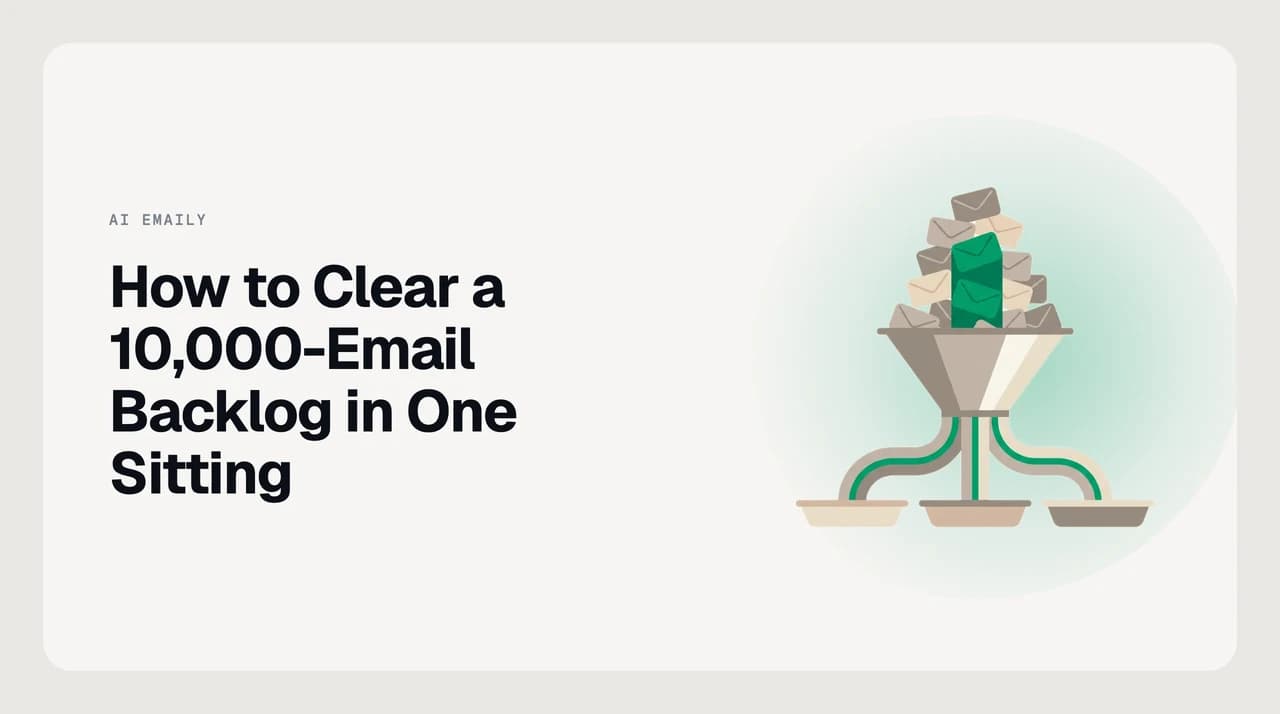
The fastest safe way to clear 10,000 unread emails is a three-phase bulk protocol: archive everything older than 90 days in one search, sweep high-volume senders in batch, then rescue what you actually need by keyword. Set aside two to three hours and work by date, sender, and search — not one email at a time.
A bulk protocol to clear 10,000 unread emails in one sitting: archive by date, sweep by sender, rescue by keyword — and when to declare email bankruptcy.
On this page
- 01Before you start: two decisions that determine the whole session
- 02The three-step bulk protocol: how to clear a huge email backlog
- 03How to run the bulk archive on Gmail, Outlook, and Apple Mail
- 04What to do when the bulk approach does not work
- 05How to declare email bankruptcy — and the note to send
- 06A faster way: keeping the inbox clear after the reset
If you are staring at 10,000 — or 40,000 — unread emails, working through them one at a time is not a strategy. At two minutes per message, a 10,000-message backlog would take over 300 hours to process the traditional way. Nobody does it. The inbox stays frozen, the guilt compounds, and the messages you actually need get buried deeper with every passing day.
This guide gives you a different approach: a three-phase bulk protocol that treats a neglected inbox as a data-cleanup problem, not a personal failing. You work by date, sender, and keyword — not by individual message — and you finish the session with a clear inbox and a real system to keep it that way. If the backlog is genuinely too far gone for even that, there is also an honest look at declaring email bankruptcy: what it means, when it is the right call, and the short note you send afterwards.
The protocol does not require a paid tool. Gmail, Outlook, and Apple Mail all have the search filters and bulk-select controls you need. What it does require is a dedicated two-to-three-hour block where you treat the cleanup as a project, not a background task. Set that time aside before you start.
Before you start: two decisions that determine the whole session#
Do not open a single email yet. Two decisions made in advance will determine whether the session takes two hours or two weeks.
The first decision is your cutoff date. Everything older than your cutoff gets archived or deleted in a single bulk operation — unread, without review. For most people, 90 days is the right cutoff. Any message older than three months that required action either no longer does, or you have already received a follow-up. If that feels aggressive, extend it to six months. The point is to pick a firm date and commit to it, because everything before the cutoff goes in one move without inspection.
The second decision is archive versus delete. Archiving removes messages from the inbox without destroying them — they stay searchable. Deleting removes them permanently after a 30-day grace period in most clients. Archive is the safer default: storage is cheap, and you will occasionally want an old thread. Delete makes sense for newsletters, promotions, and automated notifications where no archival value exists. When in doubt, archive.
Once you have chosen a cutoff date and a default action, you are ready. Do not adjust these decisions mid-session. Hesitation is what turns a two-hour cleanup into a week-long project.
Block two to three uninterrupted hours
The three-step bulk protocol: how to clear a huge email backlog#
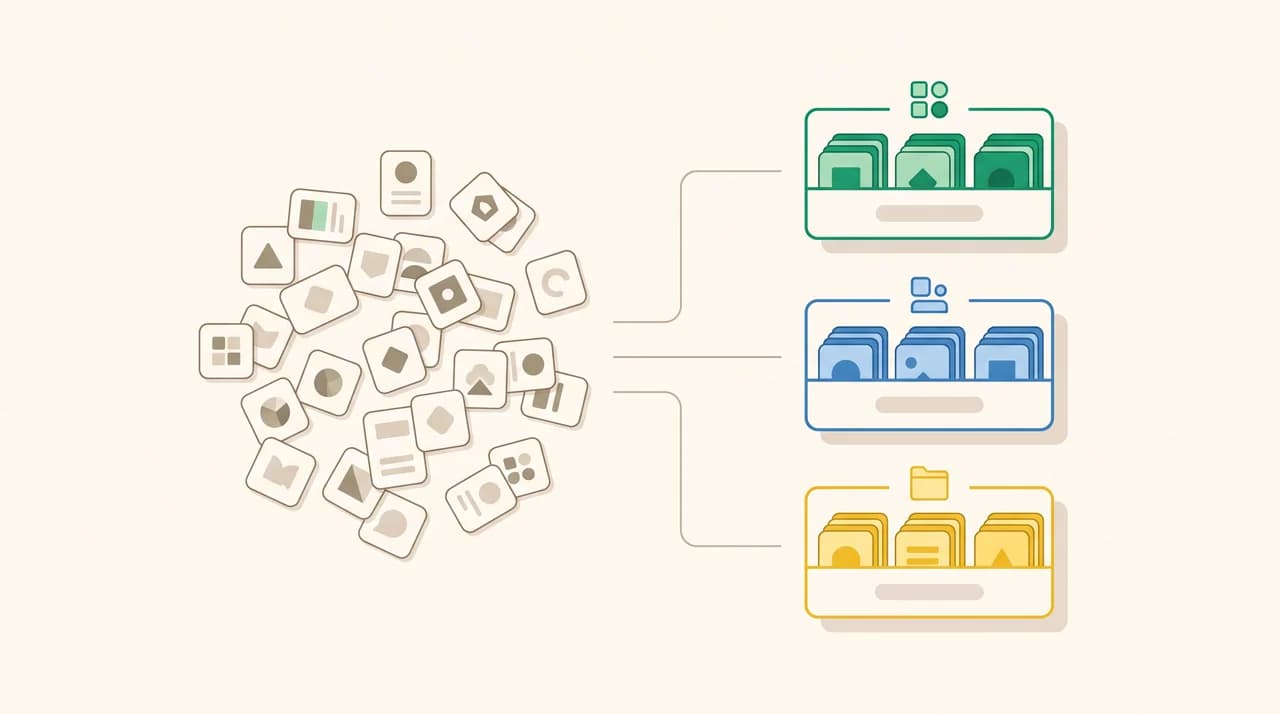
Work through these three steps in order. Each one eliminates a large slice of the backlog faster than reading individual messages ever could. Do not skip ahead — the order matters because each pass makes the next one smaller and more focused.
- 1
Step 1 — Archive everything before your cutoff date
In Gmail, type before:YYYY/MM/DD in the search bar (use your actual cutoff date, for example before:2026/05/01) and press Enter. When results load, click the checkbox at the top left to select all visible messages, then click 'Select all conversations that match this search' to extend the selection to the full result set. Click Archive. In Outlook on the web, sort by Date in the message list, shift-click to select the entire range before your cutoff, then right-click and choose Archive or Move to Archive folder. In Outlook desktop, click the Date column header to sort, shift-click the first and last message in the pre-cutoff range, and press Backspace (which archives). This single step eliminates 50 to 80 percent of the backlog in under five minutes. The messages still exist in your Archive folder and remain fully searchable — they are simply out of the inbox.
- 2
Step 2 — Sweep high-volume senders
After the date cut, what remains is mostly recent mail. Sort the inbox by sender. Identify any address or domain that appears more than ten times — newsletters, automated platform alerts, social notification digests, promotional lists. Select all messages from each sender in turn and archive or delete the batch. In Gmail, search from:[email protected], select all matching conversations, and archive. In Outlook, right-click any message from that sender and look for 'Move all messages from this sender' or sort by the From column and shift-click the full group. As you sweep each high-volume sender, also unsubscribe from every mailing list you are mass-archiving. If you do not unsubscribe, the same senders rebuild the backlog within weeks.
- 3
Step 3 — Rescue by keyword
Now search for what you actually need. Run targeted searches against the remaining messages: your own name, active client names, current project names, financial keywords like invoice and receipt, action phrases like please review or awaiting your approval, and the names of anyone you actively work with. Star or label anything that requires a response. This is the only part of the protocol where you read individual messages — and by this point you are reading a small, relevant slice of the original backlog, not 10,000 items. When you have rescued everything that matters, select the rest and archive it. The inbox should now be at zero, or close enough that the remaining messages are real tasks rather than noise.
How to run the bulk archive on Gmail, Outlook, and Apple Mail#
The three-step protocol is the same across providers, but the search syntax and bulk-select controls differ by client. Use this table to translate Step 1 and Step 2 into the specific actions for your setup.
| Email client | Bulk select by date | Bulk select by sender | Archive shortcut |
|---|---|---|---|
| Gmail (web) | Search bar: before:YYYY/MM/DD — then 'Select all conversations that match this search' | Search: from:[email protected] — select all results in the search view | E key archives selected (enable keyboard shortcuts under Settings > See all settings > Keyboard shortcuts). Or click the Archive button in the toolbar. |
| Outlook (web) | Sort by Date in the message list, shift-click to select the range from the oldest message to your cutoff row | Right-click any message from the sender and look for 'Collect messages from this sender', or sort by From column and shift-select the group | Right-click the selection > Archive. No default keyboard shortcut in Outlook web — configure one under Settings > Keyboard shortcuts. |
| Outlook (desktop) | Click the Date Received column header to sort ascending, then shift-click the first message and the last message before your cutoff | Click the From column header to sort, then shift-click all messages from one sender | Backspace key archives selected messages (moves to the Archive folder). Or right-click the selection > Archive. |
| Apple Mail | Sort by Date (View > Sort by > Date), click the first message in the range, then shift-click the last | Sort by From (View > Sort by > From), shift-click all messages from one sender, or search from:address in the search bar and select all results | Cmd+Ctrl+A archives selected messages to the Archive mailbox. Or go to Message > Archive. |
| Thunderbird / other IMAP | Sort by Date in the message list, shift-click the first and last message in the range | Search by sender address in the search bar, select all results in the thread pane | Move selected messages to an Archive folder manually. Keyboard shortcuts vary by client — check the keyboard reference under Help. |
One clarification before moving on: archiving in Gmail and archiving in Outlook behave differently at the IMAP level. In Gmail, archiving removes the Inbox label but the message lives in All Mail and remains visible to connected IMAP clients in the All Mail folder. In Outlook, Archive is a real folder that appears in the IMAP folder tree. In both cases, nothing is deleted — the messages are searchable and recoverable. If you use a third-party mail client connected to either provider, archived messages will reappear in the Archive or All Mail folder during the next sync.
What to do when the bulk approach does not work#
For most inboxes the three-step protocol reaches inbox zero in two to three hours. A few edge cases need a different move.
- The client freezes or times out on large selections. Some webmail interfaces struggle with select-all operations on very large mailboxes. In Gmail, narrow the date range — run Step 1 in six-month increments rather than one large sweep. In Outlook, prefer the desktop application over the web version; it handles large batch operations more reliably than the browser interface.
- You cannot tell which messages are important. If your cutoff date is not providing enough clarity and you are afraid to bulk-archive, run the rescue-by-keyword searches first. Once you have starred or labeled everything that matters, the remaining messages are clearly safe to archive — you no longer need to inspect them.
- The inbox refills as fast as you clear it. Automated senders are adding messages faster than Step 2 can remove them. Unsubscribe from every mailing list before starting Step 2, and set up an inbox filter to bypass the inbox for newsletters going forward. In Gmail, create a filter that matches the sender and applies 'Skip Inbox' plus a label. In Outlook, create a rule that moves matching messages to a folder automatically. Removing the inflow source is the only durable fix.
- Archived messages keep reappearing in IMAP clients. Some local clients cache messages and re-sync them after a bulk archive. This is not data loss — the messages are removed from the inbox on the server, and the local client will reconcile during the next full sync. Wait ten minutes before concluding an operation failed, then trigger a manual sync if needed.
Verify the search before running a bulk delete
How to declare email bankruptcy — and the note to send#
Email bankruptcy is the formal act of archiving every unread message in the inbox as a deliberate reset and notifying the people who might have expected a reply that you have done so. It is not a failure. It is a decision.
The three-step protocol works for inboxes in the tens of thousands where the messages span a few months. Email bankruptcy is the right move when three conditions are true: the backlog spans years rather than months, the rescue-by-keyword step would take more time than you can justify, and the cost of missing whatever is buried is lower than the ongoing cost of maintaining a frozen inbox. For a founder returning from a long break, an inbox abandoned during a career transition, or a mailbox that accumulated for over a year without triage, the math often works out in favor of the reset.
The process is a single operation: go to All Mail in Gmail (or Inbox in Outlook), select every message, and archive all. No cutoff date, no sender sweep, no keyword rescue. You are done in under ten minutes. Everything remains searchable — nothing is deleted — so any message you genuinely need can be found by searching for it afterwards.
The professional step is the note you send to anyone whose thread you may have dropped. This should not be a mass blast. Write personally to the five to ten contacts whose open threads are most likely to matter, using something like this:
A faster way: keeping the inbox clear after the reset#
The one-time bulk reset described above works. But without changing the inflow and triage habits, most people have a 10,000-message inbox again within six months. The protocol clears the backlog — it does not prevent the next one.
This is the problem we built AI Emaily to address on an ongoing basis. We build AI Emaily — it triages new mail continuously after your reset, archives noise using rules you set, labels what needs attention, and drafts replies to the messages that require one. The rescue-by-keyword pass from Step 3 is what it does in the background every day, so the pile never rebuilds to a size that needs another three-hour session.
AI Emaily connects to Gmail, Outlook, and any IMAP account. Start with a 7-day free trial on the Pro or Autopilot plan — see AI Emaily pricing for current details. Every action the agent takes is logged in a full audit trail and reversible with one click, so you stay in control of what gets archived and what gets a reply.
Run the reset first, then connect
Frequently asked
See it in AI Emaily
Keep reading

Written by
Nafiul HasanNafiul Hasan is an entrepreneur and AI automation system builder with 10+ years of experience turning messy, manual workflows into reliable automated systems. He designs and ships AI enterprise solutions end-to-end — the agent logic, the data plumbing, and the product people actually use — and founded AI Emaily to give busy professionals their attention back. He writes here from the builder's seat: what works, what breaks, and how to put AI to work without giving up control.