Email Drip Campaign Automation: Triggers, Timing & Templates

The short answer
Email drip campaign automation sends a pre-built series of emails triggered by signup, behavior, time, or a milestone, then drips them over days or weeks. Use a marketing-automation tool for bulk drips. For personal 1:1 follow-ups in your own voice, use an AI email client like AI Emaily instead.
Email drip campaign automation explained: triggers, sequencing, timing, exit conditions, the best tools, and where 1:1 follow-ups beat bulk drips.
On this page
- 01What is an email drip campaign?
- 02What triggers a drip campaign?
- 03Signup and list triggers
- 04Behavior triggers
- 05Time triggers
- 06Milestone and lifecycle triggers
- 07What are the parts of a drip campaign?
- 08The sequence
- 09The timing
- 10The exit conditions
- 11What are the most common drip campaigns?
- 12Onboarding and welcome drips
- 13Lead nurture drips
- 14Abandoned-cart and abandoned-action drips
- 15Re-engagement (win-back) drips
- 16What does a 5-email onboarding drip look like?
- 17How do you set the right cadence between drip emails?
- 18How do segmentation and personalization improve drips?
- 19What are the most common drip campaign mistakes?
- 20What tools run drip campaign automation?
- 21How the main platforms compare
- 22How do you measure and optimize a drip campaign?
- 23Which metrics matter for which drip
- 24What to test
- 25Drip campaigns vs. 1:1 personal follow-ups: which do you need?
- 26How AI Emaily runs personal 1:1 drip-style follow-ups in your voice
- 27What it actually does
- 28Private, controlled, and yours
- 29Putting it together
A drip campaign is a set of emails you write once, then let an automation send over time. Someone signs up, abandons a cart, hits a milestone, or simply waits a few days, and the next message goes out on its own. The word "drip" is the whole idea: instead of dumping everything in one blast, the content arrives in a slow, deliberate trickle that meets a person where they are.
That single shift, from "send now" to "send on a trigger, then keep sending on a schedule," is what makes drip automation one of the highest-leverage things in email. You do the thinking up front. The system does the sending forever. A welcome series greets every new subscriber the same way at 2 a.m. on a Sunday as it does at 2 p.m. on a Tuesday, without you lifting a finger.
This guide covers what a drip campaign actually is, the four trigger types that start one, the anatomy of a good sequence (steps, timing, and the exit conditions most people forget), the common drips worth building, the tools that run them, and how to measure and improve what you ship. Then we draw an honest line: bulk drip campaigns belong to a marketing-automation platform, but the personal, one-to-one follow-up — the kind that sounds like you and stops the moment someone replies — is a different job entirely. We will show you where each one wins, including where AI Emaily fits.
What is an email drip campaign?#
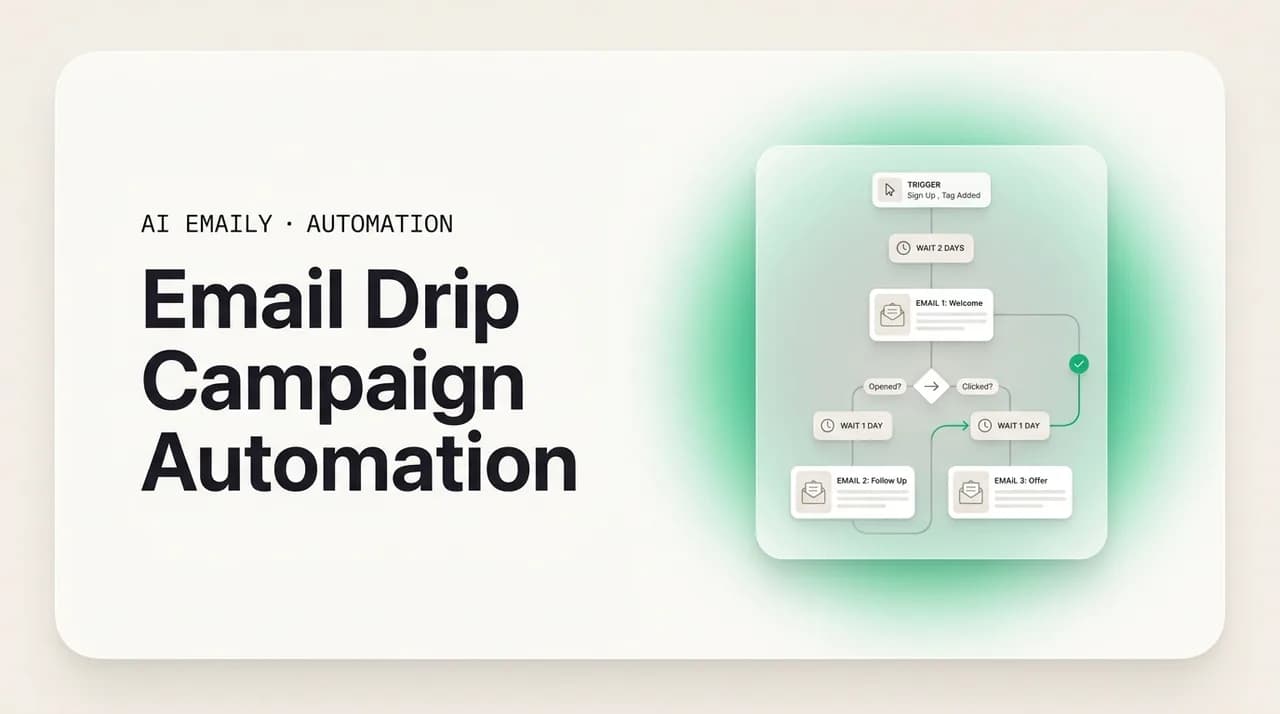
An email drip campaign is a series of pre-written, automated emails delivered to a person based on a trigger or a schedule. You build the messages and the timing once; the platform handles delivery from then on. The defining trait is automation — the sequence runs without anyone pressing send for each message.
Compare that to a broadcast email, which is a one-off message sent to your whole list at the same moment: a product announcement, a sale, a newsletter issue. A broadcast is about a moment in your calendar. A drip is about a moment in the recipient's journey. The drip does not care what day it is; it cares what the person just did, or how long it has been since they did it.
The payoff shows up in the numbers. Triggered emails — the behavior-driven heart of most drips — average roughly 70% higher open rates and far higher click-through than standard bulk sends, because each message lands when it is relevant rather than when it happens to be convenient for the sender. Industry write-ups commonly cite drip and automated flows delivering several times the engagement of a one-time blast, and meaningfully higher revenue per recipient, for the same reason: right message, right time, no manual effort.
Drip vs. automation vs. sequence
It helps to picture the simplest possible drip. A reader subscribes to your list. Immediately, they get a welcome email. Three days later, a second email shares your best resource. A week after that, a third email invites them to take a next step. That is a complete drip campaign — three messages, one trigger (the signup), and two waits. Everything more sophisticated is a variation on that skeleton: more messages, smarter triggers, branching paths, and conditions that pull people out early.
The reason drips work is not magic copy. It is consistency and timing. A human team cannot reliably email every new lead within sixty seconds, then again on day three, then again on day ten, across hundreds or thousands of people, forever. An automation can. It turns a thoughtful sequence you designed on a good afternoon into a reliable system that runs on its worst day exactly as well as its best.
What triggers a drip campaign?#
Every drip starts with a trigger: the event or condition that enrolls someone and fires the first email. Choosing the right trigger is most of the work, because it decides whether the message feels timely or random. There are four families of triggers, and good campaigns often combine them.
Signup and list triggers#
The most common trigger is the simplest: someone joins. They subscribe to a newsletter, create an account, download a lead magnet, or get added to a specific list or segment. Joining is the cue, and the classic response is a welcome series. Signup triggers are easy to set up and almost always worth having, because the moment right after someone opts in is when their interest is highest and your first impression matters most.
Behavior triggers#
Behavior triggers fire on something the person did (or pointedly did not do): clicked a link, viewed a pricing page, added an item to a cart, started a free trial but never finished onboarding, opened three emails in a week, or went quiet for ninety days. These are the highest-performing triggers because the action itself is a signal of intent. An abandoned-cart email works precisely because it arrives after a clear, specific behavior — the person was one click from buying.
Behavioral triggers usually require your platform to receive event data — page views, clicks, purchases, app events — either natively (most ESPs track email opens and clicks) or through an integration with your site, store, or product. The richer the data, the more precise the trigger.
Negative triggers are triggers too
Time triggers#
Time-based triggers launch on a schedule rather than a behavior. The delay between steps is itself the trigger: send email one now, email two in three days, email three a week later. Pure date triggers also count — a sequence that begins on a fixed calendar date, or counts down to a launch, a webinar, or the end of a trial. Most drips are a blend: a behavior enrolls the person, and time triggers space out the messages that follow.
Milestone and lifecycle triggers#
Milestone triggers fire on a meaningful point in the relationship: a subscription renewal date, a one-year anniversary, a birthday, a usage threshold ("you have sent 100 messages"), or a change in lifecycle stage (lead becomes customer, free becomes paid). These reward loyalty, prompt renewals, and celebrate progress. They tend to feel personal because they are tied to the individual's own timeline rather than your marketing calendar.
| Trigger type | Fires when | Typical drip |
|---|---|---|
| Signup / list | Someone subscribes, signs up, or joins a segment | Welcome / onboarding series |
| Behavior | Click, page view, cart add, trial start, inactivity | Abandoned cart, re-engagement, nurture |
| Time | A delay elapses or a fixed date arrives | Scheduled nurture, countdown to event |
| Milestone / lifecycle | Anniversary, renewal, usage threshold, stage change | Renewal reminder, loyalty, upgrade prompt |
What are the parts of a drip campaign?#
Three things make a drip a drip: the sequence (which messages, in what order), the timing (how long between them), and the exit conditions (who leaves early and why). Most people obsess over the first, get the second roughly right, and forget the third entirely. The third is where drips quietly break.
The sequence#
The sequence is the ordered list of emails and the logic that connects them. A simple drip is linear: email 1, then 2, then 3. A more advanced one branches — if the person clicked, send path A; if they did nothing, send path B. Each message should do one job and point to one next step. The number of emails depends entirely on the goal: an abandoned-cart drip might be two or three messages, a long-term lead-nurture drip can run to ten or more, and a re-engagement drip should stay short, usually no more than three.
- One message, one job, one call to action — do not cram three asks into one email.
- Front-load value. The earliest messages earn the right to send the later ones.
- Map branches before you build. "Clicked" and "did nothing" usually deserve different follow-ups.
- End on a clear ask or a graceful close — every drip needs a defined last step.
The timing#
Timing is the gap between messages, and it is where tone is set. Too fast feels like pressure; too slow loses the thread. There is no universal cadence, but the goal type points the way. Transactional, intent-heavy drips (abandoned cart) move fast — the first reminder often goes out within a few hours to two days. Nurture drips breathe, spacing messages by days or weeks. In a B2B context, daily emails do not build urgency, they build resentment, so two to four days between sales-sequence touches is a common, sane default.
The exit conditions#
Exit conditions decide who leaves the drip before it finishes, and they are the difference between an automation that feels smart and one that feels broken. The cardinal rule: a reply should almost always end a sales-style sequence. There is nothing worse than a prospect writing "yes, let's talk" and then receiving your scheduled "just following up again" two days later. Other common exits: the person converts (buys, books a demo, upgrades), reaches a usage milestone, or moves to a deal stage that makes the drip irrelevant.
Closely related is suppression — the rules that keep someone out of a drip in the first place. Suppress contacts with an active opportunity, anyone contacted by sales in the last few days, unsubscribes, and bounced or invalid addresses. Confirm consent and data quality before the first send. Exit conditions stop a running drip; suppression prevents the wrong people from ever entering. You want both.
The reply problem
What are the most common drip campaigns?#
A handful of drips earn their keep in almost every business. If you build nothing else, build these. Each has a clear trigger, a goal, and a rough cadence that real-world teams have converged on.
Onboarding and welcome drips#
Triggered by signup, an onboarding drip turns a new subscriber or user into an engaged one. It welcomes them, sets expectations, and walks them toward the first valuable action — the "aha" moment for a product, or the best content for a list. Because it fires when interest peaks, the welcome series is consistently among the highest-engagement automations a brand runs. Keep it focused: orient, deliver one clear win, then invite the next step.
Lead nurture drips#
Nurture drips warm leads who are interested but not ready to buy. Triggered by a content download or a form fill, they educate over days or weeks — case studies, comparisons, objection-handling — building trust until the lead is sales-ready. These are the longest drips, sometimes ten-plus messages, because trust compounds slowly. The mistake to avoid is pitching too early; nurture earns the ask by giving first.
Abandoned-cart and abandoned-action drips#
Triggered by a behavior — adding to cart without checking out, or starting an action without finishing it — these drips recover revenue that was nearly lost. A typical flow is two to three messages: a gentle reminder, then social proof or help, then sometimes an incentive. Cart-recovery emails are among the best-performing automations in commerce, with strong open rates and meaningful revenue per recipient, precisely because the buyer was already most of the way there.
Re-engagement (win-back) drips#
Triggered by inactivity — no opens or logins in 60 or 90 days — a re-engagement drip tries to reignite interest before a contact goes fully cold. Keep it short, no more than three messages: "we miss you," a reason to return, and a clear last-chance note. Win-back drips also protect deliverability by giving you a clean reason to sunset contacts who never respond, instead of mailing dead addresses forever.
| Drip | Trigger | Goal | Typical length & cadence |
|---|---|---|---|
| Onboarding / welcome | Signup or account creation | Activate, set expectations, first win | 3–5 emails over 1–2 weeks |
| Lead nurture | Content download / form fill | Build trust until sales-ready | 5–10+ emails over weeks |
| Abandoned cart | Cart add without purchase | Recover the sale | 2–3 emails over 4–48 hours |
| Re-engagement | 60–90 days inactive | Win back or sunset cleanly | 2–3 emails over 1–2 weeks |
| Renewal / milestone | Renewal date, anniversary, threshold | Retain, reward, upgrade | 1–3 emails around the date |
What does a 5-email onboarding drip look like?#
Theory is easier to trust once you see it laid out, so here is a complete five-email onboarding drip you could build this afternoon. The trigger is a signup — someone created an account or joined the list. The goal is a single one: get the person to their first real win with the product or the content, the moment they realize why they signed up. Everything in the sequence bends toward that. Notice that each message has one job, the cadence starts close and then widens, and the whole thing has a defined last step rather than trailing off.
Walk through why each step earns its place. Email one fires within minutes because that is when attention is highest and the inbox still remembers you; it confirms the signup, sets a single expectation, and asks for exactly one easy action. Email two, the next day, removes guesswork — instead of a menu of features, it points to the one path that produces the first win, because activation, not exploration, is what keeps a new user. Email three adds proof on day three, when early skepticism tends to surface, using a concrete result rather than a slogan. Email four anticipates the most common objection or sticking point and answers it before the person quietly gives up. Email five, around day ten, makes one clean ask and then closes the loop, so the sequence has a real ending.
Two design choices do most of the work here. First, the cadence widens — Day 0, 1, 3, 6, 10 — because the first days after signup carry the most intent and deserve the tightest touch, while later messages give breathing room so the series never feels like nagging. Second, every email points to one action. A welcome series that asks for five things gets none of them; a series that asks for one thing, five times, in five different framings, gets results. Build branches if you can: if someone completes the first action after email two, you can skip the 'fastest path' reminder and move them toward depth instead. But even the linear version above will outperform no onboarding drip at all, by a wide margin.
Write the last email first
How do you set the right cadence between drip emails?#
Cadence — the spacing between messages — is the variable people get most wrong, usually by sending too often, too fast. The instinct is understandable: more emails feel like more chances to convert. In practice, a cadence that crowds the inbox raises unsubscribes and spam complaints faster than it raises conversions, and once those climb, your deliverability suffers and every future email pays the price. The right cadence is the slowest one that still keeps the thread alive.
There is no single correct number, but a few principles travel well. Match the cadence to the intent behind the trigger: the hotter the intent, the faster the follow-up. A cart abandoner was seconds from buying, so a reminder within a few hours and a second within a day or two makes sense — the window is short and the relevance decays fast. A lead who downloaded a guide is curious, not urgent, so spacing those nurture emails three days to a week apart respects where they actually are. A re-engagement target has gone cold; crowding them only confirms the instinct to ignore you, so keep those touches days apart and few in number.
- Start tight, then widen. The first gaps after the trigger can be short; stretch the later ones so the series decompresses instead of accelerating.
- Let intent set the speed. Transactional and behavioral triggers (cart, trial) move in hours; nurture and lifecycle move in days or weeks.
- Respect the inbox, not your calendar. A B2B prospect emailed daily feels hounded; two to four days between sales touches is a saner default.
- Mind time zones and send windows where it matters. For a personal note, landing during the recipient's working hours beats a 3 a.m. delivery.
- Watch the leading indicators. If unsubscribe or complaint rates tick up as you tighten cadence, that is the signal to slow down — not to push harder.
A useful mental model is that every email in a sequence spends a little of the goodwill the previous ones earned. Front-loaded value buys you room for more messages; a series that asks before it gives runs out of goodwill almost immediately, no matter how clever the timing. So the cadence question is really two questions at once: how long until the next message, and has this message earned the next one? Get both right and even a long sequence feels considerate. Get the spacing right but the value wrong and no interval will save it.
There is no magic interval
How do segmentation and personalization improve drips?#
A drip sent to everyone the same way is leaving most of its value on the table. The whole premise of automation — right message, right time — only holds if the message actually fits the person. Two levers make that fit possible: segmentation, which decides who enters which drip, and personalization, which shapes what each message says once they are in it. They are different tools for the same goal, and the strong campaigns use both.
- Segment by source. Someone who downloaded a pricing comparison is closer to buying than someone who grabbed a top-of-funnel checklist; they deserve different sequences.
- Segment by behavior. Trial users who activated a key feature need a different nurture than trial users who never logged in a second time.
- Segment by lifecycle stage. A new lead, an active customer, and a lapsed account are three audiences, not one — do not drip them identically.
- Personalize beyond the first name. Reference the specific resource they downloaded, the plan they are on, or the action they just took — relevance, not just merge tags.
- Use dynamic content where the platform allows it. One sequence can show different blocks to different segments, so you maintain fewer drips while still fitting each person.
Here is the honest limit, and it is the seam this whole article keeps returning to. Segmentation and merge-field personalization make a bulk drip feel less generic, but they do not make it personal in the way a human reads 'personal.' A merge tag that inserts a first name is still, unmistakably, a mass email — the reader can feel the template underneath. There is a real ceiling on how individual a one-to-many message can ever feel, no matter how many segments you slice or how many dynamic blocks you wire up. That ceiling is fine for marketing, where the recipient expects to be part of an audience. It is a problem only when the email needs to read like it was written by one person, to one person — which is a different job, handled by a different kind of tool, and the subject of the section below.
Segment to the point of diminishing returns
What are the most common drip campaign mistakes?#
Most drips do not fail because the copy was bad. They fail because of a handful of structural mistakes that are easy to make and easy to fix once you know to look for them. If you audit an underperforming sequence, you will almost always find one or more of these.
- Too many emails. Length is not commitment. A bloated sequence trains people to ignore you and then unsubscribe; cut every message that does not earn its place.
- No exit conditions. The cardinal sin — a sequence that keeps firing after someone has replied, bought, or booked. It makes the automation feel broken and the sender careless.
- Pitching before earning. Asking for the sale in email one, before any value has been delivered, burns the goodwill the rest of the sequence needs.
- One generic path for everyone. No segmentation, no branching — the same drip to a hot lead and a cold one. Relevance collapses and so does engagement.
- Set-and-forget. A drip shipped and never reviewed slowly decays as offers, links, and context go stale. It is a system to tune, not a thing you finish.
- Ignoring list health. Optimizing for short-term conversions while unsubscribes and complaints creep up is borrowing against your future deliverability.
The single most damaging mistake, and the one worth its own warning, is the missing exit. Everything else on this list costs you some efficiency. A sequence that talks over a real human reply costs you the relationship — the prospect who wrote 'yes, let's set up a call' and then got your scheduled 'just checking in again' two days later does not think 'oh, that was automated.' They think the person on the other end was not paying attention. For bulk marketing flows this is an embarrassment; for one-to-one sales and relationship follow-ups it is disqualifying, which is precisely why reliable reply detection is the feature that separates a tool you can point at real people from one you cannot.
The two mistakes that compound
What tools run drip campaign automation?#
Bulk drip campaigns run on email service providers (ESPs) and marketing-automation platforms. They differ in how much workflow logic, segmentation, event data, and CRM they give you, and in how they price (per contact vs. per email sent). Entry-level tools get you a first campaign in under an hour with drag-and-drop builders; advanced platforms take a week or two to learn but reward you with conditional branching, event triggers, and templating.
How the main platforms compare#
Pick by your real constraint. If you are new and want simple, Mailchimp or a comparable entry-level tool is fine. If your list is large and you do not want costs to spike just because it grew, Brevo's send-based pricing helps. If you need expressive workflow logic without enterprise overhead, ActiveCampaign is the common mid-market default. If drips must react to product events in real time, Customer.io is built for exactly that. If your sequences live and die by CRM data and attribution, HubSpot earns its price for larger teams.
| Tool | Best for | Notable for drips |
|---|---|---|
| Mailchimp | Beginners, simple campaigns | Easy builder, broad templates, fast to first send |
| Brevo | High-volume senders on a budget | Send-based pricing, unified email + SMS flows |
| ActiveCampaign | Startups and SMBs scaling automation | 800+ recipes, conditional branching, built-in CRM |
| HubSpot | Enterprise and agencies | CRM-powered personalization, lifecycle logic, attribution |
| Customer.io | Product / event-driven messaging | API-first events, real-time triggers, multi-channel |
Choose for the trigger you need
One caveat worth naming early: all of these tools are built for one-to-many marketing. They send from a marketing domain or sub-domain, render in a bulk-email template, and treat recipients as a list. That is correct for newsletters, promotions, and nurture at scale. It is the wrong shape for an email that needs to look and feel like a personal note from a real person's inbox. We will come back to that distinction, because it is the whole reason a tool like AI Emaily exists alongside, not instead of, your ESP.
How do you measure and optimize a drip campaign?#
A drip is never "done" — it is a system you tune. Start by deciding what success means, then instrument it, then test one thing at a time. The wrong metric leads to the wrong optimization, so choose carefully: for a marketing nurture drip, conversion to the defined goal is what matters; for a personal sales sequence, the right primary metric is the reply rate, not opens.
- Open rate — a proxy for subject lines and timing, increasingly unreliable as a sole metric.
- Click-through rate — whether the message earned the next step.
- Conversion rate — the action that defines success (purchase, demo, upgrade).
- Reply rate — the truest signal for 1:1 and sales-style sequences.
- Unsubscribe / spam rate — your early warning that cadence or relevance is off.
Which metrics matter for which drip#
The same five numbers mean different things depending on the drip, and reading them out of context is how teams optimize the wrong thing. The table below maps each metric to what it actually tells you and where it should sit in your attention — primary, secondary, or a guardrail you watch but do not chase. The rule underneath it is simple: a drip has exactly one primary metric, tied to its goal, and everything else is either a clue to why the primary moved or a limit you must not breach to get there.
| Metric | What it tells you | Where it belongs |
|---|---|---|
| Open rate | Did the subject and timing earn attention | Diagnostic — useful, but unreliable alone since privacy features inflate it |
| Click-through rate | Did the message earn the next click | Secondary for marketing drips; a step toward conversion |
| Conversion rate | Did the recipient take the defining action | Primary for marketing nurture, onboarding, and cart-recovery drips |
| Reply rate | Did a real human respond | Primary for 1:1 sales and relationship follow-ups |
| Unsubscribe / spam rate | Is cadence or relevance pushing people away | Guardrail — a ceiling you protect, never a number you trade for short-term wins |
Notice what is not on this list as a primary metric for personal follow-ups: opens and clicks. For a one-to-one sales sequence, an open tells you almost nothing — plenty of people open and ignore — and there may be no link to click at all. The only outcome that counts is whether the person wrote back. That is why the right tool for personal follow-ups optimizes for replies and, crucially, stops the moment one arrives, rather than reporting a flattering open rate while talking over the response. For bulk marketing drips the calculus flips: there, conversion to the goal is the scoreboard, opens and clicks are the trail of breadcrumbs that explain it, and the unsubscribe rate is the brake you never let go of.
What to test#
Test at the message level, not just the subject line. Timing is often the highest-leverage variable — the same email can win or lose on whether it lands at +24h or +72h. Then iterate on the offer, the framing, the number of steps, and the segments you enroll. Define the action that signals success, set up conversion tracking before you launch, and let the data, not your gut, decide what stays.
- 1
Set the goal first
Name the single action that defines success and add conversion tracking before the first send.
- 2
Instrument every step
Track open, click, conversion, reply, and unsubscribe per message so you can see exactly where people drop.
- 3
Test one variable
Change timing, then copy, then length — one at a time — so you know what actually moved the result.
- 4
Tighten exits and suppression
Confirm replies and conversions pull people out, and that the wrong contacts never enter.
- 5
Prune and rewrite
Cut messages that do not earn their place; rewrite the weakest step rather than adding a new one.
Watch list health, not just wins
Drip campaigns vs. 1:1 personal follow-ups: which do you need?#
Here is the distinction that decides which tool you reach for, and most articles skip it. Bulk drip campaigns and personal 1:1 follow-ups look similar on the surface — both are automated, both are sequences, both space messages over time — but they are different jobs with different tools.
A bulk drip campaign is one-to-many. It goes out to a list or segment from a marketing system, in a marketing template, optimized for reach and conversion across thousands of people. The recipient is, correctly, treated as part of an audience. That is the right shape for newsletters, onboarding flows, abandoned carts, and lead nurture. For all of that, you should use a marketing-automation tool or ESP — the ones in the table above.
A personal 1:1 follow-up is one-to-one. It is the email a salesperson, founder, recruiter, or relationship-builder sends from their own inbox, to a specific human, that reads like it was written just for them — because it nearly was. It is tracked on that individual's record, sent from a real personal address rather than a marketing domain, and it stops the instant the person replies. This is the email after a sales call, the nudge to a warm lead, the gentle bump to someone who went quiet. It is not a campaign; it is a relationship, sequenced.
| Dimension | Bulk drip campaign | 1:1 personal follow-up |
|---|---|---|
| Audience | A list or segment (one-to-many) | One specific person (one-to-one) |
| Sent from | Marketing domain / ESP | Your real personal inbox |
| Looks like | A designed marketing template | A plain note you would have typed |
| Best metric | Conversion to goal | Reply rate |
| Right tool | Mailchimp, Brevo, HubSpot, Customer.io | An AI email client like AI Emaily |
Why does the boundary matter so much? Because using the wrong tool quietly costs you. Send a true 1:1 sales follow-up through a bulk marketing platform and it often lands looking like marketing — templated, from the wrong address, sometimes routed to the Promotions tab — and the personal touch that earns the reply is gone. Conversely, trying to run a 50,000-person newsletter from your personal inbox is a deliverability disaster waiting to happen. The tools are shaped for their jobs. Match them.
A simple test
How AI Emaily runs personal 1:1 drip-style follow-ups in your voice#
Let us be clear about the lane, because honesty is the point: AI Emaily is not a bulk email marketing platform. We do not send newsletters to 50,000 contacts, build branded campaign templates, or replace your ESP. For mass drip campaigns — onboarding flows, promotions, abandoned-cart series at scale — use a marketing-automation tool like the ones above. That is what they are for.
What AI Emaily does is the adjacent job those tools are bad at: personal, one-to-one, drip-style follow-ups sent from your real inbox, in your own voice. It is an AI-native email client that works on top of the email you already use — Gmail, Outlook, IMAP, and every provider — so the follow-ups go out as genuine personal emails, on your individual contact threads, not as a marketing blast. This is the sales follow-up, the warm-lead nudge, the "circling back" note that has to sound like a human wrote it.
What it actually does#
- Drafts in your voice. AI Emaily learns how you write and drafts follow-ups that read like you typed them — not a template, not generic marketing copy.
- Runs follow-up sequences per person. Set the cadence for an individual thread — a nudge in three days, another in a week — and it keeps the sequence going so nothing slips.
- Stops the moment they reply. Reply detection ends the sequence automatically. No talking over a real human response — the single failure mode that makes bulk tools feel robotic.
- Keeps you in control. Mandatory human approval before any send in Copilot mode; every action has undo and an audit trail. You decide what goes out.
- Works on every provider. Gmail, Outlook, IMAP and more — your real inbox, your real address, your real deliverability.
Private, controlled, and yours#
Because these are real emails from your real account, privacy and control are central. AI Emaily treats email content as untrusted input to the agent, requires human approval before sending in v1, and keeps an audit trail with undo for every action. It is built to be the careful, private layer over your existing inbox — the place where personal follow-ups get drafted in your voice and sent on your terms, not a bulk-marketing cannon.
Getting started is free. The Free plan is $0. Pro is $12.42/month on the annual plan, with voice drafting and follow-up autopilot for your 1:1 sequences. You can sign up at app.aiemaily.com/signup and connect the inbox you already use.
Honest boundary, restated
Putting it together#
Drip campaign automation is, at heart, simple: pick a trigger, write a focused sequence, set humane timing, and wire exit conditions so the drip stops when it should. The four trigger types — signup, behavior, time, and milestone — cover almost every campaign worth building, and the common drips (onboarding, nurture, abandoned cart, re-engagement) are the ones to ship first. Measure the metric that matches the goal, test one variable at a time, and protect your list health while you optimize.
The last decision is the most important one: bulk or personal. For one-to-many marketing drips, reach for a marketing-automation platform — that is the tool built for the job. For the one-to-one follow-up that has to sound like you and stop on reply, reach for an AI email client like AI Emaily that works on your real inbox. Get that match right and your automated email stops feeling automated — which, for the recipient, is the entire point.
Frequently asked
See it in AI Emaily
Keep reading
Sources

Written by
Nafiul HasanNafiul Hasan is an entrepreneur and AI automation system builder with 10+ years of experience turning messy, manual workflows into reliable automated systems. He designs and ships AI enterprise solutions end-to-end — the agent logic, the data plumbing, and the product people actually use — and founded AI Emaily to give busy professionals their attention back. He writes here from the builder's seat: what works, what breaks, and how to put AI to work without giving up control.