Email Sequences Explained: How to Build Ones That Convert in 2026

The short answer
An email sequence is a planned series of emails sent automatically on a trigger, with set timing and a clear exit. Sequences differ from one-off broadcasts and from fixed-schedule drips. They power onboarding, nurture, sales outreach, and re-engagement — and the right tool depends on whether you are sending in bulk or building a real 1:1 relationship.
An email sequence is a planned series of emails sent on triggers and timing. Learn the types, sequence vs drip vs broadcast, and which tool fits.
On this page
- 01What is an email sequence, exactly?
- 02Email sequence vs drip campaign vs broadcast: what's the difference?
- 03What are the parts of an email sequence: triggers, steps, timing, and exits?
- 04What are the most common types of email sequences?
- 05What's the difference between 1:1 personal sequences and bulk marketing sequences?
- 06Which email sequence tools fit which use case?
- 07How does AI Emaily run personal 1:1 sequences and follow-ups in your voice?
- 08How do you choose and build the right sequence for your goal?
An email sequence is a planned series of emails sent automatically, in order, triggered by something a person did and spaced out over time. That is the whole idea in one sentence. Instead of writing and sending each message by hand, you decide the messages once, decide what kicks them off, decide how far apart they go, and decide when they stop — and then the sequence runs on its own. A new subscriber gets a welcome, then a how-to, then a nudge toward the thing you want them to do, each arriving on its own schedule, without you lifting a finger after the first setup.
That simple mechanism turns out to be one of the highest-leverage moves in all of email, because the alternative — remembering to send the right message to the right person at the right moment, by hand, every time — does not scale and does not survive a busy week. Sequences exist precisely because the follow-through is the part humans drop. The first email is easy; the third one, days later, after you have forgotten the person exists, is the one that never gets sent. A sequence sends it anyway. And the numbers reflect that: automated email flows reliably outperform one-off sends on engagement, often by a multiple, because the same content delivered as a timed series simply gets more chances to land.
But "email sequence" is also one of the muddiest terms in marketing, used loosely to mean three or four different things. People say sequence when they mean a fixed-schedule drip. They say drip when they mean a behavior-triggered flow. They say campaign to mean a one-time blast. And they shop for "email sequence software" without realizing that the tools split into two very different worlds — one built for sending the same thing to thousands of people at once, and one built for managing real, individual relationships one thread at a time. Picking the wrong world is the most common and most expensive mistake people make here.
This guide cuts through all of it. We will define exactly what an email sequence is and is not, separate sequences from drips and broadcasts with a clear table, take apart the anatomy every sequence shares — triggers, steps, timing, and exit conditions — and walk through the four sequence types that cover most real use cases. Then we will draw the line that matters most: bulk marketing sequences sent to a list versus personal, 1:1 relationship sequences sent from your own inbox, because they need genuinely different tools. We will be honest about which tool fits which job — including when you should reach for a dedicated mass-email platform rather than us — and then show exactly where AI Emaily fits: running personal, 1:1 sequences and follow-ups in your voice, as a smart inbox and agent, not a bulk blaster. By the end you will know which kind of sequence you actually need and how to build it.
What is an email sequence, exactly?#
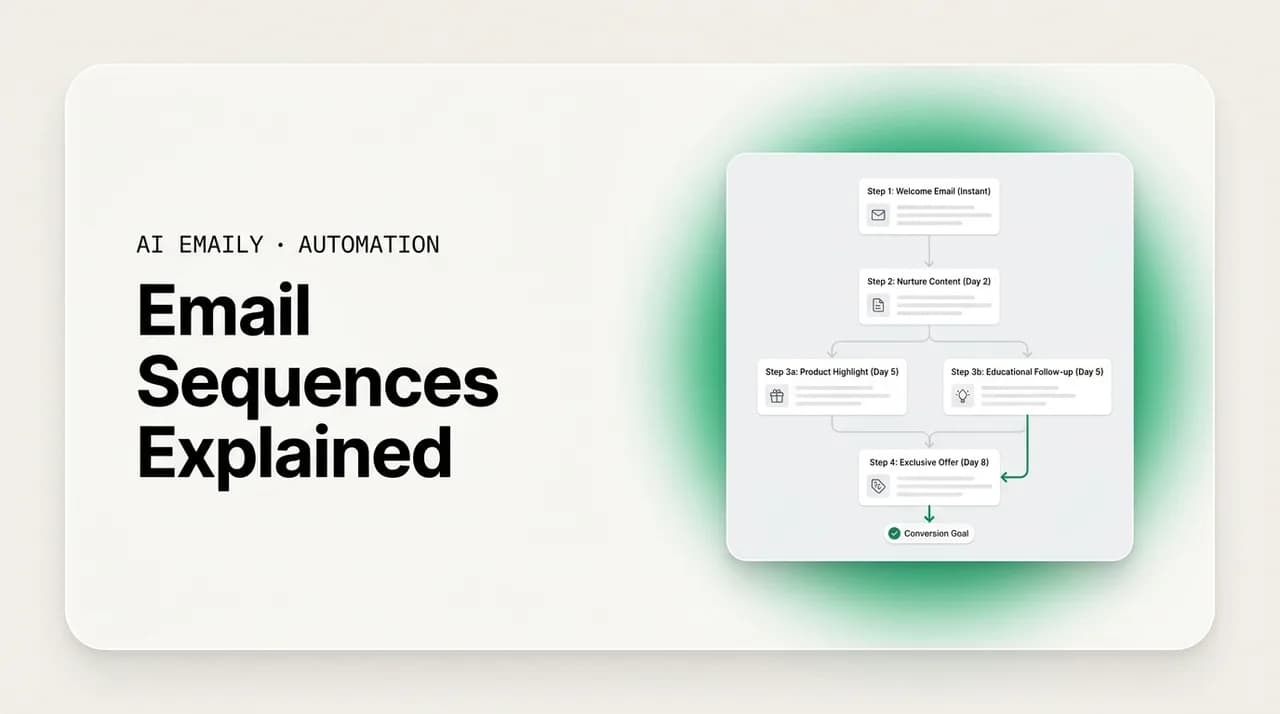
An email sequence is a predefined set of emails that send automatically, one after another, kicked off by a trigger and spaced according to timing rules you set. Each email in the sequence is a step; the trigger is the event that starts the clock; the timing is the gap between steps; and the exit is the condition that stops the sequence. Put those four pieces together and you have a small machine that delivers the right messages in the right order without you having to be present each time one goes out. That is the entire definition, and everything else is detail layered on top of it.
The defining trait — the thing that makes it a sequence rather than just a folder of emails — is that it runs on its own once started. You are not sitting at your keyboard deciding to send email two on Tuesday and email three on Friday. You set the rules once, and the sequence executes them. When someone signs up, the welcome goes out within the hour, the next message a day later, the one after that a few days on. Your job moves from sending to designing: you decide the logic, the system performs it. This is why sequences are described as automated — the automation is the point, not a feature bolted on the side.
It helps to be concrete. Imagine someone downloads a guide from your site. That download is the trigger. Within an hour they receive the guide plus a friendly hello — step one. Two days later they get a short email pointing them to a relevant case study — step two. Four days after that, a gentle email asking whether they would like to talk — step three. If at any point they reply, or book the call, the sequence stops — that is the exit. Nobody hand-sent any of those three emails. The person who downloaded the guide experienced a thoughtful, well-paced follow-up; the person who built the sequence experienced nothing at all after the initial setup. That asymmetry — effort once, value many times — is why sequences are everywhere.
One more clarification, because it trips people up constantly: a sequence is not defined by how many people receive it or what channel sends it. A sequence sent to ten thousand subscribers and a sequence of three follow-ups sent to a single sales prospect are both sequences — same anatomy, same logic, completely different context. The word describes the structure (a triggered, timed, ordered series with an exit), not the audience or the tooling. Hold onto that, because the rest of this guide turns on the fact that the same structure shows up in two very different jobs, and the jobs need different tools.
A sequence is a structure, not a size
Email sequence vs drip campaign vs broadcast: what's the difference?#
These three terms get used interchangeably, and that confusion leads people to buy the wrong tool and build the wrong thing. They are related but distinct, and the cleanest way to tell them apart is to ask two questions: what starts the message, and does the path adapt to what the recipient does? Broadcasts are one-off and go to everyone at once. Drips are time-based and follow a fixed path for everyone. Sequences, in the modern sense the word has settled into, are behavior-based and adapt to what each recipient does. Once you see the messages through those two questions, the categories stop blurring.
A broadcast email is a single message sent to a whole audience at the same moment — the newsletter, the product announcement, the flash-sale alert. There is no automation tied to individual behavior and no sequence; it is one email, one send, everyone gets it together. Broadcasts are for timely, one-to-many communication: news that everyone needs now. They are not personalized to where each person is in their journey, and they are not meant to be. When you want to tell your entire list the same thing at the same time, a broadcast is exactly the right tool, and dressing it up as a sequence would only add complexity for no gain.
A drip campaign, in the way the term is most commonly used today, is a sequence that runs on a fixed, time-based schedule that is the same for everyone who enters it. Sign up on Monday and you get email one Monday, email two Wednesday, email three the following Monday — and so does everyone else, regardless of whether they opened, clicked, or ignored the earlier messages. Drips are excellent for broad nurture across a large list where the message order is genuinely the same for everyone: a welcome series, an educational onboarding track, a standard course delivery. The path is a straight line; the timing drives everything; the recipient's behavior does not change what comes next.
An email sequence, in the sense the term has increasingly come to mean — especially in sales and lifecycle work — is behavior-driven: the next message depends on what the recipient actually did. Someone who clicked the pricing link gets a different next email than someone who did not. Someone who replied exits entirely. The path branches; the behavior drives it; timing is a constraint rather than the engine. This is the responsive, adaptive end of the spectrum, and it is where automation starts to feel less like a schedule and more like a conversation. The line between "drip" and "sequence" is genuinely fuzzy in everyday usage — many people and tools use the words as synonyms — so the distinction that actually matters is the underlying one: fixed-path-on-a-timer versus branching-path-on-behavior.
The table below lays out the three side by side. Read it as a spectrum, not three sealed boxes: a real program often mixes them — a broadcast newsletter going out weekly, a drip welcome series for new subscribers, and a behavior-triggered sequence for people who hit your pricing page. The skill is matching the mechanism to the job, not declaring one of the three the winner.
| Broadcast | Drip campaign | Email sequence (behavioral) | |
|---|---|---|---|
| What starts it | You hit send manually | A trigger (signup, etc.) on a fixed schedule | A trigger, plus the recipient's ongoing behavior |
| How many emails | One | A series, same for everyone | A series that branches per recipient |
| Does the path adapt? | N/A — single send | No — fixed path for all | Yes — next step depends on behavior |
| Timing model | Right now, once | Time-based intervals | Behavior-based, within timing bounds |
| Best for | News, announcements, one-to-many alerts | Broad nurture, welcome series, courses | Sales follow-up, lifecycle, re-engagement |
| Personalization | Same content for all | Light — same path, merge fields | Real — content and path change per person |
Don't get hung up on "drip" vs "sequence"
What are the parts of an email sequence: triggers, steps, timing, and exits?#
Every email sequence, no matter how simple or sophisticated, is built from the same four parts: a trigger that starts it, steps that make up the messages, timing that spaces them, and exit conditions that stop it. Understand these four and you can read, build, or fix any sequence you encounter. Most sequences that misfire fail on one of these four — usually a vague trigger or a missing exit — so it is worth being precise about each. Think of them as the grammar of automation: get the grammar right and the message comes through; get it wrong and you are sending nonsense to real people.
The trigger is the event that fires the sequence — the starting gun. Every sequence needs a specific, well-defined one: a signup, a purchase, a form submission, a download, a tag being applied, an inactivity threshold being crossed, a support ticket being resolved. The best modern practice leans toward behavioral triggers (something the person did) over purely time-based ones (a date on the calendar), because a behavior signals intent and intent is what makes the follow-up relevant. A vague or overly broad trigger is the most common root cause of a sequence going wrong — it pulls in people who should never have entered, and then every downstream email is misaimed. Spend real time getting the trigger exact.
The steps are the individual emails, in order, each with a job. A good sequence does not repeat the same pitch louder each time; each step advances the relationship — welcome and set expectations, then prove value, then make the ask, then handle the most likely objection, then close the loop. Best-practice length sits in a tight band: most effective sequences run between three and seven emails. Too few and you leave replies on the table; too many and you wear out your welcome. Each step should also be designed to stand alone, because plenty of recipients will only read one of them — so no single email should depend on the recipient having read the previous one.
Timing is the spacing between steps, and it matters more than people expect. The widely cited shape for an active sequence is front-loaded and then tapering: the first email lands fast (often within the first hour of the trigger, while intent is hot), the second a day or so later, the third a few days after that, and then the gaps widen. For cold outreach specifically, multi-day gaps of two to seven days between touches tend to protect deliverability and feel more human than daily pestering. The principle is the same across types: strike while interest is warm, then give people room to breathe so you read as helpful rather than impatient.
Exit conditions are the rules that stop the sequence — and they are just as important as the trigger, even though they get a fraction of the attention. The cardinal rule: when the recipient does the thing the sequence was trying to make them do, they must exit immediately. A lead who converts should drop out of the nurture flow at once; a customer who renews should stop getting the renewal-reminder series the instant they renew; anyone who replies to a sales sequence should stop being chased. Nothing destroys trust faster than a sequence that keeps running after its goal is met — it tells the recipient, plainly, that a script is sending these, not a person who noticed they already responded. Build the exit before you build the steps.
- 1
Trigger — define the exact event that starts it
Pick one specific, well-defined event: a signup, a purchase, a download, a tag, an inactivity threshold, a resolved ticket. Favor behavioral triggers (something the person did) over calendar dates, because behavior signals intent. A vague trigger is the most common reason sequences misfire — it lets the wrong people in and misaims every email that follows.
- 2
Steps — give each email one clear job
Lay out the messages in order, each advancing the relationship rather than repeating the pitch: welcome and set expectations, prove value, make the ask, handle the likely objection, close the loop. Keep the total between three and seven emails, and make each one stand on its own — assume the reader saw only this email and none of the others.
- 3
Timing — space the steps front-loaded, then tapering
Send the first email fast (often within the first hour of the trigger, while intent is hot), the second a day or so later, the third a few days on, then widen the gaps. For cold outreach, use two-to-seven-day gaps to protect deliverability and feel human. Strike while interest is warm, then give people room to breathe.
- 4
Exit conditions — stop the moment the goal is met
Define what ends the sequence before you write the steps. A lead who converts, a customer who renews, a prospect who replies — all must exit immediately. Add a hard stop on any explicit "not interested." A sequence that keeps running after its job is done is the single fastest way to lose the recipient's trust.
The missing exit is the most expensive bug in any sequence
What are the most common types of email sequences?#
Most of the email sequences you will ever build fall into four broad families: sales outreach, onboarding, nurture, and re-engagement. They share the same anatomy — trigger, steps, timing, exit — but they differ in who they target, what action they are driving toward, and how aggressive their cadence should be. Knowing which family you are in tells you most of what you need about length, tone, and timing before you write a single word. Below, each family with its job, its typical shape, and what makes it work.
A sales outreach sequence (often called a cadence in sales tools) drives toward a reply or a booked meeting from a prospect who has not yet committed. It is triggered by a list entering the system or a prospect crossing a qualifying signal, and it leans on follow-up: the data is consistent that the majority of replies come not from the first email but from the second, third, and fourth. Four-to-seven-touch sequences have been shown to produce reply rates several times higher than sending just one to three. The cadence uses multi-day gaps (two to seven days) to stay human and protect deliverability, each touch tapering to something lighter and easier to answer, and the whole thing exits the instant the prospect replies or books.
An onboarding sequence (the classic welcome series) turns a new signup or customer into an activated, successful user. It is triggered by signup or purchase, and a common, effective framework runs five emails across a roughly two-week window: welcome and set expectations, brand story and proof, the primary action you want them to take, education and use cases, then a re-engagement nudge for anyone who stalled. The payoff is large and well-documented — a multi-email welcome series generates dramatically more orders and activations than a single welcome email, with multi-email onboarding reporting meaningful revenue lift over one-and-done sends. The exit is activation: once they have done the core thing, they graduate out of onboarding.
A nurture sequence keeps a not-yet-ready lead warm and educated until they are ready to act, usually over a longer horizon. It is triggered by a lead magnet download, a content signup, or a stage in your funnel, and it runs longer and gentler than a sales cadence — six to ten emails spaced over weeks, heavy on value (guides, case studies, useful frameworks) and light on the hard ask. The goal is to be the helpful presence the lead remembers when the buying moment finally arrives. Behavioral branching shines here: someone who keeps clicking your pricing content should be routed toward a sales touch, while someone reading top-of-funnel material should keep getting education. The exit is when the lead converts or asks to talk.
A re-engagement sequence (a win-back) tries to revive a subscriber or customer who has gone quiet. It is triggered by inactivity — no opens or no logins across a defined window — and it is a short, focused burst: a "we miss you" or "is this still useful?" message, a reminder of the value or an incentive, and a final "should we stop emailing you?" The discipline that makes win-backs work is routing the genuinely dead weight out of your main list so it stops dragging down your sender reputation, and branching to the specific reason someone stalled rather than firing a generic "we miss you" at everyone. The exit is a re-open, a re-activation, or — for those who never respond — a clean removal from the active list.
The table sums up the four families. Treat the numbers as starting points, not laws: the right length and cadence always depend on your audience and your offer, and the single rule that holds across all four is that the sequence must exit the moment its specific goal is reached.
| Sequence type | Trigger | Goal | Typical length & cadence |
|---|---|---|---|
| Sales outreach (cadence) | Prospect enters list / hits a qualifying signal | A reply or a booked meeting | 4–7 touches, 2–7 days apart, tapering |
| Onboarding (welcome) | Signup or purchase | Activation — the user succeeds with the product | ~5 emails over ~2 weeks, front-loaded |
| Nurture | Lead-magnet download / funnel stage | Keep a lead warm until they are ready to buy | 6–10 emails over weeks, value-heavy, branching |
| Re-engagement (win-back) | Inactivity threshold (no opens / no logins) | Revive the contact — or cleanly remove them | 3–4 emails, short burst, then exit |
What's the difference between 1:1 personal sequences and bulk marketing sequences?#
This is the distinction that decides which tool you should buy, and almost nobody draws it clearly, which is why so many people end up with the wrong software. Both are email sequences — same anatomy — but they serve opposite ends of the relationship spectrum, and that difference changes everything about how they should be built and run. On one end: bulk marketing sequences, sent from a brand to a list of many. On the other: personal, 1:1 relationship sequences, sent from a person to one human at a time. They look similar on a diagram and feel completely different in an inbox.
A bulk marketing sequence goes out from a brand to a list — hundreds, thousands, sometimes millions of subscribers. It is mass communication: the same core message (lightly personalized with merge fields like first name) delivered to a segment, sent from a marketing domain, designed with templates and tracked with open and click rates in aggregate. Newsletters, promotional drips, ecommerce welcome flows, and broad nurture campaigns all live here. The recipient knows, more or less, that they are on a list. This is legitimate and valuable work — it is simply mass marketing, and it has its own purpose-built category of software designed to send at volume, manage subscribers and unsubscribes, handle deliverability for large sends, and report on campaign performance.
A personal, 1:1 relationship sequence is the opposite: it goes from you, one human, to one other human, from your real inbox, and it reads like a message a person actually wrote — because, with the right tooling, a person essentially did. This is the sales rep following up with a specific prospect, the founder nurturing a key partnership, the recruiter staying in touch with a candidate, the account manager checking in on a client. The volume is low, the stakes per message are high, and the entire value is in the message feeling genuinely personal and genuinely from you. These are not list sends; they are relationships, and they live in your inbox, not in a campaign dashboard.
Here is the honest part, and it is the most useful thing in this guide: these two jobs need different tools, and trying to force one tool to do both produces bad results in both directions. If you try to run a true 1:1 relationship sequence through a bulk email platform, your carefully personal message picks up the fingerprints of mass mail — it sends from a marketing domain, it looks templated, it lands in the promotions tab, and the relationship you were trying to build gets processed like a campaign. And if you try to run a genuine mass-marketing newsletter out of your personal inbox, you will hammer your sending reputation, blow past sane volume, and lack the list-management and compliance tooling that bulk sending requires. The job determines the tool. There is no single product that is excellent at both, and anyone who claims otherwise is selling you a compromise.
So the practical rule is simple. If you are sending the same thing to a list of many, that is bulk marketing — use a dedicated email marketing platform (an ESP) built for it. If you are building real relationships one human at a time, sending sequences and follow-ups that need to feel genuinely personal and come from your actual inbox, that is 1:1 relationship work — and that is a job for your inbox plus an intelligent assistant, not a mass blaster. AI Emaily lives squarely in the second world, and we will be specific about that shortly. But we will tell you plainly when you are in the first world and should reach for an ESP instead.
The honest rule of thumb
Which email sequence tools fit which use case?#
Because the two worlds need different software, the tool landscape splits cleanly into two camps — and a few specialized variants. Knowing which camp a tool belongs to saves you from the classic mistake of buying a mass-email platform to do relationship work, or vice versa. Below is the honest map: what each category is for, what it is genuinely good at, and where it falls down. The aim is to help you choose correctly, even when the correct choice is not us.
Email service providers (ESPs) and marketing automation platforms are the bulk camp. These are the tools built to send to lists at scale — managing subscribers, handling unsubscribes and compliance, designing templated campaigns, running time-based drips and branching marketing flows, and reporting on aggregate performance. They are the right and obvious choice for newsletters, promotional sequences, ecommerce lifecycle flows, and broad lead nurture. If your job is one-to-many marketing email, this is your category, full stop. Their weakness is the mirror image of their strength: they are built around the list and the campaign, so they are a poor fit for genuinely personal, one-to-one outreach that needs to look and feel like it came straight from your own inbox.
Sales engagement platforms are the high-volume outreach camp. These tools build multi-step sequences (cadences) that mix email with calls, social touches, and tasks, aimed at sales teams running structured outreach to many prospects. They excel at conditional logic, shared sequence libraries, manager approval workflows, and tying engagement to pipeline. They are powerful — and they are heavyweight and priced for teams, often starting around one to two hundred dollars per user per month with multi-seat minimums. They are also, notably, semi-bulk: they automate outreach to many prospects at once, and the messages, while personalized with variables, are fundamentally template-driven sends rather than true one-to-one mail. Worth knowing: many of them do not include serious cold-email deliverability infrastructure (inbox rotation, domain warming) out of the box, so heavy cold senders often bolt on a separate warmup tool.
Cold email tools are the deliverability-first variant of outreach software, built specifically to send high volumes of cold outreach while protecting sender reputation with inbox rotation, mailbox warmup, and throttling. They are the specialist's choice for cold prospecting at scale. They are emphatically not for warm, personal, relationship email — they are optimized for volume and deliverability, not for the texture of a genuine one-to-one thread.
Then there is the inbox-plus-assistant camp — and this is where AI Emaily sits, and where it is genuinely different from everything above. This camp is not built to send to lists at all. It is built to make the email you already send from your own inbox faster, smarter, and more reliably followed-up — including running personal 1:1 sequences and follow-ups in your own voice, to one human at a time. It is for the relationship work that the bulk and outreach tools handle badly: the high-stakes follow-up, the warm nurture of a specific person, the personal cadence that has to read like you wrote it because the whole point is that you essentially did. The table maps it all out, and is honest about where we do and do not belong.
| Tool category | Built for | Best use cases | Not the right fit for |
|---|---|---|---|
| Email marketing platform (ESP) | Sending to lists at scale | Newsletters, promo drips, ecommerce flows, broad nurture | Personal 1:1 outreach from your own inbox |
| Marketing automation platform | Branching marketing flows + CRM | Lifecycle marketing, behavioral drips, lead scoring | Low-volume, high-stakes relationship email |
| Sales engagement platform | High-volume team outreach (cadences) | Structured multi-channel prospecting at scale | Solo / warm 1:1 relationship sequences; budget teams |
| Cold email tool | Deliverability-first cold sending | Cold prospecting at volume with warmup & rotation | Warm, personal, relationship-building email |
| Inbox + AI assistant (AI Emaily) | Your real inbox, made smarter | Personal 1:1 sequences & follow-ups in your voice | Mass broadcasts / list marketing (use an ESP) |
When to pick an ESP over us — said plainly
How does AI Emaily run personal 1:1 sequences and follow-ups in your voice?#
AI Emaily is an AI-native email client — your real inbox, with an intelligent agent built into it — and it does exactly one part of the sequence world: personal, 1:1 relationship sequences and follow-ups, sent from your own inbox, in your own voice. It is not a bulk email platform and does not pretend to be one. There is no list builder, no campaign blaster, no "send to 10,000 subscribers" button, because that is not the job it is for. The job it is for is the high-stakes relationship email that the mass tools handle badly: the follow-up to a specific prospect, the warm nurture of a key contact, the personal cadence that has to read like a human wrote it because the whole point is that, with the agent's help, you essentially did.
The core of how it works is voice. The agent reads the mail you have already sent and learns how you actually write — your length, your level of formality, your habitual openings and sign-offs, whether you run warm or terse. When it drafts a step in a personal sequence or a follow-up to a quiet thread, it is not pulling a generic template and stuffing in a first name; it is composing a new message in your established style, grounded in the actual thread it belongs to. That is the difference between a 1:1 sequence and a bulk one: the message refers, specifically and naturally, to the real conversation — the proposal you sent, the question you raised, the thing they mentioned — because the agent has that thread in front of it. The result reads like you, because it is built from how you write and what was actually said.
Follow-up is where this earns its keep day to day, because follow-up is the part of relationship email everyone drops. The agent watches the threads you send, recognizes the ones that expected a reply and went quiet, drafts the nudge in your voice on a sensible cadence you control, and — this is the rule that makes it safe — stops the entire sequence the instant a reply lands. No chasing someone who already responded. That single behavior, stop-on-reply, is the thing bulk tools get wrong and the thing that separates a thoughtful 1:1 cadence from an embarrassing one. You set the rhythm and the number of touches; the agent handles the reliable triggering and the from-scratch drafting that your memory keeps failing to.
Crucially, you decide how much the agent does on its own, because relationship email is too important to hand to a black box. AI Emaily runs every action through three autonomy levels. In Manual, the agent surfaces the quiet threads and drafts the sequence steps and follow-ups, and you send them yourself — a memory and a writing aid, nothing more. In Copilot, it prepares each message and queues it, then waits for your approval before anything leaves; you get the leverage of an automated personal cadence while keeping a hand on every outbound message, which is the right home for most relationship work. In Autopilot, it sends routine follow-ups on its own within the bounds you set — with undo to pull a message back after it sends, and a complete audit log of everything it drafted, scheduled, sent, or canceled, so the agent's activity is always reviewable rather than invisible. You choose the level per scope, so a warm internal thread and a cautious first approach can run at different settings in the same inbox.
Two more things matter for relationship email specifically. First, AI Emaily works with every provider — Gmail, Outlook, IMAP, and more — because your inbox, your voice, and your sequence settings are tied to you, not to who hosts your mail; connect a second account and you are not learning a new system. Second, it is private by design: because the agent has to read your sent and received mail to learn your voice and track follow-up state, that mail is treated as sensitive throughout — it is not used to train models, content is handled with care rather than mined, and every action is recorded so it is accountable. You get a chief-of-staff for your inbox that runs your personal sequences and follow-ups the way a sharp assistant would — in your voice, with your judgment in the loop, and with a clear record — without ever turning your relationships into a mass campaign.
And to be clear about the boundary one final time: when your job is to email a list of many — a real newsletter, a promotional broadcast, a bulk drip to subscribers — AI Emaily is not the tool, and we will tell you to use a dedicated email marketing platform for it. We do the relationship half of the sequence world, deliberately and well, rather than the whole thing poorly.
Relationship email is sensitive — the agent is built to treat it that way
How do you choose and build the right sequence for your goal?#
Pull the whole guide together and choosing the right sequence becomes a short decision. First, name the goal and the audience honestly: are you communicating one-to-many to a list, or building a relationship one human at a time? That single answer routes you to the right world — an ESP or sales-engagement tool for bulk and structured outreach, your inbox plus an assistant for genuine 1:1 relationship work. Skipping this step is how people end up running personal follow-up through a campaign blaster, or trying to send a real newsletter from their personal inbox; both go badly, and both are avoidable by asking the question first.
Once you know the world, pick the family that matches your goal — sales outreach, onboarding, nurture, or re-engagement — and let the family set your defaults for length, tone, and cadence. Then build from the anatomy: define the exact trigger first, design the exit condition second (yes, before the emails — the exit is where most sequences fail), and only then write the steps, giving each one a single job and keeping the total in the three-to-seven range for active sequences, longer and gentler for nurture. Set the timing front-loaded and tapering, personalize by grounding each message in real context rather than stuffing merge fields, and test that the exit actually fires before you let real people in.
If your work is bulk, do it well in a tool built for bulk and do not apologize for it — mass marketing is legitimate and valuable, and an ESP is the right home. If your work is relationship — the follow-ups, the warm nurtures, the personal cadences that have to feel like you wrote them — then the leverage is in moving the parts you keep dropping (the reliable triggering, the timely follow-up, the from-scratch drafting) onto an assistant that works inside your real inbox, in your voice, with your judgment in the loop. That is the half of the sequence world AI Emaily was built for, and it is the half that most tools serve worst.
Whichever world you are in, the principles are constant: a clear trigger, a tight set of well-aimed steps, humane timing, and an exit that stops the moment the goal is met. Get those four right and a sequence stops being a blast and starts being what it should be — the right message reaching the right person at the right moment, reliably, without you having to remember to send it. If the right person is an individual you actually want a relationship with, you can start running those sequences and follow-ups in your own voice today. The Free plan ($0) lets you feel how the agent reads your inbox and drafts in your voice; Pro ($12.42/mo billed annually) unlocks Copilot, where it prepares each personal sequence step and follow-up and you approve it before it sends. Create your account at app.aiemaily.com/signup and let an agent run the relationship email you keep meaning to follow up on.
Frequently asked
See it in AI Emaily
Keep reading

Written by
Nafiul HasanNafiul Hasan is an entrepreneur and AI automation system builder with 10+ years of experience turning messy, manual workflows into reliable automated systems. He designs and ships AI enterprise solutions end-to-end — the agent logic, the data plumbing, and the product people actually use — and founded AI Emaily to give busy professionals their attention back. He writes here from the builder's seat: what works, what breaks, and how to put AI to work without giving up control.