How to Move From Outlook.com to Gmail (Full Migration)


The short answer
Gmail's ongoing POP fetch and Gmailify are retired, but Gmail's one-time "Import mail and contacts" wizard still works on the web. Turn on forwarding at Outlook.com so new mail arrives today, run that wizard once for old mail and contacts, export your calendar to Google Calendar, and add "Send mail as" to keep replying from your old address.
How to move from Outlook.com to Gmail now POP import is gone: forwarding, the one-time Import wizard, contacts and calendar, keeping your old address.
On this page
This is how to move from Outlook.com to Gmail in 2026, when the easiest old route no longer exists. For years the simplest way to transfer Hotmail or Outlook.com mail into Gmail was to let Gmail fetch it over POP on a schedule. Google has retired that feature, along with Gmailify, so the job now takes a few deliberate steps instead of one setting.
The good news is that nothing here is hard, and every step copies rather than moves, so it is reversible until you delete the old account. This guide covers what actually moves, the order that keeps you reachable throughout, and how to keep your old address alive so nobody who writes to it gets a bounce.
Every menu path below was checked against Gmail Help and Microsoft Support in August 2026. Both providers rename and reshuffle these screens, so confirm anything time-sensitive on their own help pages before you rely on it.
What actually moves, and what doesn't#
Moving to Gmail is really four separate transfers — old mail, new mail, contacts and calendar — plus one thing people forget, which is the ability to keep sending from your old address. They do not all use the same tool, and one of them can no longer be automated at all.
| What you're moving | How it moves to Gmail | What to watch for |
|---|---|---|
| Old mail sitting in Outlook.com | Gmail's one-time "Import mail and contacts" wizard pulls it over POP | It runs once and does not keep syncing; folders flatten into Gmail labels |
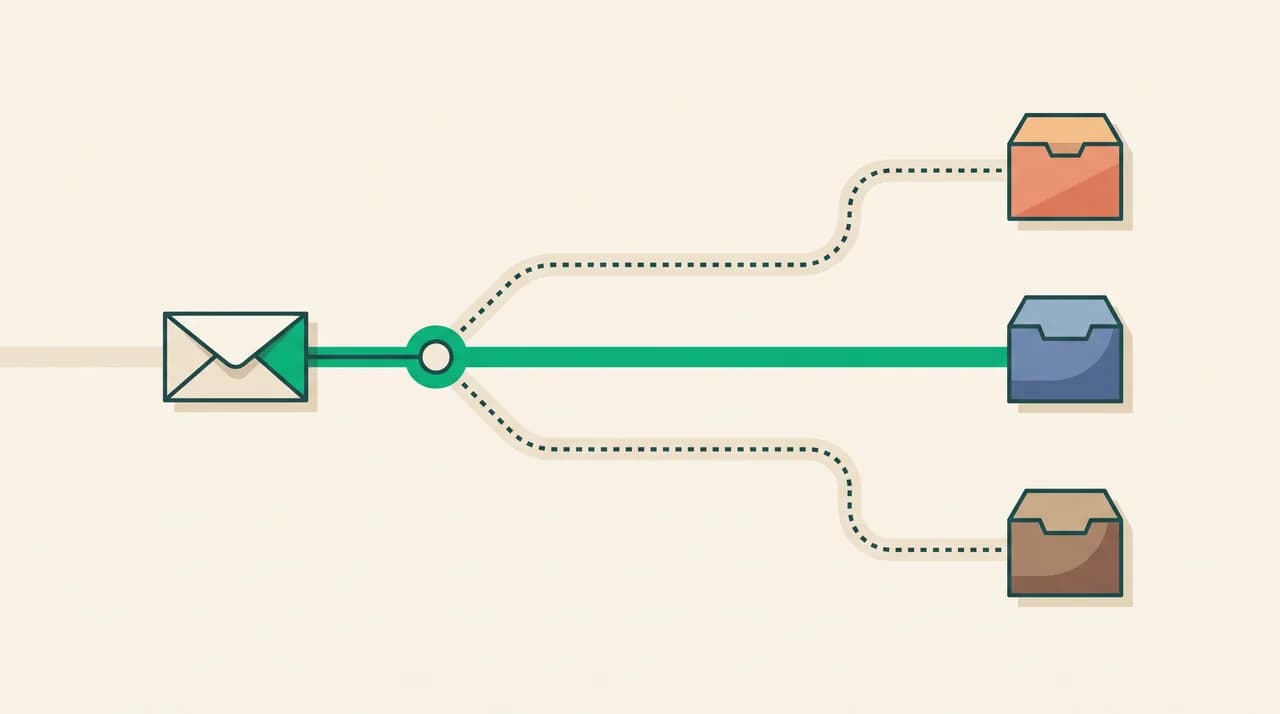
| New mail arriving from now on | Auto-forwarding set up on the Outlook.com side | Junk is not forwarded, and a copy still stays at Outlook.com |
| Contacts (the People list) | The import wizard brings them, or export a CSV and import to Google Contacts | Contact categories and photos may not map cleanly |
| Calendar events | Publish the Outlook.com calendar as an ICS file, then import it into Google Calendar | One-time import; event guests and meeting links are dropped on import |
| Your Outlook.com or Hotmail identity | Gmail's "Send mail as" lets you keep replying from it | You must pick it in the From field on each reply |
| Rules, sweep rules and signatures | Nothing migrates them | Rebuild the ones you rely on by hand in Gmail settings |
The one-click route is gone — but a one-time import survives
Pre-migration checklist#
Do these before you touch either account. Each is faster to sort out now than to untangle from a half-finished migration later.
- Confirm the Outlook.com mailbox is a personal account (@outlook.com, @hotmail.com, @live.com or @msn.com), not a work or school Microsoft 365 account your employer controls — those have their own export rules and an admin can block the move.
- Turn on two-step verification on both accounts before you start, not after.
- Note roughly how much storage your Outlook.com mail uses and check that your Gmail account has room for it.
- List every service that emails your Outlook.com address — banks, government, employers, subscription receipts — so you can update them during the forwarding overlap.
- Screenshot your Outlook.com inbox rules, sweep rules, signature and any aliases; none of these migrate.
- Decide whether you are keeping the old address reachable (recommended) or genuinely retiring it. That choice changes the last two steps.
The steps in order#
Follow this order and you stay reachable the whole way through: new mail starts flowing to Gmail before you begin importing the old mail behind it.
- 1
Turn on forwarding at Outlook.com first
In Outlook.com, open Settings (the gear) and go to Mail, then Forwarding. Choose Enable forwarding, enter your Gmail address, tick "Keep a copy of forwarded messages", and Save. New mail now reaches Gmail immediately, before you touch anything else. If two-step verification is not switched on, Outlook.com prompts you to enable it here.
- 2
Enable POP access in Outlook.com
The import wizard collects your old mail over POP, which is off by default. In Outlook.com go to Settings, then Mail, then Sync email, and under POP and IMAP set "Let devices and apps use POP" to Yes, then Save. Skip this and the import in the next step has nothing to connect to.
- 3
Run Gmail's one-time "Import mail and contacts"
In Gmail on the web, click the gear, then See all settings, then the Accounts and Import tab, then "Import mail and contacts". Enter your Outlook.com address, follow the prompts, and choose to import both contacts and old mail. Gmail also forwards new mail for 30 days as a bonus overlap. This runs once and does not keep syncing, which is why step 1's forwarding is the durable part.
- 4
Bring contacts across as a CSV — belt and braces
If the wizard misses contacts, export them yourself. In Outlook.com open the People page (bottom-left), then Manage, then Export contacts, choose All contacts, and Export to save a contacts.csv file. In Google Contacts, click Import, Select file, choose that CSV, and Import. Split the file if you have more than 3,000 contacts.
- 5
Move your calendar with an ICS export
In Outlook.com go to Calendar, then Calendar settings, then Shared calendars, and under "Publish a calendar" pick your calendar and Publish to reveal an ICS link. Download that ICS file. In Google Calendar open Settings, then Import & Export, then Import, select the file, choose which calendar to add it to, and Import. Event guests and meeting links are dropped on import.
- 6
Keep replying from your old address with "Send mail as"
In Gmail, open the gear, then See all settings, then Accounts and Import, then "Send mail as", then Add another email address. Enter your Outlook.com or Hotmail address and verify it via the link Gmail emails you. You can then pick it in the From field. Gmail lets you send from up to 99 addresses you own.
- 7
Leave the Outlook.com mailbox running
Do not close it. Forwarding and "Send mail as" both depend on it, and any service you have not updated is still delivering there. Give it at least a month of overlap before you even think about retiring it.
What breaks — and what to do about it#
Every Outlook.com-to-Gmail move hits some of these. None are fatal, but knowing them up front saves an afternoon of confusion.
| What breaks | Why | What to do |
|---|---|---|
| Folders don't arrive as folders | Gmail organises with labels, not folders, so imported mail lands under labels and any nesting flattens | Recreate the structure you care about as Gmail labels; the mail itself all comes across |
| Junk never forwards | Forwarding skips anything Outlook.com filed as junk, by design | Check the Outlook.com Junk folder directly for the first few weeks in case something legitimate was miscategorised |
| Replies go out as your Gmail address | By default Gmail sends from your Gmail identity even on forwarded mail | Set up "Send mail as" (step 6) and remember to switch the From field on each reply |
| The import runs once and stops | The surviving wizard is a one-time import, not a live sync | Lean on the forwarding from step 1 for everything that arrives after the import finishes |
| Calendar guests and meeting links vanish | Google Calendar drops attendee and conferencing data when importing an ICS file | For recurring meetings you host, recreate the important ones so invitees stay linked |
| Rules and sweep rules are gone | No tool migrates Outlook.com's inbox or sweep rules | Rebuild the handful that matter in Gmail's Filters and Blocked Addresses settings |
| A duplicate copy stays at Outlook.com | Forwarding and the import both copy rather than move | That's a feature during the overlap; clear it out later only if you eventually retire the account |
Rollback plan#
Because every step copies rather than moves, backing out is straightforward as long as the Outlook.com account still exists.
- 1
If the import made a mess of your labels
Delete the imported Gmail labels — this does not touch Outlook.com — and re-run the wizard with narrower choices about what to include. Your original mail is untouched at the source.
- 2
If you decide Gmail isn't for you
Turn off forwarding in Outlook.com, remove the "Send mail as" entry in Gmail, and carry on in Outlook.com as before. Nothing ever left your original mailbox, so there is nothing to restore.
- 3
If mail seems to be going missing
Sign in to Outlook.com directly and check both the Inbox and the Junk folder. Forwarding skips junk, so a "missing" message is often just sitting there. The copy at the source is your safety net the entire time.
Do not delete the Outlook.com account for at least a month
Doing it without downtime#
Zero downtime here is about order. Turn on forwarding before you import, so new mail is already flowing to Gmail while the one-time import works through your history. Then set up "Send mail as" before you tell anyone you have switched, so your first replies already carry the right address.
The one mistake to avoid is announcing the move, or updating your address everywhere, before the overlap has proven itself. Give it two weeks with both mailboxes live. Weekly newsletters, monthly statements and quarterly invoices each need a full cycle to show they still arrive.
Send yourself a test from each side
Where AI Emaily fits — and when you don't need to migrate at all#
Before you spend an afternoon on this, ask whether you need to migrate at all. If your goal is simply to read Outlook.com and Gmail in one place, a client that connects to both leaves your mail where it is and shows it together — no import, no forwarding, no flattened folders.
We build AI Emaily, and it is a client, not a mail host: it connects to Gmail, Outlook and standard IMAP and shows them as one inbox, leaving every message where it already lives.
On top of that it runs an AI email assistant that triages the inbox, drafts replies from a Personal Context brain you write, and closes routine loops with approve-before-send by default.
Because it moves nothing, it cannot merge two mailboxes into one address — so if you have genuinely decided to consolidate into a single Gmail address, the steps above are still the job. If you only wanted one place to read everything, connecting is reversible in a click, and there is a 7-day free trial.
Frequently asked
See it in AI Emaily
Keep reading
Sources
- Gmail Help — Learn about upcoming changes to Gmailify & POP in Gmail
- Gmail Help — Import mail and contacts into Gmail
- Gmail Help — Send emails from a different address or alias
- Microsoft Support — Turn on or off automatic forwarding in Outlook.com
- Microsoft Support — POP, IMAP, and SMTP settings for Outlook.com
- Microsoft Support — Export contacts from Outlook.com to a CSV file
- Microsoft Support — Share your calendar in Outlook.com
- Google Calendar Help — Import events to Google Calendar

Written by
Nafiul HasanNafiul Hasan is an entrepreneur and AI automation system builder with 10+ years of experience turning messy, manual workflows into reliable automated systems. He designs and ships AI enterprise solutions end-to-end — the agent logic, the data plumbing, and the product people actually use — and founded AI Emaily to give busy professionals their attention back. He writes here from the builder's seat: what works, what breaks, and how to put AI to work without giving up control.