How to Merge Two Gmail Accounts Into One Inbox


The short answer
Google does not offer a true account merge. Consolidating two Gmail accounts means setting up forwarding so new mail arrives in one inbox, adding a send-as alias so you can reply from the old address, and optionally copying historical messages via Google Takeout and IMAP. The old Google account stays open.
Google offers no account merge, and POP fetch was removed in 2024. Forward new mail, add a send-as alias for replies, and optionally import history via Google Takeout.
On this page
If you have searched for how to merge two Gmail accounts into one, you have probably noticed that Google does not provide a merge button anywhere. Two separate Google accounts cannot be combined at the account level — they own different Gmail histories, Google Drive files, Google Photos libraries, and separate identities — and Google provides no mechanism to collapse them permanently into one.
What most people actually want when they say merge is one of three specific operations: routing new messages sent to the old address into the new inbox, being able to reply from the old address so contacts see the right name and email, and moving the archived messages across so the old history lives in one place. All three are doable. None of them use the POP fetch feature Google deprecated in 2024, and the forwarding and alias parts take about 30 minutes. Moving a large archive takes longer.
This guide covers all three operations in the right order, explains what carries over and what stays behind, and walks through the fixes for the most common failure points.
The short answer: three operations, not a merge#
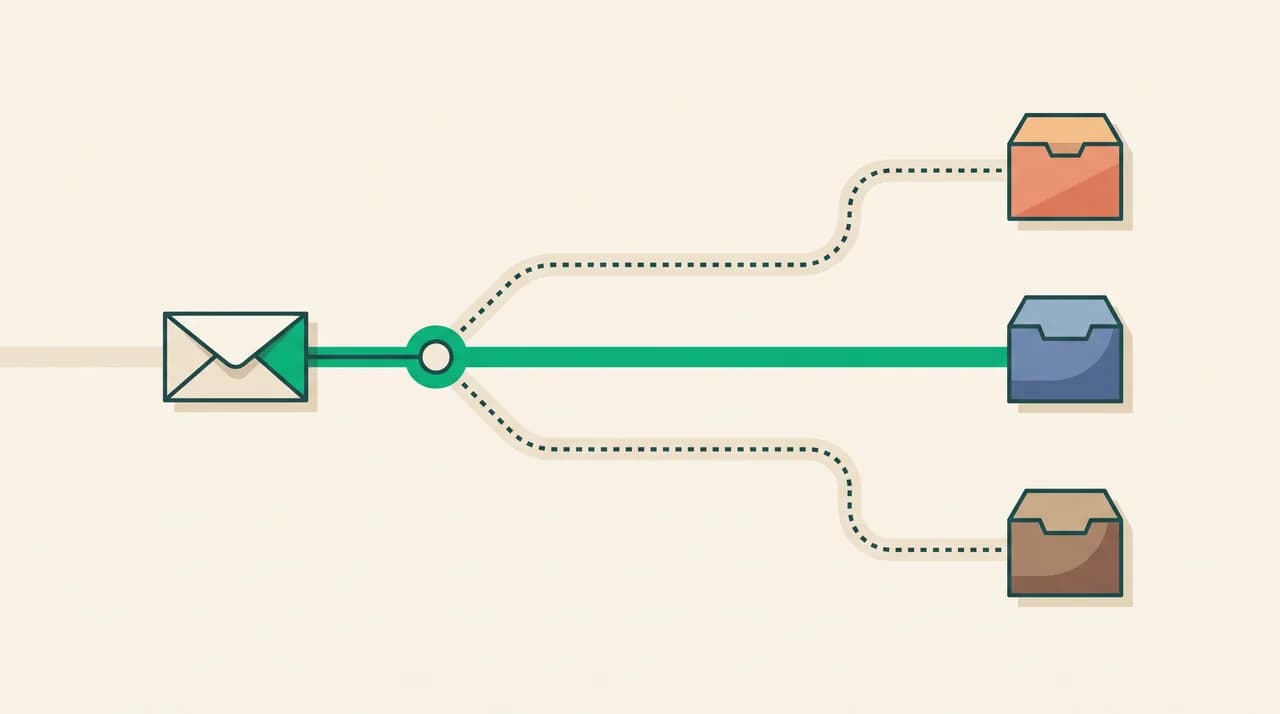
You cannot merge two Google accounts into one. What you can do is consolidate down to a single Gmail inbox by combining forwarding, a send-as alias, and an optional historical import. Forwarding means mail sent to the old address lands in the new inbox automatically. The send-as alias lets you reply from the old address, so recipients see it in the From field. The historical import means your old messages are searchable from the new account.
The old Google account does not disappear. Google will not let you delete an account and transfer everything to another one; you simply stop checking it directly, because all new mail is arriving somewhere else and all your old mail has been copied across.
The POP fetch option is gone for new setups
Before you start#
Have these ready before you open Gmail settings. The forwarding confirmation step requires you to flip between two accounts quickly, and the alias verification has an expiring code.
- Sign-in credentials for both Gmail accounts — you will need to be logged into each at different points
- Access to the old account's inbox, because Google sends a verification email there during both the forwarding setup and the alias setup
- 15 to 30 minutes for the forwarding and alias steps, plus additional time if you plan to migrate the historical archive
- For historical mail migration only: a desktop mail client such as Thunderbird, or a third-party IMAP migration service if you prefer a managed tool
The three steps#
Run these in order. Forwarding first, because you want new mail flowing immediately. Alias second, so you can reply from the right address. Historical import last, because it is optional and takes the longest.
- 1
Step 1: Set up forwarding from the old Gmail account
Sign in to the old account. Open Settings (the gear icon, top right) and click 'See all settings'. Go to the 'Forwarding and POP/IMAP' tab. Click 'Add a forwarding address' and enter the new Gmail address. Google will send a confirmation link to the new account — open the new account, find the message (check spam if it does not appear in inbox), and click the confirmation link. Back in the old account's settings, reload the Forwarding tab, select 'Forward a copy of incoming mail to [new address]', and choose what to do with the original copy in the old account (keeping it there is safest until you have verified everything works). Save changes.
- 2
Step 2: Add the old Gmail address as a send-as alias
Sign in to the new account. Open Settings and click 'See all settings'. Go to 'Accounts and Import'. Under 'Send mail as', click 'Add another email address'. Enter the name you want recipients to see and the old Gmail address. When prompted for the SMTP server, choose 'Send through Gmail' — this is the simplest path for a same-provider alias and avoids SMTP credential management. Google sends a verification code to the old address. Open the old account, find the code, and paste it into the confirmation dialog in the new account. After verification, you can select the old address from the From dropdown in the new account's compose window, and Gmail will remember your preference per thread.
- 3
Step 3: Copy historical messages (optional)
In the old account, go to takeout.google.com and create a new export. Select 'Mail' only, choose MBOX format, and pick a delivery method — Google Drive works well for large mailboxes. The export can take anywhere from an hour to a couple of days depending on mailbox size. Once the export arrives, download the .mbox file. Install Thunderbird and add the new Gmail account using OAuth (Thunderbird prompts you through Google sign-in). Install the ImportExportTools NG add-on for Thunderbird and use it to import the MBOX file into a local folder. Then drag those messages from the local folder into a folder under your Gmail IMAP account in Thunderbird — they will sync up to Gmail, though without the original labels.
IMAP rate limits slow the historical import significantly
What migrates and what stays behind#
The table below covers each category of data you might want to move, the method for each, and what the method does and does not preserve. Check the Google Account Help page for Takeout options if your needs go beyond mail.
| Data category | Method | What carries over | What does not carry over |
|---|---|---|---|
| New incoming mail to old address | Automatic forwarding (Step 1) | All messages sent to the old address after forwarding is active | Mail already in the old archive before forwarding was turned on |
| Ability to reply from old address | Send-as alias (Step 2) | Old address in the From field; recipients see the correct name and address | Gmail stars, labels, or priority markers on the old account's threads |
| Historical email messages | Google Takeout export plus IMAP copy (Step 3) | Message content, dates, sender and recipient headers, thread grouping | Gmail labels (arrive unlabelled), starring, importance markers |
| Google Contacts | Export from old account as vCard; import in new account via contacts.google.com | Contact names, email addresses, phone numbers | Contacts linked to Google Workspace directory; merge logic for duplicates |
| Google Calendar events | Calendar Settings > Export; import ICS file in new account | Events, recurrence rules, reminders | Shared calendars (must reshare from old account); RSVPs on existing events |
| Google Drive files | Takeout for Drive, then re-upload or transfer ownership per file | File content | Sharing permissions, comment threads, folder shortcut structure |
| Google Photos | Partner sharing or Takeout re-upload — no direct cross-account sync | Photo files via manual re-upload | Albums, metadata edits, auto-created memories |
What to do when it does not work#
Most problems with this process fall into a handful of known failure patterns. If a step is not behaving as expected, check these before assuming the settings are wrong.
- Forwarding confirmation email never arrives in the new account: check the new account's spam folder. Gmail sometimes misclassifies the Google verification message. Also check whether the old account has a filter that routes outbound messages away from inbox before forwarding.
- Send-as verification code expired: the code has a short validity window. If it expired, delete the pending alias in Settings and start the 'Add another email address' flow again. Check the old account's spam folder for the code on the second attempt.
- IMAP copy stalls or disconnects partway through: Gmail's IMAP rate limit will pause large uploads. In Thunderbird, close the connection, wait 30 to 60 minutes, then resume. For very large archives over 100,000 messages, a dedicated migration service with retry logic is more reliable than manual Thunderbird copying.
- Messages arrive in the new account without any labels: this is expected behavior. The MBOX format preserves the messages but not Gmail's label structure. Apply filters in the new account after import to re-categorise, or leave them in a single 'Old Archive' label and search when needed.
- Replies from the old address land in recipients' spam: the send-as alias routes through Gmail's infrastructure and should pass SPF and DKIM for @gmail.com addresses. If the old address is on a custom domain, verify that the domain's SPF record includes Gmail's sending servers (include:_spf.google.com) and that DKIM is set up in Google Workspace admin.
A faster way to manage both Gmail addresses#
The forwarding-and-alias setup works and costs nothing, but it has ongoing friction: you check new mail in the new account, remember to switch the From address for certain threads, and the old archive lives in a second account you occasionally open anyway. If the real goal is reducing the overhead of running two separate Gmail addresses rather than truly eliminating one, a unified email client solves this without any Takeout exports or IMAP copies.
We build AI Emaily, an AI-native email client that connects both Gmail accounts through Google OAuth and presents them together in one inbox. Each account keeps its own labels, filters, and identity. You pick the From address per compose or let the client default to the account the thread arrived on. The AI triage, drafting, and follow-up agent runs across both streams simultaneously, with approve-before-send on by default and a full audit log of every action. For most people who set out to merge two Gmail accounts, this addresses what they were actually after — one place to read, reply, and act — without the irreversibility of moving mail and closing an account. Start a 7-day free trial at aiemaily.com or review the plans at aiemaily.com/pricing.
Frequently asked
See it in AI Emaily
Keep reading
Sources

Written by
Nafiul HasanNafiul Hasan is an entrepreneur and AI automation system builder with 10+ years of experience turning messy, manual workflows into reliable automated systems. He designs and ships AI enterprise solutions end-to-end — the agent logic, the data plumbing, and the product people actually use — and founded AI Emaily to give busy professionals their attention back. He writes here from the builder's seat: what works, what breaks, and how to put AI to work without giving up control.