The PARA Method for Email: Does It Work in an Inbox?

The short answer
Yes, the PARA method works for email: map Projects to active-deal labels, Areas to ongoing-responsibility labels, Resources to reference material, and Archives to anything closed out. It works well for filing. It fails as a task system — email wasn't built to track deadlines, so PARA needs a companion tool for that half of the job.
Yes, the PARA method works for email organization. Here's how to map Projects, Areas, Resources and Archives onto labels or folders — and where it breaks down.
On this page
- 01What PARA actually stands for
- 02Before you start: decide labels or folders
- 03Steps: setting up PARA in your inbox
- 04How PARA maps to Gmail, Outlook, and IMAP clients
- 05Common mistakes when applying PARA to an inbox
- 06A worked example: filing three real emails
- 07Where PARA fails for email, specifically
- 08A faster way to keep PARA current
Tiago Forte built PARA (Projects, Areas, Resources, Archives) to organize notes and files, not email. But the same four buckets map onto an inbox surprisingly well, because the question PARA answers — "where does this piece of information belong, and how long do I need it?" — is exactly the question every email in your inbox is quietly asking.
The short answer: yes, PARA works for email organization, with one real limitation. It's excellent for filing — sorting mail into the right bucket so you can find it later. It's weak for tracking — knowing what still needs a reply and by when. Below is the exact mapping, a worked example, and what to add so PARA doesn't quietly become another junk drawer.
This matters because most inbox systems fail for a predictable reason: they sort by who sent something or what it's about, and both of those change less usefully than how urgent and how permanent it is. PARA sorts by the second pair instead, which is why it survives contact with an inbox that a topic-based folder tree usually doesn't.
What PARA actually stands for#
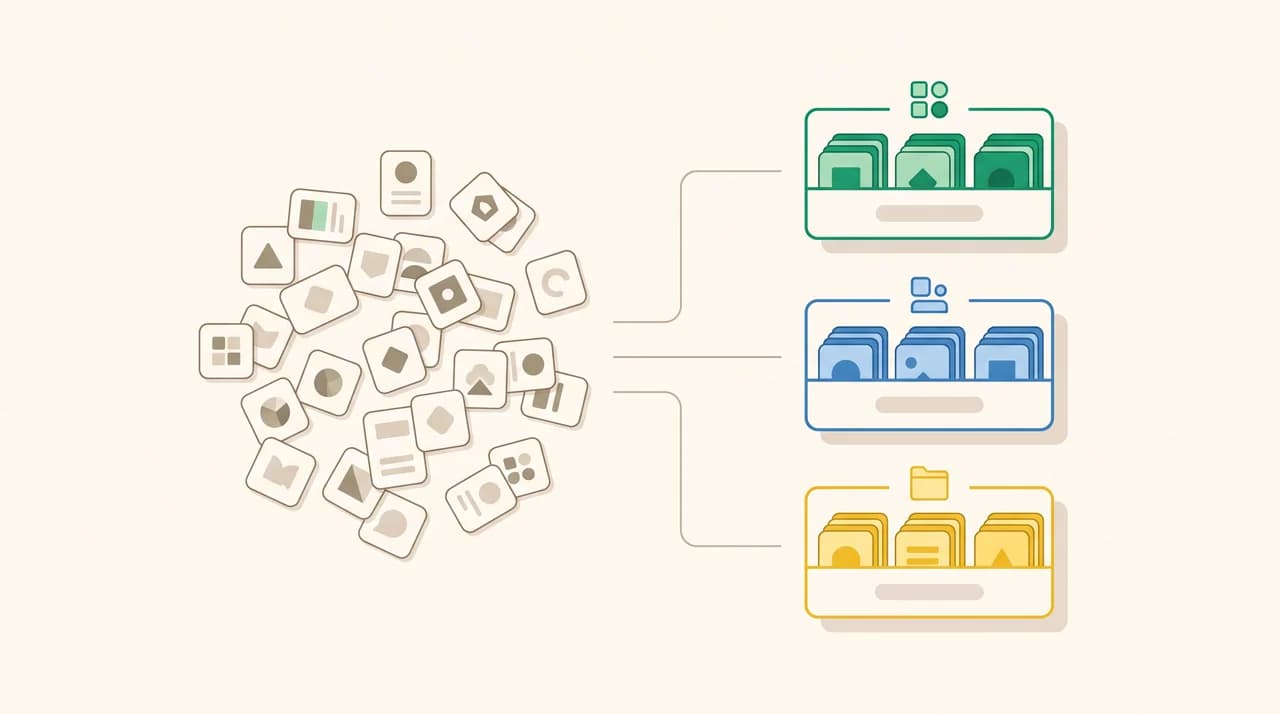
PARA sorts everything by how actionable and how long-lived it is, not by topic or sender. That's the detail most "organize your inbox" advice skips, and it's why PARA holds up in ways topic-based folders ("Marketing", "Finance", "Vendors") don't.
The order matters too. Forte deliberately lists Projects first because it's the most actionable and shortest-lived bucket, and Archives last because it's the least actionable. When you're deciding where a message goes, work down that list in order and stop at the first bucket that genuinely fits — most misfiling happens when someone starts from Resources or Archives out of habit and never checks whether the message actually belongs in Projects.
- Projects — a defined outcome with a deadline. "Close the Meridian contract by Friday." Finite by definition; it ends.
- Areas — an ongoing responsibility with no end date. "Payroll", "Client success for Acme", "Health". Standards to maintain, not a finish line.
- Resources — reference material you might need later, tied to no active project. A vendor's pricing PDF, a legal template, a conference recording.
- Archives — anything from the first three that's inactive. A closed project, a role you no longer hold, reference material that's gone stale.
Before you start: decide labels or folders#
PARA assumes one-place-per-item, which is exactly how a folder (or a single-select category) works. A label-based system where mail carries multiple tags at once needs one small adjustment: pick a primary PARA bucket for filing, and let secondary labels ride alongside it for anything else you track (sender, priority, whatever you already use).
If you're deciding between the two mechanisms themselves rather than how PARA sits on top of them, that's a separate question — see the folders-vs-labels comparison linked below. This post assumes you already have one and are asking how to structure it.
One inbox, one PARA structure
Steps: setting up PARA in your inbox#
- 1
Create four top-level labels or folders
Projects, Areas, Resources, Archives — exactly those four, exactly that order. Resist adding a fifth top-level bucket; anything that doesn't fit one of the four almost always fits Areas.
- 2
Nest by name, not by topic
Under Projects, create one sub-label per active project using the project's actual name ("Meridian Contract", not "Sales"). Under Areas, one sub-label per ongoing responsibility ("Payroll", "Client Success"). This mirrors Forte's own file-system version of PARA and is what makes search fast later.
- 3
Triage new mail into a PARA bucket, not a topic
For every new message, ask: does this have a deadline and an end state (Projects), is it an ongoing responsibility (Areas), is it reference material with no action attached (Resources), or is it already resolved (Archives)? Most inbox anxiety comes from mail that's actually Resources being treated like it's a Project.
- 4
Close projects on a schedule, not as an afterthought
When a project ends, move its whole sub-label to Archives in one pass rather than leaving it in Projects "just in case." A Projects list that never shrinks isn't PARA — it's a Projects folder with an Archives folder next to it that nothing ever reaches.
- 5
Review weekly, not daily
PARA is a weekly-review system by design. Each week, check whether anything in Areas has quietly become a Project (it grew a deadline), and whether anything in Projects should have moved to Archives already.
How PARA maps to Gmail, Outlook, and IMAP clients#
The mechanics differ enough by platform that a setup guide written for one doesn't transfer cleanly. Here's what each platform actually gives you to build the four buckets with.
| Platform | PARA container | Multi-bucket mail | Nesting |
|---|---|---|---|
| Gmail | Labels (not folders — a message can carry several) | Native — one email can sit in Projects/Meridian and Areas/Client-Success at once | Nested labels via "/" naming (Projects/Meridian) |
| Outlook (folders) | Folders — one home per message | Not native; needs a category as the second tag | Native subfolders |
| Outlook (categories) | Color categories layered on folders | Native, but a second system to maintain alongside folders | Flat — no nesting on categories themselves |
| IMAP clients (Fastmail, Proton, generic) | Folders, per IMAP's single-parent model | Varies — most are single-folder like Outlook | Native subfolders, provider-dependent depth limit |
Common mistakes when applying PARA to an inbox#
PARA is simple to describe and easy to apply inconsistently. These are the mistakes that show up most often once someone moves past the first week.
- Using Areas as a catch-all. If a message doesn't obviously belong anywhere, the reflex is to drop it in Areas because it's the vaguest bucket. Ask whether there's a real, ongoing responsibility behind it first — if not, it's Resources.
- Never emptying Projects. A Projects label with forty sub-labels, most of them finished, is a sign the Archives step got skipped, not a sign you have forty active projects.
- Renaming Areas around the calendar instead of the responsibility. "Q3 Planning" is a Project — it ends. "Financial Planning" is an Area — it doesn't. Naming a bucket after a time period usually means it's actually a Project mislabeled as an Area.
- Treating PARA as a task list. A label tells you where something lives, not that it's due today. Without a separate reminder or task step, urgent Project mail sits quietly next to non-urgent Project mail with no signal to tell them apart.
A worked example: filing three real emails#
Where PARA fails for email, specifically#
PARA was designed for notes and files you deliberately save. Email is different in one structural way: it arrives whether you want it or not, at a volume no filing system was built to absorb by hand, and a large share of it needs a reply by a specific time rather than just a home.
That's the gap. PARA answers "where does this live?" It has no native answer to "what still needs a reply, and by when?" Forte's own system pairs PARA with a separate task manager for exactly this reason — the folders hold the reference material, a task list holds the commitments. An inbox that only implements PARA's four buckets and nothing else will file beautifully and still let three unanswered client emails go quiet for a week, because nothing in the label structure itself surfaces urgency.
There's a second gap specific to email that notes and files never have to deal with: a meaningful share of any inbox is mail nobody asked for and no PARA bucket was designed around — newsletters, automated receipts, cc'd threads you're only loosely part of, and notifications from tools your team uses. None of that is a Project, an Area you own, or a Resource worth keeping. Forcing it into one of the four anyway is how Resources ends up as large and unsearchable as the inbox it was supposed to replace. The honest fix is a fifth, unofficial bucket — call it nothing, or route it out of PARA entirely with a filter — rather than stretching Resources to cover it.
The failure mode to watch for
A faster way to keep PARA current#
Everything above works by hand, and plenty of people run it that way indefinitely. The manual cost shows up in the two steps that don't have a shortcut on their own: triaging every new message into the right bucket, and remembering to sweep closed projects into Archives before Projects turns into a swamp.
AI Emaily's rules and Context Brain can apply a PARA-style label automatically as mail arrives, based on sender, project keywords, and thread history, so the Projects/Areas split stays current without a manual pass every morning. It also flags messages that are aging without a reply — the part plain PARA has no answer for. We build AI Emaily, and this is one narrow piece of what it does; the PARA structure itself is still yours to design the way this guide walks through.
Frequently asked
See it in AI Emaily
Keep reading

Written by
Nafiul HasanNafiul Hasan is an entrepreneur and AI automation system builder with 10+ years of experience turning messy, manual workflows into reliable automated systems. He designs and ships AI enterprise solutions end-to-end — the agent logic, the data plumbing, and the product people actually use — and founded AI Emaily to give busy professionals their attention back. He writes here from the builder's seat: what works, what breaks, and how to put AI to work without giving up control.