What Is Email Content Scanning and What Do Filters Read?


The short answer
Email content scanning is the automated inspection every message passes through before delivery. Filters parse MIME structure, extract and check links, inspect attachments, and score content against spam and phishing classifiers. No human reads your email — the scanning is algorithmic and runs in milliseconds.
Email content scanning is automated inspection of every message: MIME parsing, link checks, attachment scans, and classifier scoring. No human reads it.
On this page
Email content scanning is the automated inspection every message passes through before it reaches your inbox. Filters decompose the MIME structure, extract and check links, submit attachments for analysis, and run the assembled signals through spam and phishing classifiers — all before you see the subject line. No human reads the mail; the scanning is algorithmic and typically completes in under a second.
The question people are actually asking when they search for this is a privacy question: does automated scanning mean someone is reading my email? The answer is no — but the boundary between automated processing and human access is specific and worth understanding, especially if you use a work account.
How email content scanning works#
Every mail server that runs a content-scanning layer performs roughly the same sequence of steps, regardless of whether it runs on Google's infrastructure, a Microsoft data center, or a dedicated security gateway sitting in front of your mail server.
MIME parsing. An email is not a flat text file. MIME (Multipurpose Internet Mail Extensions) defines how parts are packed into a single message: a plain-text body, an HTML version of the same body, and any number of attachments, each in its own encoded part. The scanner decomposes this structure first, cataloguing what each part is and flagging mismatches — a .exe renamed as a .pdf, or a compressed archive inside another archive — before inspecting content.
Link extraction. URLs embedded in the HTML body and in plain-text parts are pulled out, de-obfuscated, resolved through redirects, and checked against blocklists of known phishing and malware domains. In enterprise environments this check happens a second time at click time — a technique called URL rewriting or Safe Links — because phishing pages are sometimes activated after a message passes initial scanning.
Attachment inspection. Each attachment's metadata is checked: filename, declared MIME type, and the actual file header, which can disagree with the declared type. Suspicious files are submitted to a sandbox — an isolated environment where the file is opened under controlled conditions and its behavior observed before delivery proceeds.
Classifier scoring. With all parts assembled, the full message — headers, body text, sender IP reputation, and authentication results from SPF, DKIM, and DMARC — is fed to classifiers. The output is a score; messages above a threshold are quarantined, tagged, or rejected. Modern classifiers are trained on billions of examples and update continuously.
Why it matters: what breaks without it#
Without content scanning, a large share of email would reach primary inboxes as spam, phishing, or malware delivery attempts. The mechanism is not perfect, but it is why a professional mailbox that has existed for a decade does not receive dozens of active phishing attempts daily in the primary folder.
Three threat types show why the mechanism needs all four layers working together:
- Phishing. A message impersonating a password-reset email from a known service, linking to a domain one character off the real one. Sender authentication checks — SPF and DKIM mismatch — and link reputation scoring together catch most of these before delivery.
- Malware delivery. An attachment — often a document or archive — that exploits a vulnerability in the mail client or document viewer. Attachment sandboxing observes whether the file tries to execute code, drop a secondary payload, or contact an external server when opened.
- Business email compromise (BEC). No attachment and no malicious link — just a message that accurately impersonates an executive or trusted vendor and requests a wire transfer or credential change. This is the hardest category to catch, and where AI-based behavioral classifiers have improved the most in recent years.
Automated scanning vs human access to your email#
The two are commonly conflated, but they operate under different technical mechanisms, legal frameworks, and triggers.
| Dimension | Automated content scanning | Human access to your email |
|---|---|---|
| What triggers it | Every inbound message, automatically, at delivery | A specific request: compliance review, legal hold, eDiscovery, IT investigation |
| Who does it | Security systems and classifiers — no person involved | An admin with elevated permissions, or an authorized legal process |
| What it reads | Headers, MIME structure, link targets, attachment type and behavior, body text for scoring | The full thread, body, and attachments, in context |
| Is content retained | Metadata and scores typically are; message content retention varies by provider and tier | Logs and audit trails are kept; scope depends on platform and employer policy |
| Legal basis (work accounts) | Built into the mail service; no per-message consent required | Employer acceptable-use policy or a legal process |
| Consumer vs business | Same underlying mechanism; consumer-tier TOS may allow broader use of aggregate signals | Consumer: the provider is the only party; business: your IT admin is also a party |
Work email and admin access
Common misconceptions#
Several things people believe about content scanning are either wrong or only partially right. These are the ones that come up most often.
Content scanning means someone read my email. No. The scanning is algorithmic — software parses the structure and produces a score. No person reads your message at the point of scanning. Human access is a separate capability, governed by different rules and discussed in the table above.
Encrypted email cannot be scanned. Partly true, and the distinction matters. Transport encryption (TLS) protects the message in transit between servers, but does not prevent the receiving server from scanning on arrival — the server decrypts TLS to receive the message. End-to-end encryption, where only sender and recipient hold the keys, does prevent server-side scanning of the body, because the provider cannot read the content. Most commercial email uses TLS in transit, not end-to-end encryption.
Attachments are not inspected, only the message body. Not accurate. Attachment inspection — including sandboxing of suspicious files — is standard in enterprise mail security and is present in consumer mail from major providers.
Spam filters only check the sender's reputation. Early filters did. Modern classifiers incorporate dozens of signals: authentication results, sending IP history, message structure, link destinations, body text patterns, and behavioral signals about how recipients interact with similar messages.
How this shows up in AI Emaily#
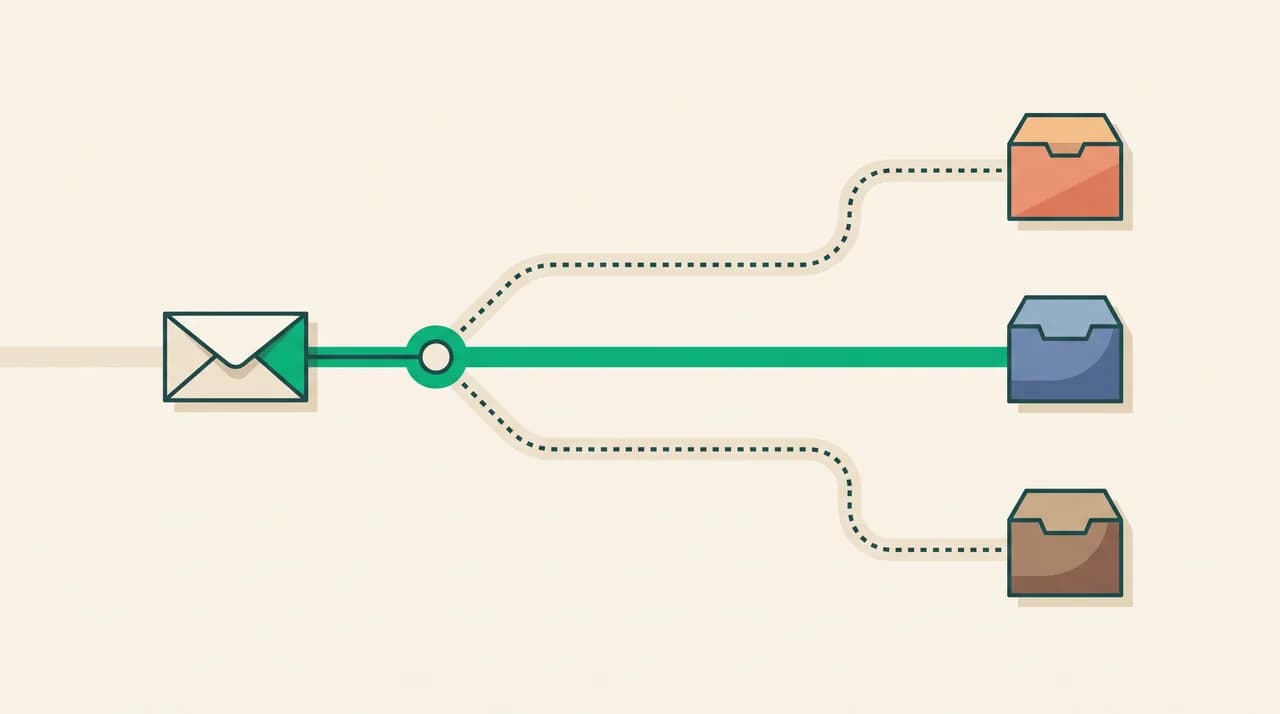
AI Emaily, which we build, runs an AI-based scanning layer on inbound mail. The classifier scores messages for spam and phishing before they reach your inbox; tracking pixels are blocked by default, and links are sandboxed before you open them. The deeper point for this post's topic: AI Emaily treats every email as untrusted input to the AI agent — the assistant will not act on instructions found inside a message body, because those instructions may be planted by an attacker rather than written by the sender. That is content scanning applied not just to delivery filtering but to agent behavior: email is data, not a command surface. Packaging is a 7-day free trial on the paid plans; there is no permanent free tier.
Frequently asked
See it in AI Emaily
Keep reading
Sources

Written by
Nafiul HasanNafiul Hasan is an entrepreneur and AI automation system builder with 10+ years of experience turning messy, manual workflows into reliable automated systems. He designs and ships AI enterprise solutions end-to-end — the agent logic, the data plumbing, and the product people actually use — and founded AI Emaily to give busy professionals their attention back. He writes here from the builder's seat: what works, what breaks, and how to put AI to work without giving up control.