AI Email Assistant for Med Spas: Reply, Follow Up & Book on Autopilot

The short answer
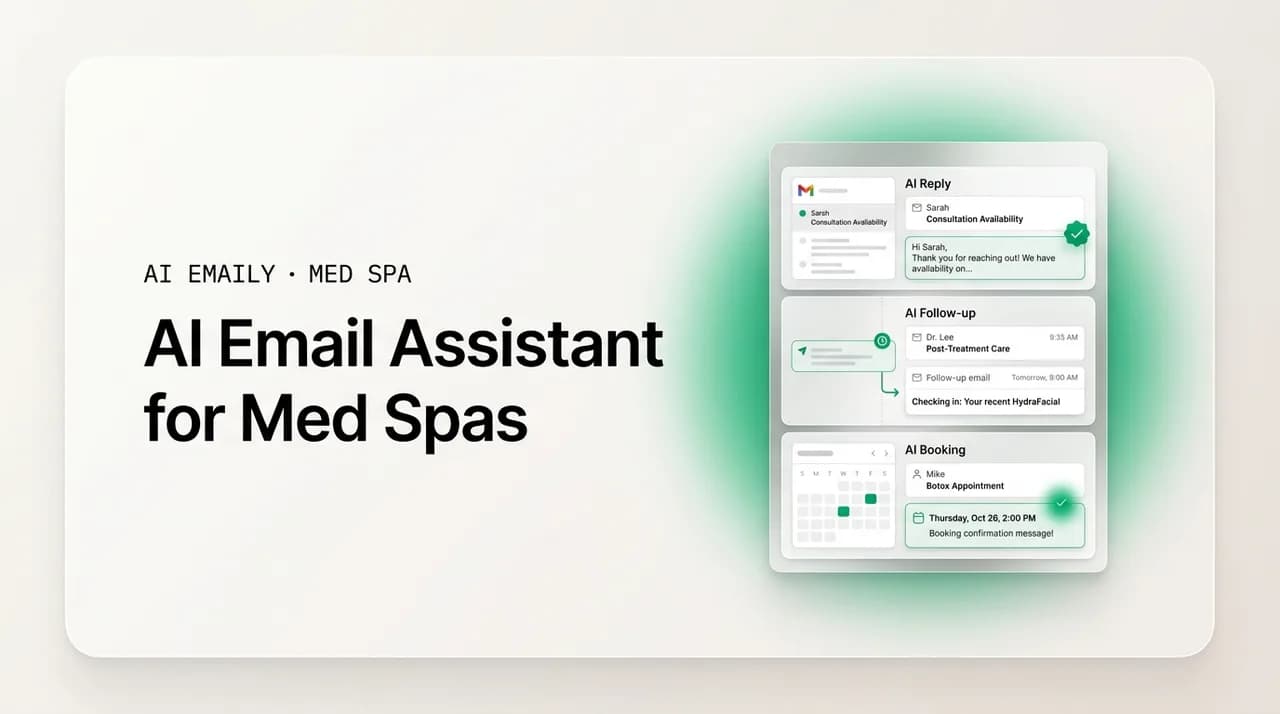
An AI email assistant for med spas answers consult requests instantly, drafts follow-ups and reminders in your clinic's voice, and keeps every appointment moving — while you approve anything before it sends. The right one automates marketing, booking, and reminders, keeps clinical and PHI content human, and never replaces your front desk. It gives you back the response speed that decides whether a lead books with you or a competitor.
An AI email assistant for med spas replies to consult requests in seconds, follows up, and books appointments in your voice — with approval before send and clinical or PHI content kept human. Here is what it does and what to look for.
On this page
- 01What is an AI email assistant for med spas?
- 02Why response speed decides who books the consult
- 03What to look for in an AI email assistant for a med spa
- 04The three modes, mapped to how a clinic actually runs
- 05The med spa use cases that actually move the needle
- 06"But will it sound like us?" — and other honest objections
- 07Objection 1: Will it actually sound like our clinic?
- 08Objection 2: What about HIPAA and patient health information?
- 09Objection 3: Does this replace our front desk?
- 10Why AI Emaily fits a med spa
- 11Putting it together
What is an AI email assistant for med spas?#
An AI email assistant for med spas is software that reads the messages landing in your clinic's inbox, understands what each one is asking for, and helps you respond — often within seconds, in your own voice, and without you touching a keyboard for the routine ones. It is not a chatbot bolted onto your website, and it is not a bulk newsletter tool. It lives where the actual conversations happen: the inbox that fills up with consult requests, pricing questions, rebooking replies, membership sign-ups, and "is it too late to move my appointment?" notes at nine on a Friday night.
The reason this matters for aesthetics specifically comes down to timing and volume. A med spa runs on inbound inquiries — most of them driven by paid social, with a cost per lead that can run anywhere from a few dollars for injectables to forty-plus for body contouring. Every one of those leads is a person who just raised their hand, compared three clinics in a browser, and is deciding right now who to trust with their face or their body. The clinic that answers first, warmly, tends to win. The clinic that answers Monday morning is often answering someone who already booked elsewhere over the weekend.
The problem is that the person best placed to answer — you, or your front desk — is almost always mid-treatment, mid-consult, or gone home. That gap between when a lead arrives and when a human is free to reply is where money leaks out of an aesthetics business, quietly and constantly. An AI email assistant exists to close that gap: to acknowledge the inquiry the moment it lands, keep the conversation warm, nudge no-shows to confirm, and stage the follow-ups that a busy front desk never gets around to sending.
Throughout this guide we will be specific about what that looks like in a clinic workflow, what to look for when you compare tools, and — because this is aesthetics, not e-commerce — where the hard line sits between what you can safely automate and what has to stay in a human's hands. This article is about email, marketing, and scheduling operations; it is not medical, legal, or compliance advice, and nothing here should be read as guidance on how to handle protected health information. When in doubt, talk to your own compliance counsel.
A note on scope
Why response speed decides who books the consult#
If there is a single number that explains why med spas are adopting AI email assistants, it is the speed-to-lead curve. The research on online lead response is blunt: contact a fresh lead within the first few minutes and your odds of a real conversation are dramatically higher than if you wait even half an hour, and they fall off a cliff after the first hour. A widely cited study of thousands of companies found that firms trying to reach leads within an hour were many times more likely to have a meaningful conversation than those who waited longer — and that the difference between a five-minute response and a thirty-minute one is enormous, not marginal.
Aesthetics is close to a worst-case scenario for this. Leads arrive at all hours because they come from social ads people scroll on the couch at night. The purchase is high-consideration and personal, so a warm, fast, human-sounding reply carries real weight. And the buyer has three competitors one tab over, all running the same ads. A consult request that sits untouched from Friday evening until Monday morning is not a warm lead waiting patiently; it is a person who spent the weekend booking a competitor who answered.
On top of the speed problem sits the expectation problem. Modern buyers — and med spa clients skew mobile and immediate — increasingly expect fast responses as a baseline, not a bonus. A reply that arrives days later does not just lose the race; it signals a clinic that is disorganized or overwhelmed, which is precisely the impression you cannot afford when someone is deciding whether to trust you with an injectable near their eye.
An AI email assistant attacks this directly. It does not sleep, it does not go into a two-hour laser session, and it does not forget. The instant a consult request lands, it can send a warm, on-brand acknowledgment that answers the obvious questions, offers next steps, and buys you the goodwill of having replied first — all while a human still reviews and owns anything that needs judgment.
What to look for in an AI email assistant for a med spa#
Not every AI email tool is built for a clinic, and a few of the differences are the difference between a tool you trust and one you quietly stop using after a week. Aesthetics has requirements that a generic sales-inbox tool does not think about — chiefly, that some of your inbound is marketing and some of it brushes up against health information, and those two categories have to be handled completely differently. Here is the checklist we would apply.
| What to look for | Why it matters for a med spa |
|---|---|
| Approval before send (a human-in-the-loop mode) | You should be able to run in a mode where nothing goes out without your review. For a clinic touching health-adjacent conversations, mandatory approval before send is not a nice-to-have — it is the guardrail that keeps the AI on the marketing side of the line. |
| Writes in your clinic's actual voice | A reply that sounds like a call-center script erodes the warm, personal trust aesthetics runs on. The assistant should learn how you and your team actually write, not paste in generic boilerplate. |
| Instant reply to new inquiries | The whole point is winning the speed-to-lead race. If it cannot acknowledge a fresh consult request in seconds, day or night, it is not solving the problem that costs you bookings. |
| Follow-up and reminder automation | Most bookings are lost in the gap between the first reply and the second, and no-shows spike without reminders. The assistant should stage multi-touch follow-ups and confirmations so nothing slips. |
| A clear line on clinical and PHI content | The tool should make it easy — ideally the default — to keep clinical detail, eligibility, dosing, and any protected health information out of automated replies and in a human's hands. If it treats a med spa inbox like a generic sales inbox, walk away. |
| Undo and a full audit trail | You need to be able to reverse an action and see exactly what the assistant did, when, and to whom. In a health-adjacent business, an auditable record of automated messaging is not optional. |
| Works with your provider and your inbox | It should connect to whatever email you already use — Gmail, Outlook, and the rest — rather than forcing a migration. Your existing address is where leads already write. |
| Private by design (control over your data and AI) | Client mail is sensitive. Look for encryption, no training on your messages, and options like an on-device path or bring-your-own-key so your data and your AI stay under your control. |
Two items on that list deserve their own paragraph, because they are the ones a generic tool will get wrong and a clinic cannot afford to.
The first is approval before send. There is a category of email a med spa handles all day that is pure marketing operations — "thanks for reaching out, here's how consults work, here are a couple of times this week." That is safe to automate aggressively. But the moment a client's message drifts toward their skin condition, their medication, their eligibility for a treatment, or anything a reasonable person would consider private health information, an automated reply is the wrong tool. The best assistants let you set a mode where drafts are staged and you approve every send, so a human is always the one who decides whether a given reply should go out at all — and whether it should be answered by the AI or by a clinician.
The second is the clinical line itself. A good AI email assistant for a med spa is deliberately narrow: it handles the booking and marketing conversation and hands off everything else. It answers "how much is a lip filler consult" and "can I move my Thursday appointment." It does not answer "is Botox safe with my blood-pressure medication" — that is a clinical question for a licensed provider, full stop. When you evaluate a tool, ask how it draws that line and how easy it is to keep the AI on the right side of it. If the answer is a shrug, that is your answer.
Guardrails are a feature, not a limitation
The three modes, mapped to how a clinic actually runs#
The most useful way to think about an AI email assistant is not "on or off" but as a dial you turn up as your trust grows. AI Emaily is built around three modes — Manual, Copilot, and Autopilot — and they map cleanly onto how a med spa actually operates, from the front desk that wants to check every word to the solo injector who needs the inbox to run itself while she is in a treatment room.
| Mode | What it does | Where it fits in the clinic |
|---|---|---|
| Manual | The AI helps only when you ask. You call on it to draft or rewrite a specific reply, then you edit and send it yourself. | Good for onboarding, for anything sensitive, and for a treatment coordinator who wants to keep a hand on every response while learning to trust the drafts. |
| Copilot | Triage, drafts, and scheduling are staged and waiting. Replies are written in your voice, ready to go with one click — but nothing leaves without your approval. | The default for most clinics. The front desk walks in to a queue of ready replies for consult requests and rebookings, reviews them in seconds, and sends. Speed without giving up control — and the right home for anything that brushes the clinical line. |
| Autopilot | Bounded, autonomous handling within rules you set — the assistant sends routine replies, follow-ups, and reminders on its own, with undo and a full audit trail. | For the repetitive, unmistakably-marketing messages: instant inquiry acknowledgments, consult reminders, no-show nudges. Set the boundaries so clinical and PHI content is never in scope, and let the high-volume routine run hands-free. |
The point of three modes is that you do not have to choose between "AI does everything" and "AI does nothing." A solo injector might run Copilot for consult requests — where a fast, personal reply matters and she wants to eyeball it — while letting Autopilot handle the pure logistics of appointment reminders and confirmations. A multi-location group might keep new-lead replies in Copilot for consistency across sites, then let Autopilot standardize the reminder and rebooking cadence so every location responds at the same speed and in the same voice.
Crucially, in v1 the safe default is approval before any send. Autopilot is something you switch on deliberately, for a bounded set of message types you have decided are safe to automate, and every autonomous action is reversible with a full audit trail. That is by design: it is how you get the speed of automation on the marketing side without ever letting the assistant wander into clinical territory on its own.
A sensible rollout
The med spa use cases that actually move the needle#
Abstract capability is easy to nod along to and hard to act on, so here are the concrete jobs an AI email assistant does in an aesthetics clinic — the specific messages that, sent fast and consistently, add up to more booked chairs and fewer empty ones. Each of these is marketing and scheduling work, which is exactly why it is safe to automate.
- 1
Instant consult-request reply
A lead fills out your form or emails at 9 p.m. Within seconds, they get a warm, on-brand reply that thanks them, answers the obvious first question (roughly what the consult involves, what it costs, how to book), and offers a next step — instead of silence until Monday. This is the single highest-leverage thing an assistant does, because it wins the speed-to-lead race that decides where the person books.
- 2
Consult and appointment reminders
Reminders are the cheapest revenue in the building. Without them, a meaningful share of med spa appointments no-show; with a timely, friendly nudge to confirm, far fewer chairs sit empty. The assistant stages the reminder cadence — a confirmation ahead of the visit, a gentle re-confirm the day before — so your front desk is not manually chasing every booking.
- 3
Rebooking and the post-booking gap
The window between when someone books and when they show up is where warm leads go cold and second-guess themselves. The assistant fills that gap with reassuring pre-visit touches in your voice, and makes rebooking effortless — a one-line reply is enough to move a time — so a scheduling wobble doesn't turn into a cancellation.
- 4
Membership and package follow-through
Memberships and treatment packages are recurring revenue that lives or dies on follow-up. The assistant nudges expiring packages, follows up on membership inquiries that stalled, and keeps the conversation going past the one-or-two attempts most clinics stop at — without you having to remember who to chase.
- 5
Review and referral requests
The best time to ask a happy client for a review is right after a great result, and that is exactly when a busy clinic forgets. The assistant times a warm, personal ask after the visit, which compounds into the social proof and word-of-mouth that lowers your cost per lead over time.
- 6
The everyday inbox triage
Underneath the named use cases is the constant grind of a full inbox: pricing questions, hours, parking, "do you take my card," duplicate threads, and the genuinely important consult buried among them. The assistant triages all of it, surfaces what needs a human, and drafts the routine answers — so the important messages stop getting lost in the noise.
Notice the through-line: every one of these is a marketing, booking, or logistics conversation. None of them requires the AI to opine on a treatment, assess eligibility, or handle a client's private health details. That is not an accident — it is the whole design. The use cases that move the needle for a med spa are precisely the ones that sit safely on the marketing side of the line, which is why an AI email assistant can be aggressive about speed there without ever creating a compliance problem.
It is also worth saying what is not on this list. The assistant is not diagnosing skin conditions, not recommending treatments, not confirming whether a specific client is a candidate for a specific procedure, and not touching anything that reads as protected health information. Those belong to your clinicians. The assistant's job is to make sure the person gets a fast, warm, well-organized experience around the edges of the clinical work — so your providers can focus on the clinical work itself.
"But will it sound like us?" — and other honest objections#
Med spa owners are right to be skeptical of AI in the inbox, because the failure modes are real and the stakes — trust, tone, and in some cases health information — are high. Here are the objections we hear most, answered honestly rather than waved away.
Objection 1: Will it actually sound like our clinic?#
This is the fear that a client emails and gets back something that reads like a call center: generic, stiff, and obviously not you. It is a legitimate worry, because a robotic reply in aesthetics does more harm than no reply at all — it makes a personal, high-trust business feel like a transaction.
The honest answer is that voice is exactly what a good assistant is built to get right, and it is where AI Emaily invests. It learns how you and your team actually write — your phrasing, your warmth, your sign-offs — and drafts in that voice rather than in template boilerplate. And because Copilot stages every draft for your approval, you are never gambling: you see the reply before it goes, edit anything that feels off, and over time the drafts need less and less editing. If a draft ever sounds wrong, you catch it, because a human is still in the loop. The goal is not to remove you from your clinic's voice; it is to let you send that voice faster and more consistently than a busy front desk ever could by hand.
Objection 2: What about HIPAA and patient health information?#
This is the objection that matters most, and it deserves a careful, honest answer rather than a marketing one. First, the disclaimer: we are an email and scheduling product, not a compliance authority, and nothing here is medical or legal advice. How your clinic handles protected health information under HIPAA is a question for your own compliance counsel, and your obligations depend on your specific setup.
What we can say is how the product is designed to keep the AI on the safe side of that line. The philosophy is simple: automate marketing, booking, and reminder messaging, and keep clinical and PHI content in a human's hands. Approval before send in v1 means nothing goes out autonomously that you have not reviewed. Autopilot is a deliberate, bounded choice you make for specific message types — the ones that are unmistakably marketing and logistics — and it is designed so clinical detail, eligibility, dosing, and health information stay out of automated scope. Every action is reversible with undo, and there is a full audit trail of what was sent, when, and to whom. On the data side, the product encrypts what it stores, does not train on your mail, and offers privacy-forward options like an on-device path and bring-your-own-key so your clinic keeps control of both the data and the AI.
None of that is a substitute for your own compliance program, a business associate agreement where one is required, or the judgment of a provider. The point is narrower and, we think, honest: the guardrails exist so you can safely automate the large, marketing-driven part of your inbox — the part that is costing you bookings when it is slow — without the tool ever being the thing that puts health information into an automated message. If a treatment-specific or health question comes in, the right move is a human, and the product is built to make that the default, not the exception.
Not medical or legal advice
Objection 3: Does this replace our front desk?#
No — and any tool that promises it does is selling you something you should not buy. Your front desk and treatment coordinators do things an AI cannot: they read a room, calm an anxious first-timer, upsell with genuine warmth, handle the phone, and make judgment calls on the edge cases that do not fit a script. An AI email assistant does not have that job and is not trying to.
What it does is take the specific load that a human is worst at and email is best for: being awake at 9 p.m. when the lead arrives, never forgetting to send the reminder, drafting the tenth pricing reply of the day as fast as the first, and making sure the important consult request does not get buried under twenty routine ones. It gives your existing team back the hours they currently spend typing the same answers and chasing the same confirmations, so they can spend those hours on the human work that actually needs a human. For a solo injector with no front desk at all, it fills a role nobody was covering. For a multi-location group, it makes the front desk faster and more consistent across sites. In neither case does it replace the people — it removes the busywork that was stopping them from doing their best work.
Why AI Emaily fits a med spa#
There are plenty of AI writing tools and plenty of clinic CRMs. AI Emaily is neither of those things exactly, and the difference is the reason it fits an aesthetics clinic. It is an AI-native email client — an autonomous chief of staff for your inbox — that connects to the email you already use and works across web, macOS, iOS, and Android. It is not trying to be your electronic health record, your booking calendar, or your clinical charting system, and that is a feature, not a gap.
Think of it as the communications layer that sits over whatever you already run. Your leads write to your existing address; AI Emaily reads that inbox, triages it, drafts in your clinic's voice, and — in the mode you choose — replies, follows up, and closes loops. It brings every provider into one unified inbox, so a group juggling Gmail, Outlook, iCloud, Fastmail, Proton, or plain IMAP sees it all in one place. It runs in the three modes we walked through, so you dial autonomy up as trust grows. And it keeps the safety story consistent: approval before send in v1, undo on everything, a full audit trail, encryption, no training on your mail, and private options like on-device AI and bring-your-own-key.
The fit for a med spa comes from that combination — fast, voice-matched, marketing-and-scheduling email, with the guardrails that let you keep clinical work human. It attacks the exact problem that costs aesthetics clinics money: the slow, inconsistent, easy-to-drop email conversation around consults, bookings, and reminders. It does not touch the exact thing you cannot hand to software: the clinical judgment your providers are licensed for. That is the line, and staying on the right side of it is what makes the speed safe to use.
You can try it free at app.aiemaily.com/signup — the Free plan is genuinely free with a real AI agent, Pro is $12.42 per month on the annual plan, and you only add a card when you decide to upgrade. Connect the inbox your leads already write to, watch a few drafts come back in your voice, and decide for yourself whether answering every consult request in seconds is worth it.
What AI Emaily is not
Putting it together#
An AI email assistant for med spas earns its place by solving one expensive, unglamorous problem: the inbox is where your paid leads land, and a human is almost never free to answer them fast enough. Speed-to-lead decides who books the consult, reminders decide who shows up, and follow-up decides who comes back — and all three run through email that a busy clinic can never quite keep up with by hand. An assistant that replies in seconds, in your voice, and keeps every appointment moving turns that leak into leverage.
The catch, and the thing that separates a tool you can trust from one you cannot, is the line between marketing and clinical. Automate the acknowledgments, the reminders, the rebookings, the review asks — the high-volume, unmistakably-marketing conversation — and let it run fast. Keep clinical detail, eligibility, and any patient health information in a human's hands, behind approval-before-send, undo, and a full audit trail. Do both, and you get the speed without the risk.
That is the shape AI Emaily is built to fit: an autonomous chief of staff for the email side of your clinic, with the guardrails that keep the clinical side human. Start free at app.aiemaily.com/signup, connect the inbox your consult requests already land in, and see how it feels to never leave a lead waiting until Monday again.
Frequently asked
See it in AI Emaily
Keep reading
Sources
- Harvard Business Review — The Short Life of Online Sales Leads (speed-to-lead)
- CDC — Health Insurance Portability and Accountability Act of 1996 (HIPAA) overview
- FTC — Health Breach Notification Rule
- American Med Spa Association (AmSpa) — industry resources
- Zendesk — Customer service statistics (response-time expectations)

Written by
Nafiul HasanNafiul Hasan is an entrepreneur and AI automation system builder with 10+ years of experience turning messy, manual workflows into reliable automated systems. He designs and ships AI enterprise solutions end-to-end — the agent logic, the data plumbing, and the product people actually use — and founded AI Emaily to give busy professionals their attention back. He writes here from the builder's seat: what works, what breaks, and how to put AI to work without giving up control.