Can Work Emails Be Used as Evidence? What to Assume

The short answer
Yes. Work emails are routinely used as evidence. In US federal lawsuits they are discoverable electronically stored information under the rules of civil procedure, and copies survive on servers, backups, and the recipient's side long after you delete yours. Assume anything you write on a work account could be read aloud in court, and write accordingly.
Can work emails be used as evidence? Almost always yes — they're discoverable, and deleting your copy doesn't erase the rest. What to assume when you write.
On this page
- 01Why are work emails discoverable in a lawsuit?
- 02Who can read your work email, and how long is it kept?
- 03How to write a work email that could be read back to you
- 04Where your email lives, and who can get it
- 05Does deleting an email remove it from the server?
- 06A faster way to write email you would be comfortable reading back
Can work emails be used as evidence? In almost every case, yes. If a dispute ends up in court, the messages on a work account are treated as records the other side can demand, read, and put in front of a judge or jury. That single fact should shape how you write every email you send from a work address.
The reason comes down to two things this guide will unpack: work email is discoverable in a lawsuit, and it is retained in more places than you can delete. What follows is a plain-English explanation of why, what deleting does and does not do, and a simple writing rule that comes out of it. This is general information about how email records are treated, not legal advice — for your own situation, ask a lawyer.
Why are work emails discoverable in a lawsuit?#
Discovery is the stage of a lawsuit where each side must hand over relevant records to the other. Email sits squarely inside it. In United States federal courts, the rule that governs this is Rule 34 of the Federal Rules of Civil Procedure. It lets a party request the other side produce and let them inspect any designated "electronically stored information" — data stored in any medium from which information can be obtained.
Email is the classic example of electronically stored information, usually shortened to ESI. The rule does not spell out the word "email" itself, but the drafters' own committee notes point to electronic messages as the common case, and courts have treated email as discoverable for two decades. State courts and other countries run their own disclosure rules, but the direction of travel is the same: relevant work email can be demanded and handed over.
One distinction is worth knowing. "Discoverable" means the other side can obtain the email. "Admissible" means it can actually be shown to a jury, which usually means proving the message is genuine and clearing rules such as hearsay. So not every email that is discovered ends up as courtroom evidence. For a writer, that is thin comfort: the safe assumption is that anything you send can be obtained, and often admitted.
General information, not legal advice
Who can read your work email, and how long is it kept?#
On a company email account, you are usually writing on a system your employer owns and controls. In the United States, employers generally have wide latitude to access and monitor email on their own accounts and devices, and employees tend to have a limited expectation of privacy there. The exact rules vary by state and country, and many employers set out their monitoring rights in an acceptable-use or IT policy you agreed to when you joined — so start by checking yours.
That includes the personal messages you send from a work account. A quick joke to a friend, a vent about a manager, a side-project note — if it lives on the company's system, it can generally be read by the company and pulled into a dispute. If you would not want it read by HR, legal, or a courtroom, it does not belong on a work address.
How long work emails are kept depends on the organization's retention policy, any regulations it has to follow, and whether a legal hold is in place. Some records are kept for years by rule, some are deleted on a schedule, and backups can quietly outlast both. In the United States, federal agencies must manage email as official records under National Archives retention schedules — a reminder that at the highest level, email is treated as a record to be kept, not a chat to be forgotten.
How to write a work email that could be read back to you#
Once you accept that a work email can be obtained, retained, and read out of context, the writing rule is simple: write every message as if a stranger might read it aloud in a deposition. That is not paranoia — it is accuracy about where the words can end up. Here is how to put it into practice.
- 1
Write for a later, unfamiliar reader
Assume the reader is not the colleague you are emailing today, but someone months from now with no context — a lawyer, an auditor, a new manager. Skip sarcasm, inside jokes, and hyperbole that reads badly in cold print. A line meant as a joke can look like an admission when it is quoted on its own.
- 2
Separate what you know from what you guess
State facts as facts and opinions as opinions. "The invoice went out on the 3rd" is a fact you can stand behind. "They probably knew it was broken" is a guess that can come back on you. If you are estimating or unsure, say so plainly in the email.
- 3
Keep legal conclusions out of it
Do not casually label things "illegal", "negligent", or "a breach" in an email. Those are legal judgments, and guessing at them in writing can create a paper trail that misstates the situation. Send genuine legal questions to the right people, and let a lawyer form the conclusions.
- 4
Be specific and accurate
Precise names, dates, numbers, and facts make a better record — including for you. Vague email helps no one and is easy to read the wrong way. If you are correcting an earlier mistake, do it clearly, so the record shows what actually happened.
- 5
Assume it gets forwarded
Write for the widest plausible audience, not just the person in the To field. A message meant for one colleague can be forwarded, screenshotted, or attached to a complaint in seconds. If a wider audience would change how you phrase it, phrase it that way now.
The one-sentence test
Where your email lives, and who can get it#
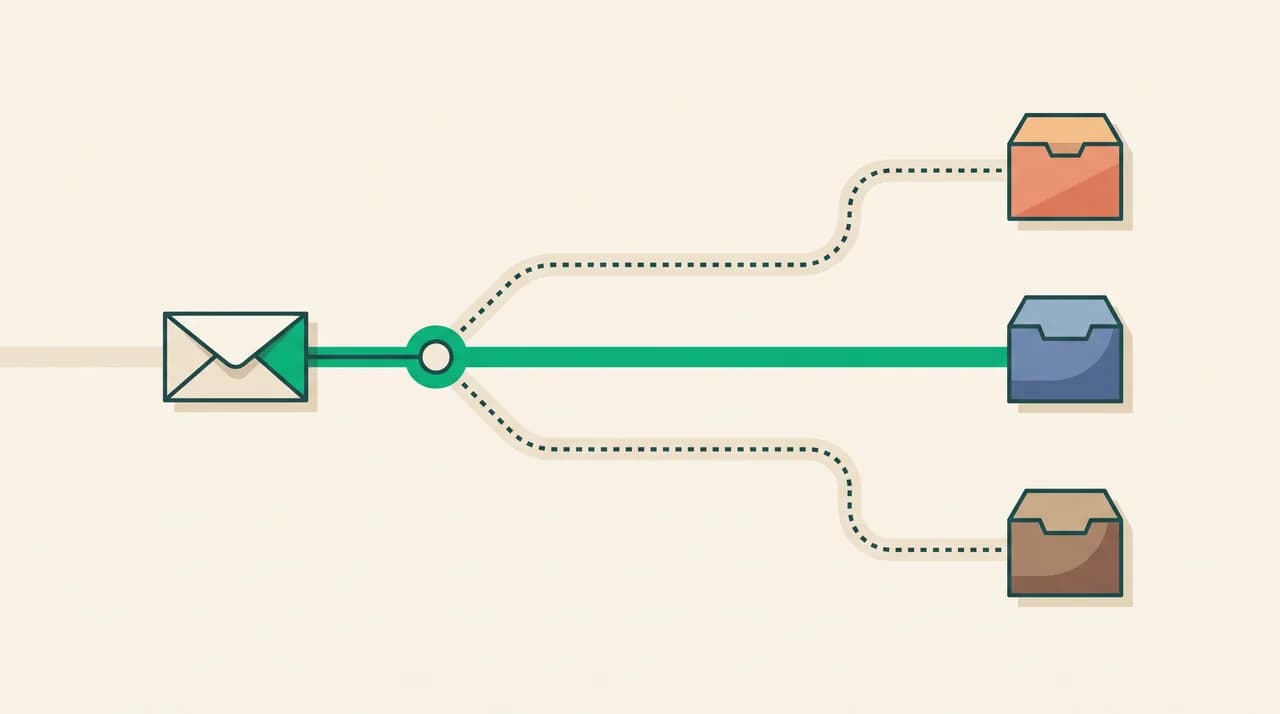
A sent email is not one file in one place. The moment you send it, copies scatter — to the recipient, to mail servers, to backups, and often to an archive your company keeps for exactly this reason. Deleting your own copy touches only one of them. The table below shows where the copies live and who can reach them.
| Where the email lives | Who can access it | What deleting your copy does |
|---|---|---|
| Your personal email account (you own it) | You, your provider, and anyone with a lawful request such as a subpoena or court order | Removes it from your view; a purged Trash may still not reach the provider's own backups |
| Your company email account | You, your employer's IT admins, and legal or HR under policy or a legal hold | Removes your copy only; retention rules and holds can preserve the real record |
| The recipient's mailbox | The recipient and their provider or employer — entirely outside your control | Nothing — you cannot delete a message you have already sent to someone else |
| Server backups, archives, and eDiscovery tools | Admins, and in litigation both sides' lawyers through the discovery process | Nothing you control; retention is set by policy and can outlast your account |
This is why "I deleted it" is rarely the end of the story. Your delete removes your view of the message. It does not remove the recipient's copy, the server's backup, or the archive an administrator controls. On business Google Workspace and Microsoft 365 accounts, admins can switch on retention and eDiscovery tools — Google Vault and Microsoft Purview, as of 2026 — that keep a copy no matter what any single user deletes.
Does deleting an email remove it from the server?#
Usually, no. Deleting an email from your mailbox moves it to Trash or Deleted Items, and providers purge that folder after a limited window — around 30 days in several consumer services as of 2026, though you should check your provider's current help page. That removes your copy. It does not reach the copies described above.
It certainly does not reach the recipient. Once a message is in someone else's inbox, you cannot delete it — it is theirs now. The recall or undo-send features some clients offer only work in narrow conditions, usually inside the same organization and within seconds, and never for mail that has already been read or left the building.
There is a more serious reason not to delete. Once a lawsuit or investigation is reasonably foreseeable, destroying relevant email can count as spoliation — the destruction of evidence — and it can carry real penalties, including court sanctions and an instruction to the jury to assume the deleted message was harmful. Organizations respond by issuing a legal hold that stops routine deletion. If you sense a dispute coming, preserve rather than purge, and ask a lawyer.
So what do you do about an email you wish you had never sent? You cannot un-send it, and you should not try to destroy it. If it is factually wrong, correct the record with a short, honest follow-up. If it touches a legal matter, loop in the right people rather than handling it alone. The clean move is to add accurate context, not to hide the original.
Deleting can make things worse
A faster way to write email you would be comfortable reading back#
The rule this post describes — write every work email as if it could be read aloud in a deposition — is a habit, and habits are easier to keep when the tool gives you a pause before you send. AI Emaily is an AI email client for Gmail, Outlook, and IMAP that drafts replies and, in Copilot mode, holds each one for your review before it goes out, so nothing leaves your outbox on reflex. Its audit log records what the agent did, and it never trains on your mail.
Be clear about what a mail client cannot do here. AI Emaily is not an archiving, legal-hold, or eDiscovery system, and nothing it does makes an email un-discoverable or overrides your employer's retention. What it changes is the moment of writing: a deliberate draft you approve, instead of a fast one you regret. We build AI Emaily.
You can see the plans and start a free trial to test the approve-before-send workflow for yourself.
Frequently asked
See it in AI Emaily
Keep reading
Sources

Written by
Nafiul HasanNafiul Hasan is an entrepreneur and AI automation system builder with 10+ years of experience turning messy, manual workflows into reliable automated systems. He designs and ships AI enterprise solutions end-to-end — the agent logic, the data plumbing, and the product people actually use — and founded AI Emaily to give busy professionals their attention back. He writes here from the builder's seat: what works, what breaks, and how to put AI to work without giving up control.