How to Be Polite in an Email: Phrases That Stay Warm and Clear

The short answer
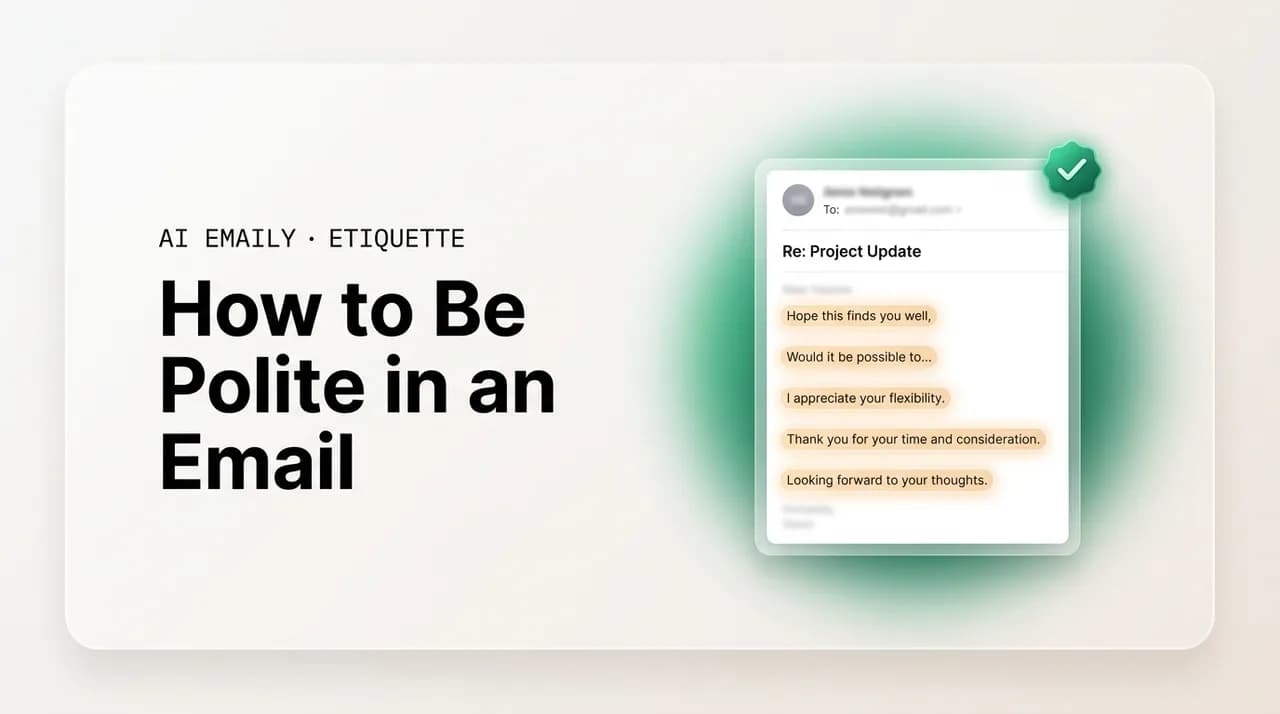
How to be polite in an email comes down to staying warm and clear at once — not groveling, not blunt. Use "please" and "thank you" where they land, soften requests with a short reason, keep the ask in plain sight, and stay direct. Politeness is respect for the reader's time, not extra padding around it.
How to be polite in an email without going soft: the phrases that stay warm and clear, how to soften a request, decline gracefully, chase a reply, and the blunt-to-polite swaps that keep you respected.
On this page
- 01What does being polite in an email actually mean?
- 02How do you use "please" and "thank you" without sounding fake?
- 03Which blunt phrases should you swap for polite ones?
- 04How do you make a polite request without burying the ask?
- 05How do you say no politely in an email?
- 06How do you follow up politely without sounding annoyed?
- 07What polite phrases work across most situations?
- 08What polite-email mistakes make you sound worse, not better?
- 09How does AI Emaily help you stay polite and clear in every email?
- 10The bottom line on being polite in an email
There is a particular kind of email everyone has sent. You wanted to be nice, so you added a "just," then a "sorry to bother you," then a "whenever you get a chance, no rush at all," and by the time you hit send the actual request was buried three sentences deep under a pile of apology. The reader skims it, cannot tell what you need or by when, and replies "Sure, what did you need again?" — which means your politeness made the email worse, not better. You were courteous and unclear, and the two are not the same thing.
The opposite failure is just as common. Trying to be efficient, you fire off "Send me the deck by EOD" with no greeting, no please, no name — and the reader, who is a person and not a task queue, reads it as cold or even rude, and answers a little slower and a little less warmly than they would have. You were clear and curt, and curt costs you over time. Both emails miss the same target: the message that is polite and clear at the same time, where courtesy makes the ask easier to say yes to instead of harder to find.
That target is the whole point of this guide. Being polite in an email is not about softening every edge until the message goes mushy, and it is not about formality or length. It is about respect — for the reader's time, their effort, and their right to say no — expressed in a way that keeps your meaning sharp. The good news is that this is a learnable, almost mechanical skill. There are specific phrases that carry warmth without fog, specific moves that soften a request without hiding it, and specific traps (the apology spiral, the passive-aggressive "per my last email," the fake-polite command) that make you sound worse the harder you try.
We will work through all of it in plain language. You will get a clear definition of what polite-and-clear actually means, the role of "please" and "thank you" and where they backfire, a table that swaps blunt phrases for warm-but-direct alternatives, and full example emails for the three situations that trip people up most — making a request, saying no, and chasing a reply that never came. Near the end, a short look at the real problem: that you make these small calls on every message, all day, and what an AI-native email client does so the polite version comes out without you laboring over it.
What does being polite in an email actually mean?#
Start with what politeness is not, because most of the bad advice lives there. Polite is not the same as soft. It is not the same as formal. It is not the same as long. You can be ruthlessly clear and deeply polite in the same sentence, and you can be wordy, apologetic, and quietly rude all at once. Politeness in email is one thing: visible respect for the person reading. Respect for their time, their effort, their autonomy, and their intelligence. Everything else is technique in service of that.
Respect for their time means you get to the point and make the ask easy to find — burying it under hedging is not courtesy, it is making them work to figure out what you want. Respect for their effort means you acknowledge what they are doing for you, with a genuine thank-you rather than a reflexive one. Respect for their autonomy means you ask rather than command, and you leave room for a no — "would you be able to" instead of "you need to." And respect for their intelligence means you do not over-explain, over-apologize, or pad the message with so much softening that you imply they cannot handle a direct sentence.
Hold those four and a useful test falls out of them: would this email feel respectful if I said it out loud, to this person's face, in a normal voice? "Could you send the figures by Thursday? Thanks — it helps me close the report on time" passes; it is the kind of thing a decent colleague says across a desk. "I'm so sorry to bother you, I know you're incredibly busy, but if it's not too much trouble, would you maybe possibly be able to perhaps send the figures sometime?" fails — said aloud, it sounds anxious and a little exhausting, not polite. Spoken language is naturally polite-and-clear because the other person is right there; email loses that, and the fix is to write closer to how you would actually speak.
The reason this matters so much in email specifically is that email strips out everything that carries warmth in person. No tone of voice, no smile, no pause, no body language — just words on a screen, read fast, often on a phone, often by someone in a hurry. So a neutral sentence that would sound perfectly fine spoken can read flat or sharp in text, and the reader fills the gap with their own mood, which is frequently worse than you intended. Politeness in email is partly the work of putting back the warmth the medium removed — not by padding, but by choosing words that signal respect plainly enough to survive a fast read.
The core idea in one line
How do you use "please" and "thank you" without sounding fake?#
"Please" and "thank you" are the two oldest tools in the politeness kit, and they still work — but only when they are doing real work. Used well, they turn a command into a request and acknowledge a kindness. Used reflexively, they become noise the reader stops registering, and at worst they tip into the fake-polite zone, where the form of courtesy wraps around something that is not actually courteous at all.
"Please" earns its place when it converts an instruction into an ask. "Send me the file" is a command; "Could you send me the file?" or "Please send the file when you have a moment" is a request, and the difference is whether you are treating the reader as someone with a choice or someone you are issuing orders to. Put "please" on the genuine asks. Where it goes wrong is the fake-polite command — "Please be advised that this is now overdue," "Kindly do the needful," "Please ensure this never happens again." Those wear politeness as a costume over an order or a scolding, and readers feel the gap instantly; the "please" makes them feel managed, not respected. One sincere "could you" beats three "kindlys."
"Thank you" works the same way: powerful when it is specific and genuine, weightless when it is reflexive. "Thanks so much for turning the deck around so fast — it made the client call a lot easier" lands, because it names what they did and why it mattered. "Thanks in advance for your immediate attention to this matter" does the opposite — it thanks them for complying before they have agreed, which reads as pressure dressed as gratitude. Thank people for things they actually did, or for help you have genuinely asked for, and skip the gratitude when the email asks nothing and they have done nothing yet, where a thank-you just reads as oddly placed.
The deeper rule under both words is sincerity over frequency. Politeness is not a quota of magic words to hit per paragraph; it is a quality the whole message either has or does not. An email with zero "pleases" can be warmly polite if it asks rather than commands and acknowledges the reader as a person. An email stuffed with "please" and "kindly" and "much appreciated" can read cold or passive-aggressive if those words are papering over an order. Use the words where they mean something, drop them where they do not, and let the underlying respect carry the weight.
Which blunt phrases should you swap for polite ones?#
Most rudeness in email is not malice; it is bluntness on a fast read. A phrase that felt neutral in your head lands sharp on the screen, because the reader cannot hear that you meant it kindly. The fix is rarely more words — it is better-chosen words. Below is the swap table: common phrases that read cold or curt, what the reader actually hears, and a warm-but-direct alternative that keeps the meaning and loses the edge. Note what the good column has in common — it is not longer or softer, it just treats the reader as a person with a choice.
The pattern to learn from the table is that the polite version usually does one of three small things: it turns a command into a question ("Send this" → "Could you send this?"), it adds a sliver of reason or context so the ask does not feel arbitrary ("by Thursday" → "by Thursday so I can close the report"), or it removes a word that carries hidden judgment ("Obviously," "As I said," "You failed to"). None of those make the email mushy. They make it land the way you actually meant it.
| Blunt / cold | What the reader hears | Warm-but-direct swap |
|---|---|---|
| Send me the report. | An order; you are a task, not a person | Could you send the report when you have a moment? |
| You need to fix this. | You are being told off | Would you be able to take another look at this? |
| As I said in my last email… | You weren't paying attention | Just resurfacing this in case it slipped through — |
| Obviously, the deadline is Friday. | You should have known; you're slow | Just to confirm, the deadline is Friday. |
| I need this ASAP. | Drop everything; your time doesn't matter | Could you get to this by [time]? Happy to flex if that's tight. |
| This is wrong. | You messed up | I think there may be a mismatch here — could you check line 4? |
| Why didn't you reply? | You're being accused | Wanted to check this reached you — any thoughts when you get a sec? |
| Per my last email, | (passive-aggressive scolding) | Following up on my note below — |
| You failed to attach the file. | Blame | It looks like the attachment didn't come through — could you resend? |
| Do the needful. | Vague, slightly imperious | Could you take the next step on this when you can? |
| FYI, this was due yesterday. | A jab | Quick heads-up — this one was due yesterday, no problem if it's nearly there. |
| Let me be clear: | I'm about to talk down to you | To make sure we're aligned — |
Two phrases on that list deserve a special warning because they are the most common accidental rudeness in professional email: "per my last email" and "as I said." Both are technically polite in their words and openly passive-aggressive in their effect — they exist to point out that the reader missed or ignored something, and everyone knows it. They have become a running joke precisely because they are so transparent. If someone genuinely missed your message, just resurface it without the dig: "Resurfacing this in case it got buried — would still love your take." You get the reminder without the cold front, and the relationship survives intact.
The other trap hiding in the table is the word "just," which is more complicated than it looks. "Just checking in," "just wanted to ask," "just a quick one" — a single "just" can soften an opening nicely. But "just" stacks fast, and three or four of them across an email start to sound apologetic and small, as if you are sorry to exist in the reader's inbox. The rule is one softener per ask, not a coat of them. Use one "just" or one "quick" to take the edge off, then say the thing plainly. Layering softeners does not make you more polite; it makes you sound unsure you are allowed to ask, which is its own kind of awkward for the reader.
The one-softener rule
How do you make a polite request without burying the ask?#
The request is where politeness and clarity most often fight, and where most people lose. The instinct, when you want a favor, is to cushion it — apologize for asking, downplay the size, hedge the deadline, surround the actual sentence with so much padding that the reader has to dig for it. The result is the email from the opening of this guide: courteous, vague, and annoying to answer. A genuinely polite request does the opposite. It respects the reader enough to be clear about what you need, why, and by when, while still asking rather than commanding and leaving room for a no.
The structure that works almost every time is short and has four parts. Lead with a brief warm opener or a one-line reason for writing. State the ask plainly, as a question, in its own sentence. Give the relevant context — the why and the when — in a line or two, because a reason makes any request feel less arbitrary and easier to grant. Then close with a real thank-you and an easy out. That is it. The politeness lives in the framing (a question, a reason, a thank-you, a no left open), not in padding around a hidden request.
The part people skip is the easy out, and it is the most polite move of all. Adding "no worries if you can't" or "happy to ask someone else if you're slammed" or "if the timing doesn't work, just let me know" tells the reader that you respect their right to decline — which, paradoxically, makes them more likely to say yes, because the ask no longer feels like pressure. It also keeps the relationship clean if they do have to pass. The example below shows the difference between the buried-ask version and the polite-and-clear version of the same request.
Look at what the good version does that the buried one does not. It opens warmly but briefly — one "Hi Sam," no anxious throat-clearing. The ask is a single clear question in its own line: take a look at the deck, by Thursday. The why is right there (presenting Friday, want your read on pricing), which makes the request feel reasonable rather than random. It sets a realistic sense of size (a 10-minute skim) so the reader can gauge the cost. It hands over a genuine out. And it thanks them once, plainly. The polite version is actually shorter than the buried one — proof that courtesy is not the same as word count.
A few specifics that lift any request from clear to genuinely gracious. Frame the ask as a question, not a statement — "Could you," "Would you be able to," "Is there any chance you could" all hand the reader agency. Name the deadline as a request with a reason, not a demand — "by Thursday so I can fold it into the Friday deck" reads completely differently from "by EOD." Acknowledge the favor for what it is when it is a real one — "I know this is extra on top of your week" shows you see the cost. And make saying yes physically easy: attach the file, link the doc, spell out exactly what "done" looks like, so the reader is not doing your work to figure out what you meant.
- 1
Open warm but brief
One friendly line or a single reason for writing. Skip the anxious preamble.
- 2
State the ask as a question
Put it in its own sentence, so a skimming reader cannot miss what you need.
- 3
Give the why and the when
A short reason makes any request feel reasonable rather than arbitrary.
- 4
Make yes easy
Attach the file, link the doc, and say exactly what "done" looks like.
- 5
Close with thanks and an out
A genuine thank-you plus "no worries if you can't" respects their choice and lifts your odds.
Reason, then request
How do you say no politely in an email?#
Declining is where most people either cave or wound. They say yes to things they should refuse because a polite no feels impossible to write, or they refuse so bluntly that they damage a relationship they wanted to keep. There is a third way, and it is entirely learnable: a clear, warm, firm no that respects both the asker and your own limits. The key insight is that a good no is honest and kind, not vague and apologetic — vagueness ("I'll try to get to it") is unkind, because it leaves the other person hoping for a yes that is not coming.
The structure mirrors the polite request but inverts it. Thank them or acknowledge the ask first, so they know it landed and was taken seriously. Give the no clearly and early — do not bury it under five sentences of throat-clearing that make them read to the end to learn the answer. Offer a brief, honest reason if there is one, but keep it short; you owe an explanation, not a justification, and over-explaining a no can sound defensive. Then, where you can, soften the landing with an alternative — a different time, a referral, a smaller version of yes. Close warmly. The decline lands as respect, not rejection.
The hardest part is saying the actual word. "I won't be able to," "I'm going to pass on this one," "That's not something I can take on right now" — these are clear nos, and clarity here is a kindness. The phrases to avoid are the fake-soft ones that are really just delayed nos: "Let me see what I can do" when you already know you can't, "maybe down the line" with no intention, "I'll try." They feel gentler in the moment and are crueler over time, because the asker plans around a yes that never arrives. Below are three polite declines for the situations that come up most.
Notice that none of those three nos are unkind, and none of them are mushy. Each one thanks or acknowledges, says no plainly and early, gives a one-line honest reason, and offers something — a conditional yes, a referral, a smaller scope, an alternative path. That last move, the alternative, is what turns a refusal into a gesture of respect: it shows you took the ask seriously enough to think about how the person still gets helped. You will not always have an alternative to offer, and that is fine — a clean, warm no with a genuine reason stands perfectly well on its own.
Two cautions on declining politely. First, do not over-apologize. One "I'm sorry I can't" is gracious; a paragraph of apology turns a normal boundary into a guilt confession and quietly invites the other person to talk you out of it. A no does not require contrition — it is a reasonable thing to do. Second, do not leave the door ajar when it is shut. If the answer is a real no, phrases like "maybe later" or "we'll see" are not polite, they are evasive; they protect your comfort at the cost of the other person's clarity. Be warm, be brief, be honest about whether there is genuinely a path forward, and let the no be a no.
A clear no is kinder than a vague maybe
How do you follow up politely without sounding annoyed?#
The follow-up is the most emotionally loaded email most people send, because by the time you are writing it you are usually a little annoyed — you asked, they went quiet, and now you have to ask again. That irritation leaks into the words if you are not careful, and out comes "per my last email" or "just following up AGAIN" or a passive-aggressive "I assume you're busy," all of which read as scolding even when you typed them through gritted teeth. A polite follow-up does the opposite: it assumes good faith, makes it easy to respond, and stays warm even on the third try.
The mental reframe that fixes the tone is to assume the email got buried, not ignored. Most non-replies are not rudeness; they are a full inbox, a forgotten tab, a "I'll deal with this later" that never came back around. If you write from "you ignored me," the email accuses; if you write from "this probably slipped through," the email helps. The second framing is almost always closer to true, and it produces a follow-up the reader can answer without feeling caught out — which is exactly what gets you the reply faster.
The structure of a good follow-up is short and generous. Resurface the thread gently ("circling back," "resurfacing this," "in case this slipped through"), restate the ask in one line so they do not have to scroll back, give a light reason for the nudge if there is a deadline, and keep the whole thing brief and friendly. Crucially, make replying low-effort: repeat the key detail, attach the file again, even offer a yes/no version of the question. The examples below show a first, second, and final polite follow-up — escalating in directness, never in warmth.
The progression across those three is worth studying, because it is the polite way to escalate. The first is a soft tap on the shoulder. The second adds the real reason and a clear deadline, so the stakes are visible without any blame. The third sets a default action — "I'll go ahead unless I hear from you" — which is the most respectful kind of firmness, because it stops chasing the reader, removes the pressure to reply, and lets them off the hook entirely if they have nothing to add. At no point does any of them get colder. The directness rises; the warmth holds steady. That is the whole trick of polite persistence.
A few practical rules keep follow-ups on the right side of the line. Give it real time before the first nudge — usually two to three business days for a normal ask, longer for a big one; following up the next morning reads as impatient. Never blame in a follow-up, even gently; "I haven't heard back" is fine, "you still haven't replied" is not. Keep each one shorter than the last, not longer. And know when to stop — after a polite final nudge with a default action, the ball is genuinely in their court, and a fourth and fifth chase crosses from persistent into nagging. Sometimes the most professional move is to let a non-reply be the answer.
Set a default action on the last nudge
What polite phrases work across most situations?#
Once you understand that politeness is respect made visible, a small set of phrases starts to earn its keep across almost every email you write — openers that warm without padding, softeners that ask without commanding, and closers that thank without groveling. These are not magic words to scatter; they are reliable building blocks you reach for when you need to take an edge off or hand the reader some room. Keep them in your back pocket and most emails write themselves a notch more graciously.
The unifying quality of every phrase below is that it grants the reader agency or acknowledges their effort, in few words, without apology. "Would you be able to" hands them a choice. "When you have a moment" respects their schedule. "Thanks for bearing with me on this" sees the cost of what you are asking. None of them are long, and none of them are servile. That is the line you are walking — warm enough to feel human, brief enough to stay clear, confident enough that you are not apologizing for occupying the inbox.
| Use it to… | Polite phrase | Why it works |
|---|---|---|
| Open warmly | I hope your week's going well — / Thanks for the quick reply earlier — | Human and brief; warms the email without anxious preamble |
| Ask for something | Would you be able to… / Could you, when you have a moment, … | Frames the ask as a request with a choice, not a command |
| Add a soft deadline | Ideally by Thursday, so I can… / No rush, but before Friday would help — | Names the when with a reason; firm without being a demand |
| Disagree gently | I see it a little differently — / I may be missing something, but — | Leaves room to be wrong; opens a conversation, not a fight |
| Push back on a deadline | Could we flex this to Friday? Happy to prioritise if it has to be today. | Honest about capacity while showing you take it seriously |
| Offer help | Happy to help with this — just say the word. / Let me know if a quick call is easier. | Generous without being pushy; leaves them in control |
| Acknowledge effort | Thanks for turning this around so fast — / I know this was extra on your plate — | Names the specific favour, so the gratitude reads as real |
| Close gracefully | Thanks so much — really appreciate it. / No worries either way, just let me know. | Warm, brief, and leaves an easy out |
A note on the phrases that try to be polite and miss — because the back-pocket list is only half the skill; the other half is knowing what to cut. "I hope this email finds you well" has been used so much it now reads as filler the reader's eye skips; a specific opener ("Thanks for the notes from Tuesday") does the warming far better. "Just a gentle reminder" tips passive-aggressive the moment there is any real impatience behind it. "As per our conversation" and "please be advised" are stiff, slightly legalistic, and put distance between you and the reader. None of these are crimes, but they are the verbal equivalent of a fixed smile — the shape of warmth without the substance.
The better instinct, every time, is to write a touch closer to how you would actually talk to the person. "Per our conversation" becomes "Like we discussed —." "Please be advised that the office will be closed" becomes "Quick heads-up: the office is closed Monday." "I am writing to inquire about" becomes "I wanted to ask about." Spoken language carries warmth and clarity together by default, because the listener is right in front of you; pulling your email toward that register, without losing the structure, is most of what separates genuinely polite writing from the formal-but-cold kind that technically follows the rules and still leaves the reader a little cold.
Write closer to how you'd say it
What polite-email mistakes make you sound worse, not better?#
Some habits feel polite while actively working against you, and they are worth calling out by name because they are so easy to fall into when you are trying hard to be nice. The irony of each is the same: the harder you lean on it, the worse the email reads. Recognizing them is most of the cure, because once you see the apology spiral for what it is, you stop doing it almost automatically.
The first and most common is the apology spiral — "so sorry to bother you," "sorry for the delay," "sorry, one more thing," "apologies for the long email." A single genuine apology is gracious; a pile of reflexive ones makes you sound anxious and small, and trains the reader to see you as someone who is always slightly in the wrong. Cut most of them. "Sorry to bother you, could you send the file?" becomes "Could you send the file when you get a chance?" — warmer, not colder, because you are no longer apologizing for the normal act of asking a colleague for something.
The second is over-hedging, the cousin of the apology spiral: "I was just sort of wondering if maybe you might possibly be able to perhaps take a look at this, if that's okay?" Every hedge is a small flinch, and stacked up they bury the ask and make you sound unsure you are allowed to send the email at all. The third is fake-polite hostility — "per my last email," "as I'm sure you're aware," "with all due respect," "I'll let you get back to whatever you were doing" — courtesy worn as a weapon, which everyone sees through. The fourth is the wall of text: a 600-word email is not more respectful for being thorough; it is less respectful, because it spends the reader's time. The table lays out each trap and the fix.
| The well-meant mistake | Why it backfires | Do this instead |
|---|---|---|
| Apology spiral ("so sorry to bother you…") | Sounds anxious; trains the reader to see you as always at fault | Ask plainly; reserve "sorry" for a real mistake |
| Over-hedging ("just maybe possibly…") | Buries the ask; you sound unsure you're allowed to ask | One softener, then the clear request |
| Fake-polite hostility ("per my last email") | The dig is obvious; reads as passive-aggressive | "Resurfacing this in case it slipped through —" |
| Wall of text | Spends the reader's time; the ask gets lost | Front-load the ask; cut to the shortest clear version |
| Excessive exclamation marks!!! | Tries to manufacture warmth; reads as nervous or fake | One, at most; let the words carry the warmth |
| All-formal armour ("please be advised") | Stiff and distant; warmth never reaches the reader | Write a step closer to how you'd say it aloud |
| Vague softening of a hard message | "We'll see" / "maybe later" leaves false hope | Be clear and kind; a real answer is the courtesy |
| Thanking before they've agreed | "Thanks in advance" can read as pressure | Thank them after, or use a plain "thank you" |
The thread running through every row is the same one from the start of this guide: politeness is respect, and most of these mistakes spend the reader's time, energy, or goodwill in the name of being nice. The apology spiral spends their patience. The wall of text spends their minutes. The fake-polite dig spends the relationship. Real courtesy is economical — it gives the reader what they need to respond, treats them as capable, and gets out of the way. When you catch yourself adding a fourth softener or a third apology, that is the signal to delete, not to add.
A simple final-pass habit catches most of this before you hit send. Reread the draft once, fast, as if you were the recipient reading it on a phone between meetings. Can you find the ask in two seconds? Is there an apology you could cut without losing anything? Is there a sentence that, read in a flat voice, could sting? Could the whole thing be a third shorter? That ten-second pass — the same one you would want someone to do before emailing you — is where a well-meant-but-clumsy draft becomes a genuinely polite one. Most of politeness is editing, not adding.
The exclamation-mark trap
How does AI Emaily help you stay polite and clear in every email?#
Here is the part the phrase lists skip over. None of this is hard to do once, when you have time and a calm head. The hard part is doing it on every email, all day, when you are firing off the fortieth reply between two meetings and the warmth-versus-clarity calibration is the last thing you have attention for. That is when the apology spiral creeps back in, when "per my last email" slips out because you actually are a little annoyed, when a rushed "Send me the file" goes out reading colder than you would ever be in person. The skill is real; the bottleneck is doing it consistently under load.
AI Emaily is an AI-native email client built to take that calibration off your plate. It learns your writing voice from the emails you have actually sent — your natural warmth, your real defaults, the way you actually talk to people — and when it drafts a reply, it keeps the message both polite and clear: the ask stays in plain sight, the tone matches the relationship, and the reflexive over-apologizing and accidental bluntness get quietly smoothed before you ever see them. A nudge to someone who went quiet comes back as a warm resurface, not a passive-aggressive jab. A no comes back clear and kind, not vague and guilt-ridden. A favor ask comes back with the reason and the easy out already in place.
It works across every account you connect — Gmail, Outlook, and any IMAP provider — so your voice is consistent wherever you write, and it is private by design: your mail is yours, used to draft for you, never to train models for anyone else. You stay in control the whole time. In its default Copilot mode, AI Emaily drafts the polite-and-clear version and waits — nothing sends until you approve it, so you can warm a line, sharpen the ask, or cut a stray apology before it goes. The point is not that software writes your manners for you; it is that the version that is both kind and clear comes out on the first try, even on the fortieth email of the day, instead of only when you have the time to fuss over it.
You can start free at app.aiemaily.com/signup. The Free plan is $0 and connects your inbox with AI drafting, and Pro is $12.42/month billed annually when you want it across everything you send. Either way, the everyday work of sounding warm and meaning it — the work this whole guide is about — stops being something you have to find spare attention for on every message.
Try it on a reply you're dreading
The bottom line on being polite in an email#
Being polite in an email is not about softening every edge or padding every request — it is about respect for the reader made visible enough to survive a fast read. Hold that and almost every decision gets simpler. Use "please" and "thank you" where they do real work and drop them where they are noise. Swap the blunt phrases for warm-but-direct ones that turn commands into questions and add a sliver of reason. Make requests clear: lead with the ask, give the why, leave an easy out. Say no early and kindly rather than vaguely and late. Chase a reply by assuming it got buried, not ignored — and rise in directness without ever rising in coldness.
Under all of it sits one test worth keeping: would this email feel respectful said out loud, to this person, in a normal voice? That single question catches the apology spiral, the buried ask, the passive-aggressive jab, and the wall of text all at once, because none of them survive being spoken aloud. The warmest, clearest emails are the ones written a step closer to how you would actually talk — structure kept tidy, padding cut, the ask in plain sight, the respect plain enough to land on a phone between meetings.
Do that consistently and politeness stops being a tightrope between sounding cold and sounding soft. If you would rather not recalibrate on every message, all day, that is exactly what AI Emaily handles — keeping each reply warm and clear in your own voice, with you holding the final say before anything sends. Either way, the principle holds: respect the reader's time, ask like they have a choice, mean your thank-you, and let the email be both kind and unmistakably clear.
Frequently asked
See it in AI Emaily
Keep reading
Sources

Written by
Nafiul HasanNafiul Hasan is an entrepreneur and AI automation system builder with 10+ years of experience turning messy, manual workflows into reliable automated systems. He designs and ships AI enterprise solutions end-to-end — the agent logic, the data plumbing, and the product people actually use — and founded AI Emaily to give busy professionals their attention back. He writes here from the builder's seat: what works, what breaks, and how to put AI to work without giving up control.