Formal vs Informal Email: How to Choose the Right Register Every Time

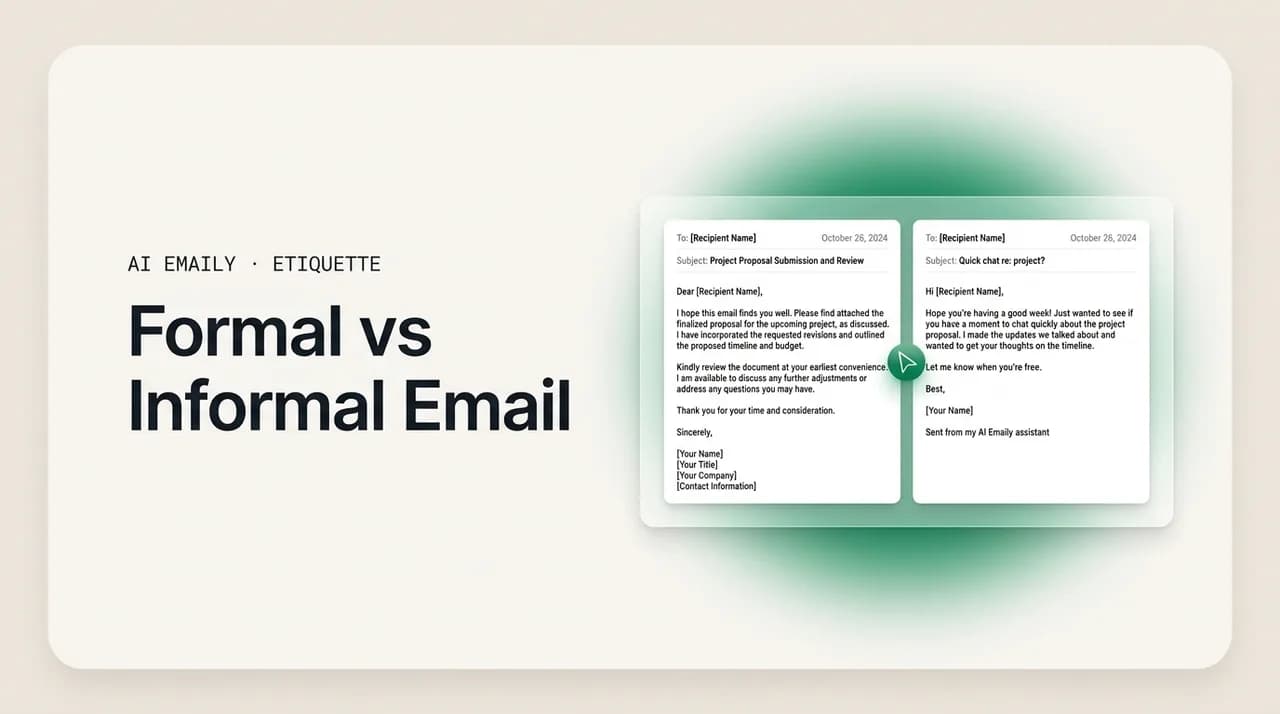
The short answer
Formal vs informal email comes down to register: formal uses full greetings, no contractions, and measured structure for strangers, clients, and executives; informal uses first names, contractions, and short lines for colleagues you know. Most work email lives in a semi-formal middle. Match the register to the relationship and the stakes, not to habit.
Formal vs informal email, decoded: how greetings, contractions, structure, and sign-offs shift between registers, when each one fits, and the semi-formal middle ground that carries most professional mail.
On this page
- 01What is the difference between a formal and an informal email?
- 02How do formal and informal emails differ element by element?
- 03What does the same message look like formal vs informal?
- 04When should you use a formal email?
- 05When is an informal email the right choice?
- 06What is the semi-formal middle ground — and why does most email live there?
- 07How do you decide which register to use in a few seconds?
- 08How does AI Emaily get the register right for each recipient?
- 09The bottom line on formal vs informal email
You open a blank email and the first decision is already waiting for you. Is this "Dear Ms. Okafor, I am writing to follow up on our conversation" or "Hi Sam, quick one"? Both are correct English. Both could be the right call. But only one fits the person on the other end, and if you pick wrong, the reader feels it before they have read a single fact — the formal email to a close teammate reads stiff and weirdly cold, and the breezy one to a new client reads like you did not take them seriously.
That decision has a name: register. Register is the level of formality you write at, and email runs on a sliding scale from buttoned-up formal to genuinely casual. The trouble is that most advice treats it as a binary — formal good, informal bad, or the reverse — when the real skill is reading where a given message sits on the scale and writing to that spot. A cover letter and a Slack-adjacent note to your desk neighbor are not two flavors of the same thing; they are different registers, and almost every part of the email changes between them.
This guide is the complete map. You will get a clear definition of what separates a formal email from an informal one, an element-by-element table showing exactly how the greeting, body, contractions, and closing shift between registers, and the same message written three ways — formal, semi-formal, and informal — so you can see the difference instead of just reading about it. We will cover when each register actually fits (clients, executives, cold outreach, colleagues, teammates), the semi-formal middle ground where most professional email genuinely lives, and a simple process for deciding in a couple of seconds rather than staring at the cursor.
We will keep it concrete and honest. No "it depends" without saying what it depends on, and a default you can fall back on when you do not want to think. Near the end we look at the part nobody mentions — that you make this register call on every single email, all day, against a steady stream of different people — and what an AI-native email client does about it so the right tone lands without you stopping to choose.
What is the difference between a formal and an informal email?#
A formal email is written for distance and respect: someone you do not know, someone senior, an official or external context, a message where the stakes are real and the relationship is either new or hierarchical. An informal email is written for closeness and ease: a colleague you talk to daily, a contact you have an easy rapport with, a thread that is already a quick back-and-forth. The difference is not politeness — both can be perfectly polite — it is the level of formality, the register, and that register shows up in almost every choice you make.
The clearest way to feel the gap is to name what actually changes. A formal email opens with a full, titled greeting ("Dear Dr. Reyes,"), avoids contractions and slang, uses complete and measured sentences, states its purpose explicitly, and closes with a formal sign-off ("Sincerely," "Best regards,"). An informal email opens with a first name or a casual hello ("Hi Sam," "Hey Jordan,"), uses contractions freely, runs shorter and looser, gets to the point fast, and closes light ("Thanks!," "Cheers,"). Same language, different dial setting.
What makes register tricky is that it is not one switch but several, and they have to agree. You cannot open "Dear Mr. Adeyemi," and then write "hey so I was thinking we could maybe just wing it" — the greeting promises one register and the body delivers another, and the reader trips on the seam. A well-pitched email keeps the greeting, the wording, the contractions, the structure, and the sign-off all at the same level. The register is a single decision expressed in many small ones, which is exactly why it is worth making on purpose.
And register is not the same as warmth, which is the confusion that sinks most people. You can be formal and warm ("It was a genuine pleasure to meet you — I look forward to working together"), and you can be informal and cold ("per my last email"). Formality controls distance and ceremony; warmth controls how friendly you sound. The best professional email is usually warm at whatever level of formality the situation calls for — formal-and-warm with a new client, casual-and-warm with a teammate. When people say a formal email "feels cold," they usually mean it lacks warmth, not that it is too formal. You can keep the formality and add the warmth back in.
The core distinction in one line
How do formal and informal emails differ element by element?#
Register is easiest to control when you can see exactly which parts of the email move. Almost every difference between a formal and an informal email lives in one of a handful of elements — the greeting, the opening line, the body language, contractions, the level of detail, and the sign-off. Change those and you change the register; leave one mismatched and the whole email reads off.
Here is the element-by-element breakdown. Read it as a dial, not a wall: most real email sits somewhere between these two columns (that is the semi-formal middle we cover below), but seeing the extremes side by side is the fastest way to understand which way to nudge any given message.
| Element | Formal email | Informal email |
|---|---|---|
| Greeting | Dear Mr./Ms. [Last name], or Dear [Full name], — titled and complete | Hi [First name], / Hey [First name], — first name, no title |
| Opening line | States purpose explicitly: "I am writing to…" / "I am reaching out regarding…" | Jumps in or chats: "Quick one —" / "Hope you're well!" |
| Contractions | Avoided: do not, cannot, I would, it is | Used freely: don't, can't, I'd, it's |
| Sentence style | Complete, measured, fuller sentences; precise word choice | Short, loose, conversational; sentence fragments are fine |
| Vocabulary | Standard, neutral, no slang: "Could you please…" / "I would appreciate…" | Everyday, casual: "Can you…" / "Mind sending…" / mild slang okay |
| Detail & structure | Context, background, explicit framing; little assumed | Minimal context; assumes shared knowledge; gets to the ask fast |
| Emoji & exclamation | None or very sparing; one exclamation at most | Natural in moderation: a "!" or a 🙂 reads as friendly |
| Sign-off | Sincerely · Best regards · Kind regards | Best · Thanks! · Cheers · Talk soon |
| Signature | Full name, title, company, contact block | First name, or a light one-line signature |
Two of these elements do more work than the rest, so they are worth fixing first. Contractions are the single fastest tell. "Do not hesitate to reach out" reads formal; "don't hesitate to reach out" reads friendly — same words, one apostrophe of difference, and the register shifts immediately. If you want to dial an email up or down a notch without rewriting it, start by expanding or contracting. The greeting is the other lever: "Dear Ms. Okafor," and "Hi Priya," set the reader's expectation for everything that follows, so getting the greeting right is half the battle of getting the register right.
Notice what does not change between the columns: clarity, correctness, and courtesy. A formal email is not a more confusing email, and an informal one is not a sloppy one. Both should be easy to read, free of errors, and respectful of the reader's time. Register controls the costume, not the substance — the same clear ask, the same accurate facts, the same basic politeness should survive at every level of formality. If lowering the formality also lowered your standards, you went too far.
The one-notch nudge
What does the same message look like formal vs informal?#
The fastest way to internalize register is to see one message written at different levels. Below is the same request — asking a recipient to review a document before a deadline — written formal, semi-formal, and informal. The facts are identical. Only the register moves: watch the greeting, the contractions, the amount of framing, and the sign-off shift together as one decision.
Read all three and the pattern is obvious. The formal version explains itself fully and keeps its distance; the informal version assumes you already know the context and trusts the relationship to carry the brevity; the semi-formal version — which is what most of your real email should look like — is warm and clear without ceremony. None is "better" in the abstract. Each is right for a different reader.
Here is a second pair to make the contrast sharper, because the register also has to fit the situation, not just the relationship. This time the message is a thank-you after someone helped you — once to a senior external contact who did you a favor, once to a teammate who covered a task. Same gratitude, very different register, and both land correctly because each fits its reader.
The formal thank-you carries weight and ceremony appropriate to a senior contact you do not know well; reaching for the casual version there would read as under-valuing the favor. The casual thank-you fits a peer you trade help with constantly; the formal version there would read as oddly stiff, almost as if you were creating distance after they did something nice. The lesson repeats: the register is right when it matches both who you are writing to and what the email is doing.
Why the facts staying the same matters
When should you use a formal email?#
Reach for a formal register when the relationship is new, distant, or hierarchical, or when the stakes are high enough that you want the email to signal seriousness. The reader does not know you yet (or knows you only as a name and a title), and formality is how you show respect and care before any rapport exists. When in doubt about a first contact, formal is the safer error — it is far easier to relax from formal to friendly than to recover after being too casual with the wrong person.
The clearest cases are straightforward to name. Cover letters and job applications are formal by convention — "Dear Hiring Manager," full sentences, "Sincerely." First contact with a client, customer, or any external party you have not built a relationship with is formal until they set a warmer tone. Messages to senior leaders you do not know well — a VP two levels up, a board member, an investor — lean formal out of respect for the distance. Anything official, legal, financial, or on the record (a formal complaint, a contract question, a notice, a regulatory matter) should be formal because the register itself signals that you are treating it with appropriate gravity. And writing across cultures where formality norms run higher than your own — much of East Asia, the Middle East, German business email — calls for stepping up by default.
The trap with formal email is letting formal slide into cold or stilted. Formal does not mean robotic, and it does not mean burying your meaning under "Please be advised that pursuant to our prior correspondence…" A formal email can and should be warm and clear: complete sentences and a titled greeting, yes, but also a genuine human tone and a plainly stated purpose. "Dear Ms. Okafor, thank you for meeting with me yesterday — I enjoyed the conversation and wanted to follow up on the timeline we discussed" is fully formal and entirely warm. Keep the formality; lose the stiffness.
A practical caution on the other side: do not stay formal once the relationship has clearly warmed up. If you have traded five friendly emails with a client and they have moved to "Hi Daniel — sounds great!," continuing to answer "Dear Mr. Cho, I am writing to confirm…" reads as a cold step backward, almost as if you are re-introducing distance they had removed. Formality is a starting position you relax as you go, not a uniform you keep wearing after the situation has changed. Mirror the warmth the other person offers, a half-step behind, and you will land in the right place.
There is also a within-company version of this. Formal is not only for outsiders — a first email to a senior leader you have never interacted with warrants more formality even if you share an employer. But routine internal email among people who work together does not need it, and over-formalizing your own teammates can read as oddly distant or even passive-aggressive. The variable is relationship and stakes, not org-chart proximity. A measured, formal note to your skip-level on a sensitive topic is right; the same register on a quick question to your desk neighbor is not.
Formal first, then mirror
When is an informal email the right choice?#
Use an informal register when there is real, established familiarity and the stakes are everyday. The reader is a colleague you message constantly, a contact you have an easy rapport with, a teammate on an active thread — someone for whom full ceremony would read as stiff and a little strange, like wearing a suit to a coffee chat you have every week. Informal email keeps things human and fast, which is exactly what these relationships want: less framing, quicker asks, a warmer and lighter tone.
The strong cases are easy to spot. Internal email among teammates and peers you work with regularly is informal by default at most companies — "Hi Sam," or "Hey Jordan," contractions, a quick ask, "Thanks!" Active back-and-forth threads naturally drop formality as they go; by the fourth reply, re-opening with "Dear" each time would be odd. People you have built genuine rapport with — a client you have worked with for a year, a vendor you talk to weekly — have earned a casual register even though they started external. And short, low-stakes logistics ("Running five late" / "Got it, thanks") barely need a register at all; a quick line is friendlier than a formal paragraph.
The thing informal email is not is sloppy. Casual register does not license typos, missing context the reader actually needs, no greeting at all, or a tone so clipped it reads as rude. "per my last email" and a one-word "No." are informal and cold — the worst combination. Keep informal email warm: a quick hello, a clear ask, basic courtesy, your name. The goal is friendly-and-efficient, not careless. If dropping the formality also dropped the warmth or the clarity, you went too far in the wrong direction.
Informal is not the same as careless
One specific case deserves its own warning, because people get it wrong constantly: cold outreach. A cold email — to a prospect, a hiring manager, someone you found on LinkedIn — feels like it wants to be casual and friendly to seem approachable, and so people open with "Hey!" and breezy familiarity. But there is no relationship yet, which means there is no rapport to justify the casual register, and the over-familiar opener reads as presumptuous to a stranger. Cold outreach belongs in the semi-formal band: warm and human, but with a real greeting ("Hi [Name],"), clean sentences, and a respectful, specific ask. Friendly, not familiar — that is the line. Faking closeness you have not earned is the fastest way to get a cold email ignored.
Cold outreach is semi-formal, not casual
What is the semi-formal middle ground — and why does most email live there?#
If you read the two extremes above and thought "most of my email is neither," you are exactly right. The pure-formal cover letter and the pure-casual one-liner to a work friend are the edges. The overwhelming majority of professional email lives in a third register that does not get a fair name in most advice: semi-formal — professional and friendly at the same time. It is the default mode of modern work, and knowing it is a real, distinct register (not a wishy-washy compromise) is what stops you from mis-pitching toward stiff or sloppy.
Semi-formal keeps the parts of formality that signal respect and competence — a proper greeting, clear and complete sentences, correct spelling, a real sign-off — while dropping the ceremony that creates distance. It opens "Hi [First name]," not "Dear Mr. [Last name]," uses contractions because that is how people actually talk, gets to the point without a paragraph of throat-clearing, and closes "Best regards," "Best," or "Thanks." It is warm without being familiar and polished without being stiff. Think of it as business-casual for writing: you are dressed appropriately for work, just not in a tuxedo.
The reason it dominates is simple: most of your email is to people you have some relationship with, about things that matter but are not high-ceremony — a colleague in another department, a client you know reasonably well, a recruiter mid-process, a peer at a partner company. None of those want full formality (it reads cold and slow), and none want full informality (it reads careless or too familiar). Semi-formal is the register built for exactly that vast middle, which is why, if you learn only one register well, this is the one to master. It is also the safest place to land when you genuinely cannot read how formal a situation is — it offends almost no one in either direction.
| Element | Semi-formal (the everyday default) |
|---|---|
| Greeting | Hi [First name], / Hello [First name], |
| Opening | Brief and warm, then straight to the point — "Hope you're well — quick question about…" |
| Contractions | Used naturally — it's, you're, we'll |
| Sentences | Clear and complete, but conversational; short paragraphs |
| Tone | Friendly and respectful; warm without being familiar |
| Sign-off | Best regards · Best · Thanks · Kind regards |
| Signature | First name, or a clean one- or two-line signature block |
A useful way to hold all three registers at once is as a single dial with three labeled stops. Formal at one end (Dear + Last name, no contractions, Sincerely) for strangers, seniors, and the record. Semi-formal in the broad middle (Hi + First name, contractions, Best) for the everyday majority. Informal at the other end (Hey + First name, loose and quick, Cheers) for the people and moments that have earned it. Most of your day should sit at the middle stop, sliding up toward formal for new or high-stakes contacts and down toward informal for close colleagues and quick logistics. You are not choosing between two boxes; you are turning one dial to the spot the relationship asks for.
| Register | Greeting → sign-off | Who it is for |
|---|---|---|
| Formal | Dear Dr. Reyes, … Sincerely / Best regards | Strangers, seniors, clients (first contact), official/legal, cross-culture |
| Semi-formal | Hi Priya, … Best regards / Best / Thanks | The everyday majority — known contacts, mid-process, cross-team, cold outreach |
| Informal | Hey Sam, … Cheers / Thanks! / Talk soon | Teammates, peers, earned rapport, active threads, quick logistics |
When you genuinely cannot tell
How do you decide which register to use in a few seconds?#
You do not have time to deliberate over every email, and you do not need to. Register is a fast read once you know the three questions that actually determine it. Run them in order, and the right level falls out in a couple of seconds.
First: do I know this person, and how well? A stranger or first contact pushes toward formal; a regular colleague pushes toward informal; everyone in between lands semi-formal. Second: what is the power distance and the context? A senior leader, an external party, or an official/legal matter pulls the register up regardless of familiarity; a peer on a routine task keeps it relaxed. Third: what is at stake? A high-stakes, on-the-record, or sensitive message wants more formality even with someone you know; a quick logistical note wants less even with someone you do not. Reading those three together — relationship, power, stakes — points you at formal, semi-formal, or informal almost instantly.
Two more checks sharpen the result. If this is a reply, mirror the sender's register a half-step behind — they have already told you where the relationship sits, so match it (relax slightly if they are clearly relaxed, hold steady if they are formal). And when the three questions leave you genuinely on the fence, round up, not down: pick the slightly more formal option, because being a touch too polite is recoverable and being too casual with the wrong person is not. Here is the decision as a short sequence.
- 1
Read the relationship
Stranger or first contact → lean formal. Regular colleague → lean informal. Anyone in between → semi-formal. This is the single biggest factor.
- 2
Weigh power and context
A senior leader, external party, or official/legal/financial matter pulls the register up — even if you know the person. A peer on a routine task keeps it relaxed.
- 3
Check the stakes
High-stakes, on-the-record, or sensitive → more formal. Quick logistics or low-stakes → more casual. Stakes can override familiarity in either direction.
- 4
If it's a reply, mirror
The sender has shown you where the relationship sits. Match their register a half-step behind — relax if they're clearly relaxed, hold if they're formal.
- 5
On the fence? Round up
When you genuinely can't tell, pick the slightly more formal option. Too polite is recoverable; too casual with the wrong person is not.
The read-it-aloud test
One consistency rule ties the whole decision together and catches most mistakes: once you have picked a register, carry it through every part of the email. The greeting, the body, the contractions, and the sign-off all need to sit at the same level — "Dear Dr. Adeyemi" with "Cheers!" is the classic mismatch, and readers feel it even when they cannot name it. The fastest self-check is to read your greeting and your sign-off back to back, ignoring the middle: if they sound like two different people, the email is mismatched, and you adjust one until they agree. Pick the register once, then make every small choice serve it.
The bookend check
How does AI Emaily get the register right for each recipient?#
Here is the part nobody talks about. None of this is hard once — the hard part is doing it on every email, all day, against a constantly shifting cast. Strangers, teammates, a new client, your skip-level, a long-standing vendor, a cold prospect — they all land in the same inbox, each needing a different register, and you are making the formal-or-not call dozens of times a day, mostly on autopilot. That is exactly where the breezy "Hey!" slips onto a first email to a client, where a stiff "Dear" gets re-typed to a teammate you message hourly, and where the greeting ends up one register and the sign-off another.
AI Emaily is an AI-native email client built to take that decision off your plate. It learns your writing voice from the emails you have actually sent — how formal you run with different kinds of people, your real defaults, the warmth you bring — and when it drafts a reply, it matches the register to the specific person you are writing to. A first email to a new client comes back semi-formal and respectful; a reply to a teammate you message daily comes back in the lighter, contraction-friendly register you would have used anyway; an on-the-record note to a senior leader comes back appropriately formal. The whole email arrives consistent — greeting, body, contractions, and sign-off all at one level — so you are reviewing and sending, not staring at the cursor deciding how formal to be.
It also helps where register most often slips. Because it mirrors the thread, a reply lands a half-step behind the sender's tone instead of re-opening cold every time, and it keeps your greeting and sign-off matched so you do not pair "Dear" with "Cheers." It works across every email account you connect — Gmail, Outlook, and any IMAP provider — in one place, so the voice and the register are the same wherever you write. And it is private by design: your mail is yours, used to draft for you, not to train models for anyone else.
You stay in control the whole time. In its default Copilot mode, AI Emaily drafts the reply at the right register and waits — nothing sends until you approve it, so you can nudge it more formal or more casual before it goes. You can start free at app.aiemaily.com/signup: the Free plan is $0 and connects your inbox with AI drafting, and Pro is $12.42/month billed annually when you want it across everything you send. The point is not that a machine decides how formal you are — it is that the right register lands without you stopping to choose it, on every email, with you keeping the final say.
Try it on your own inbox
The bottom line on formal vs informal email#
Formal vs informal is not a binary you guess at — it is a register you set, a dial you turn to the spot the relationship and the stakes call for. Formal signals distance and respect: full titled greetings, no contractions, measured sentences, a formal close — for strangers, senior or unknown readers, official matters, and cross-cultural writing where formality runs high. Informal signals closeness and ease: first names, contractions, short and quick, a light close — for teammates, peers, and contacts who have earned it. Both can be warm; neither should be careless.
The register lives in a handful of elements — the greeting, the contractions, the structure, the sign-off — and the trick is to move them together so the whole email reads as one consistent voice. Decide with three fast questions: how well do I know this person, what is the power and context, and what is at stake? Mirror a reply a half-step behind the sender, and when you genuinely cannot tell, round up to the slightly more formal option, because too polite is recoverable and too casual is not. And remember the register most of your email actually wants: semi-formal — "Hi [Name]," clear and friendly, "Best regards" — the professional-and-warm middle that fits the vast majority of work.
Get that right consistently and the opening decision stops being a thing you stall on. If you would rather not make the call on every message, that is exactly what AI Emaily handles — matching the register to your voice and to each recipient, keeping the greeting and sign-off in step, so the right level lands automatically while you keep final say. Either way, the principle holds: pitch the email to the person and the moment, carry that register all the way through, and you will sound, every time, like someone who read the room.
Frequently asked
See it in AI Emaily
Keep reading
Sources

Written by
Nafiul HasanNafiul Hasan is an entrepreneur and AI automation system builder with 10+ years of experience turning messy, manual workflows into reliable automated systems. He designs and ships AI enterprise solutions end-to-end — the agent logic, the data plumbing, and the product people actually use — and founded AI Emaily to give busy professionals their attention back. He writes here from the builder's seat: what works, what breaks, and how to put AI to work without giving up control.