Spark vs Shortwave for Small Teams: Shared Drafts and Cost

The short answer
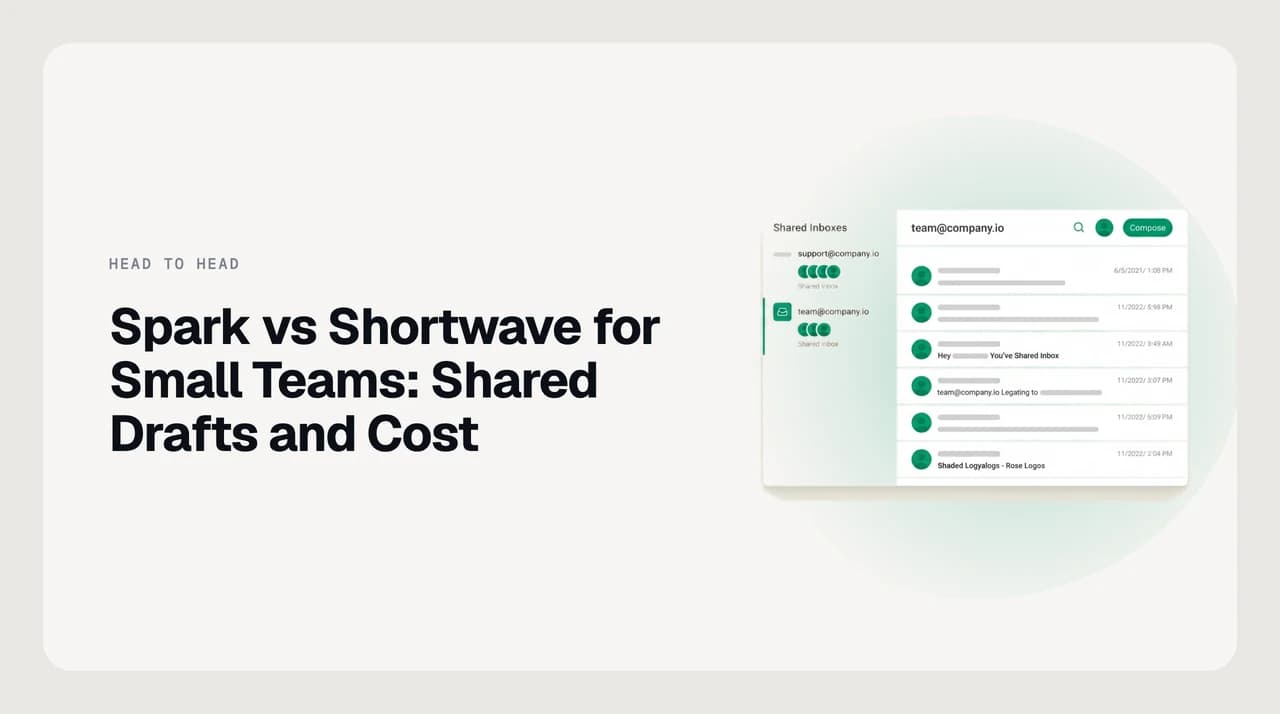
For shared email features specifically, Spark is better. Spark ships real-time shared drafts, team comments, shared inboxes, assignments and shared templates across Gmail, Outlook, iCloud and IMAP. Shortwave shares live threads, comments, assignees and labels, but only on Gmail. Shortwave wins on AI; Spark wins on collaboration and provider coverage.
Spark vs Shortwave for small teams: Spark wins shared drafts and provider coverage, Shortwave wins AI. Which one fits your team, and when both run out.
On this page
- 01The verdict: Spark for shared email, Shortwave for AI
- 02Spark vs Shortwave at a glance
- 03Where Spark wins for small teams
- 04Where Shortwave wins
- 05The axis most comparisons skip: where the collaboration sits
- 06Pricing model: verify the current plans on each vendor's page
- 07Who each one is genuinely for
- 08When do you outgrow Spark or Shortwave for team email?
- 09A third option, honestly
If you are choosing between Spark vs Shortwave for small teams, the split is cleaner than most comparison pages admit. Spark is a mail client that added collaboration. Shortwave is a mail client that added AI. Both added the other thing later, and it shows.
That matters because a three-to-eight-person team asking this question usually wants one specific capability: two people on one draft before it goes out, and a private place to argue about it. That is a collaboration question, not an AI question. Score the two apps on it and one of them wins clearly.
This page compares what each vendor names on its own site as of September 2026, on the dimensions a small team actually feels in week one: shared drafts, thread comments, assignment, which mailboxes each supports, and the shape of the bill.
The verdict: Spark for shared email, Shortwave for AI#
For shared email features, Spark wins. Its teams page names shared drafts as a first-class feature — invite a teammate into a draft and compose it together in real time — alongside team comments, shared inboxes, assignment and shared templates. Shortwave's own site names shared threads, private comments, assignees, shared labels and shared templates. Sharing a live thread is not the same thing as co-writing a draft, and Shortwave does not claim it is.
For AI, Shortwave wins, and it is not close. Shortwave ships AI search across a team's mail, plain-English AI filters, autocomplete grounded in real links and facts, summaries, meeting scheduling and a memory layer you can steer with custom instructions. Spark ships an AI writing assistant, thread summaries, search-and-act and translation. Those are useful. They are a smaller surface.
So the honest answer depends on which of those two you will notice more often:
- Pick Spark if two or more people regularly touch the same outbound email before it sends, or if your team is not all on Gmail.
- Pick Shortwave if everyone is on Gmail and the daily pain is finding, triaging and drafting fast rather than co-writing.
- Pick neither if you need routing rules, SLAs, CSAT or a customer-facing support queue — both are mail clients with collaboration bolted on.
Spark vs Shortwave at a glance#
Everything in this table is drawn from each vendor's own live pages in September 2026. Feature sets in this category move quarterly, so treat it as a starting point and confirm on the vendor page before you buy.
| Dimension | Spark | Shortwave |
|---|---|---|
| Real-time shared drafts | Yes — named feature, invite teammates into a draft | Not named; it shares live threads instead |
| Private comments on a thread | Yes, with attachments inside comments | Yes |
| Assign an email to a teammate | Yes | Yes |
| Shared inbox | Yes | Shared labels and channels |
| Shared templates / snippets | Yes | Yes, including saved AI prompts |
| Mail providers | Gmail, Outlook/Microsoft 365, iCloud, Yahoo, Exchange (EWS), IMAP | Gmail and Google Workspace only, per its own site |
| AI depth | Writing assistant, summaries, search-and-act, translation | AI search over team mail, plain-English filters, autocomplete, scheduling, memory |
| Packaging shape | Free tier plus per-seat paid tiers, with a short in-app trial on paid | Per-seat paid tiers with a time-limited trial, no permanent free plan |
| Best for | Mixed-provider teams who co-write email | All-Gmail teams who want the strongest AI in a mail client |
Where Spark wins for small teams#
The shared draft is the whole argument. Spark's teams page describes inviting teammates to compose a draft together in real time — the document-style model, applied to an email that has not been sent yet. For a small team, this is the difference between one artifact and four: no more pasting a draft into Slack, collecting three sets of edits, and re-pasting the merged version.
Comments are the second half of it. Spark's private comments live on the thread and accept attachments, so the context that explains a reply sits next to the reply instead of in a different app. That is a small thing that compounds — a new hire reading the thread six weeks later sees why it was written that way.
Provider coverage is the underrated win. Spark connects Gmail, Outlook and Microsoft 365, iCloud, Yahoo, Exchange over EWS, and standard IMAP accounts. A five-person team where the founder is on iCloud, sales is on Google Workspace and the contractor is on a custom IMAP domain can all be in the same tool. Note that Spark does not support POP3 or Exchange ActiveSync, so a legacy mailbox on either of those is out.
- Shared drafts: named, real-time, and the reason most teams land on Spark.
- Private comments with attachments, on the thread rather than in chat.
- Assignment and delegation with deadlines and progress tracking.
- Broad provider support, which decides the question for mixed teams before any feature does.
Check the tier, not just the feature list
Where Shortwave wins#
Shortwave's AI is better than Spark's, by a wide margin, and any page that does not say so is not worth reading. Its site describes AI-powered search that can analyze an entire team's email, custom filters you write in plain English rather than as rule conditions, autocomplete that pulls real links and facts into a draft, summaries at the top of threads, and an assistant that checks availability and creates calendar events.
The team-mail search is the piece a small team feels most. Searching across the team's mail — not just your own — turns the shared archive into something you can ask questions of, which is a genuinely different capability from filing mail into shared labels and hoping someone remembers the label.
Its collaboration layer is real, just differently shaped. Shared threads update live for everyone on them, comments are private to the team, assignees make ownership explicit, and shared labels give you a searchable team archive. Shared templates carry saved prompts as well as snippets, which matters if your team is actually going to use the AI.
Where it loses is scope. Shortwave's own site references Gmail. If one person on your team is on Outlook or a custom IMAP domain, that person is not coming with you, and no feature comparison after that point matters.
- Strongest AI surface of the two: search over team mail, plain-English filters, autocomplete, scheduling, steerable memory.
- Live shared threads, private comments, assignees, shared labels and channels.
- Shared templates that include saved AI prompts, not just text snippets.
- Gmail and Google Workspace only — a hard gate for mixed-provider teams.
The axis most comparisons skip: where the collaboration sits#
Most Spark vs Shortwave pages list both feature sets and call it even, because both apps do have comments and both apps do have assignment. The distinction that actually predicts which one a team keeps is where in the workflow the collaboration happens.
Spark collaborates before the send. The shared draft is the unit, so the value lands on outbound email — a pricing reply, a customer apology, an investor update that three people have opinions about. If your team's friction is that outbound email is slow because approval happens in Slack, that is the shape you need.
Shortwave collaborates around the thread. The shared thread, the assignee and the shared label are all about coordinating who handles what and finding it again later. If your team's friction is that things get dropped or that nobody can find last quarter's contract discussion, that is the shape you need.
Teams that misdiagnose this buy the wrong one and conclude that team email tools do not work. They work — the two products just solve different halves of the same day.
Pricing model: verify the current plans on each vendor's page#
We do not print competitor prices here, because both vendors have repackaged inside the last year and a number quoted on a third-party page is evidence of what was once true somewhere, not what you will be charged. What is stable enough to plan around is the shape of the bill.
Spark, as of September 2026, publishes a permanent free tier plus per-seat paid tiers and an enterprise option, with a short free trial available on the paid tiers when you subscribe in the app. The free tier is genuinely usable for a very small team, but it caps active collaborators and assignments and does not include shared drafts.
Shortwave, on its own pricing page as of September 2026, publishes per-seat tiers with a 14-day free trial and no permanent free plan. Reviews and roundups still describe a Shortwave free tier; the vendor's current pricing page does not. Its tiers separate on AI intelligence level, usage quotas and search capability rather than on team features — team collaboration is present across the paid tiers.
| What you are buying | Spark | Shortwave |
|---|---|---|
| Permanent free option | Yes, with collaboration caps | No, per its current pricing page |
| Trial on paid plans | Short in-app free trial | 14-day free trial |
| Billing unit | Per seat | Per seat |
| What separates the tiers | Collaboration features, collaborator count, read statuses | AI capability, usage quotas, search and filter limits |
Confirm both on the vendor's own pricing page
Who each one is genuinely for#
Spark is for the mixed-provider team that co-writes. Agencies, consultancies, small sales teams, founder-plus-EA pairs — anywhere more than one person's name is effectively on an outbound email. The provider breadth also means nobody has to migrate their mailbox to join the tool, which is usually the real blocker in a small company.
Shortwave is for the all-Gmail team that wants leverage rather than consensus. Startups where everyone is on Google Workspace, and the daily problem is volume: too much mail, not enough recall, drafts that take too long to start. Its AI is the strongest of the two by a clear margin and its collaboration is sufficient for coordinating work, just not for co-writing it.
If your team is split on this, the deciding question is not which app is better. It is whether your bottleneck happens before the send or after it.

When do you outgrow Spark or Shortwave for team email?#
Both are mail clients with collaboration features, not shared-inbox platforms. That distinction is invisible at four people and painful at fifteen. Here is what it looks like when you have crossed the line.
You have outgrown both when you need routing rules that assign mail by content rather than by a person clicking assign, when you need SLA timers and a queue view a manager can report on, when you need CSAT or response-time analytics, or when you need customers to be able to reply into a persistent conversation that survives staff turnover.
At that point the category you want is a shared-inbox platform — Front, Missive, Hiver, Help Scout and their peers — and the trade is real: you gain routing, reporting and workflow, and you lose the feel of a fast personal mail client. Most teams make that move somewhere between ten and twenty-five people, or earlier if the mail is customer-facing rather than internal.
- You need automatic routing, not manual assignment.
- You need SLAs, queue reporting or CSAT.
- Multiple people are answering the same external address all day, every day.
- You need audit and handover that survives someone leaving.
A third option, honestly#
We build AI Emaily, so treat this section as what it is: the vendor speaking. It belongs here anyway, because a real slice of the teams reading this page are asking the wrong question. If two people co-write one email a week but every person on the team spends an hour a day on triage and replies, the collaboration comparison above is not where your time is going.
AI Emaily is an AI-native client with an agent that triages, drafts and closes loops across Gmail, Outlook and IMAP, with approve-before-send as the default, undo on agent actions, and an audit log of everything the agent did. Voice matching comes from a Personal Context brain and per-client profiles you set yourself, not from mining your sent mail, and we do not train on user mail.
Where we lose to both apps on this page: we do not ship real-time shared drafts the way Spark does, and Spark's collaboration layer is more mature than ours. If co-writing is your actual requirement, Spark is the better buy and we would rather say so here than have you find out in week two. Our team story is a shared inbox and delegation, not a co-editing surface.
On packaging: AI Emaily has no permanent free tier. There is a 7-day free trial on Pro and Autopilot, card required, and $0 if you cancel before day seven. Team seats are priced separately — see our pricing page for the current shape.
Test it against your real bottleneck
Frequently asked
See it in AI Emaily
Keep reading

Written by
Nafiul HasanNafiul Hasan is an entrepreneur and AI automation system builder with 10+ years of experience turning messy, manual workflows into reliable automated systems. He designs and ships AI enterprise solutions end-to-end — the agent logic, the data plumbing, and the product people actually use — and founded AI Emaily to give busy professionals their attention back. He writes here from the builder's seat: what works, what breaks, and how to put AI to work without giving up control.