How to Fire an Accounting Client: Disengagement Letter, Legal Checklist & the Full Offboarding Workflow (2026)

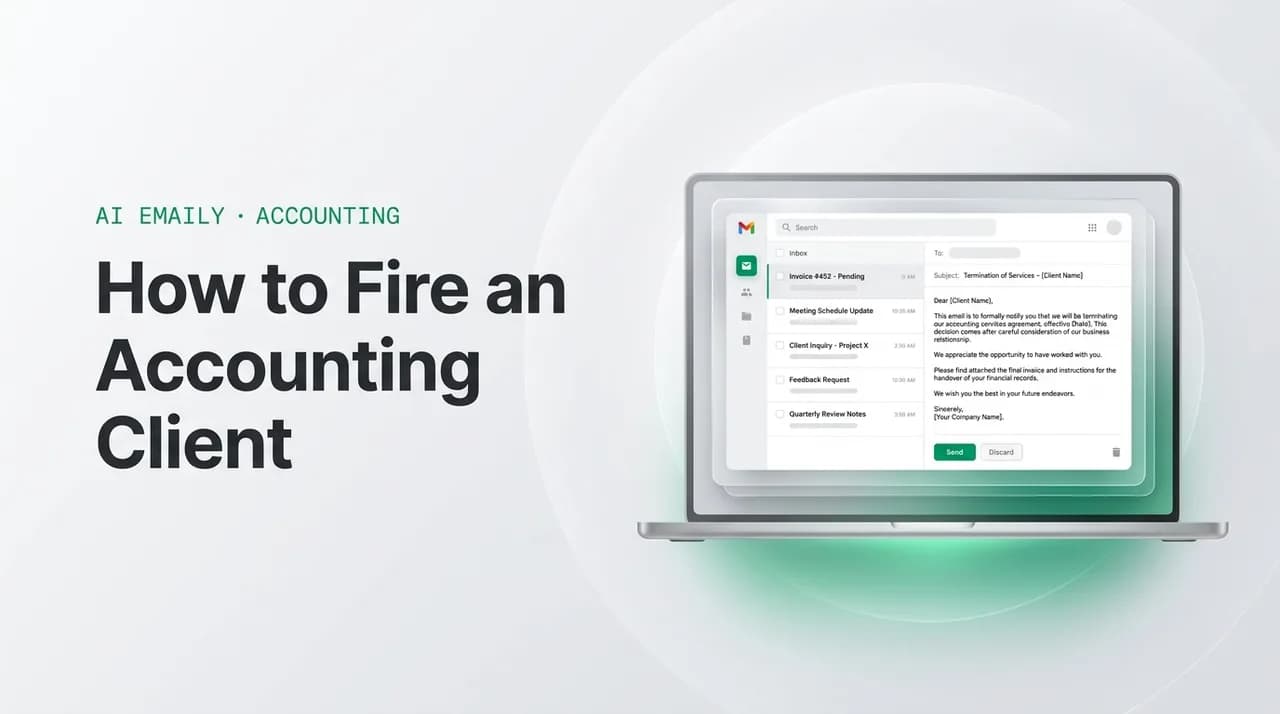
The short answer
A CPA disengagement letter should state the effective date, remaining deadlines, unbilled fees, and a recommendation to find a successor — without ever stating why you're firing the client. Send it by a method that confirms delivery, never enclose original records, and document everything internally. Time it outside filing deadlines when possible, and follow up in writing if the client goes quiet.
A client disengagement letter accountant template, plus the legal checklist and full offboarding workflow for firing a tax or bookkeeping client without creating liability.
On this page
- 01Why does firing a client the wrong way create real liability?
- 02What should a CPA disengagement letter actually include?
- 03What's the legal checklist before you send a disengagement letter?
- 04Should you ever explain why you're firing a client?
- 05Disengagement, termination, and resignation: what's the actual difference?
- 06How do you handle client records and unbilled fees when you disengage?
- 07What if the client pushes back or threatens legal action?
- 08What mistakes do firms most often make when disengaging a client?
- 09What does the full offboarding workflow look like after the letter goes out?
- 10When is the right time of year to disengage a client?
- 11What if the client never responds to the disengagement letter?
- 12Should you recommend a successor accountant?
- 13How does AI Emaily help with client disengagement and offboarding?
A client disengagement letter is the single document that protects an accounting firm when a client relationship ends — and it is also the document most firms get wrong, either by skipping it entirely or by writing one that creates more liability than it prevents. If you're searching for how to fire an accounting client the right way, the short version is this: put the termination in writing, state an effective date, list what's still owed on both sides, recommend the client find a successor, and say nothing about why. That last part trips up more CPAs and bookkeepers than any other line in the letter, because the instinct to explain yourself is strong and it is almost always the wrong instinct.
This guide is the long version — the one that doesn't exist as a single indexable page anywhere else. The AICPA publishes a sample disengagement letter behind a member login, a handful of malpractice insurers like CAMICO write short blog posts about the dos and don'ts, and every practice-management vendor has a thin template page. None of them walk through the full picture: what the letter must and must never contain, the legal checklist to run before you send it, how records and unbilled work get handled, what the actual week-by-week offboarding workflow looks like, and when in the year you should — and shouldn't — pull the trigger.
That gap matters more than it looks like it should, because firing a client is one of the moments where a normally careful, buttoned-up accountant is most likely to improvise. You've usually reached the decision after months of frustration — a client who won't send documents, argues every invoice, missed three deadlines that became your problem, or crossed a line on something you suspect isn't fully legitimate. By the time you sit down to write the letter, you're not calm. You're tired of the relationship, and tired people write letters that say too much. This guide exists to slow that moment down long enough to get the mechanics right, because the letter you send in anger is the letter a lawyer will read back to you in a deposition.
Why does firing a client the wrong way create real liability?#
Most accountants assume the risk in ending a client relationship is reputational — the client is upset, maybe leaves a bad review, tells other business owners you're difficult to work with. That risk is real but it's the smaller one. The bigger risk is legal, and it comes from three places: an ambiguous end date that leaves both sides unsure who was responsible for a missed deadline, a verbal or informal termination that the client later claims never happened, and a written explanation of your reasons that becomes evidence in a dispute the client didn't even know was coming when you sent it.
Malpractice carriers that insure accounting firms, CAMICO among them, treat the disengagement letter as a core risk-management document precisely because so many claims trace back to a fuzzy ending rather than the work itself. A client who was quietly let go without a clear letter can later argue the engagement was still active when a deadline was missed, and now the firm that thought it had walked away six months earlier is defending a missed-deadline claim on an engagement it believed was over. The letter is not a courtesy. It is the document that draws the line the rest of your defense stands on.
The second failure mode is the opposite problem: a letter that says too much. An accountant who writes "we are ending this relationship because we no longer trust the accuracy of the information you have provided us" has just handed the client, and potentially a regulator or opposing counsel in a future dispute, a written accusation with your signature on it. Even if it's true, it is rarely your job to adjudicate that in the termination letter, and doing so converts a routine business decision into a document that can be quoted back in a fraud investigation, a divorce proceeding, or a lawsuit between the client and a third party — none of which you want your firm's name attached to as a witness.
Picture the scenario that actually generates most of these claims: a bookkeeping client stops returning calls in February, three months of bank statements are missing, and the firm quietly stops working the account without ever formally saying so. Nobody sent a letter because nobody wanted the awkward conversation. Eight months later the client surfaces, furious that estimated payments were never calculated and penalties have piled up, insisting the firm was still "their accountant" the whole time. There was no termination on record, so there's no clean line to point to — just a slow fade that looks, on paper, exactly like abandonment. A disengagement letter sent the day the firm actually decided to stop would have ended that exposure in one page.
What should a CPA disengagement letter actually include?#
Strip away the legal caution and a disengagement letter is a short, structured document. It needs to accomplish six things and nothing more. Every extra sentence you add beyond these six is either unnecessary or a liability risk, so treat this as a ceiling, not a floor.
- A clear statement that the engagement is ending, in plain, unambiguous language — "this letter confirms that [Firm] will no longer be providing accounting/tax/bookkeeping services to [Client]" rather than anything that could be read as ambiguous or optional.
- The effective date of termination, stated as a specific calendar date, not "immediately" or "as soon as possible."
- Any work still in progress or any known upcoming deadline that falls near or after that date — an extension due date, a quarterly filing, an estimated payment — so there is no ambiguity about who is responsible for what happens next.
- The status of fees: what's owed for work already completed, what (if anything) is being refunded for work not completed, and how the client should proceed if they dispute the amount.
- A recommendation that the client engage a new accountant, tax preparer, or bookkeeper promptly, ideally with a note that you'll cooperate with a smooth handoff of records to whoever they choose.
- How the client can request copies of their records, and by what method and timeframe you'll provide them — a process, not the records themselves attached to the letter.
Never state the reason for termination in the letter
What's the legal checklist before you send a disengagement letter?#
Before the letter goes out, run through a short checklist. Most of this takes fifteen minutes and prevents the kind of mistake that takes months to unwind. Firms that skip this step are the ones who discover, two weeks after sending the letter, that they were still contractually obligated to finish a filing they'd already told the client they were walking away from.
- 1
Re-read the original engagement letter
Check what it says about termination — required notice period, whether either party can end the relationship for any reason, and any language about fees owed on termination. Your disengagement letter should not contradict terms you already agreed to in writing.
- 2
Confirm there's no imminent deadline you'd be abandoning
If a filing, extension, or payment is due within the next two to four weeks and you haven't completed the work, terminating now without notice can itself be the negligence claim. Either finish that one deliverable first or give the client enough runway to find a replacement before the deadline.
- 3
Calculate the final invoice before you send the letter, not after
Know exactly what's owed for completed work and whether anything is refundable for incomplete work. Sending the disengagement letter and the final invoice as two separate, uncoordinated documents days apart is where fee disputes start.
- 4
Check for any signed authorizations still in your name
IRS e-file authorizations, power of attorney (Form 2848), bank or portal access, and any online accounts you administer on the client's behalf all need to be revoked or transferred as part of the termination — not left dangling because nobody thought about them.
- 5
Decide on delivery method before you write the letter
Certified mail with return receipt, a signed acknowledgment via your client portal, or email with a read-confirmation request are all defensible. A verbal conversation with no written follow-up is not — if the relationship ever ends up disputed, "I told them in a phone call" is the weakest position you can be in.
- 6
Write down your actual reason internally, not in the letter
Keep a private file note — date, reason, any relevant incidents — for your own records and your malpractice carrier if it's ever needed. This is where the honest explanation belongs. It should never appear in anything the client receives.
Once the checklist is clear, the letter itself is short. Here is a template built around the six required elements above, written in neutral language that states the fact of termination without stating a reason. Adjust the bracketed sections to your engagement type — tax preparation, bookkeeping, or a compilation/review — and to your state's specific record-retention rules where they apply.
Should you ever explain why you're firing a client?#
Almost never in writing, and rarely even verbally beyond a brief, general statement. This is the part of the disengagement process that trips up the most accountants, because it runs against every instinct of running a service business. When you end a relationship with someone you've worked with for years, it feels rude — dishonest, even — not to say why. But the letter is not a place for honesty in that sense. It is a legal notice, and legal notices are written to minimize ambiguity and exposure, not to process feelings.
If a client calls and asks directly why you're ending the engagement, a short, general answer is far lower risk than anything specific: "we've made the decision to adjust our client roster and this wasn't the right fit going forward" covers the conversation without creating a factual claim you'd have to defend later. Compare that to "we're ending this because you didn't provide us accurate mileage logs" — which is a specific, falsifiable statement that the client could dispute, quote back to you, or use against you if the relationship ever becomes adversarial over something unrelated, like a fee dispute or a subpoena in a divorce case.
There's a real irony in why this rule matters more now than it used to: a growing number of accountants ask a general-purpose AI assistant to help draft the letter, and general-purpose models are not trained on AICPA practice-management guidance. They'll cheerfully draft a letter that includes the termination reason if you ask for one, because from a plain-language standpoint that reads as more complete and more honest. It is neither. It's a liability document generated by a system that doesn't know the professional-conduct rule it's violating.
A generic AI draft will often include the reason unless you tell it not to
Disengagement, termination, and resignation: what's the actual difference?#
The terms get used interchangeably in casual conversation, but they carry slightly different weight depending on who initiated the end of the relationship and what type of engagement it was. Getting the label right matters less for the client's understanding and more for your own file — and, if it ever comes up, for how your malpractice carrier or state board would characterize the event.
| Term | Who initiates | Typical use |
|---|---|---|
| Disengagement | The firm | Standard term for the firm ending an ongoing engagement — the one this guide focuses on. Used for tax prep, bookkeeping, advisory, and most recurring engagements. |
| Termination | Either party | Broader term, often used interchangeably with disengagement but also covers a client ending the relationship with the firm. |
| Resignation | The firm | More common language in audit and attest engagements, where professional standards (e.g., communications with a successor auditor) attach specific obligations that don't apply to compilation, review, tax, or bookkeeping work. |
| Non-renewal | The firm | A softer variant used when an engagement letter has a natural annual or seasonal end (e.g., a single tax season) and the firm simply doesn't offer a new one for the next period, rather than ending mid-engagement. |
For most accounting and bookkeeping firms, "disengagement letter" is the right term and the right document, regardless of which of these labels the situation technically fits. If your firm performs audits or reviews under attest standards, the professional-communication requirements around a change of auditor are more specific and worth a conversation with your state society or malpractice carrier before you send anything — that's a narrower, higher-stakes situation than the tax-and-bookkeeping disengagement this guide is built around.
How do you handle client records and unbilled fees when you disengage?#
Records and money are where disengagements go sideways even when the letter itself was written correctly. The client's underlying financial records — their own source documents, bank statements, and anything they gave you — are theirs, and most state boards of accountancy require you to return them within a reasonable timeframe regardless of whether fees are still owed. Withholding a client's own records as leverage over an unpaid invoice is a common instinct and, in most jurisdictions, a professional-conduct violation waiting to happen. Your firm's own work product — internal workpapers, draft memos, tax planning notes you generated — is a different category, and many engagement letters (correctly) reserve the right to withhold that until the account is settled. Know which is which before the client asks.
Unbilled fees need to be resolved cleanly and separately from the emotional weight of the termination. Calculate the final invoice before the letter goes out, not after, so the two arrive together or in quick succession rather than as a surprise follow-up that reads as an afterthought. If there's a dispute over the amount, resist the urge to relitigate the whole relationship in writing — state the amount, the basis for it, and a reasonable payment window, and let a conversation (not an email chain) handle any pushback.
| Item | Return to client promptly | Can hold until final invoice is paid |
|---|---|---|
| Client's own source documents (bank statements, receipts, invoices they provided) | Yes, in most jurisdictions | No — generally treated as the client's property regardless of unpaid fees |
| Filed tax returns and financial statements delivered to the client | Yes | No — these were already delivered as part of completed, billed work |
| Firm-generated workpapers, planning memos, internal drafts | Not required in most cases | Often yes — check your engagement letter's language on work product |
| Bookkeeping software access (QBO, Xero) set up under the firm's login | Transfer or hand off promptly | No — withholding software access to force payment is a common but risky move |
Don't enclose original records with the disengagement letter itself
What if the client pushes back or threatens legal action?#
Most disengagements end quietly, but a small share of clients respond with anger, a demand for a refund on work you consider complete, or a vague threat to "talk to a lawyer." The instinct in that moment is to over-explain — to defend the decision, list every late payment or every unreturned document request as justification. Resist it. The letter already did its job by stating the fact of termination; a heated back-and-forth in email only generates more written material that can be read out of context later.
If a client disputes the final invoice, respond once, in writing, with the basis for the amount and a reasonable window to resolve it — don't relitigate the relationship. If the language moves toward an actual legal threat rather than ordinary frustration, that's the point to loop in your malpractice carrier or firm's counsel before you respond again, not after you've already sent three more emails trying to smooth things over. Carriers like CAMICO exist specifically to help firms navigate this moment, and an early call is far cheaper than a late one.
One calm reply beats a long email chain
What mistakes do firms most often make when disengaging a client?#
The mechanics above prevent the big, obvious failure — no letter at all. These are the smaller mistakes that show up even in firms that do send one, and each is an easy, specific fix.
- Sending the letter without checking the original engagement letter's termination clause first, and contradicting terms already agreed to.
- Letting the disengagement letter and the final invoice arrive days apart, uncoordinated, so the client reads the invoice as a surprise rather than an expected part of the same process.
- Forgetting to revoke IRS e-file authorization or power of attorney, so the firm keeps receiving notices on an account it no longer manages.
- Using a delivery method with no proof of receipt, then having nothing to point to if the client later claims they were never told.
- Writing the reason for termination into the letter because it feels more honest, when a private internal note serves that purpose without the exposure.
- Leaving the client file open indefinitely instead of closing it once records are handled and the retention window has passed.
What does the full offboarding workflow look like after the letter goes out?#
The letter is one document in a longer process, and firms that treat it as the finish line are the ones who get an angry call three weeks later asking why nobody responded to a records request, or why an old e-file authorization is still active and generating IRS notices addressed to the firm. Here's the workflow start to finish.
- 1
Send the letter with a delivery-confirmation method
Certified mail, a client-portal acknowledgment, or an email with a read receipt or a required reply — something that proves the client received it on a specific date, not just that you sent it.
- 2
Log the disengagement in your practice-management system
Mark the client inactive, note the effective date, and remove them from any recurring reminder, invoicing, or automated-workflow sequence so nothing continues to fire on their account after the relationship has ended.
- 3
Revoke standing authorizations
Withdraw any IRS power of attorney or e-file authorization, remove portal and bank-feed access, and close out any third-party app connections (payroll, receipt-scanning, bank-sync tools) that were tied to the engagement.
- 4
Confirm the client acknowledged receipt
If ten business days pass with no acknowledgment through your chosen delivery method, send one written follow-up confirming the letter was sent and restating the effective date — don't assume silence means agreement, and don't let it drift into an ambiguous no-man's-land.
- 5
Fulfill any records request on the timeline you promised
If the client asks for their files, deliver them by the method and window stated in the letter. A delayed or incomplete records handoff is one of the most common sources of a formal complaint after an otherwise clean disengagement.
- 6
Close the file
Once the final invoice is settled (or written off) and records are handled, archive the client file per your firm's retention policy and close the loop internally — the engagement should have a clear, dated end in your own records, not just in the client's inbox.
That fourth step — the acknowledgment follow-up — is the one firms skip most often, usually because chasing a client you just fired feels awkward. It shouldn't. A short, neutral follow-up when the client goes quiet protects you exactly the same way the original letter does: it closes the ambiguity gap and creates a written record that the client was informed, whether or not they ever replied.
When is the right time of year to disengage a client?#
Timing changes the risk profile of a disengagement more than almost any other factor. Firing a bookkeeping client in June, when nothing is due for months, is close to risk-free from a deadline standpoint. Firing a tax client on April 10th, five days before a filing deadline, without having filed an extension first, is a different situation entirely — even a technically correct disengagement letter can look like abandonment if it lands on top of an imminent deadline the client can't realistically cover in time.
This is why most firms concentrate roster-cleaning decisions in a fairly narrow window: October through January. By mid-October, extended returns are filed and the immediate deadline pressure is off. The client still has months before the next filing season to find a replacement, which is enough runway to make the transition genuinely low-risk for them and for you. Firms that wait until February or March to decide a client isn't worth keeping are stuck choosing between finishing one more season with someone they've already decided to let go, or disengaging at the worst possible moment. Deciding early and acting in the fall is almost always the better version of the same decision.
The same logic applies at smaller scale to bookkeeping and monthly-close clients: the safest moment to disengage is right after you've closed and delivered a period, not partway through one. Ending the relationship the day after October's books go out means the client's records are current, the handoff to a new bookkeeper starts clean, and nobody is left holding half a month of unreconciled transactions. If you know in August that a client isn't going to make it to year-end, there's rarely a good reason to wait — the earlier you decide, the more of that low-risk window you get to use.
What if the client never responds to the disengagement letter?#
Silence is common and it's not a problem as long as you've documented the process correctly. Most clients who are being let go don't respond warmly, and plenty don't respond at all — they simply move on, sometimes without ever formally accepting or contesting the termination. What matters is that your side of the record is complete.
- Confirm the original letter was delivered through a method with proof — certified mail tracking, a portal read receipt, or an email delivery confirmation — even if the client never replies to it.
- Send the single written follow-up (template above) if ten business days pass with no acknowledgment, and keep a copy.
- Do not initiate any new work, send any new invoices for future periods, or answer new substantive questions about the current tax year after the effective date, even if the client emails you something that looks routine — restarting engagement, even informally, muddies the clean end you just created.
- If the client's silence coincides with an approaching deadline you flagged in the letter, resist the pull to "just take care of it" out of habit. That instinct is exactly how firms end up doing free work for a client they already terminated, with no clear engagement covering it if something goes wrong.
- Keep the file open in your own system only long enough to confirm records were requested or the retention window has passed, then archive it. An indefinitely open file for a disengaged client is a loose end, not a courtesy.
Should you recommend a successor accountant?#
Yes, and it's worth doing more than a passing mention. Recommending — even generically, without naming a specific firm — that the client find new representation promptly does two things at once. It's the professionally courteous move, especially for a client who's been with you for years and isn't leaving because they did anything wrong; plenty of disengagements happen for capacity or fit reasons that have nothing to do with the client's conduct. It's also a defensive layer: a written record that you actively pointed the client toward continuity, rather than simply cutting them loose, is exactly the kind of detail that reads well if the disengagement is ever scrutinized later.
You don't need to name a specific firm or make a formal referral if you're not comfortable with that — a neutral line stating that prompt engagement of a new preparer or bookkeeper is recommended, given the upcoming deadlines noted in the letter, satisfies the intent. If a new accountant does reach out requesting records or a professional courtesy call, cooperating promptly is both the right thing to do and, again, the version of this that looks good in hindsight no matter how the underlying relationship ended.
The one time to think twice is if you're disengaging because of something you suspect is fraudulent or materially misrepresented in the client's records. In that narrow case, a blanket recommendation to "find a new accountant promptly" is still appropriate — you're not required to say more than that — but it's worth a quick conversation with your malpractice carrier or state society before the letter goes out, since a small number of jurisdictions have specific notification obligations in that scenario that go beyond a standard disengagement. That's the exception, not the rule; the overwhelming majority of disengagements are ordinary fit-and-capacity decisions and the standard neutral letter is all that's needed.
How does AI Emaily help with client disengagement and offboarding?#
We build AI Emaily, an AI-native email client for accountants and bookkeepers who run this exact process a handful of times a year, usually in the exact window — October through January — when everything else in the practice is also busy. The disengagement letter itself is a one-time draft: AI Emaily can generate a neutral-language letter from the template pattern above, filled in with the client's name, the effective date, any known upcoming deadline pulled from your records, and the final invoice amount, so you're not starting from a blank page or copying an old letter that might carry over language that doesn't fit this client's situation.
The part that actually saves the most time is what happens after the letter is sent, which is where most firms' informal process quietly breaks down. AI Emaily can track whether the client has acknowledged the letter and, if ten business days pass with no reply, flag it and draft the follow-up confirmation — the same short, neutral message shown above — so nothing sits unresolved because everyone assumed someone else was watching for a response. It will not restart a new work thread or answer a substantive client question on your behalf once a disengagement is on file; that boundary is a rule you set, not a judgment call the system makes silently. Every draft — the original letter, the follow-up, anything client-facing — waits in Copilot for your review and explicit approval before it sends, which is the right default for a document with this much legal weight. If your firm prefers to automate the routine, low-risk parts of the sequence — the acknowledgment nudge after ten business days of silence, for instance — Autopilot can send those specific message types on its own within rules you define, always with undo and a full audit trail behind it.
None of this replaces the legal checklist or your own judgment about what a given letter should say. What it removes is the part where a busy season buries the follow-up you meant to send, or where the twelfth disengagement letter of the fall gets rushed and drops a line the first one had. You can try AI Emaily free at app.aiemaily.com/signup.
Firing a client is never the fun part of running an accounting or bookkeeping practice, but it's a routine operational task, not a confrontation, once you treat it as one. State that the engagement is ending and when. Say what's owed on both sides. Recommend the client move on to someone new. Never explain why in writing. Confirm delivery, follow up if you hear nothing, and close the file cleanly — records handled, authorizations revoked, no loose threads dangling into next season. Do that consistently and a disengagement stops being a moment of dread and becomes what it should be: a short, boring, well-documented ending to a relationship that had already run its course.
Frequently asked
See it in AI Emaily
Keep reading
Sources

Written by
Nafiul HasanNafiul Hasan is an entrepreneur and AI automation system builder with 10+ years of experience turning messy, manual workflows into reliable automated systems. He designs and ships AI enterprise solutions end-to-end — the agent logic, the data plumbing, and the product people actually use — and founded AI Emaily to give busy professionals their attention back. He writes here from the builder's seat: what works, what breaks, and how to put AI to work without giving up control.