The Real Cost of Email Distraction: What 23 Minutes per Interruption Adds Up To

The short answer
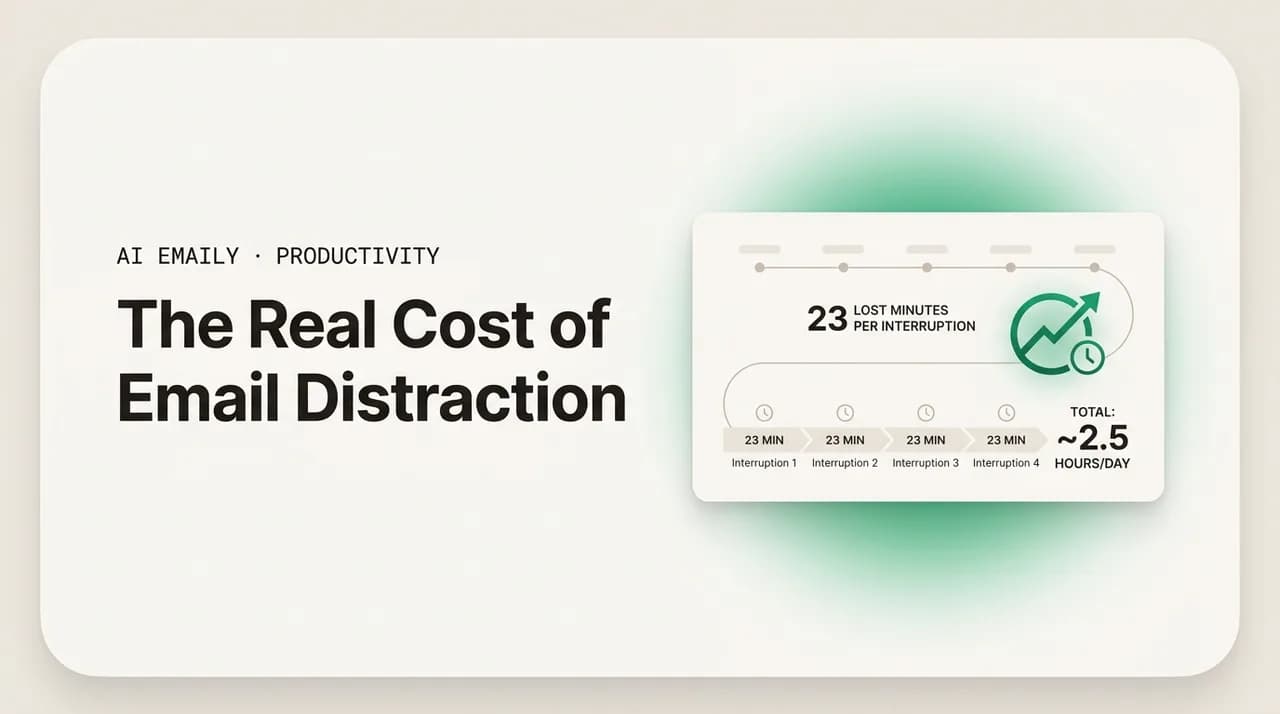
The cost of email distraction is mostly hidden: each interruption costs around 23 minutes to fully refocus, knowledge workers check email roughly every 6 minutes and lose 2–3 hours a day to the inbox, and the constant switching drains decision-making. The fix is checking less often — not reading faster.
The cost of email distraction is the refocus time after every interruption, not the minutes spent reading. Here is the real math — and how to cut the bill.
On this page
- 01What is the real cost of email distraction?
- 02Does it really take 23 minutes to refocus after an interruption?
- 03How often do people actually check email — and why does that matter?
- 04What does email distraction actually cost in hours per week?
- 05How does email distraction cause decision fatigue?
- 06What is the hidden dollar cost of email distraction?
- 07Why is checking less often the only fix that works?
- 08How does AI Emaily cut the cost of email distraction?
- 09The bottom line on the cost of email distraction
You did not lose your morning to email because you spent four hours reading messages. You probably spent forty minutes actually reading and replying. You lost the morning to the other thing — the ping that pulled you out of a document you were three paragraphs into, the glance at the badge that turned into a five-minute reply that turned into a fifteen-minute thread, the way it took you a while to find your place again afterward and you never quite got the deep part of the work back. The reading was cheap. The interruption was expensive. And the bill for the interruption never shows up on any clock, which is exactly why almost nobody adds it up.
That is the real cost of email distraction, and it is far larger than the part you can see. Most people, asked how much email costs them, answer with the visible number: the time the inbox is open and they are typing. But the research on attention is blunt about where the cost actually lives. It lives in the seconds and minutes after each interruption, when your brain is still half in the last task; it lives in the dozens of small switches a day that you never count as work; it lives in the slow erosion of the focus you need for the things that actually move your week forward. The inbox does not just take your time. It takes your attention, and attention is the more expensive resource.
This guide adds it up honestly. We will walk through the headline numbers — the often-cited 23 minutes to refocus after an interruption, the roughly six-minute gap between inbox checks, the two to three hours a day knowledge workers spend on email — and we will be careful about what each one does and does not say, because some of these figures get repeated past the point of accuracy. Then we will turn the time into money, because the dollar cost of distraction is the version that gets a manager's attention. And we will end on the part that matters most: the cost is not driven by how much email you get, it is driven by how often you check it — which is the one lever you can actually pull.
We will keep it practical and skip the hand-wringing. No claim that you should answer fewer emails or care less about your inbox; the email still matters and the people writing it still deserve a response. The argument is narrower and more useful than that: you are paying a tax you cannot see, the tax is mostly avoidable, and the way to cut it is to change the rhythm of how you check — not to work faster inside a broken rhythm. Near the end we look at what an AI-native email client does to make a slower rhythm survivable, so checking less often does not mean missing what matters.
What is the real cost of email distraction?#
Start with the distinction that the whole topic turns on, because getting it wrong is why most people underestimate email by an order of magnitude. There are two different costs hiding under the word "email," and they behave nothing alike.
The first is the visible cost: the time you spend reading, deciding, and replying. This is the cost people picture — the inbox open, the cursor in a reply, the obvious work of correspondence. It is real, it is often large (we will size it below), but it is the part you already know about and can see on a timer. If this were the only cost, email would be a straightforward time-management problem: read faster, write shorter, use templates, done.
The second is the hidden cost, and it is the one that does the damage: the cost of the interruption itself. Every time email pulls you out of focused work, you pay to leave the task and you pay again to get back into it — and the getting-back-in is slow, because attention does not snap cleanly from one thing to another. Researchers call the lag attention residue: a piece of your mind stays stuck on the previous task even after you have switched, so the new task runs on partial attention for a while. The interruption is not a clean pause-and-resume. It is a cost you pay coming and going, and you pay it on every single switch, all day, mostly without noticing.
Here is why that second cost dwarfs the first. The visible cost is roughly proportional to how much email you handle — more messages, more reading time, in a fairly linear way. The hidden cost is proportional to how often you interrupt yourself to check, which for most people is far more often than the volume of email actually requires. You can have a quiet inbox and still wreck your day by checking it every few minutes, because each check carries the refocus tax whether or not there was anything worth reading. That is the core insight of this entire guide: the cost of email distraction is driven by frequency of checking, not by quantity of mail. The rest of the article is mostly evidence for that one claim, and what to do about it.
The two costs, in one line
Does it really take 23 minutes to refocus after an interruption?#
The most-quoted number in this whole conversation is that it takes about 23 minutes to get back on task after an interruption. It comes from the work of Gloria Mark, a researcher at UC Irvine who has spent years observing how people actually work — following knowledge workers minute by minute and measuring what happens when they get pulled away. The widely-repeated figure from that research is 23 minutes and 15 seconds to return to the original task after an interruption. It is the headline that launched a thousand productivity posts, and it is worth understanding precisely, because it is both real and routinely mangled.
What the number actually describes is not 23 minutes of staring blankly before you can resume. It is the total elapsed time before you return to the interrupted task — and crucially, in Mark's observations people did not bounce straight back. After an interruption they typically worked on two or more other tasks before circling back to the one they left, so the 23 minutes is filled with other work, not idle confusion. The cost is the detour, not a frozen screen. The interruption knocks you off your intended track and you wander through several other things before finding your way back, and all of that wandering is time the original task did not get.
There is a second, subtler finding that matters more than the headline. Mark's research also found that interrupted work is often completed faster — people compensate for the interruption by working at a higher pace when they return. That sounds like good news until you read the rest: that speed comes at a cost. Interrupted people reported more stress, higher frustration, more effort, and more time pressure. So the brain does claw the time back, but it does it by running hot — and running hot all day is the mechanism behind the frazzled, drained feeling that a heavily-interrupted workday leaves you with, even when you technically got things done. You did get them done. You just paid in stress and effort for the privilege of being interrupted.
Treat the 23-minute figure as directionally true and frequently overstated. It does not mean every glance at your inbox vaporizes 23 minutes — a two-second look that finds nothing urgent and is immediately dismissed is cheaper than that. It means that a genuine interruption, the kind where you actually engage with the new thing and switch context, carries a long and underappreciated tail before you are truly back where you were. The honest reading: interruptions are far more expensive than they feel in the moment, the refocus cost is measured in many minutes rather than seconds, and the more of them you stack into a day, the less of your day is doing the work you sat down to do.
What the 23 minutes is really telling you
How often do people actually check email — and why does that matter?#
If the cost is driven by frequency, the next question is the whole ballgame: how often do people actually check? The answer, across multiple studies of knowledge workers, is sobering. The figure people quote most often from Gloria Mark's work is that workers switch tasks or check a communication tool roughly every three to six minutes — and that the average focused stretch on a screen before switching has shrunk dramatically over the years she has been measuring it, from minutes on end down to around 47 seconds in her more recent observations. Whatever the exact figure for any one person, the pattern is consistent: people check far more often than the inbound volume requires.
Other studies put concrete numbers on email specifically. Research has found knowledge workers checking email on the order of 70 to 80 times a day, with some estimates running higher — and a frequently-cited Adobe survey put self-reported time spent on email north of three hours a day for work email alone. A McKinsey analysis estimated that workers spend about 28% of the workweek reading and answering email. The exact percentages vary by study and by how they measure, but they all land in the same uncomfortable neighborhood: email is not a slice of the workday, it is a major occupant of it, and the checking behavior is compulsive rather than driven by need.
Here is the part that should change how you think about it. Most of those checks find nothing that required checking. The inbox does not fill at the rate you open it; you open it because of a habit loop — a flicker of anxiety that something might be waiting, a moment of friction in the real task, the simple availability of the tab. So the majority of checks are pure cost: you paid the switching tax to leave your work, glanced at an inbox that had nothing urgent, and paid the tax again to return, having accomplished nothing except interrupting yourself. Multiply that by 70-plus times a day and the scale of the waste becomes clear. It is not that email is so demanding. It is that we check it so compulsively, and each compulsive check is a small self-inflicted interruption.
And the checks cluster in exactly the wrong places. People check first thing in the morning, before they have done any deep work, anchoring the whole day to other people's agendas. They check between every task, so they never get more than one task deep into anything. They check during meetings, during focused work, during the small gaps that could have been recovery. The frequency is the problem, the timing makes it worse, and together they mean the average knowledge worker rarely gets a clean, uninterrupted run at anything that matters. The inbox is not stealing one big block of your day. It is taking a thousand small bites, and the bites are what bleed you.
| What gets measured | Typical finding | What it means for you |
|---|---|---|
| Time between checks / task switches | Every ~3–6 minutes; focus stretches as short as ~47 seconds | You rarely get more than a few minutes of unbroken focus |
| Email checks per day | Often 70–80+ times a day | Most checks find nothing urgent — pure switching cost |
| Time spent on email | ~2–3+ hours/day; ~28% of the workweek (McKinsey) | Email is a top occupant of the day, not a small slice |
| Refocus time per real interruption | Up to ~23 minutes to return to the task (Mark) | Each genuine switch has a long, hidden tail |
| Stress from interruption | Higher stress, frustration, effort, time pressure | You pay in mental load, not just minutes |
One honest caveat on every number in that table: these are averages and self-reports across different studies, populations, and years, and they should be read as a consistent direction rather than precise constants. Your personal figure for checks-per-day or hours-on-email could be half the average or double it. The point is not the decimal places. The point is that across wildly different methods, every credible measure of knowledge work converges on the same shape — frequent checking, short focus stretches, hours lost, and a stress cost on top. When independent studies disagree on the exact number but agree on the pattern, the pattern is the finding.
Read the studies for the pattern, not the digits
What does email distraction actually cost in hours per week?#
Let us make the abstract concrete and build the time cost from the ground up, because "a few hours a day" is easy to wave away until you total the week. We will use round, conservative numbers — deliberately lower than the headline averages, so the result is hard to argue with rather than easy to dismiss.
Start with the visible cost. Say you spend two hours a day on email — reading, deciding, replying. That is below several of the survey averages, and it is plausibly your real reading-and-writing time. Over a five-day week that is 10 hours: a full quarter of a 40-hour week, gone to the inbox before you count a single interruption. Most people would already balk at "I spend ten hours a week on email," yet that is just the part they can see.
Now add the hidden cost, conservatively. Suppose only a fraction of your daily checks are genuine interruptions that knock you off deep work — not the 70-plus total, just the real ones, say 15 a day. And suppose each one costs you not the full 23 minutes but a modest 10 minutes of degraded, refocusing, lower-quality time before you are truly back. That is 150 minutes a day — two and a half hours — of work happening at reduced capacity because of interruption, on top of the email time itself. Over a week, that is more than 12 hours of compromised focus. Even halve every assumption and you are still looking at hours upon hours a week that the inbox quietly claims through interruption alone. Here is the breakdown.
| Cost component | Conservative daily estimate | Per week (5 days) |
|---|---|---|
| Visible: reading & replying to email | 2.0 hours | 10 hours |
| Hidden: refocus tax (15 real interruptions × 10 min) | 2.5 hours | 12.5 hours |
| Total time touched by email | 4.5 hours/day | 22.5 hours/week |
| Same week, if checks doubled (frequency, not volume) | ~7+ hours/day | ~35 hours/week |
Sit with the bottom two rows, because they make the central argument visible. In a conservative scenario, email and its interruptions touch roughly 22.5 hours of a 40-hour week — more than half. And the difference between the conservative case and the bad case is not how much email arrived; it is how often you checked. Double the checking frequency and you do not double the reading time (the mail volume is the same), but you roughly double the refocus tax, because that cost is paid per interruption. The volume of mail barely moved. The cost exploded. That is the lever, in a single table: the path from a 22-hour email week to a 35-hour one runs entirely through frequency of checking, and frequency is the one thing fully in your control.
And none of this counts the cost that does not fit in a cell — the deep work that simply never happens. The strategy document you keep meaning to write, the hard problem that needs two uninterrupted hours you never assemble, the creative leap that only comes after the mind has been quiet long enough to make it. Those are not slow because email is slow. They are absent because email fragmented the day so finely that no block ever got long enough to hold them. That is the real loss, and it is the one no timer will ever show you.
Run the numbers on yourself
How does email distraction cause decision fatigue?#
Time is the cost you can measure. Decision fatigue is the cost that measures you — and for many people it is the heavier one. The idea is straightforward: making decisions consumes a finite mental resource, and the more decisions you make, the lower the quality of the ones that follow. Decisions are not free even when they are small. Each one draws down the same well, and email is a remarkably efficient way to drain that well to empty before lunch.
Look at what a single email actually demands. You read it and decide: is this urgent? Do I reply now or later? Reply, forward, archive, flag, ignore? What's the right tone? Who else needs to be on this? Is there an action hiding in here I have to remember? Should I do that thing now or add it to a list? That is half a dozen micro-decisions for one ordinary message — and you make them seventy, eighty, a hundred times a day. None of them is hard. All of them spend the same currency you need for the decisions that actually matter: the strategic call, the difficult conversation, the judgment that defines whether your day was valuable. By the time those arrive, the well is low, and so you defer them, or you make them badly, or you reach for whatever is easiest.
This is why so many people feel exhausted after a day where they cannot point to anything they accomplished. They did not do hard work. They made a thousand tiny decisions, and the cumulative draw left them as depleted as a day of genuine difficulty would have — without the genuine difficulty's payoff. The inbox is a decision-generating machine, and it generates them in a steady trickle that never lets the reservoir refill. The fatigue is real, it is cumulative, and it lands hardest on exactly the high-value choices you most needed your fresh mind for.
There is a compounding loop worth naming. A tired, depleted brain checks email more, not less — because checking is low-effort and faintly rewarding, the perfect activity for a mind too drained to start something hard. So decision fatigue drives more checking, more checking drives more micro-decisions, and more micro-decisions drive deeper fatigue. The inbox becomes both the cause of the depletion and the thing the depleted mind retreats to. Breaking that loop is less about willpower than about removing the decisions from your plate in the first place — which is precisely where the rest of this guide is headed.
The hidden tax inside every email
What is the hidden dollar cost of email distraction?#
Time and fatigue are felt by the individual. The dollar cost is what gets a budget owner's attention, and it is the version of this argument that survives a meeting. The math is uncomfortable precisely because it is so simple: take the hours lost to distraction, multiply by what an hour of that person's time is worth, multiply by the number of people. The numbers get large fast, which is the point.
Take one knowledge worker earning a fully-loaded cost of, say, $50 an hour — a modest figure for a salaried professional once you include benefits and overhead. If email distraction touches even a conservative 2.5 hours of their day in pure refocus tax and reflexive checking (set aside the legitimate reading time, which is real work), that is $125 a day, per person. Across a 230-ish-day working year, that is roughly $28,000 a year of degraded or lost productivity from one person's distraction alone. For a 50-person team, the same conservative assumptions land north of a million dollars a year. These are not exotic numbers; they fall straight out of ordinary salaries and the time figures from the studies above.
The example below works it explicitly so you can plug in your own figures. Adjust the hourly rate, adjust the hours, adjust the headcount — the structure does not change, and the result stays jarringly large across any reasonable inputs. That robustness is the real finding: you do not need the aggressive assumptions for the dollar cost to be serious. Even halving every number leaves a per-person annual cost that would never survive scrutiny if it appeared as a line item, yet it is on every team's books, invisibly, because it never gets totaled.
Two caveats keep this honest. First, lost focus does not convert one-to-one into reclaimed output — a refocused hour is not automatically a billable hour or a shipped feature, and recovered time gets partly absorbed by the normal slack of a workday. So read these figures as the scale of the leak, not a promise of exact savings. Second, some of that email time is genuine, valuable work that should not be cut at all; the target is the waste — the reflexive checks and the refocus tax on self-inflicted interruptions — not correspondence itself. With both caveats applied, the conclusion holds and even strengthens: the recoverable waste is large enough that any intervention which meaningfully reduces interruption frequency pays for itself many times over. The dollar cost of distraction is not a soft, fuzzy thing. It is a hard number hiding in plain sight on every team's payroll.
The cost is on the books whether you count it or not
Why is checking less often the only fix that works?#
Everything above points to one conclusion, and it is narrower and more actionable than the usual productivity advice. The cost of email distraction is dominated by the hidden refocus tax, the refocus tax is paid per interruption, and the number of interruptions is set by how often you check — not by how much email you get. Therefore the single most effective intervention is to reduce checking frequency. Not read faster. Not write shorter. Not declare inbox zero. Check less often, in deliberate batches, and the largest cost collapses.
Notice what this rules out. The popular advice — better folders, faster typing, snappier templates, a tidier inbox — all attacks the visible cost, the reading-and-replying time, which is the smaller and more linear of the two. You can become the world's most efficient email processor and still destroy your day by checking 80 times, because each of those checks carries the switching tax whether you process the mail in two minutes or twenty. Efficiency inside a broken rhythm is a faster way to do the wrong thing. The rhythm is the problem; speed does not fix rhythm.
Batching works because it converts many small, expensive interruptions into a few large, cheap ones. Twenty checks scattered through the morning is twenty refocus taxes. The same twenty messages handled in two dedicated windows is two switches — and inside each window you are already in "email mode," so there is no deep-work context to lose. You pay the switching cost twice instead of twenty times, and you protect long, unbroken stretches for the work that actually needs them. The arithmetic is overwhelming: fewer, longer email sessions beat constant grazing by a margin that no amount of in-session efficiency can match.
But there is an honest objection, and it is the reason most people never manage to check less. The fear is real: what if something urgent comes in during the two hours I am not looking? That fear is what drives the compulsive checking in the first place — not love of email, but anxiety about missing the one message that mattered. Telling someone to "just check less" without addressing that fear is useless advice; their nervous system will override it within a day. To actually check less, you need genuine confidence that you are not missing anything urgent while you are away. Which is exactly the problem the right tooling is built to solve, and where we turn next.
- The cost is per interruption, so fewer interruptions is the highest-leverage change you can make.
- Reading faster and tidier folders attack the small, visible cost — not the large, hidden one.
- Batching turns 20 expensive switches into 2 cheap ones and protects long focus blocks.
- Checking less only sticks if you genuinely trust you're not missing anything urgent while away.
How does AI Emaily cut the cost of email distraction?#
Here is the part nobody solves with willpower. You can resolve to check email twice a day, and you will mean it, and by Tuesday afternoon you will be back to checking every six minutes — because the fear of missing something urgent is stronger than the resolution. The only way checking less actually holds is if something trustworthy is watching the inbox for you, so that being away does not mean being blind. That is the gap AI Emaily is built to close.
AI Emaily is an AI-native email client that reads and triages your inbox continuously, so you do not have to keep opening it to find out whether anything matters. It sorts incoming mail by what actually needs you — the genuinely urgent, the things only you can answer, the noise that can wait — and surfaces just the small set that warrants a decision. The inbox stops being a slot machine you pull every few minutes hoping nothing is wrong; it becomes a quiet queue that gets your attention on your schedule, in a batch, because you already know the one truly urgent thing would have reached you. The compulsive-checking loop breaks at its source: the anxiety that something is waiting.
Instead of you opening the inbox dozens of times, AI Emaily brings you a brief — a short, scannable summary of what came in and what it means, so you absorb an hour of email in the time it used to take to triage five messages. You can have that brief delivered where you already are, including Slack or Telegram, so staying informed no longer requires sitting in the inbox at all. That is the difference between grazing and batching, made effortless: you get the signal without paying the switching tax over and over, and the long focus blocks the studies say you have lost become possible again because nothing is pulling you out of them.
It also attacks the decision fatigue directly. Because AI Emaily learns your patterns, its rules brain can handle the routine micro-decisions — the sorting, the filing, the obvious yes-and-no calls — so they never reach your depleted decision budget at all. When a reply is needed, it drafts one in your voice for the messages that warrant it, turning a cluster of decide-and-compose decisions into a single review-and-approve. The hundred tiny choices a day that drain you get absorbed by the agent; the few that genuinely need your judgment get it, with your mind still fresh. You stay fully in control — in its default Copilot mode nothing sends until you approve it — and it works across every account you connect, Gmail, Outlook, and any IMAP provider, in one place. It is private by design: your mail is used to work for you, not to train models for anyone else.
The result is the thing this whole guide has been pointing at. You check less because you no longer need to check; you trust you are not missing anything urgent because something reliable is watching; the refocus tax collapses because the interruptions are gone; and the decision fatigue eases because most of the decisions never reach you. You can start free at app.aiemaily.com/signup — the Free plan is $0 and connects your inbox with AI triage and drafting, and Pro is $12.42/month billed annually when you want it across everything. The point was never to spend more time managing email. It is to spend far less, and get the focus back.
Try it against your own checking habit
The bottom line on the cost of email distraction#
The cost of email distraction is mostly the cost you cannot see. The visible part — the hours spent reading and replying — is real and large, but it is the smaller half. The bigger half is the hidden refocus tax: the long tail after every interruption when you are detouring through other tasks, running hot and stressed to catch up, and never quite getting back the deep work you were doing. Add the decision fatigue that a hundred tiny inbox choices a day quietly inflicts, and the total — in hours, in dollars, in the deep work that simply never happens — is far larger than the part anyone bothers to count.
The crucial insight is where that cost comes from. It is not driven by how much email you receive; it is driven by how often you check, because the refocus tax is paid per interruption and most checks find nothing urgent at all. That is why the fix is not reading faster or tidier folders — those attack the small cost. The fix is checking less often, in deliberate batches, which collapses the large one. And checking less only holds if you genuinely trust you are not missing anything urgent while you are away.
That trust is the thing to build, by whatever means. If you do it manually — fixed email windows, notifications off, a clear sense of what's truly urgent — it works, but it takes discipline the fear keeps eroding. That is exactly the discipline AI Emaily is built to remove the need for: it watches the inbox, surfaces only what needs you, briefs you on the rest, and handles the routine decisions, so checking less stops being an act of willpower and becomes the obvious thing to do. Either way, the principle is the same — the inbox should run on your schedule, not the other way around. Pull the one lever that matters, and the hidden cost you have been paying all along quietly disappears.
Frequently asked
See it in AI Emaily
Keep reading
Sources
- Gloria Mark et al. — "The Cost of Interrupted Work: More Speed and Stress" (UC Irvine)
- Gloria Mark — Attention Span (research on shrinking focus and task switching)
- McKinsey Global Institute — The social economy (time spent on email at work)
- Grant & Gino (2010) — "A Little Thanks Goes a Long Way" (gratitude and effort)

Written by
Nafiul HasanNafiul Hasan is an entrepreneur and AI automation system builder with 10+ years of experience turning messy, manual workflows into reliable automated systems. He designs and ships AI enterprise solutions end-to-end — the agent logic, the data plumbing, and the product people actually use — and founded AI Emaily to give busy professionals their attention back. He writes here from the builder's seat: what works, what breaks, and how to put AI to work without giving up control.