Do You Really Need to Check Email Constantly? What the Research Says

The short answer
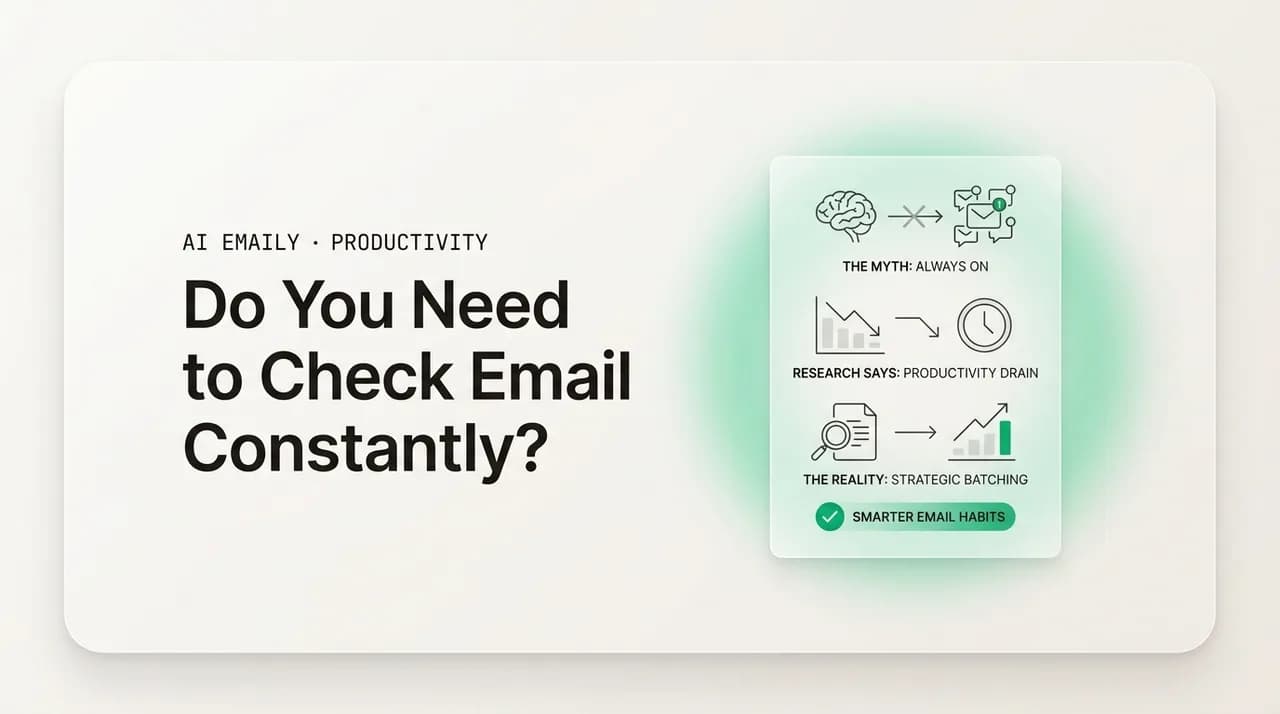
You do not need to check email constantly — the research points to checking 2–4 times a day for most roles, with real-time monitoring reserved for a narrow set of jobs. The compulsion is driven by anxiety and habit, not genuine urgency: most email tolerates a few hours, and almost no one expects a reply within minutes. Set expectations, batch your checks, and let true emergencies reach you another way.
Do you need to check email constantly? Almost never. The research says checking 2–4 times a day handles real urgency, and the constant-checking habit is driven by anxiety, not job requirements. Here is how often to actually check, by role.
On this page
- 01Why do you feel like you have to check email constantly?
- 02How fast do people actually expect an email reply?
- 03How often should you actually check email?
- 04How do you set expectations so checking less does not backfire?
- 05What about the anxiety of not checking?
- 06Who genuinely does need to check email more often?
- 07How does AI Emaily make checking constantly unnecessary?
- 08The bottom line on checking email constantly
Be honest about the number. Most people who do knowledge work check email somewhere between 15 and 40 times a day, and many check far more — every few minutes, between meetings, in line for coffee, in bed, at red lights. It does not feel like a choice. It feels like a requirement of the job, a thing responsible people do. The question underneath the habit, the one almost nobody stops to ask, is whether any of that constant checking is actually necessary. Does the work genuinely demand that you see email the moment it arrives? Or have you wired yourself to a behavior that no one is asking for and that quietly costs you your best hours?
The short answer, supported by a fair amount of research and a great deal of common sense, is that you almost certainly do not need to check email constantly. For the overwhelming majority of roles, checking a handful of times a day handles every email that genuinely matters on a timeline that matters. The emergencies that truly cannot wait a few hours — a system down, a customer escalation, a deadline today — are rare, and the ones that real, they almost never arrive only by email anyway. The compulsion to refresh is real, but the necessity behind it is mostly imagined.
This guide takes the question apart honestly. We will look at why the urge to check feels so strong — the dopamine loop, the anxiety, the false sense of urgency that email manufactures. We will look at what response times people actually expect, by role and industry, because the gap between what you imagine others expect and what they actually expect is enormous. We will give you a realistic answer to how often you should check (the research clusters around two to four times a day for most people), how to set expectations so checking less does not backfire, and how to handle the genuine anxiety of not-checking. And near the end we will look at what changes when an AI-native email client watches the inbox for you — so the rare thing that truly cannot wait reaches you, and everything else waits without you standing guard.
No guilt, no productivity-bro absolutism. Some people do need to be reachable, and we will say exactly who. But for most readers, the constant check is a habit dressed up as a duty — and seeing that clearly is the first step to getting your attention back.
Why do you feel like you have to check email constantly?#
The compulsion is not a character flaw, and it is not laziness. It is the predictable result of a system engineered — accidentally and then deliberately — to capture your attention, layered on top of normal human anxiety about work and standing. Understanding the mechanics matters, because you cannot un-wire a habit you think is just willpower.
Start with the variable reward. Email is a slot machine. Most of the time you pull the lever and get nothing — a newsletter, a notification, more noise. But occasionally you get something that matters: good news, a reply you were waiting for, a problem solved. Your brain does not know which pull will pay off, and that uncertainty is exactly the condition that produces the strongest, most compulsive checking behavior. The same mechanism that keeps people at a slot machine keeps you refreshing your inbox. You are not weak; you are responding rationally to an intermittent reward schedule.
On top of that sits anxiety, and email is unusually good at producing it. An unread count is an open loop — a visible pile of things that might need you, might be urgent, might be a problem you do not yet know about. The mind hates open loops; it nags until they are closed. Checking briefly relieves the anxiety (you looked, you know), which is precisely why it is so reinforcing — the relief trains you to check again the next time the unease builds. The badge with a number on it is, functionally, an anxiety generator with a built-in temporary cure.
Then there is the manufactured urgency. Email arrives instantly and sits in a stream that feels live, so it borrows the emotional weight of a real-time medium even though almost nothing in it is real-time. A message that would be perfectly fine to answer this afternoon feels, sitting unread at the top of the inbox, like it is waiting on you right now. The medium implies immediacy that the content rarely has. And because everyone treats it that way, the norm reinforces itself: you check constantly because you assume everyone else does and expects you to.
Finally, there is identity. For a lot of people, being responsive has become a proxy for being competent, conscientious, and committed. A fast reply feels like proof you are on top of things. Slowness feels like a small moral failure. So you check not only to manage work but to manage how you feel about yourself as a worker — which is a powerful, exhausting reason to never put the phone down.
The compulsion is designed, not innate
It is worth separating two things the habit blurs together: the cost of checking and the value of checking. The value is real but small and bursty — occasionally a check surfaces something you genuinely needed sooner. The cost is real and constant: every check is an interruption, and interruptions are expensive in a way that has nothing to do with the seconds you spend reading. When you pull yourself out of focused work to glance at the inbox, you do not pay only the glance; you pay the climb back into focus afterward, which research on attention residue and task-switching puts at far more than the interruption itself. We cover that fully in our piece on the context-switching cost of email, but the headline is that the trade is lopsided. You are paying a large, steady tax to harvest a small, occasional benefit — and the constant-checking habit is the most expensive way possible to capture value that batching would capture just as well.
How fast do people actually expect an email reply?#
Here is where the gap between imagination and reality is widest. When people are asked how quickly they expect a reply to an email, the answer is far more relaxed than the constant-checker assumes — and far more relaxed than the constant-checker themselves replies. The pressure you feel is mostly a story you tell yourself, not a standard anyone is holding you to.
Surveys of email expectations consistently land in the same range: a large share of people consider a reply within a day to be perfectly acceptable, and a meaningful minority are fine with longer. Same-day is the norm people expect; same-hour is a bonus, not a requirement; same-minute is something almost nobody expects from email at all. When researchers and email tools have looked at the question, the most common expectation for a non-urgent professional email clusters around a few hours to one business day — not minutes. The instinct that an unanswered email at 10 a.m. is a problem by 10:15 is simply not shared by the person who sent it.
There is also a revealing mismatch between how fast people reply and how fast they think they need to. Studies of actual reply behavior show that while the average reply, when it comes, often comes quickly (people who reply tend to do it within a couple of hours, and a large fraction of replies happen the same day), senders do not expect that speed and do not penalize its absence. In other words, fast replies happen, but they are a courtesy people offer, not a deadline people enforce. You can stop treating your own fast-reply habit as the baseline everyone requires of you.
The other thing the data shows: urgency is rare and usually signaled out of band. When something genuinely cannot wait, people do not quietly send an email and hope you refresh in time. They call. They text. They walk over. They mark it urgent, they follow up, they escalate. Truly time-critical communication finds a louder channel almost every time, precisely because the sender knows email is not reliable for immediacy. So the email sitting in your inbox is, by the very fact that it is only an email, probably not an emergency. The emergencies announce themselves.
The expectation you imagine is higher than the one that exists
How often should you actually check email?#
For most knowledge workers, the honest, research-aligned answer is two to four times a day, in defined blocks, not continuously. That is enough to catch everything that matters on a timeline that matters, and few enough that you reclaim long stretches of uninterrupted focus. It sounds radical only because the baseline you are comparing it to — checking dozens of times a day — is itself extreme.
Where does two-to-four come from? It is the sweet spot between two costs. Check too rarely (say, once a day) and you do occasionally leave something that mattered sitting too long, and you create a daily pile big enough to feel overwhelming. Check constantly and you destroy focus for a benefit that, as we have seen, is small and rarely time-sensitive. Two to four checks spreads coverage across the day — early, midday, mid-afternoon, end of day — so nothing waits more than a few hours, while still leaving you several multi-hour focus blocks that no email is allowed to interrupt. A controlled study by Kushlev and Dunn found that limiting email checking to three times a day measurably lowered stress compared with unlimited checking — the constraint itself was the intervention that helped.
The mechanism that makes this work is batching: processing email in concentrated sessions rather than a steady trickle. Batching is more efficient (you are in inbox mode, moving fast, not paying the switch cost dozens of times), it is calmer (you decide when to engage, rather than being yanked in by every arrival), and it matches how email actually behaves (asynchronous, tolerant of a few hours' delay). We go deep on the trade-offs in batching vs real-time email, but the practical version is simple: pick your windows, and outside them, the inbox is closed.
Concretely, a default day for most roles looks like this. A short check mid-morning, after your first focus block — not first thing, because opening with email hands your best cognitive hours to other people's agendas. A longer processing session around midday. A check in the mid-afternoon. An optional final pass near the end of the day to clear anything that came in and set up tomorrow. Four touch points, each a deliberate session with a start and an end, and between them, real focus. Adjust the count to your role using the table below.
| Role / situation | Suggested checking cadence | Why |
|---|---|---|
| Deep-focus roles (engineer, writer, designer, researcher, analyst) | 2× a day (midday + late afternoon) | Output depends on long uninterrupted blocks; email almost never time-critical |
| General knowledge work / management | 3–4× a day in blocks | Needs to stay reachable across the day but not in real time; the common default |
| Client-facing / account management | 4–5× a day, faster in business hours | Clients expect same-day, sometimes same-hour; still no need for constant refresh |
| Sales / business development | Several blocks; fast on live deals | Speed-to-lead matters on hot threads, but most of the day is still batchable |
| Customer support / front-line ops | Continuous or near-real-time (queue-based) | Response time is the job; handled via a shared queue/SLA, not personal inbox anxiety |
| Executive / on-call / incident duty | Continuous via alerts, not the inbox | Genuinely needs immediacy — but routed through paging/alerts, not constant email refresh |
| Solo founder / very small team | 3× a day, plus a VIP alert path | Wears every hat; protect focus by batching most mail and letting true urgency break through |
Notice what the table is really saying. The number of checks scales with how genuinely time-sensitive your role is — and even at the high end, almost no role requires staring at the inbox. The two roles that need true immediacy (front-line support and on-call/incident duty) do not solve it with personal-inbox vigilance; they solve it with systems — a shared queue with a service-level target, or a paging tool that alerts on the specific events that matter. That is the deeper point: when immediacy is genuinely required, the answer is a designed channel for the urgent thing, not constant manual checking of everything. For everyone else, two to four batched checks is plenty. Find your row, set your windows, and let the rest of the day be yours.
Start first thing with your work, not your inbox
How do you set expectations so checking less does not backfire?#
The fear that keeps people checking constantly is that slowing down will look bad — that a colleague or client will be left hanging, get annoyed, and conclude you are unreliable. The fix is not to reply faster. It is to set expectations so that a few hours' delay reads as normal and intentional rather than as you dropping the ball. Done well, this almost entirely removes the downside of checking less, because nobody is sitting there refreshing for your reply either.
The single highest-leverage move is to give people a louder channel for genuine emergencies. If your signature, your auto-reply, or a quick note to your team says some version of 'I check email a few times a day; if something is truly urgent, call or text me,' you have solved the problem that drives most constant checking. The reason you refresh is the nagging what-if that something on fire is sitting unread. Once everyone knows the fire alarm is a phone call, the inbox stops being the place emergencies could be hiding, and you can let it wait without anxiety.
The steps below build the full expectation-setting system. None of them require permission or a big announcement; most are quiet defaults you set once.
- 1
State your rhythm where people see it
Add a short line to your email signature or an always-on auto-reply: you check email a few times a day and reply within one business day. This reframes a few hours' delay as your normal cadence, not neglect.
- 2
Route urgency to a louder channel
In that same note, tell people how to reach you if something genuinely cannot wait — a call, a text, or a specific tag. This is what lets you stop guarding the inbox: the real emergencies have a path that is not email.
- 3
Reply once, completely, instead of fast and partial
When you do process email, answer thoroughly so the thread closes. A complete same-day reply earns far more trust than a quick 'will look into this' that drags a conversation across the whole day.
- 4
Use send scheduling to shape perceived availability
If you process email at 8 p.m., schedule the replies for morning. You answer on your schedule, but you avoid training people to expect you at all hours — which protects your boundaries and theirs.
- 5
Set a status during deep work
A calendar block, a chat status, or a simple 'heads-down until 1' tells people you are in focus mode and replies come after. Visible focus time normalizes the gaps between your checks.
- 6
Tell your immediate team explicitly, once
The people you work with daily are the ones whose expectations matter most. A single clear message — 'I'm batching email to protect focus; ping me directly for anything urgent' — converts your whole working group to the new normal at once.
The fix for urgency anxiety is a channel, not speed
What about the anxiety of not checking?#
Even with expectations set, the first days of checking less are genuinely uncomfortable, and it helps to name why. The discomfort is not evidence that you should be checking; it is withdrawal from a habit. The unread count climbs, the what-ifs start, and the easiest way to quiet them is to peek — which is exactly the loop you are trying to break. Expecting the anxiety and having a plan for it is what gets you through the adjustment to the calmer state on the other side.
The anxiety has a specific shape: it is fear of a hypothetical. 'What if there's something urgent?' is a question with no answer until you look, so the mind keeps asking. The way through is not to answer it by looking but to make the answer not matter. Once a real emergency has a guaranteed louder path to you (the call, the text, the alert), the honest answer to 'what if there's something urgent in there?' becomes 'then it would have reached me another way' — and the loop loses its fuel. The unread email might be important, but it is, by definition, not an emergency, because emergencies escalate.
It also helps to right-size the stakes. Play the worst case all the way out. You check at noon instead of 9 a.m., and there was an email at 9:05 that wanted a reply. What actually happens? In the vast majority of cases: nothing. The person waits a few hours, exactly as they expected to. In the rare case it mattered more, they followed up or called — and you handled it. The catastrophe the anxiety predicts almost never arrives, and when you collect evidence over a couple of weeks of checking less, you build the lived proof that the sky does not fall. That accumulated evidence, more than any willpower, is what finally quiets the urge.
There is a fourth, gentler reframe worth holding. Not-checking is not neglect; it is choosing what to give your attention to. Every minute spent guarding an inbox that does not need guarding is a minute not spent on the work that actually requires you. Letting email wait is not falling behind — it is deciding that your focused work, your thinking, your one finite stretch of morning attention, is worth protecting from a stream that is, almost always, perfectly happy to wait. Reframed that way, checking less stops feeling like a risk you are taking and starts feeling like a priority you are honoring.
Who genuinely does need to check email more often?#
It would be dishonest to claim nobody needs to be reachable in close to real time. Some roles really do, and pretending otherwise just makes the advice easy to dismiss. The point is to be precise about who, so the genuine exceptions do not become an excuse for everyone to keep refreshing.
The clearest case is anyone whose response time is the product. Front-line customer support, sales reps working live inbound leads, on-call engineers, emergency or operations coordinators, executive assistants managing a principal's calendar in real time — for these people, latency is a real cost and faster is genuinely better. But notice two things. First, even here, 'reachable' rarely means 'staring at a personal inbox' — it means a shared support queue with a service-level target, a CRM that surfaces hot leads, a paging tool that alerts on incidents. The immediacy is engineered into a system, not extracted from a human's vigilance. Second, these roles are a minority. If you are reading this and quietly hoping you are one of them, you are probably not — most jobs that feel urgent are urgent in stretches, not continuously.
There is also a legitimate temporary version: a live launch, a deal closing today, an active incident, a deadline this afternoon that depends on someone's reply. During those windows, checking more is the right call. The skill is to make it a window — an explicit, time-boxed period of heightened responsiveness — and then return to your normal cadence when it ends, rather than letting the launch-week urgency quietly become your permanent baseline. Most chronic over-checking starts as a justified sprint that nobody ever ended.
And client-facing work sits in a real middle ground. Some clients genuinely expect fast responses, and meeting that expectation is part of the relationship. But 'fast' for a client usually means same-hour during business hours, not same-minute always — and that is comfortably handled by checking every couple of hours, plus a clear path for them to call when something is truly pressing. Even the responsive end of the spectrum almost never requires the constant refresh that the anxious habit produces.
Beware the permanent emergency
How does AI Emaily make checking constantly unnecessary?#
Here is the practical problem with everything above. Even once you accept that you should check two-to-four times a day, the urge does not vanish — because the inbox is still a black box between checks. You do not know what is accumulating, whether the one thing that matters is sitting in there, or whether your batched rhythm just let something genuinely urgent wait too long. So you peek 'just to be safe,' and you are back to constant checking. The advice is right; the missing piece is something watching the inbox so you do not have to.
That is what AI Emaily is built to do. It is an AI-native email client with an agent that continuously reads and triages your inbox in the background — sorting what arrives, surfacing what needs a decision, and handling the routine according to rules you set. Instead of you opening the inbox dozens of times to find out what is in there, the agent already knows, and it tells you. When you do sit down for one of your batched checks, you are not facing a raw pile of unread mail; you are looking at an organized, prioritized view of what actually needs you — the 5 to 15 things that matter, separated from the noise. The constant checking was a way of monitoring the inbox manually. The agent does the monitoring, which is precisely the job that made constant checking feel necessary.
The Living Brief is the part that directly replaces the refresh habit. Rather than you opening email to see if anything happened, AI Emaily can deliver a periodic brief — a short, plain-language summary of what came in, what it handled, and what is waiting on you — and send it to where you already are, including Slack or Telegram. You stay fully informed about your inbox without opening it, which is the whole goal: the value of checking (knowing what is going on) without the cost (the interruption and the focus tax). For most of the day, the brief is all you need; you process the actual mail in one focused session when you choose to.
And for the narrow case that genuinely cannot wait, the agent solves the urgency-anxiety at the root with VIP alerts. You tell it who and what is truly important — a key client, your manager, anything matching a pattern you define — and it pushes you a real-time alert only for those. Everything else stays batched and quiet. This is the missing channel that makes checking less safe: the rare urgent thing breaks through on its own, so you never have to stand guard over the inbox to catch it. The fear that drove the constant checking — 'what if something urgent is in there?' — is answered structurally, because if it were urgent, the agent would have already pinged you.
You stay in control throughout. In its default Copilot mode, AI Emaily triages, drafts, and briefs, but it waits for your approval before sending anything on your behalf — so letting an agent watch the inbox never means losing your say over what goes out. It works across every account you connect (Gmail, Outlook, and any IMAP provider) in one place, and it is private by design: your mail is used to brief and draft for you, not to train models for anyone else. You can start free at app.aiemaily.com/signup — the Free plan is $0 and connects your inbox with AI triage and drafting; Pro is $12.42/month billed annually when you want the full agent across everything. The point is not that you stop caring about email. It is that you stop having to check it constantly, because something trustworthy is watching it for you and will tell you the moment it actually matters.
Let the agent be your urgency channel
The bottom line on checking email constantly#
No, you do not need to check email constantly. For most roles, the research and the reality both point to the same thing: checking two to four times a day in deliberate blocks handles everything that genuinely matters on a timeline that genuinely matters, while giving you back the long stretches of focus that constant checking destroys. The compulsion to refresh is real, but it is driven by a variable-reward loop, anxiety about open loops, and a medium that fakes urgency — not by any actual requirement that you see email the instant it lands.
The expectations you imagine are higher than the ones that exist. Most senders consider a same-day reply fine and a few hours generous; almost nobody expects a reply within minutes of an email, and when something is truly urgent, people escalate to a call or a text. So the way to check less without it backfiring is not to reply faster — it is to set expectations and, above all, to give genuine emergencies a louder channel than the inbox. Once the fire alarm is a phone call, the inbox stops being the place an emergency could be hiding, and you can let it wait without the anxiety that drove the habit.
If you want the structural version of that — something that watches the inbox so you do not have to, briefs you on what is in there without your opening it, and pings you the moment a VIP or a true urgency arrives — that is what AI Emaily provides, with you approving anything that gets sent. Either way, the principle holds: protect your attention, batch your checks, route real urgency elsewhere, and stop standing guard over a stream that is almost always perfectly content to wait.
Frequently asked
See it in AI Emaily
Keep reading
Sources

Written by
Nafiul HasanNafiul Hasan is an entrepreneur and AI automation system builder with 10+ years of experience turning messy, manual workflows into reliable automated systems. He designs and ships AI enterprise solutions end-to-end — the agent logic, the data plumbing, and the product people actually use — and founded AI Emaily to give busy professionals their attention back. He writes here from the builder's seat: what works, what breaks, and how to put AI to work without giving up control.