How to Use Multiple Stars in Gmail as a Triage System


The short answer
In Gmail, open Settings → See all settings → General, find the Stars section, and drag icons from 'Not in use' to 'In use.' Clicking a starred email's star cycles through them in order. Each icon can mean anything you decide — assign meanings once, write them down, and search with has:yellow-star or similar operators.
Turn on Gmail's extra star icons and use each one as a triage tag — a full setup, meaning system, and search guide.
On this page
Gmail ships with one star. Click it once and an email turns yellow, which tells you nothing except that you clicked it at some point. Learning how to use multiple stars in Gmail changes that — the setting almost nobody finds is that Gmail actually has twelve icons hiding behind that one star: six colored stars (yellow, orange, red, purple, blue, green) plus six other markers — a red exclamation, a yellow exclamation, an orange double-chevron, a green check, a blue info marker, and a purple question mark.
Google's own settings label the feature Superstars, though the name doesn't show up anywhere else in the interface — part of why so few people discover it. Turn a few icons on and clicking a starred email repeatedly cycles through them.
The hard part isn't the setting. It's deciding what each icon means and remembering it three weeks later when your inbox is back to 40 unread. This post covers both: the two-minute setup, a star vocabulary specific enough to survive a bad week, and the exact search operators that turn a colored icon into a filter.
Before you start: decide the vocabulary, not just the icons#
The single reason multi-star systems fail is that people turn on five icons the first day, assign meanings on the spot, and forget three of them by Friday. Decide the vocabulary before you touch a setting.
A vocabulary that holds up under a busy week is short — three to five meanings, each one a decision you'd otherwise have to make every time you look at an email. Good candidates: needs a reply today, waiting on someone else, needs to be paid, personal — not work triage, and read later when you have time. Bad candidates: important (too vague to act on), interesting (not a decision), and follow up (too broad — follow up how, and by when?).
Once you've picked the vocabulary, assign your most-used meaning to whichever icon sits first in the "In use" row — that's the one a single click lands on. Every position after it costs one more click to reach, so a rarely-used meaning buried near the end costs nothing, but a daily one buried there gets skipped out of sheer friction.
Write the meanings down somewhere outside Gmail
Steps: turning on extra stars in Gmail#
- 1
Open Settings
Click the gear icon in the top right of Gmail, then "See all settings." You'll land on the General tab, which is where the Stars section lives.
- 2
Find the Stars section
Scroll down the General tab until you see "Stars." You'll see two groups of icons: "In use" (currently just the yellow star) and "Not in use" (orange star, red star, purple star, blue star, green star, red exclamation, yellow exclamation, orange double-chevron, green check, blue info, and purple question mark). It's easy to scroll past this section the first time, since it sits between Signature and Vacation responder with no bolded header calling it out.
- 3
Pick a preset, or build your own
Gmail offers three quick options above the icon grid: "1 star" (the default), "4 stars" (yellow star, blue star, green check, red exclamation), and "all stars" (every icon). Clicking "all stars" is the fastest way to get every icon into "In use" at once — you can still drag any of them back out afterward if your vocabulary doesn't need all twelve.
- 4
Drag icons from "Not in use" into "In use"
If you'd rather build the set by hand instead of using a preset, click and drag each icon you want into the "In use" row, using the vocabulary you decided on above. Order matters: clicking a star repeatedly cycles through the "In use" list in the order they appear there, so put your most-used meaning first and your rarest one last.
- 5
Scroll down and save
Click "Save Changes" at the bottom of the page. There's no confirmation dialog — if you navigate away without saving, the change is lost.
- 6
Test the cycle
Open any email and click the star (or the empty star outline) next to the sender in the inbox list. Click again. Each click should advance to the next icon in your "In use" order, looping back to unstarred after the last one.
Platform differences: where multi-star setup and use diverge#
Gmail's multi-star system is a webmail setting, and it doesn't behave identically everywhere you read mail. Set expectations before you build a workflow around it, especially if you switch between a laptop and a phone during the day.
| Platform | Can you enable extra stars here? | Can you cycle through them? | Can you search by star color? |
|---|---|---|---|
| Gmail on desktop web | Yes — Settings → General → Stars | Yes, click to cycle | Yes, with has:yellow-star and similar operators |
| Gmail Android app | No — enable it on web first | Yes, once enabled on web, the icons sync and cycle | Yes, same search operators work |
| Gmail iOS app | No — enable it on web first | Yes, once enabled on web | Yes, same search operators work |
| Any IMAP client reading a Gmail account | No — this is a Gmail-side setting, not an IMAP flag | Depends on the client — most show only starred/unstarred, not which icon | Rarely — most IMAP clients don't expose Gmail's star-color metadata |
The practical takeaway: set up the icons once on desktop web, and every other surface you touch mail from — phone, tablet, another laptop — inherits the same vocabulary without any extra configuration. The one place it breaks down is a third-party IMAP client, where the star color is Gmail-side metadata the client usually can't see.
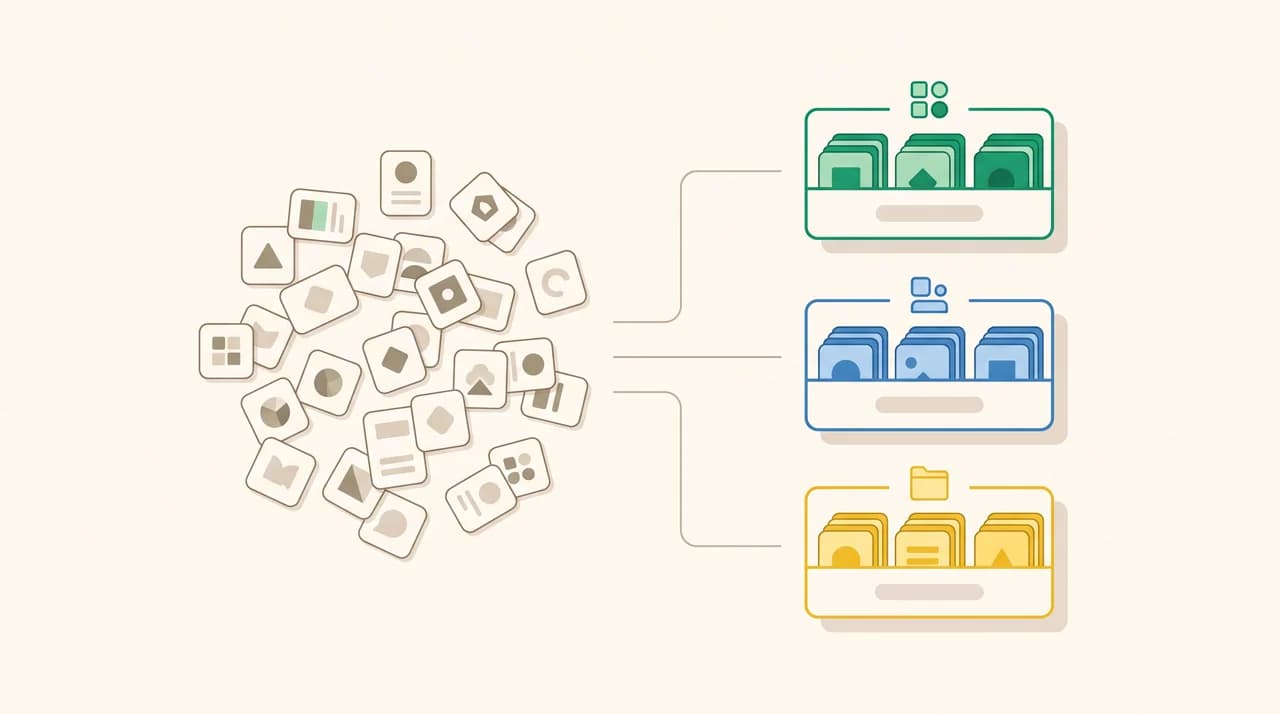
Once the icons are live, the work shifts from clicking to sorting — each star color is really just a bin you're dropping a message into, and the search operators below are how you pull a bin back out.
What to do when it doesn't work#
Most multi-star problems aren't Gmail bugs — they're the setting living somewhere the reader didn't expect, or a search operator typed slightly wrong. Here's what actually causes each one.
- Clicking the star only ever shows one color: you haven't added any icons to "In use" yet, or you added them but didn't click Save Changes at the bottom of the settings page.
- The star cycle skips a color you added: check the order in the "In use" row — it's possible you dragged it in and then dragged something else on top of it by mistake.
- Mobile doesn't show the star options: this is expected. You can't add or remove icons from the Android or iOS app; do it on desktop web once, and mobile will reflect the current "In use" set.
- A search like has:orange-star returns nothing: the operator name has to match Gmail's internal name for that icon exactly. The six star colors use has:yellow-star, has:orange-star, has:red-star, has:purple-star, has:blue-star, and has:green-star. The six non-star icons use different names — has:red-bang, has:yellow-bang, has:orange-guillemet, has:green-check, has:blue-info, has:purple-question. Type has: into the search bar and Gmail autocompletes the full list, which is the fastest way to confirm the exact string for an icon you're unsure about.
- You want one search across every used icon regardless of color: use is:starred, which matches any of the twelve icons, not just the plain yellow star.
- You built a filter to auto-apply a specific star color and it keeps applying plain yellow instead: this isn't a bug. Gmail's filter actions only include a generic "Star it," which always applies the default star — there's no filter option to choose a color, even with a full vocabulary enabled. Automatic, color-specific starring by rule isn't something Gmail's filters do.
Why search matters more than the icon itself
A faster way: skip assigning colors by hand#
Gmail's filters can't auto-apply a specific star color because "Star it" was built as one generic action, never extended to match the twelve-icon system. AI Emaily's auto-triage skips the star field entirely — it reads new mail against rules and context you set once (sender, subject pattern, whether it needs a reply) and sorts it into the equivalent of your star categories automatically, before you open the inbox.
The manual star system above still works, and for a light inbox it's genuinely enough — you don't need a tool to click a star five times a day. Where it stops scaling is volume: past a certain number of emails a day, remembering to star consistently is itself a chore. We build AI Emaily, and auto-triage is the feature that removes the manual step this whole post just walked through.
Frequently asked
See it in AI Emaily
Keep reading
Sources

Written by
Nafiul HasanNafiul Hasan is an entrepreneur and AI automation system builder with 10+ years of experience turning messy, manual workflows into reliable automated systems. He designs and ships AI enterprise solutions end-to-end — the agent logic, the data plumbing, and the product people actually use — and founded AI Emaily to give busy professionals their attention back. He writes here from the builder's seat: what works, what breaks, and how to put AI to work without giving up control.