How Real Estate Agents Can Send Investor Deal-Flow Emails in Minutes

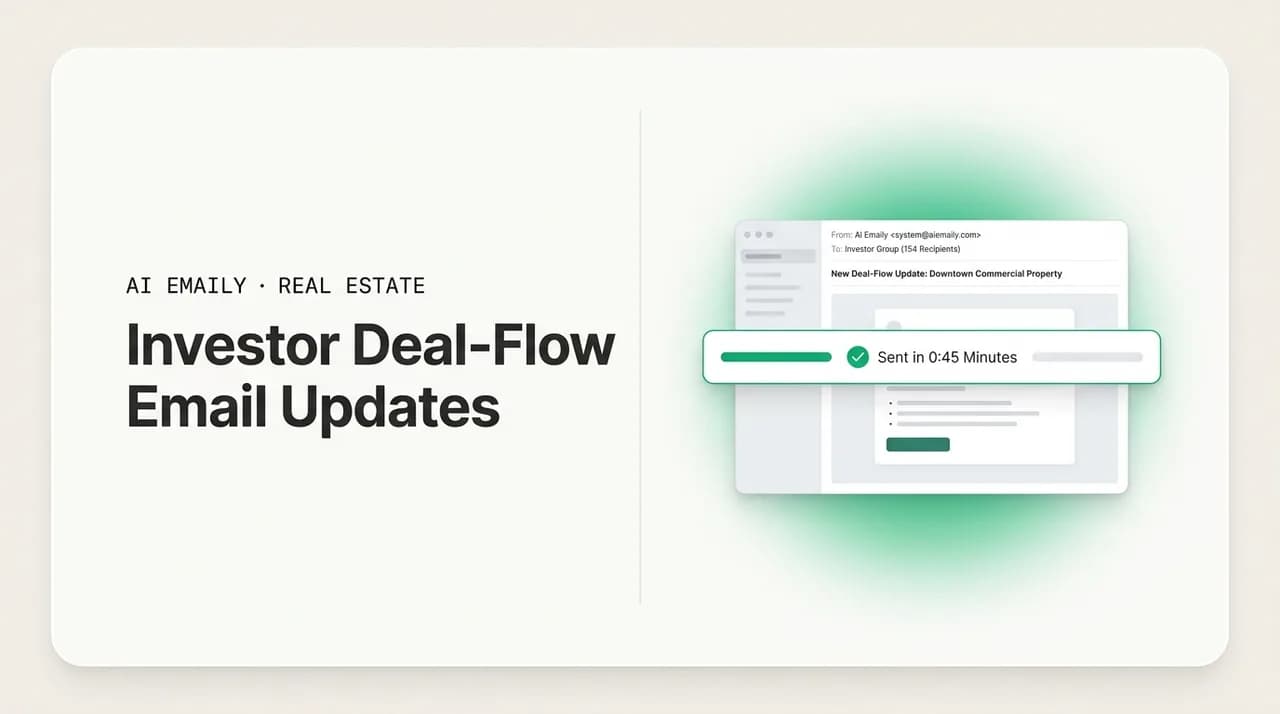
The short answer
Real estate investor email updates work when they lead with numbers, not adjectives. Investors want cap rate, cash flow, comps, and offer status in a scannable format, delivered fast. Standardize five deal-flow email types into templates, batch your deal blasts, and automate the routine data-forward updates so you reply in minutes instead of hours.
A practical guide to real estate investor email updates: the deal-flow email types investors actually read, templates with the numbers they want (cap rate, cash flow, comps), and how to stay fast and consistent at volume.
On this page
- 01Why real estate investor email updates are a different job
- 02How investor clients differ from retail buyers
- 03The five deal-flow email types you send on repeat
- 04New-deal alert: the fastest email you send
- 05Cap-rate and cash-flow summary: the numbers investors underwrite on
- 06Offer status update: keep them in near-real-time
- 07Closing coordination: the checklist that prevents dropped deals
- 08Portfolio update: the roll-up that keeps repeat clients close
- 09How to be fast and consistent at investor volume
- 10Batching a deal blast without sounding like spam
- 11How AI Emaily handles investor deal-flow email
- 12Putting it all together
Why real estate investor email updates are a different job#
If you have worked with both first-time buyers and investors, you already know they are two different clients wearing the same 'looking for property' label. The first-time buyer emails you because everything is new and a little scary; they want reassurance, hand-holding, and a human voice on the other end. The investor emails you because a number changed, or because they want a number they do not have yet. They are not buying a home. They are buying a spreadsheet row that has to pencil out, and they will read your email the way they read a term sheet: fast, skeptical, and looking for the figures.
That single difference reshapes how you should write to them. Real estate investor email updates are transactional communication in the literal sense. The relationship is built on speed and accuracy, not warmth. Investors transact repeatedly rather than once every seven years, so a good investor client is not one sale, they are a pipeline of sales over years. But that same repeat-buyer economics cuts the other way too: because the relationship is transactional, an investor will move to a faster-responding agent without a second thought if you go quiet or bury the numbers under three paragraphs of enthusiasm.
So the stakes are high and the margin for fluff is low. The good news is that this is exactly the kind of communication that is easy to systematize. Investor emails are repetitive by nature, the same handful of update types, the same numbers, the same structure, over and over. Once you build the templates and a fast way to fill them, you can serve more investor clients in less time and out-respond every agent who is still writing each one from scratch.
This guide is built for the agent who serves investors: flippers, buy-and-hold landlords, wholesalers, and small commercial buyers. We will cover how investor clients actually differ from retail buyers, the five deal-flow email types you will send again and again, copy-paste templates loaded with the numbers investors expect, how to stay fast and consistent when you are running volume, how to batch a deal blast to a whole buyer list without it reading like spam, and finally how an AI email client like AI Emaily can draft these data-forward updates in your voice and send the routine ones on autopilot inside rules you set, with undo and an audit trail so you stay in control.
How investor clients differ from retail buyers#
Before the templates, it is worth being precise about who you are writing to, because the whole style of investor communication falls out of three traits. Get these right and the emails write themselves.
- They think in numbers, not emotion. A retail buyer falls in love with a kitchen. An investor asks what the cap rate is, what it rents for, what the rehab costs, and what it comps out at after repair. Lead your emails with those figures and you have answered the real question before they ask it.
- They transact repeatedly. This is the whole reason the segment is worth serving. An investor who trusts you often returns for every purchase, so one solid relationship can produce a deal every few months for years. That repeat volume is why speed and consistency matter more than any single polished message.
- They switch fast. Because there is little emotional attachment, an investor feels no guilt leaving a slow agent. If a wholesaler blasts a deal to fifty buyers, the one who replies first and with the numbers attached usually wins it. Response time is not a courtesy here, it is competitive positioning.
- They are deadline- and pipeline-driven. Deals have inspection windows, financing contingencies, and closing dates that do not move. Investors juggle several at once, so every update you send is landing in a busy pipeline. The easier you make it to scan and act, the more you help them and the more they lean on you.
- They are ROI-literate and tool-savvy. Investors run their own numbers in calculators and underwriting models. You do not need to soften the math or over-explain it. Give them the inputs cleanly and they will trust the output, and you, more.
Notice the through-line: every one of these traits rewards the same behavior, which is fast, structured, numbers-first communication. That is very different from the trust-building, reassurance-heavy tone that works with first-timers, and it is a big reason investor email is easier to standardize. There is less that has to be original in each message, because the value is in the accuracy and the speed, not the prose.
The one-glance test for investor email
The five deal-flow email types you send on repeat#
Almost every email you send an investor falls into one of five buckets. Naming them matters, because once you can name a recurring email you can template it, and once it is templated you can send it in a minute instead of ten. Here is the full set, what each one is for, and how often it tends to go out.
| Deal-flow email type | What it does | Typical cadence |
|---|---|---|
| New-deal alert | Notifies an investor (or a buyer list) that a property matching their box is available, with the headline numbers up top. | As deals surface — often the fastest, most competitive email you send. |
| Cap-rate / cash-flow summary | Breaks down the underwriting on a specific property: price, rents, expenses, cap rate, cash flow, cash-on-cash. | On request or attached to a serious new-deal alert. |
| Offer status update | Tells the investor where their offer stands: submitted, countered, accepted, or beaten, with the number that matters. | Every time status changes — investors expect near-real-time. |
| Closing coordination | Moves an accepted deal to the finish line: inspection dates, financing, title, and the document checklist. | Weekly or per-milestone during the closing window. |
| Portfolio update | A periodic roll-up across the investor's holdings or active pipeline: what closed, what is pending, what is worth a look. | Monthly or quarterly, depending on the client. |
Two of these, the new-deal alert and the cap-rate summary, carry most of the competitive weight, because they are where speed and numbers combine. The other three are largely about consistency: an investor who always knows where their offer stands, always has the closing checklist, and gets a clean portfolio roll-up on schedule will stay with you because you are predictable, which is exactly what a numbers person values. We will template all five below.
New-deal alert: the fastest email you send#
The new-deal alert is the sharp end of investor email. When a property hits your radar that fits a client's buy box, or when you have an off-market deal to move, the agent who emails the numbers first usually gets the conversation. This is not the place for a warm-up paragraph. Put the address, the price, and the return metric in the subject line and the first line, then let the rest support it.
Here is a lean new-deal alert for a single investor whose criteria you know:
The structure is doing the work: subject line carries the deal, the first line confirms it fits their criteria, then the numbers stack in a fixed order so a repeat client learns exactly where to look. The close ends on an action, showing or offer, because an investor reading a deal they like wants the next step to be one reply away.
For an off-market deal you are shopping to more than one buyer, the same skeleton works but the urgency and the call to action shift, because now it is a race. Be explicit that it is going to a short list, which is honest and also creates the real pressure that moves investors.
Speed is the feature investors are buying
Cap-rate and cash-flow summary: the numbers investors underwrite on#
When an investor is seriously considering a property, they want the underwriting laid out cleanly so they can drop it into their own model or sanity-check yours. The cap-rate and cash-flow summary is where you show your work. The two headline figures investors anchor on are the capitalization rate, net operating income divided by purchase price, which lets them compare properties on a like-for-like basis, and monthly cash flow, what is left after every expense and the mortgage. Get those right, show the inputs, and you have earned trust with a numbers person.
A clean, structured summary an investor can scan and re-model:
Two things make this template land. First, the inputs are visible, not just the outputs, so the investor can see your rent and expense assumptions and swap in their own without emailing you back three times. Second, you flagged that the rent estimate is conservative and invited them to adjust, which signals you are giving them a real number, not a sales number. Investors are allergic to inflated pro formas; showing restraint on the assumptions is how you become the agent they trust with the math.
If your investor works buy-and-hold versus flips, keep two versions of this template. The buy-and-hold version leads with cap rate, cash flow, and cash-on-cash, as above. The flip version leads with purchase price, rehab budget, after-repair value, and projected profit, because a flipper does not care about monthly cash flow, they care about the spread and the timeline.
Offer status update: keep them in near-real-time#
Once an investor has an offer out, they want to know the moment anything changes, because they are usually running other deals in parallel and their capital is committed against outcomes. The offer status update is short by design. It exists to answer one question, where does my offer stand, and to name the next move. Do not make an investor email you to ask; a client who has to chase you for status is a client already half-shopping for a faster agent.
A submitted-and-waiting update:
When the status changes, the update changes with it but stays just as tight. A counter needs the new number and a clear ask; an acceptance needs the confirmed terms and the immediate next step. Here is a counter that puts the decision in front of the investor cleanly.
Re-run the numbers inside the status update
Closing coordination: the checklist that prevents dropped deals#
Once an offer is accepted, the job shifts from selling to logistics, and this is where consistency quietly wins loyalty. An investor closing multiple deals at once cannot hold every inspection date, financing deadline, and title item in their head. A predictable, structured closing update, ideally on the same day each week, becomes the thing they rely on. It is highly templated by nature: the same milestones, the same document checklist, the same format, with the specific dates and open items swapped in.
A weekly closing status an investor can act on in thirty seconds:
The 'needs you' line is the whole point. An investor scanning this email wants to know, in one glance, whether the ball is in their court. Putting outstanding action items in a single, clearly labeled line, with a deadline, means nothing slips because it got lost in a paragraph. When you are coordinating several closings for the same client, keep the format identical across all of them so they can process five updates as fast as one.
Portfolio update: the roll-up that keeps repeat clients close#
The portfolio update is your retention email. It goes out on a schedule, monthly or quarterly, and it is how you stay in an investor's pipeline between active deals. It does two jobs at once: it recaps where their current holdings and active offers stand, and it surfaces a couple of new opportunities that fit their box, keeping the deal flow warm. Because it is periodic and structured, it is one of the safest emails to standardize and even automate, since the format never changes, only the data does.
A monthly investor roll-up:
The portfolio update is a pipeline tool, not a report
How to be fast and consistent at investor volume#
Templates solve the 'what to write' problem. They do not solve the 'how do I do this forty times a week without it becoming my whole day' problem. Serving investors well means running volume, and volume rewards a system. Here is what actually keeps you fast and consistent when the pipeline is full.
- Standardize the number order. Pick a fixed order for your figures, price, then cap rate, then cash flow, then comps, for example, and never vary it. Repeat clients learn the pattern and read your emails in seconds. Inconsistent ordering forces them to hunt, which is friction you control.
- Keep buy-box notes on every investor. Record each investor's criteria, target cap rate, price ceiling, market, property type, financing, so you can tell in one look whether a new deal fits. This is what lets you fire a matched new-deal alert the same hour a property surfaces.
- Build the template library once. Have all five deal-flow emails saved and ready. The work is in getting the structure right one time; after that, each send is a fill-in-the-blanks job, not a writing job.
- Attach, don't retype. Keep your underwriting in a reusable format, a one-page deal sheet or a spreadsheet, and attach it. The email carries the headline numbers; the attachment carries the full model. Do not rebuild the analysis inside the email body every time.
- Answer status before it's asked. The single biggest driver of investor loyalty is never having to chase you. Send offer and closing status the moment it changes, proactively. It is a small habit that quietly makes you the agent they do not want to leave.
- Batch the routine, prioritize the live deals. Not every email is a race. Portfolio updates and non-urgent status notes can be written in a block once a day. Reserve your instant-response energy for new-deal alerts and live offer changes, where speed actually wins deals.
That last point, batching, deserves its own paragraph, because it is where a lot of agents either save hours or leak them. The instinct is to treat every investor email as urgent. It is not. New-deal alerts and offer changes are genuinely time-sensitive and deserve near-instant replies. But portfolio updates, weekly closing statuses, and routine confirmations can be drafted in a single focused block, once a day or once a week, and sent together. Separating the truly urgent from the merely routine is what lets you be fast where it counts without being reactive all day long.
Batching a deal blast without sounding like spam#
Sending one deal to a list of qualified buyers, a deal blast, is one of the highest-leverage things an investor-focused agent does, and one of the easiest to get wrong. Done badly, it reads as a mass email and investors tune it out. Done well, each buyer feels like they got a targeted heads-up on something that fits them. The difference is not the tooling, it is the discipline of segmenting the list and letting the numbers do the personalizing.
- Segment by buy box, not by 'all buyers.' A deal only goes to the buyers whose criteria it actually fits. A 7.4% cap 8-unit goes to your multifamily buyers, not your single-family flippers. Relevance is what keeps a blast from feeling like spam.
- Lead with the numbers, personalize the first line. The body of the email, the figures, can be identical across the segment; that is fine, because the figures are the value. Personalize only the opening line with the buyer's name and a nod to their criteria, so it reads as a match, not a mass send.
- Be honest that it's a short list. Telling buyers a deal is going to a handful of qualified people is both true and motivating. Investors move faster when they know they are competing against a real, small field.
- Give one clear next step. End every blast with the same single action, 'reply to tour with proof of funds' or 'reply for the full underwriting.' A blast with a fuzzy call to action gets ignored; a blast with one crisp ask gets replies.
- Track who's live on what. When five people reply to the same off-market deal, you need to know instantly who was first and who has proof of funds ready. Losing track here is how you damage trust with the buyers you most want to keep.
The honest tension in a deal blast is speed versus personalization. Personalizing fifty emails by hand is slow, and slow loses deals; sending fifty identical emails is fast but reads as spam and gets tuned out. The resolution is to make the data-heavy body reusable and the personalization shallow but real, one tailored line per buyer, driven by their buy box. That is a pattern a human can run at small volume and that automation can run at large volume, which is where an AI email client starts to earn its keep.
How AI Emaily handles investor deal-flow email#
Everything above, the five templates, the fixed number order, the fast matched alerts, the batched blasts, is a system a disciplined agent can run by hand. It just costs time, and at real investor volume that time adds up. AI Emaily is an AI-native email client, connected to Gmail, Outlook, and any IMAP account, that is built to run exactly this kind of repetitive, data-forward communication for you, in your voice, so you get the speed and consistency without the manual grind.
Because investor communication is templated and numbers-driven, it is close to the ideal case for automation: there is very little that has to be original in a deal-flow update, so an AI draft has a low risk of sounding 'off.' Here is specifically how it fits the workflow in this guide.
- Data-forward drafts in your voice. It learns how you actually write to investors, terse, numbers-first, no fluff, and drafts new-deal alerts, cap-rate summaries, offer-status updates, and portfolio roll-ups in that voice, with the figures laid out in your standard order. You review a finished draft instead of starting from a blank page.
- Copilot for the deals that matter. In Copilot mode, every draft waits for your approval before it sends. For live offer changes and competitive new-deal alerts, where a wrong number is costly, you stay in the loop, read the draft, tweak a figure, and hit send in seconds.
- Autopilot for the routine, inside your rules. For the genuinely repetitive updates, routine status confirmations, scheduled portfolio roll-ups, standard closing checklists, you can let Autopilot draft and send within rules you define, so those go out on time without touching your day. You set the boundaries; it works inside them.
- Undo and a full audit trail. Every action the agent takes, drafted, sent, or scheduled, is logged and reversible. You can see exactly what went to which investor and undo a send if something needs to change. Automation without an audit trail is a risk; this is automation you can inspect.
Two honest caveats, because investors are the last clients you want to mislead. First, Autopilot is for the routine, templated updates, not for the judgment calls. Pricing strategy, whether to counter and at what number, how to position a marginal deal, those stay with you; the tool handles the mechanical sends, not the deal-making. Second, the numbers are only as good as what you put in. AI Emaily drafts and formats your updates fast and consistently; it does not replace your underwriting. You still own the analysis, it owns the speed of getting it to the investor cleanly.
Used that way, the split is simple and honest: you make the calls and run the numbers, and the tool removes the repetitive drafting and sending that otherwise eats your day. That is how an agent serving investors out-responds the field, by being first with the numbers on every deal, every time, without burning out doing it by hand. You can try it free at app.aiemaily.com/signup.
Putting it all together#
Real estate investor email updates come down to a few durable rules. Lead with numbers, because investors read for figures, not feelings. Standardize five deal-flow email types, new-deal alert, cap-rate summary, offer status, closing coordination, and portfolio update, so each send is a fill-in job, not a writing job. Keep a fixed number order and a buy box on every client so you can fire a matched, accurate alert the same hour a deal surfaces. Batch the routine, sprint on the live deals, and segment every blast so it reads as a match rather than a mass send.
Do that consistently and you become the agent investors do not leave, not because they are attached, but because you are reliably fast and reliably accurate, which is the only loyalty a numbers person offers. And if running all of that by hand at volume is the bottleneck, an AI email client can draft the data-forward updates in your voice and send the routine ones inside your rules, with undo and an audit trail, so you keep the speed without the grind. Grab the templates above, set your number order, and start replying to investors in minutes instead of hours.
Frequently asked
See it in AI Emaily
Keep reading
Sources

Written by
Nafiul HasanNafiul Hasan is an entrepreneur and AI automation system builder with 10+ years of experience turning messy, manual workflows into reliable automated systems. He designs and ships AI enterprise solutions end-to-end — the agent logic, the data plumbing, and the product people actually use — and founded AI Emaily to give busy professionals their attention back. He writes here from the builder's seat: what works, what breaks, and how to put AI to work without giving up control.