Speed to Lead for Real Estate Agents: How to Respond in Under 5 Minutes

The short answer
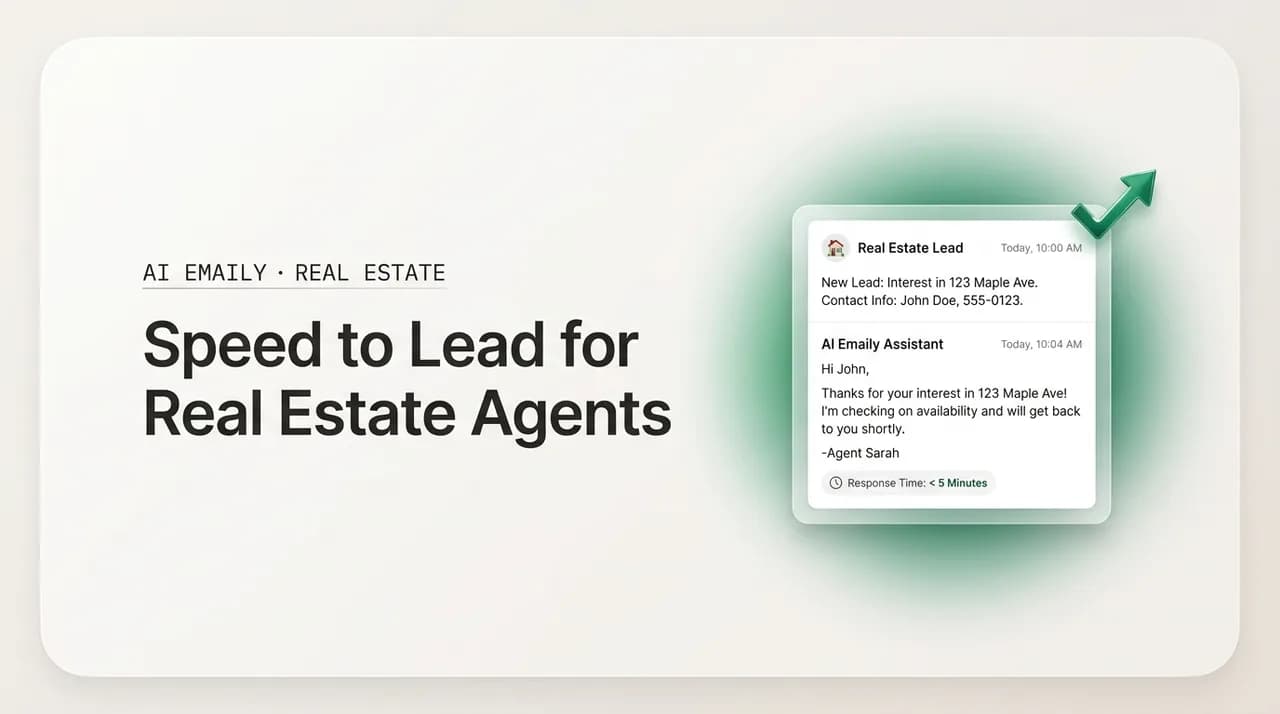
Speed to lead is the biggest lever on real estate conversion: the agent who replies first almost always wins, and the research says respond within five minutes or your odds fall off a cliff. Most agents can't, stuck on showings or mid-transaction. The fix is two layers: an instant acknowledgment when a lead arrives, then a personal reply close behind.
Speed to lead in real estate decides who wins the deal. Here is the research, the real numbers, why agents are slow, and a step-by-step system to respond to every lead in under five minutes.
On this page
- 01Why speed to lead decides who wins the deal in real estate
- 02The research: what lead response time actually does to conversion
- 03Why real estate agents are slow to respond (even when they know better)
- 04The under-5-minute system: respond to real estate leads faster, every time
- 05Auto-acknowledgment vs personal reply: what each one is for
- 06Templates for an instant first touch
- 07Handling leads after hours without working 24/7
- 08How AI Emaily gets you to a sub-5-minute first touch
- 09Putting it all together
Why speed to lead decides who wins the deal in real estate#
Speed to lead in real estate is not a soft metric or a nice-to-have. It is the closest thing the business has to a physical law: the agent who responds first to a new inquiry wins a hugely disproportionate share of the deals. A buyer who fills out a form on a listing at 9:14 p.m. is not loyal to you. They are loyal to whoever answers. If you reply at 9:16 and the next agent replies the next morning, you already have the conversation, the rapport, and usually the appointment. By the time the competition shows up, the lead has a name, a face, and someone who felt responsive when it counted.
This is what makes speed to lead real estate agents' most underrated skill. Agents pour money into Zillow, Realtor.com, Facebook lead forms, and their own websites, then let the leads those channels produce sit for hours or days. The lead cost is fixed the moment you buy it; the only variable left in your control is how fast you touch it. A slow reply does not just lower your odds on that one lead, it quietly wastes the marketing budget that produced it. Most real estate leads are lost not to a better agent, a better price, or a better pitch, but to a faster one — the deal decided in the first few minutes, before anyone talked about the house at all.
There is a reason this feels obvious and still almost nobody does it well. Everyone agrees, in the abstract, that fast follow-up matters. Then a real day happens: an appointment runs long, a showing pushes into the evening, an inspection blows up mid-transaction, and the three leads that came in between 2 and 4 p.m. sit untouched until you finally sit down at 8. Intention is not the problem. The gap between knowing you should respond fast and having a system that actually does it is where deals leak out.
This guide closes that gap: the research behind lead response time, the numbers that should scare you, the honest reasons agents are slow, and a repeatable system to get a meaningful first touch to every lead in under five minutes, including after hours, without chaining yourself to your phone.
The research: what lead response time actually does to conversion#
The most-cited work here comes from research led by Dr. James Oldroyd, whose Lead Response Management study analyzed thousands of inbound leads and tens of thousands of contact attempts across many companies. The findings are blunt and they have held up for more than a decade: the odds of making meaningful contact drop sharply with every minute that passes after the inquiry. Wait an hour and you are competing at a fraction of the odds you had in the first five minutes.
Two numbers get quoted constantly, and they earn it. Contact a lead within five minutes versus thirty, and you are far more likely to reach them. Contact within five minutes versus an hour, and the difference is not incremental, it is an order of magnitude. The window is not a gentle slope; it is a cliff, and most of the fall happens in the first hour.
The Harvard Business Review put a sharper point on it in a widely read piece based on the same research: firms that tried to contact leads within an hour were many times more likely to have a meaningful conversation than firms that waited even an hour longer — yet a startling share of companies took far longer than an hour, or never responded at all. The gap between what the data says to do and what businesses actually do is the whole opportunity.
It is worth being precise about what "response" means, because it is easy to fool yourself. The research measures meaningful contact, not just any activity. A reply that lands while the lead is still on your site, still comparing three homes, is worth far more than the same words sent four hours later when they have moved on or already talked to someone else. Speed compounds: fast contact does not just improve the odds you reach them, it improves the odds they are still warm when you do.
The table below distills the pattern the lead-response research keeps finding. The exact multipliers vary by study, but the shape is remarkably stable, and real estate — where inquiries are emotional, time-sensitive, and easy to send to five agents at once — sits right in the teeth of it.
| Response time | Relative odds of contact / conversion | What it means for you |
|---|---|---|
| Under 1 minute | Highest — the lead is still on the page | You catch them in the moment of intent; almost nobody competes here. |
| 1–5 minutes | Strong — the widely cited target window | The proven sweet spot. Contact odds are dramatically higher than at 30+ minutes. |
| 5–30 minutes | Falling fast | Still workable, but odds are already declining minute by minute. |
| 30–60 minutes | Sharply lower | By an hour, contact odds can be a small fraction of the five-minute mark. |
| 1–24 hours | Low | The lead has likely talked to another agent or cooled off entirely. |
| 24+ hours | Very low | Most of these are gone. You paid for the lead and handed it to a faster agent. |
Read that table as a curve, not a set of buckets. There is no magic switch at exactly five minutes. Every minute you shave off your response time moves you up the curve, and the steepest part of the curve is the first few minutes. That is why the target is not "same day" or "within the hour," phrases that feel responsive but sit near the bottom of the odds. The target is under five minutes, every time, and the honest question is not whether that matters but whether your current process can actually hit it.
Speed buys you the conversation, not the close
Why real estate agents are slow to respond (even when they know better)#
No agent believes slow is better. The slowness is structural, baked into the shape of the job, and understanding exactly where it comes from is the first step to engineering it out. There are three big reasons real estate lead response time is worse than agents want it to be.
The first is showings and appointments. The core of the job happens away from a desk — in a car, in someone's living room, at an inspection, walking a property with a client. Your phone is in your pocket, on silent, because you are with a paying client and it would be rude not to be. Meanwhile the leads keep arriving on their own schedule, which is almost never yours. The very activity that makes you money is the activity that makes you unresponsive.
The second is being mid-transaction. An active deal is a firehose of time-sensitive email: the lender, the title company, the other agent, the inspector, the client's forty questions. When you are heads-down keeping a transaction from falling apart, a new lead inquiry looks like noise, one more unread message in a flooded inbox. It gets buried under the transaction that already feels urgent — even though the new lead is the one on the clock.
The third reason is the honest one nobody likes to say out loud: leads arrive when you are living your life. A huge share of real estate inquiries come in during evenings and weekends, precisely when people have time to browse homes — exactly when you are at dinner, at your kid's game, or finally off the clock. You are not going to respond to every 9 p.m. Zillow lead personally, and you should not have to. But right now, for most agents, "I'm off" and "the lead waits until tomorrow" are the same thing, and tomorrow is often too late.
Layer these together and you get the typical agent's real response pattern: fast when they happen to be free, slow when they are working, and dark when they are off. The leads do not care which state you are in — they just contact the next agent. The goal is not to work more hours or stare at your phone; it is to break the link between your availability and the lead's first experience of you, so a lead who arrives at your worst moment still gets an immediate, competent first touch.
The after-hours leak is the biggest one
The under-5-minute system: respond to real estate leads faster, every time#
Here is the mental model that makes this achievable: separate the acknowledgment from the answer. You do not need to write a thoughtful, personalized reply in under five minutes — you need the lead to hear back in under five minutes. Those are two different jobs, and conflating them is why agents feel they can't hit the window. The first can be instant and near-automatic; the second can follow at human speed, minutes or an hour later, and still land while the lead is warm.
Build your speed-to-lead process in these six steps. It works whether you are a solo agent or running a small team, and most of it can be set up once and left running.
- 1
Route every lead source into one inbox
Zillow, Realtor.com, Facebook forms, your IDX site, referrals — make sure every one of them lands in a single email inbox you actually watch. You cannot respond fast to leads you don't see. Scattered sources are the root cause of most slow responses.
- 2
Fire an instant acknowledgment the moment a lead arrives
Every new inquiry gets an automatic first touch within seconds: a short, warm message confirming you got it and are on it. This alone puts you ahead of most agents, because it happens whether you are on a showing, in a closing, or asleep. It buys you the five-minute window.
- 3
Get an alert that cuts through the noise
Route new-lead notifications to a channel you'll actually notice — a distinct sound, a push notification, a text — separate from your general email pings. The acknowledgment already went out, so this is not a fire drill; it's a prompt to send the personal reply when you get a free moment.
- 4
Send the personal reply within the hour
As soon as you have a gap between appointments, follow the acknowledgment with a real reply: reference their specific inquiry, ask one qualifying question, and propose a concrete next step (a call, a showing, a time). This is the message that starts the actual relationship.
- 5
Make the next step frictionless
End every first touch with one clear, easy action: a scheduling link, two proposed times, or a single question that's easy to answer. Momentum dies when the lead has to figure out what to do next. Give them the smallest possible yes.
- 6
Follow up on a schedule, not on your memory
Most leads don't reply to the first message. Set a follow-up cadence — a few touches over the next week or two — and let a system remind you or send them, so no lead goes cold because it slipped your mind mid-transaction.
The load-bearing step is the second one. If a lead hears back within seconds, automatically, you have already won the speed race against nearly every competitor, regardless of what you were doing when the inquiry landed. Everything after that is about converting a lead you've already secured the first-mover advantage on, and that work can happen at human pace. This is the reframe that makes under-five-minutes realistic instead of aspirational: automate the acknowledgment, personalize the answer.
Auto-acknowledgment vs personal reply: what each one is for#
These two messages do different jobs, and the most common mistake is trying to make one message do both. An auto-acknowledgment is a receipt. Its entire purpose is to close the anxiety gap: the lead just reached out and wants to know a human is on the other end. It should go out instantly, sound warm and specific enough not to feel robotic, and set a clear expectation for what happens next. It does not need to answer their question, quote a price, or qualify them. It needs to say, credibly, "I've got this, and here's what's coming."
The personal reply is the actual conversation. It references their specific situation, shows you read what they sent, asks the question that moves things forward, and proposes a concrete next step. It is where your judgment shows up, and it should never be fully automated in a way that could send something wrong to a real buyer — this is the message that earns trust or loses it. It can be drafted for you, but a human should decide it's right before it goes.
The handoff is where it works. The acknowledgment holds the lead's attention and buys you time; the personal reply, arriving minutes or an hour later, converts that attention into a relationship. Handled well, the lead experiences a fast, attentive agent, even though one message was instant and automatic and the other was written by you between showings.
One caution: an auto-acknowledgment only helps if it does not read like a generic autoresponder. "Thank you for your submission, an agent will contact you shortly" is worse than nothing, because it signals a lead-farm operation, not a responsive individual. The acknowledgment should sound like you, name the property or neighborhood if you can, and promise a real next step on a real timeline. The templates below are written to clear that bar.
The two-message test
Templates for an instant first touch#
Below are first-touch acknowledgments you can adapt. They are short on purpose. The goal is speed and warmth, not a wall of text. Swap in the property, neighborhood, or lead source so the message never feels mass-produced. Start with a general-purpose acknowledgment that works for almost any inbound inquiry:
For a specific-listing inquiry, name the property. Referencing the exact home tells the lead this is not a form letter and quietly shows you already know what they're asking about.
For a first-time buyer, who is often anxious and unsure what happens next, lead with reassurance. This segment emails constantly precisely because everything is new to them, so the acknowledgment's job is to lower the temperature and signal patience.
And the personal reply that follows the acknowledgment, sent once you have a free moment. This one does the real work: it references their inquiry, qualifies gently, and asks for a concrete next step.
Handling leads after hours without working 24/7#
After-hours is where speed to lead is won or lost, because it is where volume is high and your availability is zero. The mistake agents make is treating it as a binary: either answer every night-and-weekend lead personally, which is unsustainable and bad for your life, or let them all wait until morning, which is where the deals leak. There is a third option, and it is the whole point of separating acknowledgment from answer.
The instant acknowledgment runs regardless of the hour. A lead who fills out a form at 10:47 p.m. gets a warm, specific reply within seconds that a human is on it and will follow up in the morning. That single message does most of the work: it wins the speed race against every agent whose leads sit dark overnight, and it sets an honest expectation so the lead is not annoyed when the detailed reply comes at 8 a.m. instead of midnight. You are not pretending to be awake; you are making sure the lead's first experience of you is immediate even when you are not.
The personal reply then happens the next morning, on your schedule, while the lead still holds the reassurance that you're responsive. For most residential leads this is the right balance. For the genuinely time-critical segments — relocation clients on a fixed move date, investors who will switch agents without a second thought — you can tighten the loop further and let more of the routine follow-up send automatically. But the baseline of an instant honest acknowledgment at any hour plus a prompt personal reply during your working hours already closes the biggest leak in most agents' funnels.
Set the acknowledgment to be honest about timing
How AI Emaily gets you to a sub-5-minute first touch#
Everything above is a system you can build by hand with templates, alerts, and discipline. The reason most agents still don't hit five minutes is that the manual version depends on you remembering, at your busiest and most distracted moments, to do the right thing. AI Emaily is an AI-native email client built to remove that dependency. It connects to Gmail, Outlook, and any IMAP account, watches your inbox, and treats a new lead the way a great assistant would: it acts immediately, then hands the judgment calls back to you.
When a lead lands, AI Emaily can send an instant acknowledgment in your voice — not generic autoresponder boilerplate, but a message that reads like you wrote it, because it has learned how you actually write. That is the load-bearing move: the sub-five-minute first touch happens automatically, whether you're on a showing, mid-transaction, or asleep. At the same time, it drafts the personal follow-up and has it waiting, referencing the lead's specific inquiry, so when you get a free minute the real reply is already written and you just review and send.
How much runs on its own is your call, and the controls are the honest part of the pitch. In Copilot mode, every outbound message waits for your approval — nothing reaches a lead until you say so, the right default for personal replies and higher-touch clients. In Autopilot mode, you let it send routine, safe messages on its own within rules you set, which fits the instant acknowledgment and templated follow-ups where the risk of sounding "off" is low. Both modes come with undo and a full audit trail, so you can see exactly what went out, to whom, and when, and reverse anything that shouldn't have. You are never handing your reputation to a black box; you decide, per message type, where the line between automatic and approved sits.
The result is the two-layer system running without you having to hold it together by willpower: the acknowledgment is instant and automatic, so you win the speed race on every lead including the 10 p.m. ones, and the personal reply is drafted in your voice and ready, so following up fast costs a glance instead of a blank page. Because approval, undo, and audit are built in, you get the speed of automation without giving up control of what a real buyer reads. You can try it free at app.aiemaily.com/signup, with a Free plan at no cost and Pro at $12.42 per month on the annual plan.
Putting it all together#
Speed to lead is the highest-leverage habit in real estate because the deal is often decided before anyone talks about the house. The research has said the same thing for over a decade: contact within five minutes and your odds are dramatically higher than at thirty minutes or an hour, and most of the drop-off happens fast. The agents who win are not smarter or cheaper; they are first.
The reason agents stay slow is structural, not lazy: showings pull you away from your desk, active transactions bury new leads, and inquiries arrive on evenings and weekends when you're off. The fix is to stop trying to be personally available at all hours and instead separate the acknowledgment from the answer — an instant, honest, human-sounding first touch the moment any lead arrives, then a personal reply at human speed while the lead is still warm.
Build that by hand with templates and alerts, or let an AI email client run the instant layer and draft the personal one in your voice, with Copilot approval or Autopilot autosend inside your rules, plus undo and audit so you stay in control. Either way the goal is the same: no lead ever again waits hours to hear from you, and no deal ever again goes to a faster agent simply because you were doing your job when the inquiry came in.
Frequently asked
See it in AI Emaily
Keep reading
Sources

Written by
Nafiul HasanNafiul Hasan is an entrepreneur and AI automation system builder with 10+ years of experience turning messy, manual workflows into reliable automated systems. He designs and ships AI enterprise solutions end-to-end — the agent logic, the data plumbing, and the product people actually use — and founded AI Emaily to give busy professionals their attention back. He writes here from the builder's seat: what works, what breaks, and how to put AI to work without giving up control.