How Real Estate Agents Can Respond to Leads After Hours (Without Working 24/7)

The short answer
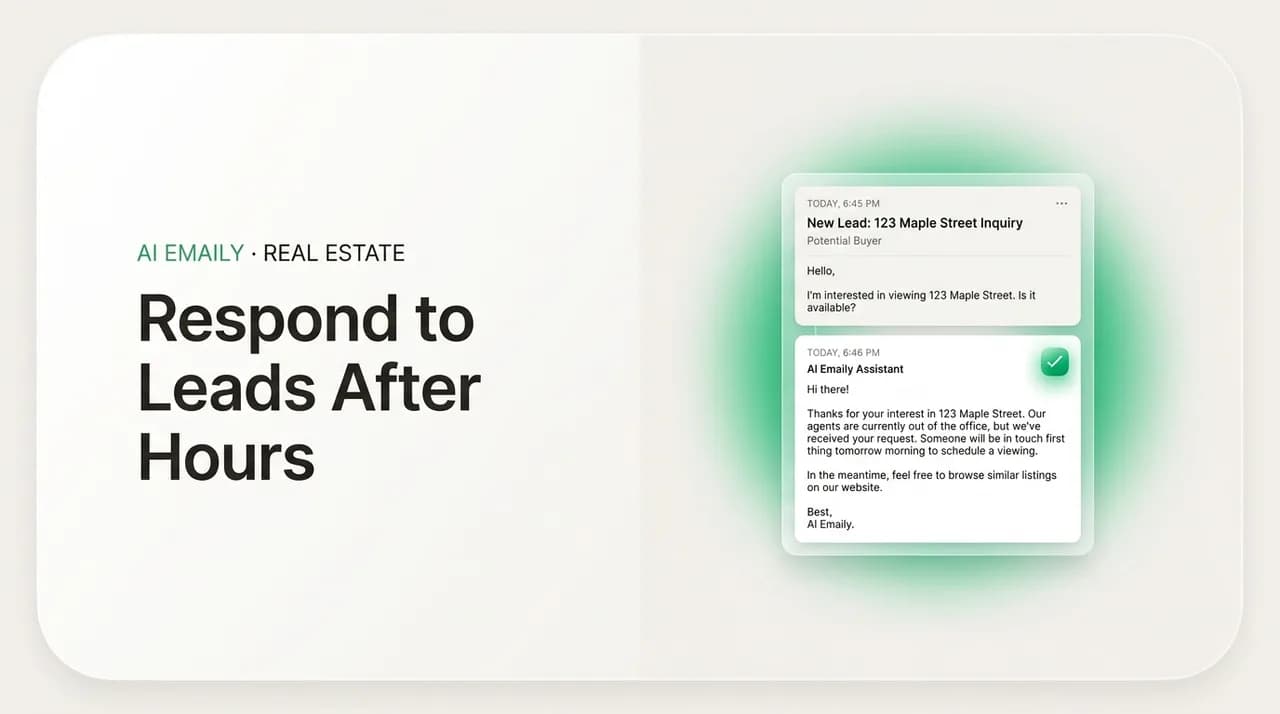
To respond to real estate leads after hours without working around the clock, send an instant, personal acknowledgement the moment an inquiry lands, then triage it by urgency. A same-minute reply keeps a portal lead warm until you can call in the morning, and an AI email client can send that first touch in your voice while you sleep, within rules you set.
How to respond to real estate leads after hours without working 24/7: why so many inquiries arrive at night, the cost of a morning-only reply, and how to build an instant-acknowledgement system with escalation rules that still feels personal.
On this page
- 01Why do so many real estate leads arrive after hours?
- 02What does a morning-only reply actually cost you?
- 03What are your options for covering nights and weekends?
- 04How do you build an after-hours system that still feels personal?
- 05What should an instant after-hours acknowledgement say?
- 06How do you set escalation rules without staying up all night?
- 07How do you protect your boundaries and avoid burning out?
- 08How does AI Emaily respond to real estate leads after hours?
- 09Putting it all together
Why do so many real estate leads arrive after hours?#
If you feel like half your inbox fills up after you have closed your laptop, you are reading your own data correctly. The people shopping for homes are, overwhelmingly, doing it in the evening. They finish work, eat dinner, put the kids to bed, and then open a portal on the couch. That is when a listing catches their eye, when a mortgage number finally makes sense, and when they tap the "contact agent" button. By the time you see the message, it is 7:14 the next morning and the lead is eleven hours cold.
This is not a quirk of your particular market. Home search has become a nights-and-weekends activity because that is when buyers and renters actually have time to look. Nearly every buyer now searches online at some point in the process, and the portals that dominate that search — the big listing sites, plus your own IDX pages and social ads — never close. A lead form submitted at 10 p.m. on a Tuesday looks exactly like one submitted at 10 a.m., except one of them is going to sit unanswered for the length of a full night's sleep.
The National Association of Realtors' research on how buyers shop confirms the shape of it: the overwhelming majority of buyers use the internet to search for homes, and for younger buyers the first step in the entire process is looking online. Online is available at 11 p.m. You, for good reasons, are not. That gap between when interest peaks and when a human is at the desk is the whole problem this article is about.
It helps to name the specific moments that generate after-hours inquiries, because each one has a different level of heat and a different right response.
- Portal and IDX form fills. A buyer browsing a listing site at night taps "request a showing" or "ask a question." These are often the warmest — the person is looking at a specific property right now.
- Evening open-house follow-through. Someone who walked a home over the weekend emails on Sunday night with the questions they thought of on the drive home.
- Relocation and out-of-timezone leads. A military family under PCS orders or a corporate transferee three time zones away emails at what is midday for them and midnight for you, on a hard deadline.
- Tenant and property-management traffic. For agents who also manage rentals, maintenance requests and lease questions do not respect business hours; a tenant with a problem at 9 p.m. wants an acknowledgement, not a voicemail.
- Weekend deal flow. Investor clients who think in numbers often review comps and cash-flow spreadsheets on weekends and fire off questions expecting a fast, data-forward reply.
What does a morning-only reply actually cost you?#
The instinct is to treat overnight leads as "I'll get to them first thing." First thing feels fast. It is not. The research on lead response is uncomfortable reading for anyone who waits until morning, and it has been consistent for well over a decade.
The most-cited study on this, the Lead Response Management research, found that the odds of qualifying a web lead drop sharply as the minutes pass — contacting a lead within the first few minutes rather than the first half hour makes you dramatically more likely to reach and qualify them. A Harvard Business Review analysis of the same problem found that firms trying to contact leads within an hour were many times more likely to have a meaningful conversation than firms that waited even a couple of hours, and that most companies were far too slow. An overnight lead answered at 8 a.m. is not answered in an hour. It is answered in ten.
There is a second cost that does not show up in the response-time studies but is obvious to any working agent: the lead did not email only you. Portal leads are frequently sent to several agents at once, and buyers who fill out one form fill out five. The first agent to respond with something human and useful sets the anchor. If you reply at 8 a.m. and a competitor's system replied at 10:02 p.m., you are not the first voice the lead heard — you are the follow-up.
Then there is the reputational cost, which is quieter but compounding. A prospect who emails and hears nothing for twelve hours forms an impression before you ever speak: this person is slow, or busy, or does not want my business. NAR's buyer research repeatedly finds that responsiveness and communication are among the top things clients value in an agent — and that many buyers now weigh an agent's use of technology when deciding who to work with. A morning-only reply signals the opposite of both.
None of this means the answer is to work all night. The point of measuring the cost is to separate two things that usually get bundled together: the acknowledgement, which genuinely needs to happen fast, and the real work — the call, the showing, the CMA — which can absolutely wait until you are awake and sharp. The rest of this article is about splitting those two apart so the fast part happens automatically and the human part happens on your schedule.
Acknowledgement is not the same as service
What are your options for covering nights and weekends?#
There are really only a handful of ways to answer a lead when you are not at your desk, and each trades money, quality, or control differently. It is worth being honest about all of them before jumping to any one solution, because the right answer for a first-time-buyer specialist is not the right answer for a property manager with round-the-clock tenant traffic.
Here is how the main options compare on the things that actually matter: how fast the lead hears back, whether the reply sounds like you, what it costs, and how much of your night it consumes.
| Option | Speed | Feels personal? | Cost & effort |
|---|---|---|---|
| Do it yourself, on your phone | Fast if you are awake and see it; otherwise not at all | Yes — it is genuinely you | Free, but it costs your evenings and burns you out |
| Virtual assistant (VA) | Depends on their shift and timezone; often not truly 24/7 | Somewhat — scripted, one step removed from you | Roughly $8–25/hr; needs training and oversight |
| Inside sales agent (ISA) or answering service | Fast during covered hours; gaps overnight unless staffed 24/7 | Variable — a stranger speaking for you | Salary or per-lead fees; the priciest option |
| Basic auto-responder | Instant | No — obviously canned, same text for everyone | Cheap or free, but can read as "do not reply" |
| AI email client (acknowledge + draft) | Instant, any hour | Yes — matched to your voice, specific to the message | Low monthly cost; you set the rules and keep control |
A few notes on the trade-offs, because the table flattens some real nuance.
Doing it yourself is the only option that is unquestionably, authentically you — and that is exactly why it does not scale. You cannot answer a 2 a.m. relocation lead and be sharp for a listing appointment at 9. The evenings you spend triaging your phone are evenings you are not resting, and the studies on agent burnout are not subtle. This is the default most agents fall into, and it is the one this whole article is trying to help you climb out of.
A VA or ISA can genuinely work, especially for teams with the volume to justify the cost and the process to train someone well. The catch is coverage and consistency: a single VA is not awake 24/7 either, per-lead ISA services get expensive fast, and a scripted stranger answering for you is only as good as the script and the training. For a solo or small-team agent, the overhead often outweighs the benefit for the overnight window specifically.
The basic auto-responder — the "Thanks, we got your message, we'll be in touch" bounce — is better than silence, but only just. Buyers can smell a canned reply, and a generic acknowledgement that ignores what they actually asked can feel like being put on hold. It buys you a little time but builds no rapport. The rest of this article is about how to do meaningfully better than that without hiring anyone.
How do you build an after-hours system that still feels personal?#
A good after-hours system is not one thing you buy. It is a small set of decisions you make once, so that when a lead lands at 11 p.m. the response is already determined and does not require you to be conscious. Think of it as three layers: an instant acknowledgement, a triage rule that sorts the message by urgency, and a clear handoff to the morning-you who does the real work. Get those three right and "after hours" stops being a scramble and becomes a system.
Here is how to build it, step by step. You can implement most of this manually with templates and filters, or let an AI email client run it for you — the logic is the same either way.
- 1
Segment your incoming leads before you write a single reply
Not every after-hours message deserves the same answer. Decide your buckets up front: hot portal lead on a specific property, general buyer inquiry, relocation with a deadline, tenant or maintenance issue, investor question, and obvious spam. Each bucket gets its own acknowledgement and its own escalation rule. Doing this once means the overnight system never has to improvise.
- 2
Write one strong acknowledgement per segment, in your voice
The first reply's only job is to make the person feel like a human read their message and to set the expectation of when they'll hear more. Reference the specific property or question when you can — "the three-bed on Maple" beats "your inquiry." Keep it to three or four sentences, warm and plain, no jargon. This is the template library your whole system runs on.
- 3
Set a clear expectation for the real reply
Every acknowledgement should say when a human follows up: "I'll call you first thing tomorrow morning," or "I'll have those comps to you by 9 a.m." A specific promise beats a vague one, and it converts the lead's impatience into a scheduled appointment in their head. Just make sure morning-you actually keeps it.
- 4
Define escalation rules for the genuinely urgent
Some things cannot wait for morning — a tenant with a burst pipe, a relocation client whose closing window is closing, a buyer ready to write an offer tonight. Decide in advance what counts as urgent and what happens when it does: a text to your cell, a forward to your on-call partner, or a specific line in the reply telling the person how to reach you right now if it truly cannot wait.
- 5
Capture the lead into your CRM automatically
An acknowledged lead that never makes it into your database is a lead you'll forget by Thursday. Make sure every overnight inquiry is logged with source, property, and the promise you made, so morning-you has a clean queue instead of a scavenger hunt through the inbox.
- 6
Review the queue first thing and do the human work
The system's job ends where yours begins. Each morning, work the overnight queue in order of heat: call the hot portal leads first, send the promised comps, book the showings. The acknowledgements held the leads; now you convert them — rested, sharp, and on your own schedule.
The thread running through all six steps is that the personal part and the fast part happen at different times. The acknowledgement is fast and can be automated because it is bounded — you decided in advance what it says. The conversion is personal and stays human because it is unbounded — it is a real conversation you have when you are awake. Systems that feel robotic usually fail because they try to automate the conversation. Systems that feel personal automate only the acknowledgement and protect the conversation.
Name the property, not "your inquiry"
What should an instant after-hours acknowledgement say?#
Templates are where the system becomes real. Below are acknowledgements for the most common after-hours segments. They are deliberately short, specific, and warm, and each one sets a clear expectation for the real follow-up. Swap in your details, your voice, and your actual next-morning promise. The bracketed fields are what a good system fills in automatically from the lead source.
Start with the warmest and most common: a portal lead on a specific listing.
For a general buyer inquiry with no specific property attached, acknowledge the intent and steer gently toward a call, which is where these convert.
Relocation and out-of-timezone leads are deadline-driven and often mid-move. Acknowledge the constraint and the timezone gap explicitly, because these clients are anxious about exactly that.
For agents who also manage rentals, a tenant or maintenance message at night needs a different tone: reassurance and a clear line between "emergency" and "morning." This is the segment where a fast acknowledgement matters most, because a tenant left waiting until morning is a tenant who feels ignored.
Always give an emergency out
How do you set escalation rules without staying up all night?#
Escalation is the part people skip, and it is the part that keeps an after-hours system honest. The whole premise — that most overnight leads can wait until morning — only holds if the rare message that genuinely cannot wait has a way to reach you. Without an escalation path, you either check your phone all night (defeating the point) or you miss the one lead that mattered (defeating the point differently).
The fix is to decide, in advance and in writing, three things: what counts as urgent, what happens when something urgent arrives, and what the reply tells the sender about reaching you now. Keep the list of "urgent" short and honest — if everything is urgent, nothing is, and you are back to answering your phone at 2 a.m.
- Define "urgent" narrowly. A tenant safety issue, a relocation client past a hard deadline, or a buyer explicitly saying they want to write an offer tonight. Not "a new lead came in." New leads are normal, not emergencies.
- Route urgent messages to a channel you actually monitor. A text to your cell or a push notification cuts through in a way that another email in the pile never will. Decide the channel and make sure it is one that wakes you only for things worth waking for.
- Build an on-call handoff if you have a partner or team. Alternate who carries the phone on weekends. Even a two-agent rotation means each of you sleeps every other night knowing the other has it.
- Put a self-serve escalation line in every acknowledgement. "If this can't wait, reply URGENT or call me at [number]." This pushes the judgment call to the sender, who knows better than any rule whether their thing is truly an emergency — and most of the time they will simply wait for morning.
- Log everything so nothing depends on memory. An urgent item you handled at 11 p.m. still needs to be in the queue tomorrow so it doesn't fall through the crack between "I dealt with it last night" and "I forgot the details by morning."
The point of good escalation rules is not to catch more work at night. It is to let you confidently ignore almost everything at night, because you trust the small number of things that truly need you to break through and everything else to wait. A system without escalation makes you anxious and you check constantly. A system with clear escalation lets you actually close the laptop.
How do you protect your boundaries and avoid burning out?#
There is a version of "respond to leads after hours" that quietly turns into "never stop working," and it is worth naming, because it is the failure mode this whole approach exists to prevent. The goal is not to be available 24/7. The goal is for your business to feel available 24/7 while you are asleep. Those are very different things, and conflating them is how good agents burn out and start resenting the leads they worked so hard to get.
The instant acknowledgement is what makes boundaries possible, not what erodes them. Once a lead has heard back within a minute — warmly, specifically, with a clear promise of a morning call — the pressure is off. You do not have to answer them tonight, because the system already did the one time-sensitive thing. That is the trade: you give up doing the acknowledgement personally, and in exchange you get your evenings back without leaving anyone hanging.
- Decide your real hours and let the system cover the rest. If you take calls until 8 p.m., say so, and let acknowledgements handle everything after. Publishing hours is not slow; it is professional.
- Batch the overnight queue instead of grazing it. Working the whole overnight batch once in the morning is faster and less draining than answering leads one at a time across the evening.
- Trust the acknowledgement to hold the lead. The research says speed matters most in the first minutes; a same-minute acknowledgement captures that, so the human follow-up a few hours later is not the make-or-break moment it feels like at 11 p.m.
- Keep one true off-switch. Even with a great system, protect at least one block — a weekend morning, a weeknight dinner — where not even escalation reaches you, because sustainable beats heroic every time.
- Measure conversion, not hours online. If your overnight leads convert as well as your daytime ones, the system is working. Hours spent staring at your phone is the wrong metric; booked appointments from acknowledged leads is the right one.
Availability is a feeling, not a schedule
How does AI Emaily respond to real estate leads after hours?#
Everything above is doable by hand — templates, filters, a text-me-if-urgent rule. The reason most agents don't run it consistently is that it takes discipline to maintain and someone awake to trigger it. This is exactly the gap an AI email client is built to close. AI Emaily is an AI-native email client that connects to Gmail, Outlook, and any IMAP account, and it can run your after-hours acknowledgement system automatically, in your voice, within rules you set — so a lead that lands at 11 p.m. hears back at 11:01 while you're asleep.
Here is honestly what it does and does not do. When an after-hours lead arrives, AI Emaily reads the message, identifies what kind of lead it is, and drafts a specific acknowledgement in your writing style — referencing the property or question, setting the morning-follow-up expectation, and including your escalation line. Because it learns how you actually write, the reply reads like you rather than like a bounce message. That first-touch acknowledgement is exactly the templated, low-risk work that is safe to handle end to end.
How that acknowledgement gets sent is your call, through the three modes the whole product runs on:
- Manual: nothing sends without you. The draft is ready in your inbox; you review and send it yourself in the morning. Slower, but fully hands-on.
- Copilot: AI Emaily drafts every after-hours acknowledgement and holds it for your approval. Good if you want speed on the drafting but a human check before anything goes out — which for higher-stakes or luxury leads is the right default.
- Autopilot: within rules you define, AI Emaily sends the acknowledgement itself, instantly, at any hour. This is where after-hours coverage actually happens while you sleep. You choose which lead types qualify — routine portal acknowledgements and tenant maintenance confirmations are the safest; anything you flag stays a draft.
Autopilot for after-hours is deliberately bounded, because sending on your behalf is a serious thing. You set the rules: which segments auto-send, which quiet hours it covers, and what always escalates to you instead. Every action is reversible with undo, and every send is written to a full audit trail, so you can see exactly what went out overnight, to whom, and why — and unwind anything that wasn't right. The design principle is that the agent handles the bounded, repetitive acknowledgement and hands you the real conversation. It does not try to sell a house at midnight; it makes sure the lead is still warm when you wake up.
The result is the split this article has been building toward. The fast part — the same-minute, voice-matched acknowledgement that captures the lead while the interest is hot — runs on its own overnight. The human part — the call, the showing, the CMA, the relationship — is still entirely yours, done rested and on your schedule. You cover nights and weekends without working nights and weekends. You can try it free at app.aiemaily.com/signup, with a Free plan at no cost and Pro at $12.42 per month on the annual plan.
Putting it all together#
Real estate leads arrive after hours because home shopping is an evening-and-weekend activity, and the portals that drive it never close. A morning-only reply is slower than it feels — the research is blunt that the odds of qualifying a lead fall fast in the first minutes — and it hands warm prospects to whichever competitor answered first. But the fix is not to work around the clock.
The fix is to split the response in two. The acknowledgement is time-sensitive and bounded, so automate it: one strong, personal reply per lead type, sent instantly, in your voice, with a clear promise of a morning follow-up and an escalation line for the rare true emergency. The conversion is personal and unbounded, so keep it human: work the overnight queue each morning, rested and sharp, and do the real work of calling, showing, and closing.
Build that system with templates and filters, or let an AI email client run it for you within rules you set, with undo and an audit trail so you stay in control. Either way, the outcome is the same: every lead hears back within a minute, no matter the hour, and you still get to close your laptop and sleep. That is what it means to respond to real estate leads after hours without working 24/7.
Frequently asked
See it in AI Emaily
Keep reading
Sources

Written by
Nafiul HasanNafiul Hasan is an entrepreneur and AI automation system builder with 10+ years of experience turning messy, manual workflows into reliable automated systems. He designs and ships AI enterprise solutions end-to-end — the agent logic, the data plumbing, and the product people actually use — and founded AI Emaily to give busy professionals their attention back. He writes here from the builder's seat: what works, what breaks, and how to put AI to work without giving up control.