The Property Manager's Monthly Owner Report Email: What to Include, How to Structure It, and How to Automate Delivery (2026)

The short answer
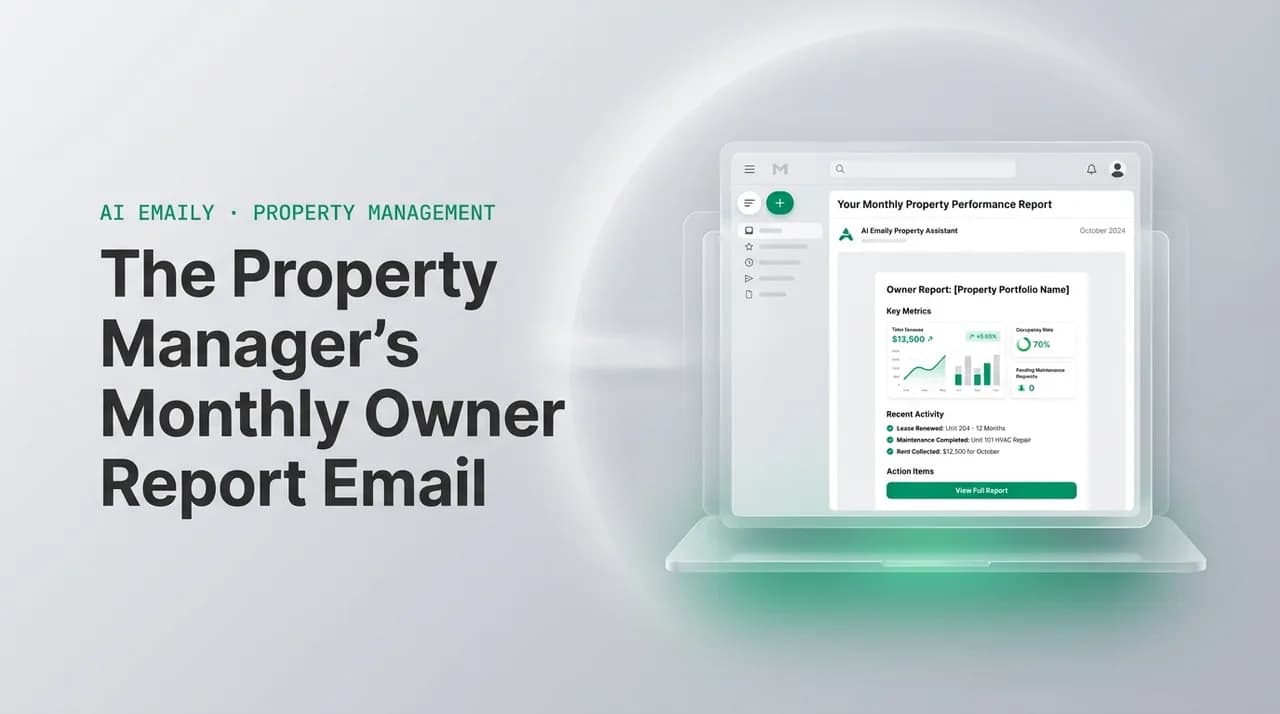
The monthly owner report email should open with the one number the owner cares about, then cover occupancy, income, expenses, maintenance, and next month's outlook in that order — never bury bad news. Send it by the same date every month, in writing, even when the report itself lives in a portal. Automating the narrative (not the numbers) is what actually saves the hours, as long as a person reviews it before it goes out.
How to write the property management report to owner email: what to include, how to structure the narrative, and how to automate delivery without sounding robotic.
On this page
- 01What exactly goes in a monthly owner report email?
- 02How is the report email different from the report itself?
- 03How often should property managers send owner reports — and by when?
- 04What's the ideal structure for the report narrative?
- 05How do you handle owner reports across a large portfolio without it becoming a form letter?
- 06Does the owner report look different for short-term and mid-term rentals?
- 07What belongs in the email when there's a distribution or disbursement, not just a report?
- 08How do you write the email when the month was bad?
- 09What does a strong owner report narrative actually sound like?
- 10How do you automate delivery without it reading like a form letter?
- 11Should the report sound different for a hands-off investor versus a first-time landlord?
- 12What owner-communication mistakes actually cause PMs to get fired?
- 13What if an owner never replies to the report at all?
- 14Does the owner report have any compliance obligations behind it?
- 15Email and PDF, or an owner portal — which one do owners actually want?
- 16What does poor owner communication cost a property management business?
- 17How do you introduce the reporting process to a new owner during onboarding?
- 18How does AI Emaily automate the owner report narrative?
Every property manager eventually sends the same email, every month, to every owner on the roster. It's the property management report to owner email, and it is the single most-read message you will ever write for a client, because it is the one moment each month where an investor who otherwise never thinks about their rental decides whether you're doing a good job. Get it right and it becomes your best retention tool — better than any glossy pitch deck, because it's proof, delivered on a schedule, that you have the property under control. Get it wrong — late, vague, missing the number the owner actually cares about, or silent in a month things went sideways — and it becomes the reason a well-managed property quietly leaves for a competitor at lease renewal.
This sounds like a solved problem. Every property management platform on the market — Buildium, AppFolio, DoorLoop, Rentvine — generates an owner statement: a PDF or portal view with income, expenses, and a running balance. What almost none of them do well is the email that wraps around it: the two or three paragraphs of narrative that tell the owner what the numbers mean, why a repair line item is bigger than usual, and what's coming next month. The report is data. The email is the relationship. This guide is about the email — what belongs in it, how to structure it so a busy owner reads it in ninety seconds and comes away reassured, and how to automate the parts that are safe to automate without losing the parts that aren't.
Search for advice on this and you'll mostly find content about the report itself — which line items to track, how to calculate net operating income, which accounting fields your software needs. That's useful, but it treats the report like an artifact and ignores the fact that most owners never open the PDF at all. They read the email. If the email doesn't tell them what they need to know, the report might as well not exist. The gap between "we generated a statement" and "the owner feels informed" is exactly where property managers lose owners — not because the numbers were wrong, but because nobody translated them.
What exactly goes in a monthly owner report email?#
A good owner report email is short — most owners want the headline in the first sentence and the detail available if they want it, not the other way around. It covers five things, roughly in this order of importance to the reader: what came in, what went out, what's occupied, what needed fixing, and what's coming next month. Everything else — the full ledger, the itemized maintenance invoices, the lease documents — belongs in an attachment or a portal link, not in the body of the email.
The order matters more than most property managers give it credit for. An owner opening this email on their phone between meetings is scanning for one thing: is my property okay, and did I make money this month. Bury that under three paragraphs of maintenance-vendor logistics and you've already lost them, even if the news is good. Lead with the answer, then support it.
| Section | What it covers | Why the owner cares |
|---|---|---|
| Headline | Net cash to owner, or the one number that changed most this month | This is what they scan for first — everything else is context for this figure |
| Occupancy | Leased status, lease-end date, any vacancy or upcoming turnover | Vacancy is the fastest way an owner's income surprises them — flag it before they ask |
| Income | Rent collected, any late payments or partial payments, other fees | Confirms the property is performing and shows you're tracking collections closely |
| Expenses | Maintenance, management fee, any one-off costs above the routine | Owners accept normal costs; what erodes trust is an unexplained large expense |
| Maintenance | What was fixed, what's pending, what it cost and why | This is where "why is this line item so high" questions come from — answer them first |
| Outlook | Anything coming next month: lease renewal, known repair, rate change | Turns you from a reporter of the past into a manager of the future — this is the trust builder |
How is the report email different from the report itself?#
The report — the statement, the ledger, the PDF your accounting module spits out — is a record. It's built for audit, for tax season, for the owner's accountant to reconcile against a Schedule E filing at year end. It needs to be complete, itemized, and defensible. The email is not a record. It's a translation. Its job is to take that record and answer, in plain language, the two or three questions an owner actually has this month, so they don't have to open the attachment to find out if everything's fine.
Conflating the two is the single most common mistake in owner communication. A property manager who pastes the full ledger into the body of an email, or writes "please see attached statement for details" with nothing else, has technically reported — and has told the owner nothing. The owner still has to do the work of interpreting the numbers, and if they're not looking closely, a legitimate but unusual expense line reads as a red flag with no explanation attached. The email exists specifically to remove that work from the owner's side of the relationship and put it on yours, where it belongs — you're the one being paid to manage the asset and to know why the numbers look the way they do.
Reporting is part of the job, not an add-on to it
How often should property managers send owner reports — and by when?#
Monthly is the standard cadence for long-term rentals, and it should land on a date the owner can set a clock by. Many management companies target somewhere around the third week of the month, after rent has posted and any month-end reconciliation is done, but the exact date matters less than the consistency of it. An owner who knows the report always arrives by the 20th stops thinking about it between reports — which is exactly the state you want them in. An owner who gets it on the 15th one month and the 27th the next starts wondering what else is inconsistent.
Short-term rental and mid-term rental owners often expect a tighter loop — some want a lighter monthly summary plus real-time alerts on bookings and larger repairs, since occupancy and revenue swing faster in that model than in a 12-month lease. The principle carries over either way: pick a cadence you can actually hit every single month without exception, commit to it in writing when you onboard a new owner, and treat a missed date as a service failure, not a scheduling inconvenience. Consistency is doing more of the trust-building work here than content quality — an owner who trusts your timing will forgive a plainer report; an owner who doesn't trust your timing will scrutinize a beautiful one.
What's the ideal structure for the report narrative?#
Structure the email so an owner can get everything they need from the first three lines, with the rest available for whoever wants it. Open with a one-line headline: net proceeds this month, and how it compares to last month or to the pro forma if there's a meaningful gap. Follow immediately with occupancy status, because that's the second thing every owner checks. Then walk through income, expenses, and maintenance in a short paragraph each — specific enough to answer the obvious follow-up question, brief enough that nobody has to skim past filler to get through it.
Close with an outlook paragraph: what's coming next month that the owner should know about before it happens, not after. A lease renewal decision point, a repair you're watching, a rate change you're proposing. This is the section that turns the email from a report of the past into evidence you're actively managing the property, and it's the section owners remember. A report that only ever looks backward reads as bookkeeping. A report that also looks forward reads as management.
- Headline number first — never make the owner hunt for it in paragraph three
- Occupancy status second — it's the fastest read on whether income is at risk
- One short paragraph each for income, expenses, and maintenance — specific, not exhaustive
- An outlook line naming anything material coming next month, before it happens
- A clear, low-friction way to ask a question — a reply, not a support ticket
Keep the full detail — the itemized ledger, contractor invoices, lease copies — as an attachment or a portal link rather than in the body. Owners who want to dig in will click through; owners who just want the headline get it without wading through a wall of line items on their phone. The email's job is to make the click optional, not mandatory.
One more structural detail that trips up new property managers: subject lines matter more than they seem to. A subject like "June statement" or "Monthly report" is easy to skim past in a crowded inbox, and it gives the owner no information before they open it. A subject that includes the address and the headline number — something like "142 Birchwood — June: $1,410 net, fully occupied" — lets the owner register the important fact even if they never open the email at all, and it makes the report instantly searchable later when they're trying to find "the month the water heater went out."
How do you handle owner reports across a large portfolio without it becoming a form letter?#
The math changes once you're managing forty, eighty, or two hundred doors instead of five. Writing a genuinely custom narrative for every owner every month is not realistic at that scale, and pretending it is leads to burnout, not better reports. But the alternative most companies default to — one templated paragraph, mail-merged with the property address swapped in — is exactly the form-letter feel that makes owners stop reading. The way through is to separate what has to be identical from what has to be specific, and be disciplined about which is which.
The mechanical skeleton — headline, occupancy, income, expenses, maintenance, outlook — can and should be identical in structure for every owner in the portfolio. What has to vary, every single time, is the one or two sentences that explain whatever was actually unusual that month for that specific property. A vacancy, a large repair, a late payment, a lease decision point. If nothing was unusual, the report can be short and confident and still feel specific, because it correctly reports a quiet month rather than reusing last month's paragraph verbatim.
- Keep the skeleton (section order, headline placement, tone) identical across every owner — consistency here reads as professionalism, not laziness
- Flag anything outside the normal range for each property before drafting a word of narrative
- Write the one or two sentences of context only for what's actually flagged — a quiet property gets a short, honest "nothing unusual this month" rather than padding
- Batch the mechanical data pull across the whole portfolio at once, but review each owner's narrative individually before it sends
- Rotate who reviews if more than one person handles owner communication, so no owner's report quietly becomes the one nobody double-checks
This is also where the gap between "automated" and "automatic" matters. Automating the pull of numbers and the assembly of a draft for eighty owners in one pass saves real hours every month. Automatically sending all eighty without a human glance at each one is where a portfolio-wide mistake — a miskeyed expense, a maintenance note that reads wrong out of context for one specific owner — can reach dozens of people before anyone catches it. Scale is exactly the argument for keeping review in the loop, not the argument for removing it.
Does the owner report look different for short-term and mid-term rentals?#
The structure holds, but the cadence and the headline metric shift. A long-term rental owner cares most about occupancy and net rent; a short-term rental owner's month can swing widely on booking volume, average nightly rate, and platform fees, so the headline is often revenue and occupancy rate rather than a single flat rent figure. Many short-term rental owners also want a lighter-weight monthly summary supplemented by real-time alerts for anything urgent — a large repair, a guest incident, a booking cancellation — rather than waiting a full month to hear about something that happened on the second day.
Mid-term rental owners, whose properties are often filled by travel nurses or relocating professionals on 30-to-90-day stays, sit somewhere between the two: occupancy still matters most, but the report should also flag anything about tenant screening or lease-term changes that a traditional annual-lease report wouldn't need to mention. In every case, the underlying discipline is the same — lead with what the owner checks first, explain anything unusual in plain language, and keep the report on a schedule the owner can predict, even if that schedule is tighter for a property that turns over every few weeks instead of every year.
What belongs in the email when there's a distribution or disbursement, not just a report?#
Many property managers send the owner report and the owner disbursement — the actual transfer of net proceeds — as two separate events, sometimes on different days depending on when the trust or operating account reconciles. When they're separate, say so plainly: an email that reports a number without confirming when that money actually moves creates a small but real anxiety gap, especially for an owner relying on that income. "Net proceeds of $1,410 will disburse to your account on the 25th" closes that gap in one sentence.
If your process combines the two — the report doubles as the disbursement notice — make that connection explicit rather than assumed. State the disbursement date and method (ACH, check, portal transfer) in the same paragraph as the headline number, not as an afterthought at the bottom. Owners who manage their own cash flow around rental income are, in practice, reading this email as much for the transfer date as for the performance summary, and a report that nails the narrative but leaves the disbursement timing vague hasn't actually finished its job.
How do you write the email when the month was bad?#
This is where most property managers actually lose owners, and it's rarely because something went wrong — things go wrong on every property eventually. It's because the report that month got vague, late, or quietly omitted the thing the owner most wanted explained. A burst pipe, an eviction, a vacancy that ran long, a maintenance bill that blew past the usual range — every one of these is defensible if you lead with it and explain your handling. Every one of them looks like something hidden if the owner has to find it buried in an expense line with no context.
The instinct to soften bad news by burying it is understandable and almost always backfires. An owner who scans the headline, sees a lower number than expected, and then has to dig through the email to find out why loses more trust in the digging than they would have lost from the number itself. Say what happened, in the first or second sentence, in plain terms. Then explain what you did about it, what it cost, and what you're doing to prevent a repeat if that's relevant. An owner who reads "the water heater failed on the 8th, we had it replaced same-day to avoid a habitability issue, cost was $X against a $Y reserve" trusts you more after that email than before it — because you handled a real problem and told them plainly.
Bad news travels better first
What does a strong owner report narrative actually sound like?#
Below is a realistic monthly report email, written the way a property manager sending this every month for a single-family rental might actually word it — specific enough to be useful as a template, generic enough to adapt to any property.
Notice what this email doesn't do: it doesn't restate every line of the ledger, it doesn't hedge the maintenance cost with excessive detail, and it doesn't wait until the end to mention the upcoming renewal. It answers the three things this owner actually needed to know and gets out of the way. That's the target for every report, whether the property is a single unit or one of forty in a portfolio the owner barely thinks about day to day.
How do you automate delivery without it reading like a form letter?#
The instinct once you're managing more than a handful of doors is to template the whole thing and mail-merge it out. That works for the numbers — income, expenses, occupancy status pull cleanly from your PM software every time — and fails for the narrative, because a report that reads identically every month, regardless of what actually happened, stops being read at all. Owners tune out repetition fast; a report that never varies its language starts to feel like noise even when the underlying management is fine. The goal is to automate the mechanical parts (pulling the numbers, formatting the email, scheduling the send) while keeping the narrative specific to what actually happened that month.
Here's a sequence that scales from a handful of owners to a large portfolio without losing the specificity that makes the report worth reading:
- 1
Pull the structured numbers first
Export or paste the month's income, expenses, occupancy status, and maintenance line items from your property management software. This is the mechanical part — it should never require a human to retype anything.
- 2
Flag anything outside the normal range
Before writing a word, mark any line item that's meaningfully larger, smaller, or different from a typical month — a repair over your usual threshold, a late payment, a vacancy. These are what the narrative needs to explain; everything else can stay brief.
- 3
Draft the narrative from the flagged items, not from scratch
Write (or have a tool draft) the two or three sentences of context the flagged items need, plus a one-line outlook for next month. A routine month gets a short, confident narrative; an unusual month gets the plain explanation it needs.
- 4
Review every draft before it sends — no exceptions
Even with a repeatable process, a human should read each owner's email before it goes out. Numbers get miskeyed, a maintenance note can read wrong out of context, and an owner relationship is exactly the wrong place to find that out after the fact.
- 5
Send on the same date every month, and log that it sent
Consistency is most of the trust here. Keep a simple record of when each owner's report went out so you can prove your own reliability if it's ever questioned, and so a missed month gets caught immediately rather than at renewal time.
The step that's tempting to skip — review before send — is the one that actually protects the relationship. Automation should remove the hour of copy-pasting numbers into a template every month, not remove the person who decides whether this particular email, to this particular owner, in this particular month, says the right thing. Autopilot only earns its keep here once you trust the drafts it's producing; until then, every report gets a human's eyes first.
Should the report sound different for a hands-off investor versus a first-time landlord?#
The structure stays the same, but the amount of reassurance built into the wording shouldn't. A hands-off investor with a dozen properties in different states wants the headline number, confirmation that nothing needs their attention, and to be done reading in under a minute — extra explanation of routine items reads as noise to them, not care. A first-time landlord who inherited a rental or bought their first investment property is often anxious in ways the numbers alone won't address: they want to know that a $185 repair is normal, not a sign the property is falling apart, and a report that states that plainly does real work beyond the number itself.
The easiest way to calibrate this without maintaining two templates is to notice how each owner has responded in the past. An owner who has never once asked a follow-up question in eighteen months of reports is telling you the current level of detail is right, or possibly too much. An owner who replies to every report with a question about a line item is telling you they want more context up front, not less — and giving it to them proactively usually reduces the total number of email exchanges rather than increasing it, because you're answering the question before it's asked instead of after.
What owner-communication mistakes actually cause PMs to get fired?#
Owners rarely leave a property manager over a single bad month. They leave because a pattern of silence made them stop trusting that anyone was paying attention. The complaints that show up over and over in owner-side forums and investor communities aren't about rent collection mechanics or maintenance quality — they're almost always about not hearing anything, hearing about a problem too late, or getting a generic report that doesn't answer an obvious question. A property manager can be doing excellent work on the ground and still lose the account because the owner never found out about it in a form they could actually read.
This is also why the failure often isn't visible until it's too late to fix cheaply. An owner who is quietly accumulating doubt from three or four thin reports in a row rarely emails to complain about it — they just start returning calls from other property management companies more readily than they used to, and by the time the account is formally at risk, the relationship has already been eroding for months. Treating each month's report as a small, independent deposit into that trust account is the most reliable way to avoid ever finding out about the erosion only when it's already a lost renewal.
The fix costs nothing to implement and has nothing to do with how well the property is actually managed day to day — it's purely a communication discipline. A report that arrives on schedule, leads with the number the owner cares about, and explains anything unusual in plain language closes almost every one of these gaps before an owner has a reason to open a forum thread about it.
Never promise more in writing than your process can back up
What if an owner never replies to the report at all?#
Silence from an owner is easy to misread as approval, and sometimes it is exactly that — a hands-off investor who trusts the process and only reads closely if a number looks off. But it's worth distinguishing that from an owner who has quietly stopped opening the email altogether, because the two look identical from your side of the inbox and require opposite responses. A reliable way to tell them apart is to occasionally ask a direct, low-effort question in the report itself — "any questions on this month, or should I keep the renewal at the current rate?" — and see whether it gets a response. An engaged-but-quiet owner will usually answer a direct question even if they never comment on the report itself; a disengaged one often won't, and that's useful information before a renewal conversation catches you by surprise.
Don't mistake a lack of replies for a lack of attention on the owner's part in the other direction either — some of the owners least likely to respond to a routine report are the ones most likely to react strongly if something goes wrong and they feel they weren't warned. The report's job is to make sure that if an owner is quietly paying close attention, they always have the information they'd need to trust your handling, whether or not they ever click reply.
Does the owner report have any compliance obligations behind it?#
Reporting itself isn't usually the regulated part — how you handle owner funds is. Most states require trust or escrow accounting for rent and security deposits collected on an owner's behalf, with specific rules about commingling, disbursement timing, and recordkeeping. The monthly report and the disbursement it describes should reflect that underlying trust accounting accurately; the email is a communication artifact, but the numbers in it need to tie back to books that would hold up if an owner, a regulator, or the owner's accountant ever asked to see them.
This is also part of why the report belongs to the property manager and shouldn't be delegated to a template nobody checks. An email that states a disbursement date, an expense figure, or an occupancy status that doesn't match the underlying trust ledger is a bigger problem than an awkwardly worded paragraph — it's a discrepancy between what you told an owner and what your books actually say. Whatever process you build to speed up the narrative, the numbers themselves should always trace back to the same source of truth your accounting and any regulatory recordkeeping relies on.
Email and PDF, or an owner portal — which one do owners actually want?#
Most property management platforms now offer an owner portal — a login where the owner can view statements, documents, and maintenance history whenever they want. Portals are genuinely useful for owners who want to dig into details, pull a document for their accountant, or check history from six months ago. What they are not is a substitute for the email. Most owners do not proactively log into a portal every month; they wait to be told something happened, and the email is what tells them. A portal with no accompanying notification is a report nobody reads.
The practical answer for most portfolios is both: the portal as the system of record, and a short email every month as the notification and narrative layer that tells the owner what changed and points them to the portal if they want more. Treat the portal as storage and the email as the actual communication, and you avoid the common failure mode of a beautifully built portal that owners simply never open.
| Format | Best for | Where it falls short |
|---|---|---|
| Email narrative | Monthly touch point, flagging anything unusual, the relationship layer | Not a system of record on its own — needs an attachment or portal link for full detail |
| PDF attachment | A complete, itemized, printable statement for the owner's own records | Rarely read start to finish; most owners skim or skip it if the email already answered their question |
| Owner portal | Historical lookups, document storage, self-serve access for accountants | Passive — owners who aren't told something changed usually don't log in to check |
What does poor owner communication cost a property management business?#
The direct cost of a missed or thin owner report is easy to underestimate because it doesn't show up immediately. Nothing breaks the month a report is late or vague — the property still gets managed, rent still gets collected. The cost shows up later, at lease renewal or contract renewal, when an owner who has spent months feeling uninformed decides to interview other management companies rather than automatically renew. By the time that conversation happens, the actual quality of the maintenance work or the collections process barely factors in; the deciding memory is how it felt to not know what was going on.
For a management company running dozens or hundreds of doors, this compounds. Every owner relationship lost to a communication gap is a door that has to be replaced through new business development, which is a far more expensive way to grow than simply keeping the doors you already have. The report email is, in that sense, one of the cheapest retention tools available to a property management business — it costs a few minutes a month per owner and directly addresses the reason owners actually leave.
| Signal | What it usually leads to |
|---|---|
| Report arrives on a different date every month | Owner starts wondering what else is inconsistent behind the scenes |
| Report lists numbers with no explanation of anything unusual | Owner assumes the worst about any large line item, absent context |
| A promised follow-up (renewal analysis, repair update) never arrives | Trust erodes faster than if the follow-up had never been mentioned |
| Owner has to log into a portal to find out anything happened | Most owners simply stop checking, then feel blindsided later |
| Report is the only touch point all month, even during a problem | A single bad month reads as a pattern rather than an isolated event |
How do you introduce the reporting process to a new owner during onboarding?#
Set the expectation before the first report ever goes out, not after. When you sign a new owner, tell them explicitly what they'll receive, on what date, and in what format — "you'll get a short email from me around the 20th of every month with your net proceeds, occupancy status, and anything that needs your attention; the full statement and documents live in your portal" — so the first report isn't the moment they discover what your process looks like. Owners who know what's coming read the first report as confirmation the process is working exactly as promised, which builds trust faster than the report's content alone would.
This is also the moment to set the bar for what counts as unusual enough to flag versus routine enough to summarize briefly, so the owner isn't surprised later by a quiet month's shorter email. A sentence like "if nothing unusual happens, the report will be brief — that's a good sign, not something I'm skipping" heads off the common misread where a shorter-than-expected email gets interpreted as a sign you didn't look closely, when it's actually the correct response to a quiet month.
How does AI Emaily automate the owner report narrative?#
We build AI Emaily, and this is one of the clearer places an AI-native email client earns its keep for a property management business rather than just organizing an inbox. The mechanical part of the report — pulling occupancy, income, expenses, and maintenance line items — already lives in your property management software; that's not something an email client should try to replace. What AI Emaily does is take those structured numbers, once you paste or forward them in, and draft the narrative around them: the headline sentence, the plain-language explanation for anything unusual, and the outlook line for next month, in a voice that matches how you actually write to owners rather than a generic template.
The control model matters as much as the drafting. Every owner report drafted this way sits in Copilot review before it goes anywhere — you read it once, adjust anything that needs a human correction, and approve the send. For a portfolio where the report content genuinely doesn't vary much month to month — a stable property, no unusual repairs, occupancy unchanged — some management companies move the routine version of that report into Autopilot, inside rules they set, so a quiet month's report goes out on schedule without manual review while anything flagged as unusual still routes to a human. Every send, in either mode, has undo and a full audit trail, so there's a record of exactly what went to which owner and when — useful on its own merits, and directly relevant if an owner ever disputes what they were told and when.
None of this changes what belongs in the report or how it should read — the structure and honesty rules in this guide apply whether you're drafting the email yourself at 11 p.m. or reviewing a draft AI Emaily prepared from your numbers. What changes is how many hours a month it costs to get a genuinely specific, non-templated report in front of every owner on schedule. AI Emaily connects to Gmail, Outlook, and IMAP, so this works whatever your existing setup is, and there's a Free tier to try it before deciding whether Pro or Team fits a growing portfolio.
For a management company running a large roster, this is also where the portfolio-scale problem from earlier in this guide gets easier: the mechanical skeleton stays consistent across every owner, while the narrative for each one is drafted from that specific property's flagged items rather than a single shared paragraph mail-merged with the address swapped in. A quiet property gets a short, honest report; a property with an unusual repair or a vacancy gets a narrative that actually explains it — and a person still reads every single one before it reaches an owner's inbox.
The owner report email is small, unglamorous, and easy to let slide during a busy month — which is exactly why it's worth building a repeatable system around instead of relying on remembering to do it well every time. Lead with the number the owner cares about, explain anything unusual in plain language before they have to ask, send it on a date they can set a clock by, and keep a human reviewing the narrative even after you automate the parts that are safe to automate. Owners rarely leave over one bad month. They leave when they stop feeling informed. The monthly report, done consistently, is the cheapest way to make sure that never happens.
Frequently asked
See it in AI Emaily
Keep reading
Sources

Written by
Nafiul HasanNafiul Hasan is an entrepreneur and AI automation system builder with 10+ years of experience turning messy, manual workflows into reliable automated systems. He designs and ships AI enterprise solutions end-to-end — the agent logic, the data plumbing, and the product people actually use — and founded AI Emaily to give busy professionals their attention back. He writes here from the builder's seat: what works, what breaks, and how to put AI to work without giving up control.