Tenant and Guest Email Templates for Landlords

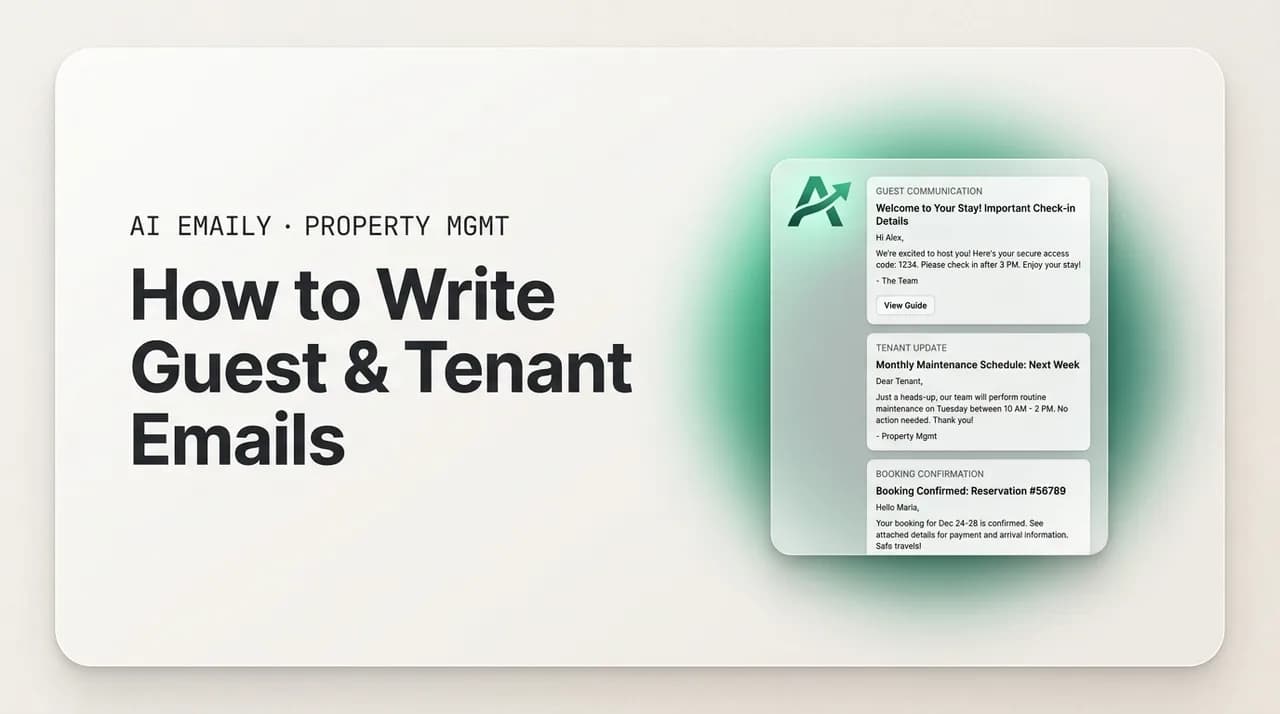
The short answer
Good tenant and guest emails are clear, professional, consistent, and documented. State the point in the first line, give exact dates and amounts, keep one message to one purpose, and use the same neutral language for everyone. Copy the templates below, swap in your details, and keep a record of what you sent.
Copy-paste tenant and guest email templates for rent reminders, late rent, lease renewals, maintenance updates, deposit returns, and guest check-in.
On this page
- 01Why guest and tenant emails are worth getting right
- 02The four principles behind every good tenant or guest email
- 03How do you write a welcome email to a new tenant or guest?
- 04How do you write a rent reminder email?
- 05How do you write a late-rent notice without escalating?
- 06How do you write a lease renewal email?
- 07How do you write a maintenance update email?
- 08How do you write a rule or policy reminder email?
- 09How do you write a security deposit return email?
- 10How do you handle a guest inquiry and a checkout message?
- 11Tone by scenario: a quick reference
- 12Etiquette, fair-housing awareness, and consistent language
- 13Common mistakes landlords and hosts make in emails
- 14How AI Emaily helps you write guest and tenant emails
- 15Putting it all together
Why guest and tenant emails are worth getting right#
If you manage rentals, most of your day is not fixing sinks or showing units. It is writing. A rent reminder here, a maintenance update there, a lease-renewal offer, a late-rent notice you would rather not send, a welcome note to a guest arriving Friday. Learning how to write tenant emails and guest messages that actually get read is one of the highest-leverage skills in property management, because clear communication is the thing residents and guests judge you on more than almost anything else. When people know what is happening and when, they stay calm, pay on time, renew, and leave good reviews. When they are left guessing, they call, they complain, and they remember it at renewal.
The stakes are quietly high. Slow or muddled communication is one of the fastest ways to earn a negative review, and in the short-term-rental world a guest kept waiting is measurably more likely to leave a bad rating than one who got a fast, clear reply. On the long-term side, a fumbled rent notice or an inconsistent late-fee message is not just annoying, it can create a real legal problem, because tenant communications are held to standards that a casual email between friends is not. This guide is about writing messages that do the job on both fronts: friendly enough to keep the relationship warm, precise enough to protect you if a dispute ever lands in front of a mediator or a judge.
One note before we start, and we will repeat it where it matters: this article is general guidance on writing, not legal advice. Landlord-tenant law, notice periods, fair-housing rules, and security-deposit timelines vary by country, state, and city, and some notices have to be delivered a specific way or contain specific language to be valid. Use the templates below as a starting point for tone and structure, then check your local requirements, and when a message could affect someone's tenancy, their money, or their protected rights, have the specifics reviewed by a qualified professional. The goal here is to make your everyday emails clearer and more consistent, not to replace the rules your jurisdiction sets.
We will cover the principles that make any guest or tenant email work, then walk scenario by scenario, welcome through checkout and deposit return, with a copy-paste example for each. After that, a tone-by-scenario table, a section on fair-housing-aware and consistent language, the mistakes that get landlords and hosts in trouble, and an honest look at how an AI email client fits in without taking the human out of the sensitive moments.
The four principles behind every good tenant or guest email#
Before any template, it helps to internalize the four things that separate an email that works from one that generates a follow-up call. Every scenario below is just these four principles applied to a specific moment.
- 1
Clarity: one point, stated first
Lead with the reason you are writing. "Your rent is due Friday," "your maintenance request is scheduled for Tuesday," "we would like to offer you a renewal." A busy tenant skims on a phone; if the point is buried in paragraph three, it gets missed. Put the who, what, when, and how much in the first two lines, then add detail.
- 2
Professionalism: warm, calm, and never emotional
You are running a business, even if it is one unit. Keep the tone courteous and even, especially when you are frustrated. A late-rent email written in anger reads as a threat; the same facts written calmly read as a routine notice. Professional does not mean cold. It means you would be comfortable if the message were read aloud in a hearing.
- 3
Documentation: write it so it survives a dispute
Assume every important email could one day be evidence. That means dates, amounts, unit numbers, and references to the lease clause or house rule you are relying on, all in writing, all saved. Email is naturally time-stamped and searchable, which is exactly why it is often better than a phone call for anything that matters. If it is not written down, it did not happen.
- 4
Consistency: same message, same rules, every time
Use the same templates, the same tone, and the same enforcement for every resident and every guest. Consistency is partly professionalism and partly protection: applying rules unevenly, or writing warmly to some applicants and curtly to others, is how well-meaning landlords drift into fair-housing trouble. Templates are not lazy. They are how you stay fair.
Hold those four in mind and the rest is mechanical. A good subject line that names the topic and the unit. A first line that states the point. The specifics, dates, amounts, and any required next step, in the body. A clear ask or a clear "no action needed." A courteous close and a real way to reach you. Every template below follows that shape, and once you have written a few, you will find you can produce any of them from memory.
The 'read it aloud in a hearing' test
How do you write a welcome email to a new tenant or guest?#
The welcome message sets the tone for the entire relationship, and it is the one email where warmth matters as much as clarity. For a new tenant, a good welcome does three jobs: it makes them feel good about the choice they made, it hands them the practical information they will need in week one, and it quietly establishes how you communicate, professionally and in writing. For a short-term guest, the welcome is even more operational, because they need to actually get into the property, so the key details, check-in time, address, and access instructions, have to be impossible to miss.
Here is a warm, practical welcome for a new long-term tenant on move-in:
For a short-term-rental guest, front-load the arrival logistics. Guests skim, and the single thing they need most is how to get in. Lead with check-in time and access, then layer in the niceties. Sending this a day or two before arrival, with a shorter reminder on the morning of check-in, prevents the vast majority of "how do I get in?" messages at 11 p.m.
Put access details where they cannot be missed
How do you write a rent reminder email?#
A rent reminder is a routine, low-drama message, and it should read that way. Its whole job is to be a helpful nudge before the due date, not an accusation. The best reminders are friendly, specific about the amount and date, and clear about how to pay. Sent a few days before rent is due, they reduce late payments simply by keeping the date top of mind for busy tenants, and they do it without implying the tenant is a problem. Keep it short and keep it warm.
A simple pre-due-date reminder:
If you want a version that gently reinforces the timing and the late-fee terms without sounding heavy, you can add a single neutral line referencing the lease. Keep it factual, not threatening, the point is to inform, not to warn.
How do you write a late-rent notice without escalating?#
The late-rent notice is where tone matters most and where the most damage gets done. It is tempting to write it sharply, especially if this is not the first time. Resist that. A late-rent email should be firm, factual, and completely free of insult or threat, because its two goals are to get the rent paid and to create a clean record, and hostility undermines both. State that the rent is past due, the amount owed including any late fee the lease allows, and what happens next, all in a measured tone. You are documenting a business matter, not winning an argument.
This is also the category where the legal caveat is loudest. A late-rent notice can be the first step toward a formal notice to pay or quit, and those formal notices often have strict requirements about wording, amounts, delivery method, and timing set by your state or city. A friendly email reminder is not the same as a legal notice, and sending an email does not necessarily satisfy a legal delivery requirement. Use the template below for the early, relationship-preserving reminder, and consult your local rules or a professional before anything that could start an eviction clock.
A late-rent email is not a legal eviction notice
How do you write a lease renewal email?#
A lease-renewal email is a sales email in disguise, and it deserves a bit more care than a routine notice. A good tenant is worth keeping, turnover is expensive, and the renewal offer is your chance to make staying feel like the easy, obvious choice. Send it well ahead of the lease end, name any change in rent plainly and early rather than burying it, and make the next step, sign and return by a date, unmistakable. Warmth here is strategic: a tenant who feels valued is far more likely to re-sign than one who receives a terse form.
A straightforward renewal offer with a modest increase:
If you are not raising the rent, say so up front, it is a genuine goodwill lever, and leading with "same rent, same terms" makes renewing feel like a no-brainer. Keep the ask and the deadline just as clear as in the version above.
How do you write a maintenance update email?#
Maintenance is where fast, clear communication earns the most goodwill for the least effort, because a tenant or guest with a problem is anxious, and a prompt acknowledgment turns that anxiety into relief. The most important maintenance email is the first one: a simple confirmation that you received the request and are on it. Even if you cannot fix it immediately, telling someone "I got this, here is what happens next" is often more calming than the repair itself. Then keep them posted at each real step, scheduled, in progress, done.
The acknowledgment, sent as fast as you can after a request comes in:
Once you have a time, confirm it clearly, and because entering someone's home usually requires proper notice, use this message to give it. Many places require advance written notice before a landlord enters, so a scheduling email doubles as your notice-of-entry record. State the date, the window, the reason, and whether the tenant needs to be present.
Entry notice rules vary — check yours
How do you write a rule or policy reminder email?#
Sometimes you have to remind a tenant or guest about a rule: quiet hours, parking, trash day, no smoking, a pet policy. These are delicate because nobody likes being told they broke a rule, and a heavy-handed note can sour a good relationship fast. The trick is to keep it friendly and factual, address the behavior rather than the person, and, crucially, send the same reminder to everyone the same way. Frame it as a helpful heads-up or a general community reminder rather than a personal scolding, and reference the specific rule so it does not feel arbitrary.
A gentle, individual reminder about a specific rule:
When a rule applies to everyone, a building-wide reminder is often kinder and safer than singling one person out, it makes the point without putting anyone on the defensive, and it keeps your communication consistent across all residents.
How do you write a security deposit return email?#
The deposit-return email is one of the most dispute-prone messages a landlord ever sends, so clarity and documentation matter enormously. When you are returning a deposit in full, the email is a pleasure to write and worth doing warmly, it is a chance to end on a great note and earn a good reference or review. When you are making deductions, the email has to be scrupulously clear: an itemized list, the reason for each deduction, the amount, and the net returned, ideally with receipts. This is a category with strict legal timelines and rules in most places, so precision here is not optional.
Full return, the easy and pleasant version:
When you have to withhold part of the deposit, itemize everything. Vague deductions are the number-one source of deposit disputes; a clear, receipted breakdown is your best protection and, frankly, the fair thing to do. State the original amount, each deduction with its reason, the total withheld, and the net returned.
Deposit timelines and rules are strict and local
How do you handle a guest inquiry and a checkout message?#
On the short-term-rental side, two messages carry outsized weight: the reply to a pre-booking inquiry and the checkout note. The inquiry reply is where speed wins bookings, platforms reward fast responses, and a prospective guest deciding between listings often books whoever answers first and clearest. Answer the actual question, add anything genuinely helpful, and make it easy to say yes. Keep it warm and prompt; you are competing on both.
A fast, helpful reply to a booking inquiry:
The checkout message should go out the evening before departure. Keep it friendly and simple: checkout time, the two or three things you actually need done, and a warm sign-off. Do not hand guests a chore list, a short, kind note gets better cooperation and sets up a good review.
Tone by scenario: a quick reference#
The right tone shifts with the message. A welcome can be warm and expansive; a late-rent notice has to be measured and precise. Here is a scan-friendly guide to the tone, the goal, and the one thing to nail for each of the scenarios above. Use it to sanity-check a draft before you hit send.
| Scenario | Tone | The one thing to get right |
|---|---|---|
| Welcome (tenant or guest) | Warm, welcoming, practical | Front-load the essentials: keys/access, dates, how to pay or get in. |
| Rent reminder | Friendly, light, routine | Exact amount, exact due date, and how to pay — no accusation. |
| Late-rent notice | Firm, calm, factual | Amount owed, late fee per lease, next step and date — zero hostility. |
| Lease renewal | Warm, appreciative, a little persuasive | State any rent change up front and give a clear sign-by date. |
| Maintenance update | Reassuring, prompt, specific | Acknowledge fast, then confirm the date, window, and notice of entry. |
| Rule / policy reminder | Light, non-judgmental, factual | Address the behavior not the person; reference the rule; treat everyone the same. |
| Deposit return | Clear, fair, documented | Itemize every deduction with a reason and amount; state the net returned. |
| Guest inquiry reply | Fast, warm, helpful | Answer the real question and make booking easy — speed wins. |
| Guest checkout | Friendly, brief, appreciative | Checkout time plus two or three simple asks, then a warm sign-off. |
Etiquette, fair-housing awareness, and consistent language#
Beyond tone and structure, a handful of etiquette habits make guest and tenant emails read as professional, and one of them, consistency, doubles as legal protection. In the United States, the federal Fair Housing Act prohibits discrimination in housing on the basis of race, color, national origin, religion, sex (including sexual orientation and gender identity), familial status, and disability, and many state and local laws add further protected categories. Fair housing applies to communication, not just to who you rent to. The language you use, who you send warm emails to versus curt ones, and how consistently you enforce and phrase rules can all become evidence of how you treat people. This is exactly why the consistency principle matters so much, and why templates are a landlord's friend.
Here are the everyday habits that keep your communications professional and fair. As always, this is general guidance, not legal advice, and fair-housing and landlord-tenant rules vary, so follow the law where your property is located.
- Use the same templates and the same tone for everyone. Sending a friendly, detailed welcome to some new tenants and a terse one to others, or enforcing quiet hours for one resident but not another, is how uneven treatment creeps in. One template per scenario, applied to all, is the simplest safeguard.
- Keep language neutral and focused on the tenancy, never the person. Write about the lease, the property, the payment, the rule, and the behavior. Avoid comments about someone's family situation, where they are from, their religion, their apparent disability, or anything unrelated to the terms of the rental.
- Be careful with anything a reader could hear as a preference. Phrases in listings or replies that signal a preferred type of tenant, even casually, can cross a line. Stick to describing the unit and the terms, and answer inquiries the same way for everyone.
- Accommodate reasonable requests professionally and in writing. Requests related to a disability, such as a reasonable accommodation or modification, deserve a prompt, respectful, documented response. If you are unsure how to handle one, get guidance rather than guessing, and keep the tone helpful.
- Document facts, not opinions. "Rent was received on June 6, past the June 1 due date" is a fact. Editorializing about a tenant's character or habits does not belong in an email and can come back to hurt you.
- Give proper notice and reasonable timing. Whether it is entry for maintenance, a rule change, or a renewal decision, sending clear written notice within the timeframe your jurisdiction requires is both courteous and protective.
- Save everything. Keep a copy of every important email, with its date, so you have a record if a question or dispute ever arises. Email's built-in time-stamping is one of its quiet advantages over a phone call.
Consistency is fairness you can prove
Common mistakes landlords and hosts make in emails#
Most problem emails are not disasters, they are small, avoidable habits that erode trust or create risk. Here are the ones that come up again and again, with what to do instead.
- Writing while angry. A late payment or a broken rule can make you want to fire off something sharp. Don't. Draft it, wait an hour, and send the calm version. An emotional email is the one you will regret in a dispute.
- Burying the point. Opening with three sentences of context before you get to "rent is due Friday" means the tenant misses the one thing that matters. Lead with the point, every time.
- Being vague about amounts and dates. "Rent is due soon" or "there will be a fee" invites confusion and argument. Always give the exact figure and the exact date.
- Confusing a friendly reminder with a legal notice. An email nudge is not a formal pay-or-quit notice, and email may not satisfy legal delivery rules. Know the difference and follow your local requirements for anything formal.
- Inconsistent treatment. Warm to some, curt to others; enforcing a rule unevenly; different wording for different people. Beyond being unfair, it is a fair-housing risk. Use one template per scenario for everyone.
- Unitemized deposit deductions. Withholding money with a vague explanation is the fastest route to a deposit dispute. Itemize every deduction with a reason, an amount, and a receipt.
- Oversharing or editorializing. Comments about a tenant's family, background, or personal life have no place in a rental email and can create liability. Keep it about the tenancy.
- No record. Handling important matters by phone with nothing in writing leaves you exposed. Put anything that matters in an email so it is dated and searchable.
- Slow replies to guests. In short-term rentals, a delayed answer loses bookings and invites bad reviews. Reply fast, even if only to acknowledge and promise detail soon.
- Skipping proper notice. Scheduling entry, changing a policy, or raising rent without the notice your jurisdiction requires is both discourteous and potentially invalid. Build the notice into the email.
One email, one purpose
How AI Emaily helps you write guest and tenant emails#
If you manage even a handful of units or listings, the volume of this writing is the real problem, not the difficulty of any single email. Between rent reminders, maintenance updates, guest inquiries, renewals, and the occasional late notice, property managers and hosts routinely spend hours a day on messages that follow a handful of patterns, often at inconvenient times, midnight check-in questions, an after-hours leak, a weekend inquiry. AI Emaily is an AI-native email client that connects to Gmail, Outlook, iCloud, Fastmail, Proton, and any IMAP account, and it is built to take that load off you without making your emails sound like a robot wrote them.
Because it learns how you actually write, the drafts come back in your voice, warm where you are warm, plainly professional where you need to be, not generic template boilerplate. You can tell it "draft a rent reminder for Unit 3" or "reply to this guest asking about parking," and it produces a clean, on-brand message with the right details in the right places, so you are editing rather than writing from a blank page. For the repetitive, low-risk guest questions, check-in time, Wi-Fi, parking, house rules, it can handle the routine stream so you are not answering the same question at 11 p.m. for the hundredth time.
The part that matters most for property management is control, and it is built into how the product works. AI Emaily runs in Manual, Copilot, and Autopilot modes, so you decide how much it does on its own. For anything sensitive, a late-rent notice, a deposit-return statement, a lease-renewal offer, an accommodation request, you keep it in Copilot: the assistant drafts the message, but nothing sends until you read it and approve it. That is exactly the right posture for messages that touch someone's tenancy, their money, or their protected rights, the ones where a human should always have the last look. Every action comes with undo and a full audit trail, so you can see what was drafted or sent and roll it back if needed.
None of this replaces knowing your local rules, and it is not legal advice, an AI draft still needs your judgment on notice periods, deposit timelines, and fair-housing specifics for your jurisdiction. What it does is remove the blank-page friction and the after-hours grind, keep your language consistent across every tenant and guest, and make sure the routine stuff gets answered fast and the sensitive stuff gets a human's approval. It works the way the rest of the app does, as an autonomous chief of staff for your inbox that drafts, triages, and handles the busywork so you spend less time typing and more time running your properties. You can try it free at app.aiemaily.com/signup, with a Free plan at no cost and Pro at $12.42 per month on the annual plan.
Putting it all together#
Good guest and tenant emails are not complicated, they are consistent. Lead with the point, give exact amounts and dates, keep the tone calm and professional even when you are frustrated, treat every resident and guest the same way, and write everything down so you have a record. Match the tone to the moment, warm for a welcome, light for a reminder, measured for a late notice, itemized for a deposit, fast for a guest inquiry, and you will handle almost anything a rental throws at you without a call-back or a complaint.
Grab whichever template above fits your situation, swap in your details, and send. Keep the fair-housing habits front of mind, consistent language, neutral and tenancy-focused, proper notice, everything documented, and remember that the templates are a starting point for structure and tone, not a substitute for the law where your property is. When a message touches someone's tenancy, money, or protected rights, check your local requirements and get professional advice. And if the sheer volume of this writing is what is eating your day, let your email client draft in your voice and handle the routine stream, while you keep the human hand on every message that matters.
Frequently asked
See it in AI Emaily
Keep reading
Sources

Written by
Nafiul HasanNafiul Hasan is an entrepreneur and AI automation system builder with 10+ years of experience turning messy, manual workflows into reliable automated systems. He designs and ships AI enterprise solutions end-to-end — the agent logic, the data plumbing, and the product people actually use — and founded AI Emaily to give busy professionals their attention back. He writes here from the builder's seat: what works, what breaks, and how to put AI to work without giving up control.