How to Stop Junk Email With No Unsubscribe Link

The short answer
Junk email with no unsubscribe link falls into three cases: a transactional message that legitimately needs none, non-compliant bulk mail, or outright spam. Do not reply or click anything — replying confirms a live address to a spammer. Instead, report as spam or phishing, block the sender, and for legitimate senders contact the company directly.
How to stop junk email with no unsubscribe link: block the sender, report as spam or phishing, and never reply to a suspicious sender.
On this page
- 01Why some emails have no unsubscribe link
- 02Is it legal to send marketing email with no unsubscribe link?
- 03Do not reply, and do not click anything in a suspicious email
- 04Steps to stop junk email with no unsubscribe link
- 05How to block and report by provider
- 06What to do when blocking still does not stop the mail
- 07A faster way to filter mail that never offered an opt-out
Junk email with no unsubscribe link is not one problem — it is three. The message is either a legitimate transactional notice that the law does not require an opt-out for, a commercial sender who should have included one and did not, or outright spam that never intended to let you leave at all. The right action is different in each case, and in the third case it is the opposite of what most people try first.
How to stop junk email without an unsubscribe link depends entirely on which of those three cases you are dealing with. The steps below rely on your email provider's own tools — no third-party app required, no reply needed. The warning about replies comes first because it is the single habit that makes the problem measurably worse.
Why some emails have no unsubscribe link#
Three distinct situations produce the same symptom, and telling them apart determines which action you take.
The first is a transactional or account message. Password resets, order confirmations, shipping updates, billing receipts, and security alerts are not commercial solicitations. US and EU law both exempt these messages from opt-out requirements because you initiated the transaction and the sender is communicating with you about it. A missing unsubscribe link here is legal and intentional. If you want to stop these messages, you need to change your account notification settings, not report the email as spam.
The second is a commercial marketing email whose sender omitted the required opt-out. CAN-SPAM in the United States makes an opt-out mechanism mandatory for all commercial email. A missing one means the sender is likely in violation of federal law. You cannot force them to add a link, but you can report the message.
The third is spam or phishing mail with no interest in letting you leave. The absence of an opt-out is not an oversight in this case — it is the design. Some of these messages include a fake unsubscribe link whose real function is to confirm that your address is live and monitored. That confirmation is worth money to a spammer culling a list of millions of addresses looking for the active ones.
Is it legal to send marketing email with no unsubscribe link?#
In the United States, no — if the message is commercial. The CAN-SPAM Act requires all commercial email to include a clear, conspicuous mechanism for recipients to opt out of future messages. The sender must honour that request within ten business days. Transactional messages are exempt because they are not solicitations. Every other commercial message must include an opt-out or the sender is in violation.
The European Union's GDPR and Canada's CASL impose a stricter standard: commercial email requires prior consent from the recipient, not merely a chance to opt out afterward. A missing unsubscribe link in a marketing email landing in an EU or Canadian inbox represents a more fundamental compliance failure.
The Federal Trade Commission enforces CAN-SPAM in the US and can pursue civil penalties. In 2024 the FTC required Verkada to pay $2.95 million — the largest CAN-SPAM penalty the commission had imposed at the time — for violations that included the Act's requirements. The FTC publishes its own compliance guide at ftc.gov; verify the current penalty ceiling there, since the numbers are adjusted periodically.
For you as a recipient, the legal framing changes how you think about the sender, not what you do. A missing opt-out means either a technical violation or deliberate spam. Either way, looking for a link to click is not the answer.
Transactional messages are legally exempt from opt-out requirements
Do not reply, and do not click anything in a suspicious email#
Most guides on unwanted email say to find the unsubscribe button or block the sender. This one covers what not to do first, because the consequences are specific.
Do not reply to an email you are not certain about. A reply sends the sender direct confirmation that your address is active and monitored. Spammers run large lists in which a significant proportion of addresses are invalid, abandoned, or wrong. A reply marks yours as live — worth keeping, worth selling, worth targeting more aggressively. The correct response to suspicious mail is silence plus a report, not engagement.
Do not click any link in a suspicious email, including one labelled Unsubscribe, Opt out, or Manage preferences. A link in a phishing email is not what its label says. It may redirect to a page that installs software without your knowledge, pass click data back to the sender confirming your address is active, or take you through a credential-harvesting form that looks like a login page.
The unsubscribe link in a phishing email is not an unsubscribe link
Steps to stop junk email with no unsubscribe link#
Work through these in order — step one determines which of the remaining steps applies to your situation.
- 1
Identify which of the three cases you have
Look at the From address, the sending domain, and the message type. Is it a receipt, account notice, shipping update, or password reset? Probably transactional — go to step 2. Does it look like marketing from an identifiable company with a real website? Probably non-compliant bulk mail — go to step 3. Does the From domain not match any recognisable organisation, or does the message pressure you to click a link that does not obviously connect to the purported sender? Stop here, click nothing, and skip to step 4.
- 2
For a transactional message, change your preferences at the source
Log into the account the message relates to and look for a notification settings or email preferences page. Most services let you turn off non-essential message types — weekly digests, promotional offers, activity summaries — while keeping critical account notices active. If you cannot find the setting, contact their support team directly and ask to adjust your email preferences. Do not report a transactional email as spam; it trains your provider's filter against a sender you likely still need for receipts, security codes, and billing alerts.
- 3
For non-compliant bulk mail, report as spam — do not reply
Select the message and use your provider's spam-reporting tool: Report spam in Gmail, or Report then Junk in Outlook. Do not reply asking to be removed from the list. A spam report moves the message out of your inbox, gives your provider's classifier a labelled training example, and contributes to shared intelligence that affects how that sender reaches everyone on the provider's network — not just you. That is more effective than an opt-out request to a sender who is already ignoring the law.
- 4
For suspicious or malicious mail, report as phishing and then block
Use Report phishing rather than Report spam for anything that impersonates a brand, a bank, a delivery service, or a colleague, or that includes links you do not recognise. In Gmail: open the message, click More (the three-dot icon next to Reply), and select Report phishing. In Outlook: select the message, click Report, then Report phishing. Important: reporting as phishing in Outlook does not block the sender — it only files the report. You must also block the address separately as a second step.
- 5
Block the sender address, then consider the whole domain
In Gmail: open the message, click More next to Reply, then click Block. Future mail from that address goes to Spam. In Outlook: right-click the message and select Block then Block Sender (classic Outlook), or go to Settings then Mail then Junk email then Blocked senders (new Outlook). Note that new Outlook does not support blocking senders for third-party accounts such as Gmail or Yahoo — those require blocking through the original provider. If the From address comes from a domain you want nothing from at all, block the entire domain rather than just the one address — the table below shows how.
How to block and report by provider#
The same actions have different labels and paths in Gmail and Outlook. All of them are free and built into the provider with no extension required.
| Action | Gmail (web) | Outlook.com / new Outlook | What it does |
|---|---|---|---|
| Report spam | Select message, click Report spam in the toolbar | Select message, click Report then Junk | Moves to spam or junk; trains the provider filter |
| Report phishing | Open message, click More (three dots next to Reply), select Report phishing | Select message, click Report then Report phishing | Files report with the security team; does not block the sender |
| Block one address | Open message, click More next to Reply, click Block | Right-click message, select Block then Block Sender (classic), or Settings then Mail then Junk email then Blocked senders (new Outlook) | Future mail from that address goes to spam or junk |
| Block an entire domain | Settings then Filters and Blocked Addresses then Create a new filter; in the From field enter @domain.com | Settings then Mail then Junk email then Blocked senders; enter the domain name only, without an address prefix | Catches every address at that domain, not just the one you saw |
What to do when blocking still does not stop the mail#
Blocking a sender by address has a structural limit: it covers exactly one From address. A bulk sender using an email platform can cycle through dozens of addresses at the same domain — or across multiple domains — on a rotating schedule. A new address arrives the day after you blocked the last one, and the block has no effect on it.
Domain blocking is the next level. Both Gmail and Outlook let you block an entire domain in their junk-mail settings, so every message from that domain lands in spam or junk regardless of the local part before the at-sign. This handles senders who rotate addresses but stay on one domain.
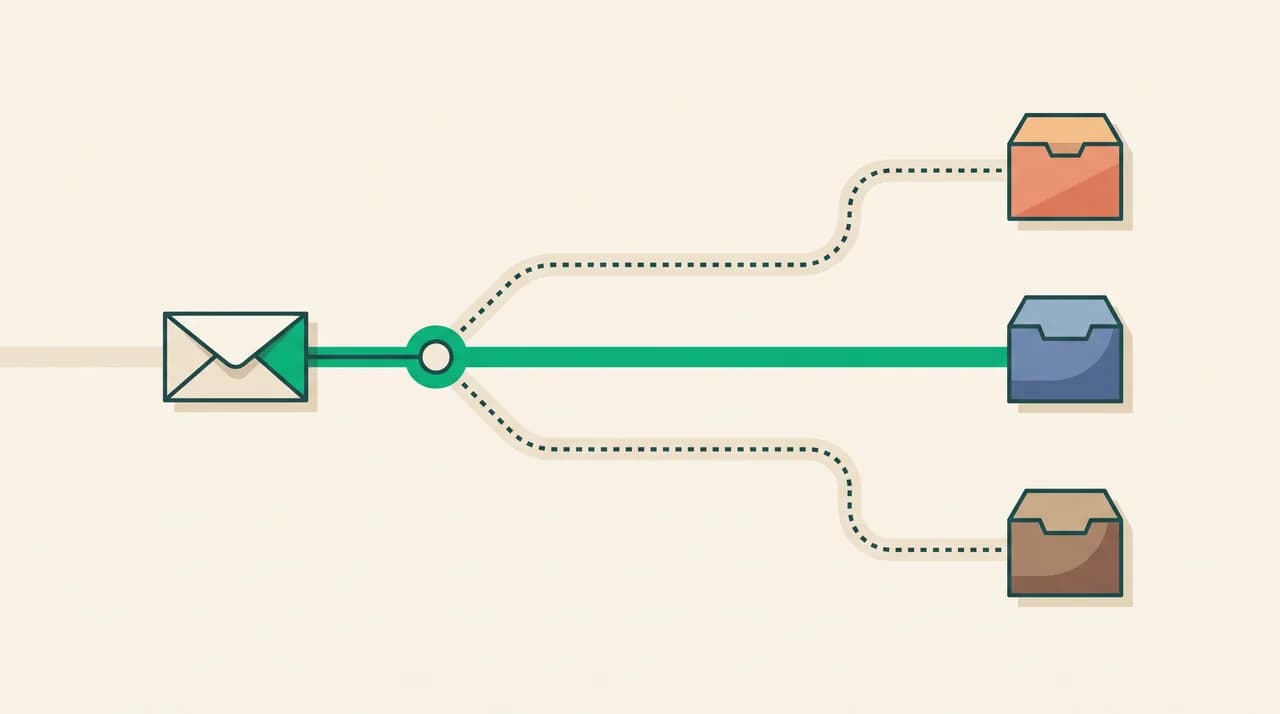
When the sender uses multiple domains — as aggressive commercial spammers and botnet operators routinely do — domain blocking becomes a list you cannot keep current. At that point a filter rule targeting message structure, header patterns, or content categories does what a block list cannot: it catches the category rather than a specific identifier.
Gmail's filter builder lets you create rules based on From-domain, subject keywords, or the List-Id header — a constant identifier some mailing lists include in every message even when the From address rotates. Outlook's rules engine under Settings then Mail then Rules offers similar capability. Both are free and do not require installing anything.
A faster way to filter mail that never offered an opt-out#
The steps above are the right ones, and they cost nothing. The limit is that they are one-message-at-a-time actions against a problem that arrives on a schedule the block list has not caught up with. Most people spend more sustained effort managing these messages than the messages ever cost to send.
We build AI Emaily, so this is our own product: AI Emaily is an AI-native email client that connects to Gmail, Outlook, iCloud, and IMAP accounts and adds a layer above the provider's own filter. The cold-email filter recognises the structure and behaviour of unsolicited outreach rather than matching on a specific From address — so a sender rotating through addresses does not reset it with each new one. The rules brain lets you define patterns based on sender-domain families and header values rather than individual addresses. Neither replaces blocking or spam-reporting; they mean you reach for those tools less often because fewer of these messages clear the first layer.
For the single-message case, the provider's own tools are the right ones. For the category that keeps returning on a schedule, that is the problem those tools were not designed to solve continuously.
Frequently asked
See it in AI Emaily
Keep reading
Sources

Written by
Nafiul HasanNafiul Hasan is an entrepreneur and AI automation system builder with 10+ years of experience turning messy, manual workflows into reliable automated systems. He designs and ships AI enterprise solutions end-to-end — the agent logic, the data plumbing, and the product people actually use — and founded AI Emaily to give busy professionals their attention back. He writes here from the builder's seat: what works, what breaks, and how to put AI to work without giving up control.