Wedding Photography Inquiry Response Templates (Copy, Paste & Book More)

The short answer
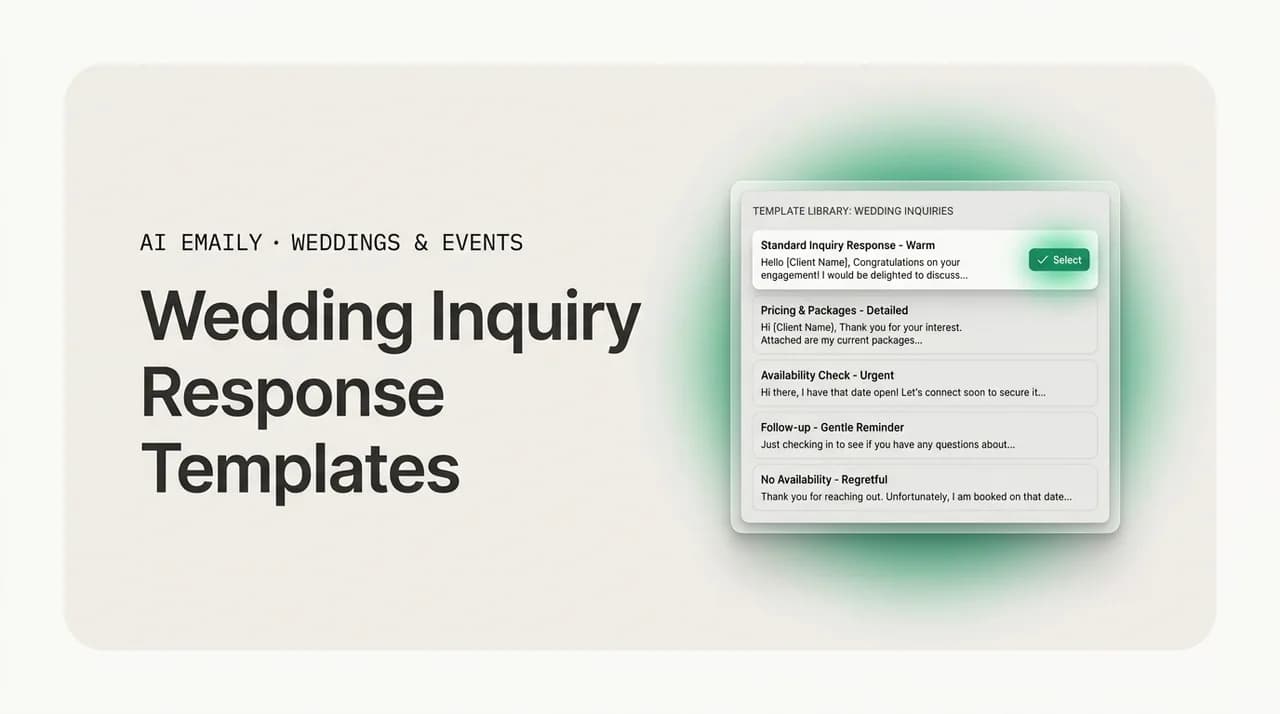
A strong wedding photography inquiry response template answers within the hour, uses the couple's names and date, shows warmth and a clear next step, and does not dump full pricing before you have a conversation. Follow up two or three times, not once, and keep every message in your own voice.
A complete set of wedding photography inquiry response templates, from the first reply to the booking, plus follow-up sequences and post-wedding scripts you can copy, paste, and personalize to book more couples.
On this page
- 01Why your wedding photography inquiry response template decides who books
- 02What makes a great wedding photography inquiry response?
- 03The first inquiry reply template (send within the hour)
- 04The pricing and availability response template
- 05The follow-up sequence: why one email is never enough
- 06The booking and contract email template
- 07The pre-wedding check-in template
- 08The gallery delivery template
- 09The review request template
- 10The referral request template
- 11The mini-session announcement template
- 12Which wedding photography emails should you automate?
- 13How AI Emaily helps wedding photographers respond faster and book more
- 14Putting your inquiry response system together
Why your wedding photography inquiry response template decides who books#
Most weddings are won or lost in the first reply. A couple rarely emails one photographer; they open a tab, fill out five or six contact forms in an evening, and then wait to see who answers, how fast, and how they feel reading it. Your wedding photography inquiry response template is the first real experience they have of working with you, long before any gallery or contract. It sets the tone for whether they picture you calm and organized on their wedding day or scattered and hard to reach.
Speed is the uncomfortable part. Research on online sales leads found that firms trying to reach a lead in the first hour were many times more likely to have a meaningful conversation than those who waited even a couple of hours, and that the odds of qualifying a lead drop sharply once you pass the first sixty minutes. Couples are not running a stopwatch on purpose, but the effect is the same: the photographer who replies warmly while the inquiry is still fresh in their mind gets the call, and the one who answers three days later is replying to someone who has already booked.
This is exactly where a lot of talented photographers leak bookings. You use your inbox as a to-do list, an inquiry lands while you are mid-ceremony or driving home from an engagement shoot, and by the time you surface it is buried under twenty other emails. The work is not the problem. The gap between the inquiry arriving and your first warm, useful reply is the problem, and that gap is exactly what a good template plus a little automation closes.
This guide is built to close that gap. Below you will find a full library of copy-paste scripts covering the entire booking journey: the first inquiry reply, the pricing and availability response, a two- and three-touch follow-up sequence for couples who go quiet, the booking and contract email, the pre-wedding check-in, gallery delivery, the review request, the referral ask, and a mini-session template for portrait work between weddings. Each one is written to sound like a real person, not a form letter, and each has notes on when to send it and whether it is safe to automate.
A quick word on how to use these. Do not paste them verbatim and leave the brackets in; nothing kills a warm first impression faster than "Hi [FIRST NAME]." Treat each template as a strong first draft. Keep the structure, which is what makes it effective, and rewrite a sentence or two so it sounds like you. By the end you will have a repeatable system that answers every couple quickly and consistently, whether you are at your desk or shooting a wedding three states away.
The 60-minute rule
What makes a great wedding photography inquiry response?#
Before the templates, it helps to know why they work, because once you understand the anatomy you can adapt any of them to your own style without breaking what matters. Every strong wedding photography inquiry response does the same handful of jobs, in roughly this order.
- 1
It arrives fast and acknowledges them personally
Use their names and their wedding date in the first two lines. "Hi Maya and Chris, congratulations, and thank you for thinking of me for your October 11 wedding" tells them instantly that a human read their note, not a robot. Speed plus personalization is the whole first impression.
- 2
It matches their energy and shows you are excited
A wedding is emotional. A flat, transactional reply reads as indifference. One or two genuine lines about their venue, their date, or a detail they shared signals that you actually want to shoot their day, not just fill a slot.
- 3
It answers the real question without dumping everything
Couples usually ask about availability and price. Confirm availability directly, give a starting point on price so you do not waste each other's time, but save the full breakdown for a call or a proper guide. The goal of the first reply is a conversation, not a transaction.
- 4
It gives one clear next step
End every inquiry reply with a single, easy action: book a call, reply with a question, or view a pricing guide. One next step converts far better than three options that make the couple decide.
- 5
It sounds like you
Your voice is part of what they are buying. If you are warm and casual in person, be warm and casual in the email. Consistency between your emails and the real you builds the trust that closes a booking.
There is one more principle worth naming because it trips people up: whether to send pricing in the first reply. There is no single right answer, and it depends on your market and your booking style. Sending a starting price upfront filters out couples far outside your budget and respects everyone's time. Withholding it entirely pushes every inquiry toward a call, where you can sell the experience before the number. Most photographers land in the middle: a "collections start at" figure in the first email, with the full guide or call to follow. The templates below give you both versions so you can pick the one that fits.
Personalize, do not just fill in blanks
The first inquiry reply template (send within the hour)#
This is the most important email you will send in the whole booking process, so it is worth getting right. The first reply has two jobs: make the couple feel genuinely welcomed, and move them toward a real conversation. Here is a warm, complete version that works for most wedding photographers. Swap in your details and rewrite a line so it sounds like you.
If you would rather keep pricing out of the first email and drive every inquiry to a call or a guide, use this leaner version. It still opens warmly and confirms the date, but it points to a downloadable pricing guide or a call instead of naming a number.
For portrait photographers, or for the quick inquiries that do not warrant a full pitch, a shorter reply is often better. This one keeps the warmth but gets to the point fast, which suits family, couples, and senior sessions where the decision is smaller and faster.
Send the fast version first
The pricing and availability response template#
Sometimes the first inquiry is a straight pricing or availability question, or the couple replies to your first email asking for the full breakdown. This is the moment to be clear and confident about your value, not apologetic about your rates. Present collections as an easy choice, tie the price to the experience, and always end with a next step. Here is a full pricing response you can adapt.
If the couple asks about a date you cannot shoot, do not just say no and disappear. A gracious "I'm booked, but here's what I can do" reply protects your reputation, keeps you top of mind for their next event, and often earns you a referral. Never leave a booked-out inquiry hanging.
The follow-up sequence: why one email is never enough#
Here is the single most common way photographers lose bookings they could have won: they send one great reply, hear nothing back, and quietly assume the couple went with someone else. Most of the time that assumption is wrong. The couple got busy, the email slipped down their inbox, they got engaged three weeks ago and are drowning in decisions. Silence almost never means no. It means not yet, and not-yet is exactly what a follow-up sequence is built for.
The data on this is consistent across sales research: a large share of deals close only after multiple follow-up touches, yet most people give up after one. The same pattern holds for wedding inquiries, where couples are comparing several vendors on their own timeline. Experienced photographers and booking coaches consistently advise following up two or three times, spaced out and adding value each time, rather than sending a single note and hoping. The follow-up is not pestering; done right, it is a service. You are making it easy for a busy couple to keep the conversation going.
The rhythm below works well: a gentle nudge a few days after your first reply, a value-add touch a week or so later, and a soft final check-in after that. Space them out, change the angle each time, and always keep the door open rather than guilt-tripping. Here is the full sequence.
Follow-up one goes out three to four days after your first reply if you have heard nothing. Keep it short, friendly, and low-pressure. The job here is simply to float back to the top of their inbox.
Follow-up two goes out about a week after the first follow-up. This one earns its place by adding something useful rather than just asking again. Share a relevant gallery, a helpful tip, or a piece of planning value. It reframes you from a vendor chasing a sale to a helpful pro they want on their team.
Follow-up three is your soft final check-in, sent a week or so after the second. Its job is to create a gentle, honest reason to reply now, usually because you genuinely cannot hold an unbooked date forever. Be warm, be clear, and give them a graceful exit so you never sound pushy.
Stop the sequence the moment they reply
The booking and contract email template#
The couple said yes. This email should feel like a celebration and make the next steps effortless, because a confusing or slow booking process can still lose you a couple who was ready to commit. Confirm the excitement, then lay out exactly what happens next: contract, retainer, and what they can expect from you. Clarity here sets the tone for a smooth relationship all the way to the wedding day.
Once the contract is signed and the retainer is in, send a short, warm welcome that reassures them they made the right choice and previews what happens next. This is a small email with a big payoff: it reduces buyer's remorse and starts the relationship on a high note.
The pre-wedding check-in template#
In the weeks before the wedding, a proactive check-in does a lot of quiet work. It reassures a couple who may be nervous, confirms the logistics you need to shoot well, and reminds them of the balance payment without it feeling like a bill. Sending this a few weeks out, rather than waiting for them to chase you, is the mark of a photographer who has their act together.
Confirm the week-of details separately
The gallery delivery template#
Delivering the gallery is one of the most emotional moments of the whole experience, and it is also a prime opportunity to prompt sharing, reviews, and referrals while the couple is glowing. Do not just drop a link. Frame the moment, guide them on what to do next, and make it easy to spread the word.
If you send sneak peeks before the full gallery, which is a great way to feed the couple's excitement and get quick social shares, a short teaser email keeps momentum high and buys goodwill while you finish editing.
The review request template#
Reviews are the quiet engine of a photography business, and the best time to ask is right after gallery delivery, when the couple is at peak happiness. The mistake most photographers make is asking too vaguely ("a review would be great!") instead of making it a two-minute task with a direct link and a hint about what to write. Ask clearly, make it easy, and time it well.
One link, one ask
The referral request template#
A happy couple is your best marketing channel, and their newly-married friends are exactly the people planning weddings next. Referrals feel awkward to ask for only when you make it about you; framed as helping their friends find a photographer they will love, it becomes a natural, generous offer. Ask a few weeks after delivery, once the glow has settled into genuine advocacy.
The mini-session announcement template#
Between weddings, mini-sessions, short, themed portrait slots for families, couples, and seniors, fill your calendar and keep cash flowing in the off-season. They convert best with a sense of scarcity and an easy, fast booking path, because the whole appeal is "quick and limited." Announce them to your past-client list, which is your warmest audience.
Your past-client list is your best list
Which wedding photography emails should you automate?#
Not every email in this list should be automated, and not every one should be typed by hand each time. The right split depends on how personal and how time-sensitive the message is. Highly personal, relationship-defining moments deserve a human touch; predictable, logistical, or purely reminder-style messages are safe to template and schedule. The table below maps each email to when it goes out and how much you can safely automate it.
| When to send | Automate? | |
|---|---|---|
| Instant inquiry acknowledgment | Within minutes of the inquiry arriving | Yes, fully. A fast "got your note, details soon" is templated and safe. |
| First inquiry reply (full) | Within the hour | Mostly, draft automatically then personalize one line before it sends. |
| Pricing and availability response | When they ask, or after the first reply | Mostly, the structure is fixed; confirm the date and tweak the fit. |
| Follow-up 1, 2, 3 | Days 3–4, ~10, ~17 if no reply | Yes, as a sequence that cancels the moment they respond. |
| Booking confirmation and contract | As soon as they say yes | Semi, trigger it fast, but glance at it before it goes. |
| Pre-wedding check-in | 3–4 weeks before the wedding | Yes, scheduled; it is mostly logistics and a payment reminder. |
| Week-of logistics confirmation | A few days before the wedding | Yes, scheduled and short. |
| Gallery delivery | When the gallery is ready | Semi, keep the warm personal line human, automate the mechanics. |
| Review request | A few days after delivery | Yes, scheduled to fire after delivery. |
| Referral request | A few weeks after delivery | Yes, scheduled to your happy past clients. |
| Mini-session announcement | Seasonally, to your past-client list | Yes, a saved template you send to a warm list. |
The pattern is clear: the messages that win a couple over, the very first warm reply and the gallery delivery, benefit from a human touch, while the reminders, follow-ups, and logistical confirmations are exactly the kind of repetitive work that should not depend on you being at your desk. The trick is a system that handles the predictable parts automatically and hands you the moments that need you. That is the whole idea behind letting an AI email client run the routine while keeping you in control of the personal.
How AI Emaily helps wedding photographers respond faster and book more#
Every template in this guide assumes you are at your desk to send it, and that is exactly the assumption that breaks when you are shooting a wedding, driving between locations, or finally taking a Sunday off. AI Emaily is an AI-native email client that acts as an autonomous chief of staff for your inbox, and it is built for precisely this problem: never letting an inquiry go cold while you are doing the work you were hired for.
The instant acknowledgment is the piece that changes bookings most. The moment a wedding inquiry lands, AI Emaily can recognize it and fire back a warm, on-brand acknowledgment within minutes, day or night, so the couple who emailed five photographers at 10 p.m. hears from you first. Because it learns how you actually write, from your real sent emails, the drafts come back in your voice, warm where you are warm and casual where you are casual, not in generic form-letter boilerplate. You keep the personality that books couples without typing the same opener for the hundredth time.
It also runs the follow-up sequence you almost certainly are not running by hand. AI Emaily can draft and schedule the two- or three-touch follow-ups for couples who go quiet, spaced out and value-adding, and it stops the sequence the instant a couple replies, so you never send "just floating this up" to someone who already answered. The pre-wedding check-in, the review request, the referral ask, and the mini-session announcement can all be templated and scheduled the same way.
Crucially, you stay in control. AI Emaily works in three modes so you decide how much to hand over. In Manual, you write everything yourself with AI help on tap. In Copilot, it drafts every reply in your voice and waits for your one-tap approval before anything sends, ideal for the personal, high-stakes first reply and gallery delivery. In Autopilot, gated to the safe, templated parts of the booking motion like the instant acknowledgment and the follow-up nudges, it can send within rules you set, always with undo and a full audit trail of exactly what it did and when. Nothing goes out that you have not authorized, and you can reverse anything.
The result is the thing this whole guide is really about: a couple who inquires gets a fast, warm, personalized reply and a thoughtful follow-up sequence whether or not you are anywhere near a keyboard, and you get your evenings back. You can try it free at app.aiemaily.com/signup, with a Free plan at no cost and Pro at $12.42 per month on the annual plan.
Your voice, your approval, your inbox
Putting your inquiry response system together#
The photographers who book the most weddings are rarely the ones with the flashiest gear. They are the ones who answer fast, sound like a real, warm person, and follow up when a couple goes quiet. Everything in this guide serves those three things. Save the first inquiry reply and the pricing response as your go-to scripts, build the two- or three-touch follow-up sequence so no lead dies in silence, and template the predictable milestones, booking, pre-wedding, delivery, review, referral, so your business runs like a studio even if it is just you.
Start with the two templates that move the needle most: a fast, warm first reply and a follow-up sequence. Personalize a line in each so it sounds like you, decide which messages you are comfortable automating, and let the rest run on a schedule. Do that, and the next time a couple emails six photographers on a Tuesday night, you will be the one who answered first, sounded like someone they would love to have at their wedding, and gently followed up, while you were out shooting the last couple who booked you exactly the same way.
Frequently asked
See it in AI Emaily
Keep reading
Sources

Written by
Nafiul HasanNafiul Hasan is an entrepreneur and AI automation system builder with 10+ years of experience turning messy, manual workflows into reliable automated systems. He designs and ships AI enterprise solutions end-to-end — the agent logic, the data plumbing, and the product people actually use — and founded AI Emaily to give busy professionals their attention back. He writes here from the builder's seat: what works, what breaks, and how to put AI to work without giving up control.