How to Book More Weddings: A Lead-Nurture System That Actually Converts

The short answer
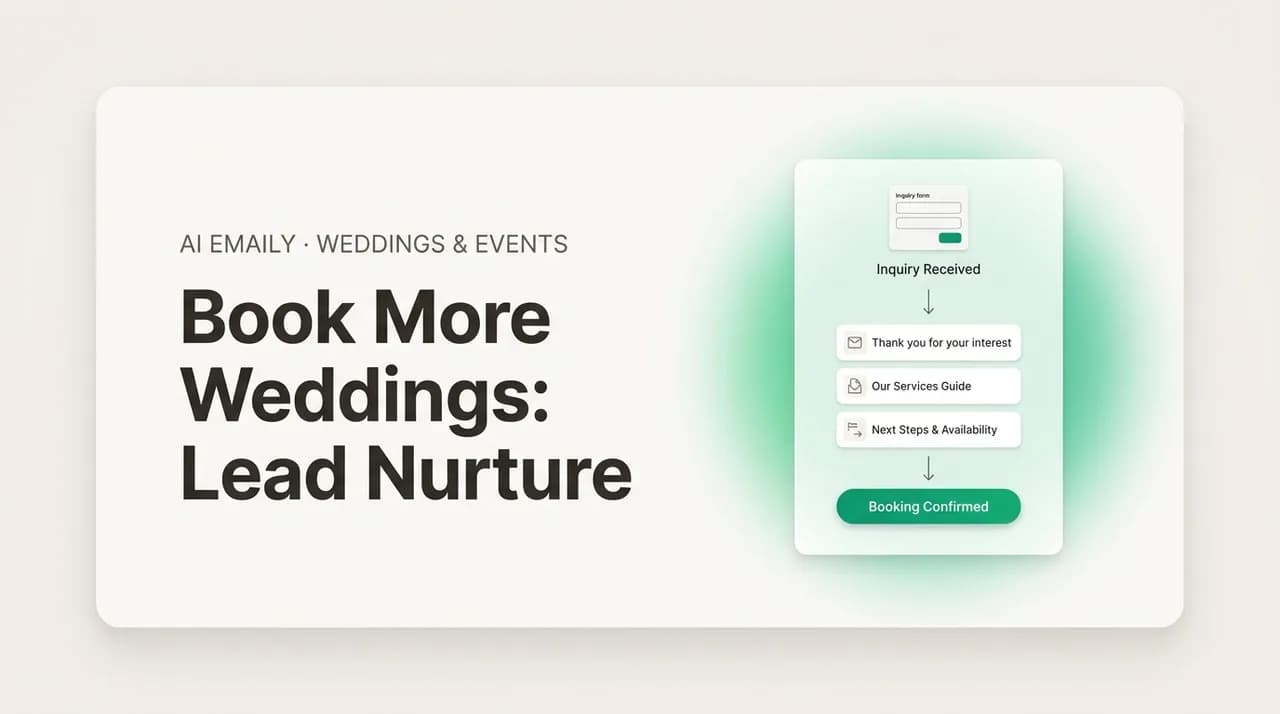
If you want to book more weddings, one reply to an inquiry is not enough. Couples email several vendors at once, so the vendor who answers fast and follows up warmly through consult, proposal, and decision wins the booking. Build a nurture system: fast first reply, value-add touches, a booked consult, proposal follow-up, and gentle persistence, so no lead goes cold while you are out shooting.
How to book more weddings by building a lead-nurture system that converts inquiries into consults, proposals, and signed contracts, with stage-by-stage templates and a follow-up cadence that never drops a couple.
On this page
- 01Why do so many wedding inquiries never turn into bookings?
- 02What is the wedding booking funnel, and why does each stage matter?
- 03The five stages of a wedding lead-nurture system at a glance
- 04Stage 1: How fast should you reply to a wedding inquiry?
- 05Stage 2: What value-add touches keep a couple warm before they book?
- 06Stage 3: How do you move a couple to a booked consult?
- 07Stage 4: How do you follow up on a proposal without being annoying?
- 08Stage 5: How do you handle a couple who has gone quiet?
- 09How do you keep a nurture system running when you are always shooting?
- 10How AI Emaily helps you book more weddings
- 11Putting your wedding lead-nurture system into practice
Why do so many wedding inquiries never turn into bookings?#
Here is the uncomfortable truth most wedding pros run into a year or two into the business: getting inquiries is not the hard part. The hard part is turning them into signed contracts. You can have a full inbox, a healthy stream of "Hi, are you available for our June wedding?" messages, and still watch your calendar sit half-empty. The inquiries are coming in; they are just not coming out the other side as booked couples. If you have ever wondered how to book more weddings when you already have plenty of leads, this is the gap you are staring into, and it is almost never a problem with your work. It is a problem with what happens between the first hello and the signed agreement.
The reason is structural, and it is specific to how couples shop for wedding vendors. When someone gets engaged, they do not email one photographer, one planner, or one venue. They email several at once, often five or six, frequently late at night, frequently on their phone, and frequently through more than one channel: your website contact form, your direct email, an Instagram DM, and a lead form on The Knot or WeddingWire. From the couple's side, this is a casting call. They are collecting responses, comparing vibes and prices, and forming a shortlist within a day or two. From your side, every one of those inquiries is a race you did not know you had entered, against vendors you will never see.
In that race, the vendor who wins is rarely the most talented one. It is the one who replies first, replies warmly, and then keeps showing up. Speed gets you noticed; nurture gets you booked. Most wedding pros do the first part inconsistently and skip the second part almost entirely. They fire off one reply, maybe with a price list attached, and then wait. When the couple goes quiet, they assume the couple "went with someone cheaper" and move on. What actually happened, most of the time, is that the couple got busy, got overwhelmed by six near-identical PDFs, and drifted to the vendor who stayed in touch and made the decision easy.
This post is about closing that gap on purpose. Not with pushy sales tactics, and not by working nights and weekends chained to your inbox, but with a repeatable lead-nurture system: a defined path that moves a couple from inquiry to consult to proposal to booked, with the right message at the right moment and a follow-up cadence that never lets a lead die in silence. We will walk the booking funnel stage by stage, give you copy-paste templates for each touch, lay out a follow-up schedule you can actually keep, and then, honestly, show where an AI email client can carry the repetitive parts of this system for you so it runs whether or not you are behind a desk.
One framing to carry through the whole post: your inbox is not your sales pipeline. Treating email as a to-do list, where a lead "counts" as handled the moment you have replied once, is exactly why inquiries fall through the cracks. A booking is not a single reply; it is a sequence. Build the sequence, and the same volume of inquiries you have right now starts converting at a noticeably higher rate.
Nurture is not the same as being pushy
What is the wedding booking funnel, and why does each stage matter?#
Before you can fix your conversion, you need a shared picture of the path a couple actually travels. For most wedding pros, whether you are a photographer, a planner, or a venue, the funnel has four stages, and each one has a single job. A lead that stalls is almost always a lead that did not get the message that stage needed.
The four stages are inquiry, consult, proposal, and book. Think of them as gates. At each gate, the couple decides whether to keep walking toward you or drift toward someone else. Your job at every gate is to make the next step feel easy, warm, and obvious. Here is what each stage is for, and what quietly kills a booking there.
- 1
Inquiry — win the shortlist with speed and warmth
The couple has just reached out, usually to several vendors. The only goal here is to earn a spot on their shortlist and open a conversation. What kills it: a slow reply (hours or days later, after a faster vendor has already charmed them) or a cold, price-list-only response that gives them nothing human to connect to.
- 2
Consult — turn interest into a real conversation
Once you have their attention, the aim is to get them on a call, a video chat, or into your inbox for a genuine back-and-forth where you learn about their day and they get to like you. What kills it: leaving the next step vague. "Let me know if you'd like to chat" puts the work on the couple; a specific, easy booking link or two proposed times moves them forward.
- 3
Proposal — make saying yes simple
Now they have context and rapport, and you send pricing, packages, or a full proposal. The goal is a clear, confident offer they can act on. What kills it: a wall of options with no guidance, or, most commonly, sending the proposal and then never following up on it, so it sits unopened in a busy couple's inbox.
- 4
Book — remove the last bit of friction
They are ready, or nearly. The job is to make signing and paying frictionless: contract, deposit, next steps, all in one clear message. What kills it: a clunky, manual booking process, a delay in sending the contract while their excitement cools, or failing to nudge a couple who said yes but got distracted before signing.
Notice a pattern across all four gates: the failure is almost never that your work was not good enough. It is that a message was too slow, too vague, or never sent. Couples do not fall out of the funnel because they found someone dramatically better. They fall out because the momentum stalled, and momentum is entirely within your control. A nurture system is nothing more than a promise to yourself that momentum never stalls, at any gate, for any couple, whether you are at your desk or shooting a ten-hour wedding.
It is also worth being honest about how leaky an untended funnel is. If half your inquiries never get a fast reply, and half of the ones that do never get a follow-up on the proposal, you can lose the majority of your winnable bookings to nothing but silence and timing, while blaming price or fit. The good news is the inverse: plugging those leaks does not require more leads or lower prices. It requires a system.
The five stages of a wedding lead-nurture system at a glance#
Here is the whole system in one view before we go deep on each part. Each stage has a trigger (what starts it), a goal (what it needs to accomplish), a timing target (how fast), and the key move that makes it work. Keep this table handy; it is the backbone of everything that follows.
| Nurture stage | Trigger | Goal | Timing target | Key move |
|---|---|---|---|---|
| 1. Fast first reply | New inquiry lands (form, email, DM, or directory) | Land on the shortlist; open a conversation | Within minutes, ideally under an hour | Warm, personal acknowledgment that answers their core question and proposes the next step |
| 2. Value-add touch | Couple has replied but not yet booked a consult | Build trust; stay top of mind without pushing price | 1–2 days after first reply | Send something genuinely useful: a guide, a relevant portfolio gallery, a planning tip, a testimonial |
| 3. Consult booking | Couple is engaged in the conversation | Get a call or meeting on the calendar | As soon as interest is clear | Offer a specific booking link or two concrete times, never an open-ended "let me know" |
| 4. Proposal follow-up | Proposal or pricing has been sent | Keep the proposal alive; answer objections; ask for the booking | 2–3 days after sending, then again ~1 week later | A friendly check-in that offers help and gently asks if they are ready to move forward |
| 5. Gentle persistence | Couple has gone quiet at any stage | Recover the lead before it is truly cold | Spaced touches over 2–4 weeks | 2–3 low-pressure nudges, then a graceful final note that leaves the door open |
Everything else in this post is detail on these five stages: what to say, when to say it, and how to keep the whole thing running when you are too busy shooting or coordinating to babysit your inbox. If you take nothing else away, take this: convert wedding inquiries into bookings by treating each one as a five-stage sequence, not a single reply. Now let us build each stage.
You do not need all five every time
Stage 1: How fast should you reply to a wedding inquiry?#
The first reply is the highest-leverage message in your entire business, and speed is most of the battle. Because couples inquiry-blast several vendors at once, the response-time race is real and it is unforgiving. The classic research on online sales leads found that responding within the first few minutes dramatically outperforms responding even an hour later, and the odds of ever making meaningful contact collapse quickly after that. Wedding inquiries behave the same way: the vendor who replies while the couple is still sitting on the couch scrolling, still in shopping mode, gets the conversation. The vendor who replies the next morning is often replying to someone who has already fallen for a faster vendor's warm, immediate note.
That does not mean you have to be chained to your phone. It means your first reply needs to go out fast and reliably, which is exactly the kind of message that should be templated so it is never delayed by your having to think about what to write. A great first reply does four things: thanks them warmly, shows you actually read their message, answers or acknowledges their core question (usually availability or ballpark price), and proposes a clear next step. Notice what it does not do: dump a full price list and go silent. You are opening a relationship, not closing a transaction.
A few things make that message work, and they transfer to any wedding niche. It uses their names and their specific date and venue, which instantly separates you from the vendor who blasted a generic "Thanks for your interest!" It gives a real answer on availability and a transparent starting price, so the couple does not feel like they have to pry. And it ends with one obvious, low-effort next step, a booking link, rather than a vague "let me know." The easier you make the next click, the more couples take it.
For a venue or a planner, the same skeleton applies with a small shift: venues live and die on availability and quote turnaround, so lead with the date and a clear path to a quote or tour; planners lead with warmth and a discovery call. Here is a venue version tuned for the after-hours reality that so many inquiries arrive at 10 p.m. on a Sunday.
Have the first reply ready before the inquiry arrives
Stage 2: What value-add touches keep a couple warm before they book?#
Most wedding pros go straight from first reply to price, and if the couple does not bite, they assume the deal is dead. The couples who book at higher rates get something in between: a value-add touch. This is a message, sent a day or two after your first reply, that gives the couple something genuinely useful without asking for anything in return. It does two things at once: it keeps you top of mind during the exact window when they are comparing vendors, and it demonstrates the care and organization they are hoping to hire.
The key word is useful. A value-add touch is not "just checking in" (that asks the couple to do work) and it is not another push on price (that reads as sales pressure). It is a gift. The best ones are things you can prepare once and reuse forever, so this stage costs you almost nothing per couple.
- A relevant portfolio gallery. "Since you mentioned a barn venue, here is a full wedding I shot at a similar space so you can see how I handle that light." This lets them picture their own day and shows range without a sales pitch.
- A short planning guide or checklist. A "wedding-day timeline template" or "questions to ask any photographer before you book" positions you as a helpful expert, not a vendor waiting for a decision.
- A relevant testimonial or story. "A couple I worked with last summer had a similar rainy-day worry, here is what they said afterward." Social proof lands harder when it maps to the couple's own situation.
- An answer to a question they did not ask yet. If most couples wonder about travel fees, engagement sessions, or how many images they get, answer it proactively. Removing a hidden objection early keeps momentum.
- A genuine, specific compliment or note. "I looked at your venue's site, the garden ceremony space is gorgeous, and I have some fun ideas for portraits back there." Specificity signals you are already invested in their day.
Here is what a value-add touch looks like as an actual message. Notice that it does not ask for the booking; it simply adds value and keeps the door open, which paradoxically makes the couple more likely to come back to you.
Value-add touches double as objection-handling
Stage 3: How do you move a couple to a booked consult?#
The consult, a call, a video chat, or a venue tour, is where warm interest becomes a real relationship, and it is the single biggest predictor of a booking for most wedding pros. Couples very rarely sign a five-figure contract for the most important day of their lives with someone they have only traded two emails with. They book the person they have talked to, laughed with, and come to trust. Your job at this stage is simple: get them on the calendar with as little friction as humanly possible.
The most common mistake here is ending your messages with "let me know if you'd like to hop on a call!" That sentence sounds friendly, but it quietly hands all the work to the couple. They now have to decide they want a call, figure out when, propose times, and wait for you to confirm, four small frictions, any one of which can stall a busy couple. Replace it with a single click. "Grab any time that works for you here: [link]" removes every one of those frictions at once. If you do not use scheduling software, offer two or three specific times instead: "Would Tuesday at 6 p.m. or Thursday at 7 p.m. work for a quick call?" A concrete choice is far easier to say yes to than an open-ended invitation.
Two details make consults convert better. First, name the low-pressure nature of the call explicitly. Many couples avoid booking because they fear a hard sell; telling them it is "just to get to know each other" removes that fear. Second, once a consult is booked, protect it with a reminder the day before. A no-show consult is a lead you nearly won and then lost to a forgotten calendar invite. A one-line "Looking forward to our chat tomorrow at 6, here is the link" message meaningfully cuts no-shows, and it is exactly the kind of small, timed touch that is easy to forget and easy to automate.
After the consult, send a warm recap the same day while the connection is fresh. This bridges directly into the proposal stage and keeps momentum from stalling in the gap between "great call" and "here is my pricing."
Stage 4: How do you follow up on a proposal without being annoying?#
This is where the most bookings are quietly lost, and it is the most fixable leak in the entire funnel. A wedding pro sends a beautiful proposal, feels the work is done, and waits. The couple, meanwhile, opened it on their phone between meetings, meant to discuss it that weekend, got busy, and never circled back. No decision was made against you. The proposal just went cold in a crowded inbox, and the vendor who followed up got the booking instead. Following up on a sent proposal is not optional; it is the difference between a proposal and a booking.
The advice most wedding-business coaches repeat is to follow up on an inquiry or proposal more than once, commonly around three times, not the single attempt most people manage. The reason people under-follow-up is fear of being annoying. But a well-timed, warm, helpful follow-up is the opposite of annoying, it is service. The couple asked for your proposal; checking that it landed and offering to help is exactly what an organized professional does. Here is a cadence that stays on the right side of the line.
- 1
Follow-up 1 — confirm it landed (2–3 days after sending)
Short and helpful. "Just wanted to make sure my proposal reached you, sometimes they land in spam. Any questions at all, I'm happy to walk through it." This gives them an easy on-ramp to reply and surfaces objections early.
- 2
Follow-up 2 — add value and ask (about 1 week later)
Reinforce why you are the right fit and make a gentle, direct ask. "I'd love to be the one documenting your day. If the collection looks right, I can send the contract whenever you're ready. Anything I can adjust to make it a fit?" A direct, low-pressure ask gives them permission to say yes.
- 3
Follow-up 3 — the graceful close (about 1 week after that)
Create gentle urgency and leave the door open. "I want to be upfront: I've had another inquiry for your date, so I wanted to check in before I respond to them. No pressure at all, but if you'd like to lock it in, just say the word." Honest scarcity, when true, is a legitimate and effective nudge.
The two rules that keep proposal follow-up from feeling pushy: every touch should add something (a question answered, an offer of help, a true piece of urgency), and every touch should keep the pressure low and the door open. You are not demanding a decision; you are making it easy to say yes and easy to ask for more time. Here is a full proposal follow-up in the voice you would actually use.
Only use scarcity when it is real
Stage 5: How do you handle a couple who has gone quiet?#
No matter how good your system is, some couples go silent. They loved the call, said the proposal looked great, and then vanished. This is not a signal to give up; it is a signal to nurture gently over a longer arc. Couples go quiet for reasons that have nothing to do with you: a family member weighed in, they hit a budget snag, they are deciding between you and one other vendor, or life simply swallowed the decision. A patient, low-pressure sequence recovers a meaningful share of these leads that a single "following up!" email never would.
The tone shifts here. Persistence is not pressure. Space your touches out, keep them short, and make each one easy to ignore, which, counterintuitively, makes them easier to respond to. Aim for two or three touches over two to four weeks, then a graceful final note. That last message is important: done right, a "no pressure, I'll leave this here" close often prompts the very reply that books the wedding, because it removes the last bit of decision-pressure the couple was avoiding.
When you reach the end of the sequence with no reply, send one clean, gracious final message and then stop. This protects your energy, keeps your list of active leads honest, and, importantly, leaves such a good final impression that couples sometimes come back weeks later, or refer a friend even if they booked elsewhere. A wedding pro who bows out with warmth is a wedding pro people remember.
A graceful exit is part of the system
How do you keep a nurture system running when you are always shooting?#
Here is the catch that sinks most wedding pros who try to build a system like this: it only works if it runs every time, and the busiest weeks of your business, wedding season, are exactly when you have the least capacity to run it. A couple inquires on Saturday while you are eight hours into a wedding. Your fastest-possible reply is now Sunday night, by which point a competitor answered in ten minutes and already booked the consult. A proposal you sent Thursday needs its first follow-up Sunday, but Sunday you are editing and asleep by nine. The system is sound; your availability is the bottleneck.
The traditional fix is a CRM with canned templates and reminder tasks, and those help, they are a real step up from an inbox used as a to-do list. But they still depend on you to be at a desk, to remember to trigger the template, to see the reminder, and to actually send the touch. During a ten-wedding month, that is a lot to ask of a human. What the busiest, highest-converting wedding pros are increasingly reaching for is a layer that does not just remind them to nurture, but can carry out the routine parts of the nurture itself, in their voice, whether or not they are behind a screen.
How AI Emaily helps you book more weddings#
This is where an AI-native email client earns its place in a wedding business, and it is worth being precise about what it does and does not do. AI Emaily is not a bulk email blaster and it is not a bot that talks to your couples in a robotic voice you would never use. It is an email client that connects to your Gmail, Outlook, or IMAP inbox, learns how you actually write, and runs the repetitive parts of your nurture system in your own voice, so the system keeps moving whether you are at your desk or on your third wedding of the weekend.
Concretely, it maps onto the five stages you just read. For the fast first reply, it can recognize a new inquiry the moment it lands, whether the couple emailed you directly or a directory forwarded a lead, and draft, or with your permission send, a warm, personalized acknowledgment in seconds, using their name, date, and details, so you win the response-time race even when you are unreachable. For the value-add and follow-up touches, it can stage the sequence: it knows a proposal went out on Thursday, so it drafts the two-day check-in and the one-week nudge on schedule and never lets a proposal go cold in a busy inbox. For gentle persistence, it keeps track of every quiet couple and surfaces the next touch at the right interval, the exact busywork a human running ten weddings a month inevitably drops.
The reason it stays in your voice rather than reading like a template is that it learns from how you already write, your greetings, your warmth, the way you talk about your work, so the drafts come back sounding like you on your best, most organized day, not like generic sales copy a couple has already received from five other vendors.
Just as important is that you stay in control, because these are your couples and your reputation. AI Emaily runs on three modes, and you choose how much to hand over. In Manual mode, it drafts and you review and send every message yourself, useful when you are new to the system and want to see how good the drafts are. In Copilot mode, it prepares each nurture touch and waits for your one-tap approval, so you keep final say on everything that goes out but skip the writing. In Autopilot mode, you can let it handle the truly routine, safe touches on its own, an instant inquiry acknowledgment, a proposal-received check-in, a consult reminder, while it escalates anything that needs a human judgment call to you. Every action, in every mode, comes with undo and a full audit trail, so you can always see exactly what went out, to whom, and roll it back if it is not right.
The honest framing: AI Emaily does not book the wedding for you, the call, the rapport, the artistry, and the final yes are yours. What it does is make sure the system that gets a couple to that yes never stalls because you were busy being great at your actual job. It carries the fast first reply, the timed follow-ups, and the never-drop persistence, so your inbox stops being the place where winnable bookings quietly die. You can try it free at app.aiemaily.com/signup, with a Free plan at no cost and Pro at $12.42 per month on the annual plan.
Your couples' messages stay private
Putting your wedding lead-nurture system into practice#
If you want to book more weddings from the inquiries you already get, the move is not to chase more leads or drop your prices. It is to stop treating each inquiry as a one-and-done reply and start treating it as a five-stage sequence: a fast, warm first reply that wins the shortlist; a value-add touch that keeps you top of mind and dissolves quiet objections; a frictionless push to a booked consult where real trust is built; a persistent, helpful proposal follow-up that turns a sent PDF into a signed contract; and a gentle-persistence arc that recovers the couples who went quiet and bows out gracefully from the ones who moved on.
None of these touches is hard to write, and every one of them is easy to skip when you are in the thick of the season, which is precisely why so many bookings are lost to silence rather than to a better competitor. Build the sequence once. Save the templates in this post, set the timing, and commit to running it on every single couple. Do that and the same volume of inquiries starts converting at a rate that can quietly transform your calendar and your revenue.
And when the season gets loud and your capacity to run it by hand runs out, let your email client carry the repetitive parts in your voice, so the system keeps its promise even on your busiest wedding weekend. The couples who book you are not always the ones who found the most talented vendor. They are the ones who felt looked-after from the very first reply to the final yes. A nurture system is how you make that feeling reliable, and reliability is what fills a wedding calendar.
Frequently asked
See it in AI Emaily
Keep reading
Sources

Written by
Nafiul HasanNafiul Hasan is an entrepreneur and AI automation system builder with 10+ years of experience turning messy, manual workflows into reliable automated systems. He designs and ships AI enterprise solutions end-to-end — the agent logic, the data plumbing, and the product people actually use — and founded AI Emaily to give busy professionals their attention back. He writes here from the builder's seat: what works, what breaks, and how to put AI to work without giving up control.