Automate Inquiry Follow-Up Sequences for Photographers & Venues

The short answer
Most wedding inquiries that book need three or more follow-ups, but most photographers and venues stop after one or two. A five-touch follow-up sequence, sent on a schedule in your own voice, recovers the couples who were interested but busy. Automate the sending, keep the writing personal, and approve before send until you trust it.
How to automate wedding inquiry follow up for photographers and venues: why multi-touch sequences book more weddings, a five-touch follow-up sequence with timing and templates, and how to automate it without sounding like a robot.
On this page
- 01Why follow-up is where wedding bookings are won and lost
- 02Why does multi-touch follow-up book more weddings?
- 03What does it cost you to stop after one or two touches?
- 04The inquiry follow-up sequence: timing and templates
- 05How do you automate follow-up without sounding like a robot?
- 06Should follow-ups auto-send, or should you approve each one?
- 07How do you set up an automated follow-up sequence?
- 08How AI Emaily helps you automate inquiry follow-up
- 09Putting it all together
Why follow-up is where wedding bookings are won and lost#
Here is the uncomfortable truth behind most empty booking calendars: the couples did inquire. They filled out the form, they sent the email, they liked your work enough to raise their hand. Then they went quiet, and the booking went somewhere else. It rarely happens because your photos were not good enough or your venue was not beautiful enough. It happens because someone followed up and you did not, or because you followed up once, heard nothing, and quietly gave up. If you want to automate wedding inquiry follow up, the first thing worth internalizing is that follow-up is not the polite afterthought to the sale. For wedding and event pros, it is the sale.
A wedding inquiry is not like a normal lead. When a couple starts planning, they inquiry-blast several vendors at once, often late at night, often on their phone, usually in a burst of excitement that fades by the next morning. They are comparing you against three or four other photographers or venues they contacted in the same sitting. They are not sitting by their inbox waiting for you. They are at work, at a tasting, arguing about the guest list, or simply overwhelmed by the sheer number of decisions a wedding demands. Your first reply lands in that chaos. Sometimes it gets read and answered. Very often it gets seen, mentally filed under "deal with later," and buried under the next forty things life throws at them.
That is the gap follow-up exists to close. The couple was interested, they just got busy. A second, third, or fourth gentle touch is not you being pushy. It is you being the vendor who was still there when they finally had a free evening to make a decision. The photographers and venues who book consistently are almost never the ones with dramatically better work than everyone else in their price range. They are the ones with a follow-up habit that does not quit after the first unanswered email.
This matters more in weddings than in almost any other business, for one structural reason: the buying window is long and the decision is emotional. A couple might inquire in January for an October wedding, disappear for three weeks while they sort out a venue, and resurface ready to book the photographer they still remember warmly. If your entire follow-up strategy was a single reply on the day they inquired, you are long gone from that decision. The vendor who sent a friendly "still thinking about your date?" note two weeks later is the one who gets the contract.
None of this is a secret to people who study sales for a living, and it is not a secret to the wedding coaches and educators who teach this segment either. The consistent advice across the industry is the same: follow up on inquiries up to three times, not once. The problem is almost never that pros disagree with this advice. The problem is that in the middle of a wedding season, with a camera in one hand and a timeline in the other, actually doing it, on time, every time, for every inquiry, is close to impossible by hand. That is the exact gap automation is meant to fill.
Why does multi-touch follow-up book more weddings?#
The case for multiple touches is not a motivational slogan. It is a pattern that shows up everywhere someone has bothered to measure how deals actually close, and it maps almost perfectly onto how couples behave when they are planning a wedding.
Start with attention. A single follow-up assumes the couple saw your first email, read it, weighed it, and consciously decided not to book you. In reality, most non-responses are not rejections at all. The email arrived at a bad moment. It slipped below the fold. It got opened on a phone in a grocery line and forgotten before checkout. Every additional touch is another chance to catch the same couple in a moment when they actually have the bandwidth to respond. You are not wearing them down; you are widening the window in which a reply is possible.
Then there is the compounding effect of consistency. When you follow up on a schedule, without disappearing for weeks and then panic-emailing, you signal something a couple cares about more than they will ever say out loud: that you are organized, reliable, and easy to work with. Your follow-up cadence is a live demo of what hiring you feels like. A vendor who replies fast, then checks in warmly a few days later, then offers to hold a date, reads as a professional who has their act together. A vendor who fires off one reply and vanishes reads as a coin flip. On a day couples are trusting someone with photos they can never re-take, or a venue they can never re-book, that impression is worth more than a price cut.
The behavioral math also favors persistence in a way that surprises people. Sales research consistently finds that the majority of deals require several follow-up contacts after the first outreach, and that a large share of salespeople give up long before they reach that number. The result is a strange, lopsided market: the leads are sitting there, ready to convert on the third or fourth touch, and almost nobody is making the third or fourth touch. In weddings, where the emotional buying window stretches over weeks, this gap is even wider than in a fast B2B sale. The vendor willing to send a fourth, friendly, non-desperate note is competing against a field that mostly quit after the first.
Finally, follow-up compounds with speed rather than replacing it. Fast first replies win the initial impression, and there is good evidence that responding within minutes rather than hours dramatically lifts conversion for inquiry-driven businesses. But speed alone leaks bookings if you never circle back. The couple who loved your instant reply still got busy. The strongest booking machine is both: a fast, warm first response and a patient, multi-touch sequence behind it. Speed opens the door; follow-up walks the couple through it.
The mindset shift that changes everything
What does it cost you to stop after one or two touches?#
It is easy to underrate this cost because it is invisible. A lead that goes cold does not send you an angry email explaining that you lost them by not following up. They just quietly book someone else, and you never learn their name again. So the damage hides. Let us make it visible, because once you can see it in real numbers, the effort of building a follow-up sequence stops feeling optional.
Picture a solo wedding photographer who gets, conservatively, forty inquiries in a busy stretch. Suppose that with a fast first reply and nothing else, they book eight of them. Not bad, on the surface. But now suppose that among the thirty-two who did not book, a meaningful slice, say a quarter, were genuinely interested and simply got busy or distracted before making a decision. That is eight more couples who were reachable, who liked the work, who were one or two well-timed nudges away from saying yes, and who instead drifted to the competitor who did nudge. At an average wedding package, those eight lost bookings are not a rounding error. For most photographers, they are the difference between a stressful year and a comfortable one.
The exact percentages will vary with your market, your pricing, and your work. The shape does not. Every inquiry-driven wedding business is quietly leaking a stack of winnable bookings out the back of the funnel, not because the leads were bad, but because the follow-up stopped one or two touches too early. The couples who needed a third contact never got it.
There is a second cost that is harder to put a number on but just as real: the erosion of your brand every time a couple gets a slower, less complete experience from you than from the vendor who booked them. Even when they choose someone else, couples talk. Wedding decisions are social. The couple who found you disorganized because you replied once and disappeared is the couple who does not recommend you to their newly engaged friend six months later. A tight follow-up habit does not just win the booking in front of you; it protects the reputation that produces the next ten inquiries.
And then there is the cost to you personally, which is the one that quietly burns people out. When follow-up lives entirely in your head and your inbox, it becomes a nagging, low-grade anxiety that never switches off. Did I ever get back to that couple from the barn wedding? Was I supposed to check in with the October inquiry this week? You carry a mental list of half-finished conversations into every shoot and every day off. That load is real, and it is exactly the kind of repetitive, rule-shaped work that does not need a human holding it in memory. The goal of automating your follow-up is not only more bookings. It is getting that list out of your head so you can actually be present for the work you got into this for.
The quiet leak nobody puts on a report
The inquiry follow-up sequence: timing and templates#
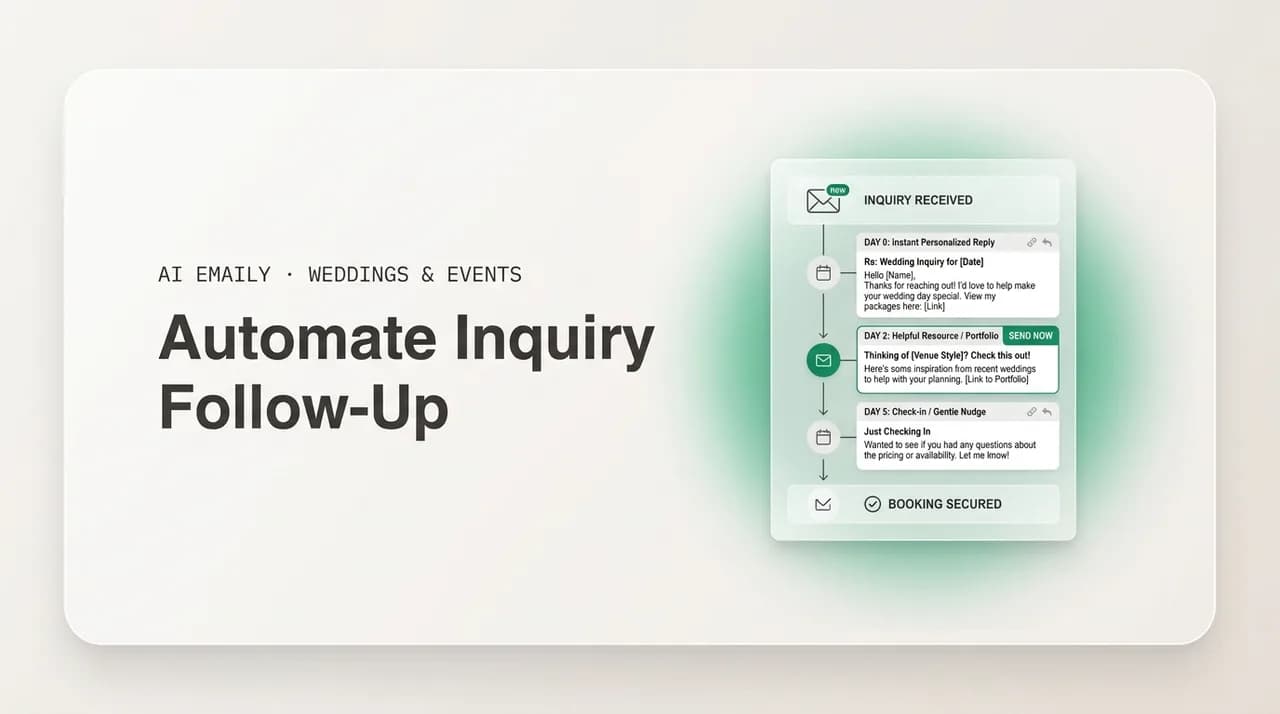
Here is a complete, five-touch follow-up sequence you can adapt for a photography business or a venue. It is deliberately simple, because a sequence you will actually run beats a clever one you abandon. The whole thing spans about three weeks, starts warm, and ends with a graceful exit that leaves the door open rather than slamming it. Read the timing table first, then the templates below it.
The logic behind the cadence: the first reply goes out immediately, because speed wins the initial impression. The next two touches sit close together, within the first week, while the couple is still actively comparing vendors. The last two space out, because by then the couple has either moved on or is deep in other planning, and spacing keeps you present without becoming noise. Every touch adds something, a resource, a question, an offer to hold the date, rather than just repeating "just checking in."
| Touch | Timing | Goal | What it says |
|---|---|---|---|
| 1. Instant reply | Within minutes of the inquiry | Win the first impression, answer the core question | Warm thanks, confirm their date, give pricing or a starting point, invite the next step (call or availability check). |
| 2. Helpful nudge | 2 days after the inquiry | Stay top of mind while they compare | Check they got your note, add value (a guide, a real wedding, an FAQ), and gently ask if they have questions. |
| 3. Soft check-in | 5 days after the inquiry | Catch the couple who got busy | Short, low-pressure: "Still figuring out your date? Happy to answer anything or hop on a quick call." |
| 4. Date-hold or urgency | 10 days after the inquiry | Create a real, honest reason to decide | Offer to tentatively hold their date, or note that the date is getting requests, only if true. Never fake scarcity. |
| 5. Graceful close | 18–21 days after the inquiry | Exit warmly, leave the door open | Assume they may have booked elsewhere, wish them well, invite them to reach out if plans change. Zero guilt. |
Now the templates. Swap in your details and adjust the voice until it sounds like you. Each one is written to be reused for most inquiries with light personalization at the top, which is exactly what makes the sequence automatable later. Notice that none of them is a hard sell. They are the kind of notes a thoughtful, organized human would send if they had the time, and the whole point of automating this is to send them even when you do not.
Touch 1 is your instant reply, the one that wins the first impression. Keep it warm, answer the obvious question, and point clearly at the next step.
Touch 2, two days later, is the helpful nudge. Its job is to stay top of mind while the couple is still actively comparing, and it should add something rather than just asking whether they saw your last email.
Touch 3, around day five, is the soft check-in. This is the single most valuable email in the whole sequence, because it is the one most vendors never send. Keep it short and pressure-free. You are simply catching the couple who got busy.
Touch 4, around day ten, is where a venue in particular can give the couple a real, honest reason to decide: an offer to tentatively hold the date. This is powerful precisely because it is true. Never manufacture scarcity you do not have; couples can smell a fake "only one date left" from a mile away, and it damages trust more than a lost booking ever could.
Touch 5, at around three weeks, is the graceful close. Its job is to exit warmly and leave the door open, not to guilt anyone. Assume the couple may have booked elsewhere and be genuinely gracious about it. Counterintuitively, this is often the email that gets a reply, because it lowers the pressure entirely and a surprising number of couples resurface at exactly this moment.
Adapt, do not copy blindly
How do you automate follow-up without sounding like a robot?#
The moment people hear "automated follow up for photographers," they picture the thing they hate receiving: cold, obviously mass-produced emails that open with "Hi there" and read like a sales funnel. That fear is legitimate, and it is exactly why so many wedding pros avoid automation and then lose bookings by hand instead. But the fear is based on a false choice. Automation and personalization are not opposites. What you want to automate is the timing, the discipline, the never-forgetting, the not-having-to-do-it-at-11pm-after-a-wedding. What you want to keep human is the voice. Those are two different layers, and good tools let you separate them.
Think of it this way. The robotic feeling in a bad automated email does not come from the fact that it was scheduled. It comes from the fact that it was written for no one in particular. A couple cannot tell whether the warm, specific note in their inbox was typed live or queued three days ago. They can absolutely tell whether it sounds like a person who looked at their inquiry or a template that got blasted to a list. So the entire art of automating follow-up well is this: automate the delivery, personalize the content, and make sure the content sounds like you.
Here is what that looks like in practice, as a set of principles that keep an automated sequence feeling human.
- Automate the schedule, not the sincerity. Let the system decide when touch three goes out. Let your own voice, and a real detail about the couple's date or venue, decide what it says.
- Personalize the top, template the bottom. The opening line, the couple's names, their date, and one specific reference should be tailored. The structure and the helpful resource underneath can be reused. Most of the email can repeat; the part that proves you are paying attention cannot.
- Write in your actual voice. If you say "so excited" and use exclamation points in real life, your sequence should too. If you are calm and understated, it should be that. A tool that learns how you write is doing this for you; a generic template library is not.
- Stop the sequence the instant they reply. Nothing feels more robotic than getting "just checking in!" the day after you already answered. The whole automation must halt the moment a human enters the conversation, and hand the thread back to you.
- Never fake scarcity or urgency. Automated "only one spot left" messages that are not true are the fastest way to burn trust. If you offer a date hold or mention interest in a date, it has to be real.
- Keep it short and human-scaled. Automated does not mean longer. The best follow-ups are two or three sentences that could plausibly have been typed on a phone between shoots.
The other half of sounding human is knowing what should never be automated at all. Some replies are genuinely bespoke, a couple asking about a complicated multi-day event, a sensitive question, a negotiation, a message that needs judgment or warmth that no template can carry. The goal is not to automate every word you send. It is to automate the predictable, repetitive follow-up scaffolding so that your time and attention go to the conversations that actually need a human. A good system handles the routine touches on its own and pulls you in the moment something needs you, rather than forcing you to choose between automating everything or automating nothing.
The test for any automated email
Should follow-ups auto-send, or should you approve each one?#
This is the question that decides whether you will actually trust an automated sequence, and it deserves an honest answer rather than a sales pitch. There is a real spectrum here, and the right point on it depends on how templated the message is and how much you trust the system.
At one end is fully manual: you write and send every touch yourself. This is where most wedding pros are today, and it is why the follow-up leak exists. It gives you total control and total inconsistency, because the moment a wedding weekend swallows you, the whole thing stops. At the other end is fully automatic: the sequence sends every touch on schedule with no human in the loop. This is genuinely appropriate for the safest, most templated parts of the motion, the instant acknowledgment, the day-two helpful nudge, the graceful close, because those messages are low-risk and nearly identical for every couple.
In between sits the mode that most pros should start in and many should stay in for the higher-stakes touches: approve-before-send. The system drafts the follow-up, on time, in your voice, with the couple's details filled in, and then holds it for a single tap of approval before it goes out. You get almost all the benefit of automation, the never-forgetting, the perfect timing, the draft already written, without ever losing control of what leaves your name. Approving a pre-written, correctly-timed draft takes five seconds. Remembering to write it from scratch on day ten takes willpower you will not always have.
The sensible way to adopt automation is to move along this spectrum as trust builds, rather than jumping straight to hands-off. Start with approve-before-send on everything. Watch what the system drafts. When you notice that you are approving the day-two nudge and the graceful-close email unchanged every single time, those are the touches you can safely let send on their own. Keep the higher-stakes ones, the date-hold offer, anything involving pricing negotiation or a custom request, under approval for longer, or forever. The point is that you decide the line, per touch, and you can move it whenever you want.
Two guardrails make this safe no matter where you set the line. First, a real send-delay and undo, so that even an auto-sent message can be caught and pulled back in the seconds after it goes, before it reaches the couple. Second, a complete audit trail, so you can always see exactly what was sent, to whom, and when, with nothing happening in a black box under your name. Automation you cannot see or reverse is a liability. Automation with approval, undo, and an audit log is just you, made reliable. Those guardrails are why approve-before-send is the honest default in the first version of any trustworthy system, with true hands-off reserved for the touches you have explicitly cleared.
Never let anything send in a black box
How do you set up an automated follow-up sequence?#
Whether you build this in a dedicated tool, a CRM, or an AI email client, the setup follows the same handful of steps. Getting the structure right matters more than the specific software, so here is the sequence of decisions to make.
- 1
Write your five touches in your own voice
Start from the templates above and rewrite them until they sound like you, not like a template. This is the foundation; a sequence built on generic copy will underperform no matter how well it is automated. Save them as your reusable base.
- 2
Set the timing for each touch
Use a cadence like instant, day two, day five, day ten, and day eighteen to twenty-one. Front-load the touches while the couple is comparing, then space out. Adjust to your market, but keep the first reply as close to instant as you can.
- 3
Define the trigger and the stop condition
The sequence should start automatically when a new inquiry arrives, and, most importantly, stop the instant the couple replies. A sequence that keeps firing after someone has answered is the fastest way to sound robotic. Make the stop-on-reply rule non-negotiable.
- 4
Decide auto-send versus approve for each touch
Set the safe, templated touches (the instant acknowledgment, the day-two nudge, the graceful close) to draft-and-hold or auto-send, and keep higher-stakes touches (date holds, pricing, custom requests) under approve-before-send until you trust them.
- 5
Add light personalization tokens
Pull in the couple's name, their date, and their venue so every email opens with something specific. Even a single real detail transforms how a scheduled message reads. Leave room to add a bespoke line at the top when a particular inquiry deserves one.
- 6
Turn on undo and audit, then test it on yourself
Confirm you have a send-delay or undo window and a log of what was sent. Then run a test inquiry through the whole sequence to yourself so you see exactly what a couple would receive, and fix anything that sounds off before it goes live.
One practical note on tooling. Many wedding pros already run a CRM like HoneyBook or Dubsado, and those tools can automate follow-up to varying degrees. The limitation most people hit is that CRM automations tend to be rigid template blasts, they send the same words to everyone, they do not sound like you wrote them fresh, and they do not reliably stop and hand back to you the instant a real conversation starts. The follow-up leak often persists even for people who technically have automation, because the automation feels generic enough that they turn it off, or because it fires at the wrong moments and embarrasses them. The bar to clear is not just "can it send scheduled emails." It is "does it send emails that sound like me, stop when a human replies, and stay under my control."
How AI Emaily helps you automate inquiry follow-up#
This is exactly the problem AI Emaily is built for. It is an AI-native email client, an autonomous chief of staff for your inbox, and inquiry follow-up is one of the clearest cases where it earns its place for a photographer, a solo shooter, or a venue. Because the inquiry-response and multi-step follow-up motion is highly templated and safe to automate with light voice-matching, it is close to the ideal thing to hand off, and AI Emaily handles it end to end while keeping you in control.
The core of it is voice. AI Emaily learns how you actually write, so the follow-ups it drafts come back sounding like you, warm where you are warm, understated where you are understated, not like generic auto-reply boilerplate. It fills in the couple's name, their date, and their venue, so every touch opens with something specific rather than "Hi there." And it runs the multi-step sequence on its own timing, so touch three actually goes out on day five even when you spent that day on your feet at a wedding. The whole point is that the follow-up you know you should be doing gets done, on schedule, in your words, without living in your head.
Crucially, it lets you decide how much to hand over, and it never operates in a black box. AI Emaily works in Manual, Copilot, and Autopilot modes. In Copilot, which is the honest default, it drafts each follow-up in your voice and holds it for your approval, so nothing leaves your name without a tap; you get the never-forgetting and the perfect timing while keeping the final say. As you watch it draft the safe, repetitive touches, the instant acknowledgment, the day-two nudge, the graceful close, correctly every time, you can move those to Autopilot and let them send on their own, while keeping the higher-stakes touches under approval. Every mode ships with a real undo window and a full audit trail, so you can always see exactly what was sent, to whom, and when, and pull anything back in the moment. And the sequence stops the instant a couple replies, handing the conversation back to you, so you never send "just checking in" to someone who already answered.
The result is the thing the whole industry keeps telling wedding pros to do but almost nobody manages by hand: follow up three, four, five times, on time, in your own voice, for every single inquiry, without it becoming a second job. You connect your Gmail, Outlook, iCloud, Fastmail, Proton, or any IMAP account, and the inbox that used to leak bookings out the back starts closing them instead. You can try it free at app.aiemaily.com/signup, with a Free plan at no cost and Pro at $12.42 per month on the annual plan.
Putting it all together#
The bookings you are losing are not lost on the merits. They are lost in the gap between the first reply and the follow-up that never came. Couples inquiry-blast several vendors, get busy, and book whoever was still warmly, consistently present when they finally had a free evening to decide. The advice the whole wedding industry gives, follow up three or more times, not once, is correct. It just collides with the reality that doing it by hand, on time, for every inquiry, in the middle of a season, is nearly impossible.
That collision is what automation resolves. Build a simple five-touch sequence, instant reply, a helpful nudge, a soft check-in, an honest date-hold or urgency touch, and a graceful close, spread across about three weeks. Write it in your own voice. Then automate the timing and the discipline while keeping the words human, personalizing the top of each message, stopping the instant the couple replies, and never faking scarcity. Start with approve-before-send so nothing leaves your name without a tap, keep undo and an audit trail on everything, and move individual touches to hands-off only as you learn to trust them.
Do that, and the single largest source of winnable bookings you are currently leaking, the couples who were interested but busy, starts converting instead of disappearing. You stop carrying a mental list of half-finished conversations into every shoot, and you get to spend your attention on the work you actually got into this for. If you would rather not build and babysit the sequence by hand, let an AI email client run it in your voice, on time, under your control. Either way, the goal is simple: never let an interested couple go cold again.
Frequently asked
See it in AI Emaily
Keep reading
Sources

Written by
Nafiul HasanNafiul Hasan is an entrepreneur and AI automation system builder with 10+ years of experience turning messy, manual workflows into reliable automated systems. He designs and ships AI enterprise solutions end-to-end — the agent logic, the data plumbing, and the product people actually use — and founded AI Emaily to give busy professionals their attention back. He writes here from the builder's seat: what works, what breaks, and how to put AI to work without giving up control.