How to Respond to Wedding Inquiries Faster (and Win the Booking)

The short answer
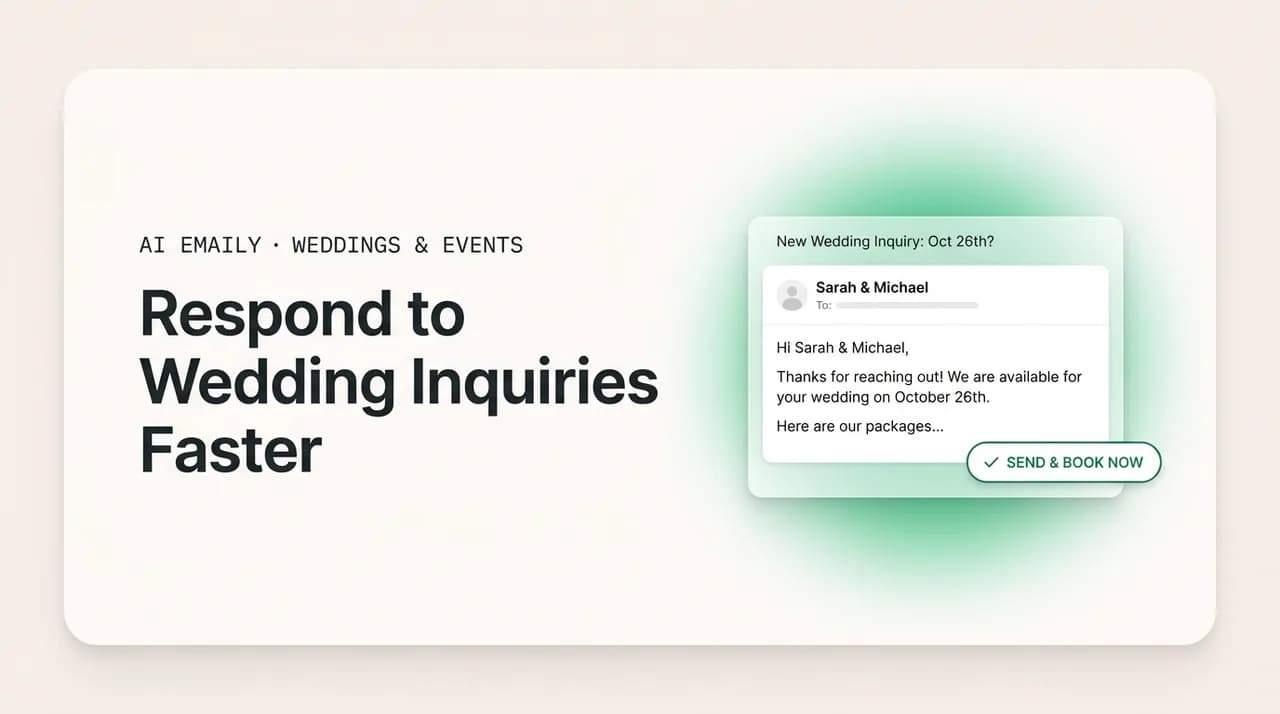
Couples inquiry-blast several vendors and tend to book the first warm, organized reply. The single biggest lever on your booking rate is speed: answer within minutes, not hours. Build a system of an instant acknowledgment, a same-day personal reply, and three planned follow-ups, and cover the after-hours and out-shooting gaps that let leads go cold.
Learn how to respond to wedding inquiries faster and win more bookings. A speed-to-lead system for photographers, planners, and venues: instant acknowledgment, templates, after-hours coverage, and honest AI help.
On this page
- 01Why does responding to wedding inquiries faster win the booking?
- 02How much does wedding inquiry response time actually affect booking odds?
- 03Why are wedding and creative pros so slow to respond to inquiries?
- 04What does a fast wedding inquiry response system look like?
- 05Instant acknowledgment vs. personal reply: what's the difference?
- 06What are the best templates to respond to wedding inquiries faster?
- 07How do you respond to wedding inquiries after hours and while shooting?
- 08Why isn't one reply enough? The case for fast follow-up.
- 09How does AI Emaily help you respond to wedding inquiries faster?
- 10Putting it all together
Why does responding to wedding inquiries faster win the booking?#
Here is the uncomfortable truth about booking weddings: the couple who just filled out your contact form probably filled out four or five others in the same sitting. They found you on The Knot or Instagram at 10 p.m., liked your work, and sent the same message to every photographer, venue, or planner whose portfolio caught their eye. From that moment, you are not competing on price or portfolio yet. You are competing on speed. Learning how to respond to wedding inquiries faster is the highest-leverage change most creative pros can make to their booking rate, because the vendor who replies first, warmly and clearly, is the one who gets to have the real conversation while everyone else is still sitting in an unread inbox.
This is not a hunch or a motivational-poster cliché. Sales research has said the same thing for more than a decade across every industry that runs on inbound leads. The pattern holds whether you sell software, real estate, or wedding photography: the odds of connecting with and converting a fresh lead collapse fast in the first hour, and they keep falling by the day. A couple who gets a thoughtful reply eleven minutes after inquiring feels seen. A couple who hears back eleven hours later has, in the meantime, already booked a call with someone else, or worse, decided you must be too busy, too disorganized, or too disinterested to bother.
For wedding vendors the effect is sharper than in most industries, for three reasons we will unpack in this guide. Couples inquire in bursts to many vendors at once. They inquire on their own schedule, which means nights and weekends, precisely when you are least available. And a wedding is an emotional, deadline-driven purchase where the couple wants reassurance that the person handling one of the biggest days of their life is on top of things. A fast, warm reply is the first proof that you are. A slow one plants the first seed of doubt.
It helps to picture the inquiry from the couple's side of the screen. They are excited, a little overwhelmed, and working through a long checklist of vendors to lock in before the good dates and the good people are gone. Wedding planning runs on a countdown. Popular venues and in-demand photographers book twelve to eighteen months out, and every week a couple waits, another option disappears. That urgency is why they inquiry-blast in the first place: they are trying to compress a slow, high-stakes decision into a few evenings of research, and they will happily let the vendors who respond fastest and clearest shrink the shortlist for them.
So when your reply lands first, it does more than get you in the door. It quietly frames you as the organized, reliable one, which is exactly the trait a couple is subconsciously screening for. When your reply lands last, or never, it does the opposite. The goal of everything that follows is to make sure yours is the one that lands first, sounds like you, and moves the conversation forward, without chaining you to your inbox on a Saturday night or during a wedding you are actually shooting.
The one number to remember
How much does wedding inquiry response time actually affect booking odds?#
The relationship between speed and bookings is steep and well documented. A landmark study of inbound sales leads found that firms trying to reach a lead within an hour were far more likely to have a meaningful conversation than firms that waited even a couple of hours, and that the odds of qualifying a lead dropped sharply the longer the wait ran. Later analyses of speed-to-lead across industries reached the same conclusion from different angles: responding in the first few minutes can multiply your conversion rate several times over compared with responding an hour or a day later. The exact multipliers vary by study and by market, but the shape of the curve never changes. Fast wins. Slow loses. And the drop-off is front-loaded into the very first minutes and hours.
The table below translates that research into the terms a wedding vendor actually thinks in. Treat the booking-odds column as directional rather than a precise promise for your specific business, because your numbers depend on your price point, your market, and how strong your portfolio is. But the direction is not in doubt, and it is dramatic. The difference between replying in five minutes and replying the next morning is not a rounding error. It is often the difference between a booked wedding and a polite "we went with someone else."
| Time to first reply | What the couple experiences | Relative booking odds |
|---|---|---|
| Under 5 minutes | You feel eager, professional, and available. Often the first reply they get. | Highest — you set the pace for the whole shortlist |
| Under 1 hour | You feel responsive and on top of things. Still likely near the front of the pack. | Very strong — most of the speed advantage intact |
| 1 to 5 hours | You feel normal. Another vendor has probably already replied. | Good, but you have lost the first-mover edge |
| Same day (5 to 12 hours) | You feel acceptable. The couple may already be booking a call with someone else. | Fading — you are now competing to be remembered |
| Next day (12 to 24 hours) | You feel slow. The couple wonders if you are too busy for them. | Weak — many couples have moved on |
| 2+ days or never | You feel unreliable or uninterested. The lead is effectively dead. | Lowest — most of these never convert |
Two things about that curve matter most for how you build your system. First, the biggest gains are captured early. Going from a next-day reply to a same-day reply helps. Going from a same-day reply to a sub-hour reply helps more. Going from a sub-hour reply to a sub-five-minute reply is where the compounding really kicks in, because that is where you routinely become the first vendor the couple hears from, and being first has its own gravity: it anchors the conversation, earns the first call, and makes every other vendor a comparison against you rather than the other way around.
Second, and this is the part most vendors underestimate, the clock does not care about your schedule. A couple who inquires at 9:40 p.m. on a Sunday is not thinking about the fact that you are asleep, or shooting a rehearsal dinner, or with your own family. From their point of view they sent a message and are now waiting. If a competitor has any kind of instant response in place and you do not, you have already lost the first round before you even see the email on Monday. That is why the rest of this guide is less about typing faster and more about building a response system that keeps racing on your behalf when you personally cannot.
Speed is necessary, not sufficient
Why are wedding and creative pros so slow to respond to inquiries?#
If speed is so obviously valuable, why do so many talented photographers, planners, and venues reply late? Not because they do not care. They are late for a set of structural reasons baked into how a creative service business actually runs, and naming those reasons is the first step to designing around them. Almost every slow reply traces back to one of a handful of predictable traps.
The single biggest one is that the work itself pulls you off email at exactly the wrong moments. When you are shooting a wedding, you are unreachable for eight to twelve hours straight, and those hours are prime inquiry time because they fall on weekends. When you are deep in a culling and editing session, you are heads-down for good reason, and stopping to answer a new lead feels like breaking flow. A solo creative is, by definition, the artist and the salesperson and the accountant all at once, and the artist part of the job is loud and immediate while the salesperson part is quiet and easy to postpone. So inquiries pile up during the exact stretches when you are doing the thing you got into this business to do.
- You are out shooting. Weekends are peak inquiry time and peak shooting time. An all-day wedding means an all-day inbox blackout, right when new couples are browsing and sending.
- You are in editing tunnel vision. Post-production demands long, uninterrupted focus. Every context switch to answer a lead is expensive, so you batch email for "later," and later slips.
- Your inbox is your to-do list. New inquiries land in the same stream as gallery-delivery emails, vendor questions, and client logistics, so a hot lead sits three screens down under yesterday's noise.
- You want the reply to be perfect. Because the message matters, you wait until you can write a thoughtful, personalized response, and "when I have time to do it right" becomes tomorrow, then the day after.
- Inquiries arrive across too many channels. Web form, direct email, Instagram DM, The Knot, WeddingWire, and a contact page all feed leads in from different places, and the ones that land somewhere you check less often go stale first.
- You have no system, only willpower. Every reply is a fresh act of discipline instead of a repeatable process, so the moment life gets busy, the process is the first thing to fall away.
Notice that none of these are character flaws. They are the natural consequence of running a service business where the delivery work and the sales work compete for the same pair of hands, and where the delivery work almost always feels more urgent in the moment. The perfectionist trap is especially cruel, because it punishes the vendors who care most about their client communication: they wait to send the ideal reply, and while they wait, a competitor sends a good-enough reply now and books the call. In a speed race, a good reply that goes out in three minutes beats a perfect reply that goes out in three hours, every single time.
The way out is not to try harder or to check your phone more compulsively between shots. That path leads straight to burnout and still leaves the after-hours gap wide open. The way out is to separate the two jobs the reply has to do, the instant part and the personal part, and build a system that handles the instant part automatically so your slower, human, personal part still lands well within the window that matters. That is what the next section lays out.
The hidden cost of a lost lead
What does a fast wedding inquiry response system look like?#
The goal is a repeatable system, not a personality transplant that turns you into someone who loves email. A good system does two things at once: it puts something warm and helpful in front of the couple within minutes, no matter what you are doing, and it makes your personal follow-up fast and consistent so you never stare at a blank reply again. Here is the framework, built as a sequence you set up once and then run on every inquiry.
The core idea is to split the response into layers. The first layer is instant and automated. The later layers are personal and human but heavily assisted by templates, so they take you a minute instead of twenty. Each layer buys you time and keeps the couple warm while you move to the next one.
- 1
Send an instant acknowledgment within minutes
The moment an inquiry lands, a warm, on-brand acknowledgment goes out automatically. It confirms you received their message, thanks them, tells them exactly when they will hear from you personally, and includes one or two useful next steps. This is the layer that wins the speed race even when you are unreachable.
- 2
Follow with a personal reply the same day
Within a few hours, or as soon as you are off the shoot, send a real reply that references their date, venue, and vision. Start from a template so it takes two minutes, then personalize the top and the details. This is the message that actually starts the relationship and the sale.
- 3
Make it effortless to answer their questions
Have your pricing range, availability check, package overview, and a link to book a call ready to paste. The faster you can answer "how much" and "are you free," the faster the couple can say yes. Slow answers to those two questions are where most momentum dies.
- 4
Follow up on a schedule, not a whim
If they go quiet, follow up. Experienced pros advise following up on an inquiry up to three times, not once, because most bookings happen after the first message. Space your touches over a couple of weeks and stop when they book or clearly decline.
- 5
Cover the after-hours and out-shooting gaps
Decide in advance what happens to an inquiry that arrives at 10 p.m. or during a Saturday wedding. Either the instant acknowledgment holds the line until you surface, or an assistant or automation handles the routine reply. The gap is where most leads are quietly lost.
- 6
Track every inquiry so none fall through
Give every lead a place to live, whether a CRM, a label, or a simple pipeline, so you can see at a glance who has been acknowledged, who is awaiting a personal reply, and who is due for follow-up. What you cannot see, you cannot respond to.
Read those six steps again and notice how little of the winning move depends on you being fast in the moment. Only step two, the personal reply, actually requires your attention within a few hours, and templates make it quick. Everything that has to happen in the first few minutes, the part where the speed race is won, is handled by the instant acknowledgment in step one, which runs whether you are asleep, shooting, or editing. That is the whole trick. You stop trying to be a faster human and start being a vendor whose system is always fast, so your human self can be thoughtful without being late.
The rest of this guide drills into the two layers that do the heavy lifting: the instant acknowledgment versus the personal reply, the templates that make both quick, the follow-up cadence, and the after-hours plan. Get those right and your effective response time drops from hours to minutes without you touching your phone any more than you already do.
Instant acknowledgment vs. personal reply: what's the difference?#
This distinction is the most important idea in the whole guide, so it is worth slowing down on. An instant acknowledgment and a personal reply are two different messages doing two different jobs, and most vendors fail because they try to make one message do both, which forces them to choose between fast and good. You do not have to choose. You send both, in that order.
The instant acknowledgment is the auto-reply that fires the second an inquiry arrives. Its job is to win the speed race and set expectations. It should feel warm and human, never robotic, and it should do three things: confirm you got the message, tell the couple precisely when they will hear back from you personally, and give them something small and useful to do in the meantime, such as a link to your pricing guide, your portfolio, or a short questionnaire. Done well, it makes the couple feel taken care of within minutes and buys you hours of goodwill. Done badly, as a cold "This is an automated message," it can feel like a brush-off, so the wording matters.
The personal reply is the real, human message you send within a few hours. Its job is to start the relationship and move toward a call or a booking. It references the specifics they shared, their date, their venue, their vision, answers their actual questions, and invites the next step. This is where warmth, expertise, and personality do the selling. It does not need to be instant, because the acknowledgment already handled the clock. It needs to be genuine, specific, and clear about what happens next.
Make the acknowledgment sound like you
Here is what a strong instant acknowledgment looks like. It is friendly, it sets a clear expectation, and it gives the couple a next step so the momentum keeps building while you finish the shoot or the edit.
And here is the personal reply that follows a few hours later. Notice how it picks up specifics, answers the two questions every couple has, availability and price, and drives cleanly toward a call. It starts from a template but is personalized at the top and in the details, which is why it takes two minutes rather than twenty.
Together these two messages give the couple the best of both worlds: the reassurance of an instant response and the substance of a thoughtful, personal one. The acknowledgment lands while you are unreachable and holds your place at the front of the line. The personal reply lands within the same day and does the real selling. Neither one asks you to drop your camera mid-ceremony or answer email at midnight, which is precisely why the system survives a busy wedding season instead of collapsing under it.
What are the best templates to respond to wedding inquiries faster?#
Templates are how you make the personal reply fast without making it generic. The mistake is thinking a template means a canned, one-size-fits-all message. A good template is a strong skeleton, the structure and the reusable language, that you personalize at the top and in the specific details. You should never write the words "my collections start at" from scratch again; you should absolutely still write a fresh line about their venue or their date. The template carries the ninety percent that repeats, and you supply the ten percent that makes it feel like it was written just for them.
Build a small library of templates for the handful of situations that come up over and over. You do not need dozens. Five or six cover almost everything, and each one turns a twenty-minute writing task into a two-minute editing task. Here are the ones every wedding vendor should have ready to paste.
- 1
The available-and-eager reply
For when you are free on their date. Confirm availability enthusiastically, give a pricing range, attach your guide, and drive to a call. This is your workhorse; make it warm and make the next step obvious.
- 2
The date-unavailable reply
For when you are already booked. Be gracious and quick, express genuine regret, and, where you can, offer an associate, a referral, or a spot on a waitlist. A fast, kind "I'm booked" protects your reputation and sometimes earns a referral.
- 3
The pricing-question reply
For couples who ask "how much?" up front. Answer with a real range rather than dodging, frame the value, and invite a call to tailor a package. Vendors who hide pricing entirely tend to lose the fast, decisive couples.
- 4
The more-info-needed reply
For vague inquiries missing a date or venue. Warmly ask the two or three questions you need to check availability and quote, so you can move to a real reply on the next round without a long back-and-forth.
- 5
The gentle follow-up
For a couple who went quiet after your first reply. Light, no pressure, one useful nudge: reconfirm availability, add a testimonial or a relevant gallery, and ask if they have any questions.
- 6
The final check-in
For your last follow-up before you close the loop. Honest and warm: let them know their date is still open but filling up, and that you'd love to hold it for them if they're ready.
A few rules keep a template library from going stale or sounding robotic. Keep every template short enough to read on a phone, because most couples open your reply on a screen the size of a playing card. Always end with a single clear next step, usually a link to book a call, so the couple never has to wonder what to do. Personalize the first line and at least one specific detail every time; that one custom sentence is what separates a warm reply from a mail-merge. And revisit the library each season, because your pricing, your packages, and your voice all drift over time, and a template with last year's prices is worse than no template at all.
For a deeper set of ready-to-paste scripts covering each of these situations, including the exact wording for the available reply, the booked reply, and the follow-up sequence, see our companion guide of wedding photography inquiry response templates. This guide is about the speed system; that one is about the words.
Templates are a starting line, not a finish line
How do you respond to wedding inquiries after hours and while shooting?#
This is the gap that quietly costs the most bookings, and almost no amount of personal discipline can close it. A huge share of wedding inquiries arrive in the evenings and on weekends, because that is when engaged couples have time to sit down and plan. And that is precisely when you are least available: it is when you are shooting, when you are at your own family dinner, when you are asleep. If your only plan for these inquiries is "I'll get to it when I'm back at my desk," you are structurally guaranteed to be slow on a large fraction of your leads, and those are often the most motivated couples, the ones planning late into the night because their date is a priority.
You cannot solve this by being available around the clock. That way lies burnout, and it still fails the moment you put your phone in your pocket to shoot a first dance. The only durable solution is to decouple the instant response from your personal availability, so that the couple gets something warm and useful within minutes even though the human behind it is completely offline. There are a few honest ways to do that, from lowest to highest effort on the couple's behalf.
- Set an always-on instant acknowledgment. The lowest-effort, highest-return move: an auto-reply that fires on every inquiry, day or night, confirming receipt and setting a clear expectation for when you'll personally follow up. It runs while you shoot and sleep.
- Use a dedicated shooting-day reply. On days you know you're unreachable, tune the acknowledgment to say so plainly and reassuringly: "I'm out capturing a wedding today and will reply personally tomorrow morning." Honesty about being on a shoot reads as proof you're in demand, not as a red flag.
- Route routine questions to a template automatically. For the most common inquiries, availability and pricing, a well-built automation can send the real information immediately, not just a placeholder, so the couple can keep moving toward booking even at midnight.
- Delegate to an assistant or second shooter's downtime. If you have a team, a studio manager or associate can own first-touch replies during your shoot days, keeping the response fast under one consistent brand voice.
- Batch personal replies at fixed times. Pair the always-on acknowledgment with two or three set windows a day, morning, midday, evening, when you send your personal replies. The acknowledgment holds the line; the batch keeps you sane.
The through-line here is that after-hours coverage is a design decision you make once, not a heroic effort you sustain nightly. Decide what a 10 p.m. Sunday inquiry should experience, write the messages that deliver that experience, and put them on autopilot for the instant layer. Then your personal replies can happen on a humane schedule, batched into a few windows, without the couple ever feeling ignored. The couple gets speed; you get to keep your evenings and your focus.
One caution worth stating plainly: an after-hours acknowledgment should never over-promise. If you tell a couple at midnight that you'll reply "first thing in the morning," reply first thing in the morning. The instant message buys you goodwill and a defined window; blowing through that window costs you more than never setting it. Set an expectation you can actually keep, even on your busiest weekend, and then keep it.
Don't let one channel go dark
Why isn't one reply enough? The case for fast follow-up.#
Speed to the first reply wins you the conversation, but speed alone does not close the booking. A large share of couples do not respond to your first message, not because they are not interested, but because they are busy, comparing options, or waiting to talk to their partner. If you treat a single reply as the whole job and move on when they go quiet, you leave a meaningful chunk of your would-be bookings on the table. Experienced wedding pros are consistent on this point: you should follow up on an inquiry up to three times, not once, because a large fraction of bookings happen on the second or third touch, not the first.
This is where fast and persistent combine into something powerful. Being the first to reply gets you noticed. Following up promptly and warmly, two or three times over a couple of weeks, is what turns that early attention into a signed contract. The couple who went quiet after your first message may simply have gotten swept up in another part of planning; a light, well-timed nudge brings them back at exactly the moment they have bandwidth to decide. The vendor who follows up is not being pushy. They are being the organized, attentive professional the couple was hoping to find.
- 1
Follow-up one: a couple of days later
Short and warm. Reconfirm their date is still open, add one piece of value like a relevant gallery or a quick testimonial, and ask if they have any questions. Assume they simply got busy, not that they said no.
- 2
Follow-up two: about a week later
Gently reintroduce urgency without pressure: mention that their date is a popular one and starting to get inquiries, and that you'd love to hold it for them. Offer the call again with a direct booking link.
- 3
Follow-up three: the honest final check-in
Close the loop with grace. Let them know you don't want to crowd their inbox, that their date is still available for now, and that you're here whenever they're ready. This last touch books more couples than most vendors expect.
The reason most vendors stop after one reply is not strategy; it is friction and forgetting. You mean to follow up, but the couple's email drifts down the inbox, a wedding weekend eats your attention, and by the time you remember, weeks have passed and it feels awkward. The fix is the same as everywhere else in this guide: turn the intention into a system. Decide the cadence once, three touches over roughly two weeks, and give each pending lead a reminder or a place in a pipeline so the follow-up happens on schedule instead of on memory. When follow-up is a process rather than a personal to-do, it actually happens, and your booking rate climbs on the back of the leads you used to quietly abandon.
For a full walkthrough of building these sequences so they run on their own, including how to space them, what to say, and when to stop, see our guide on automating inquiry follow-up for photographers and venues. The principle to hold onto here is simple: the first reply is the ante, and the follow-up is the game.
How does AI Emaily help you respond to wedding inquiries faster?#
Everything above is a system you can build by hand, and plenty of vendors do, with an auto-responder, a folder of templates, and a calendar full of follow-up reminders. It works, but it leaks: the auto-reply sounds robotic, the templates go stale, the follow-ups get forgotten during a busy weekend, and the whole thing still depends on you remembering to run it. AI Emaily is built to close those leaks. It is an AI-native email client that acts as an autonomous chief of staff for your inbox, and inquiry response is exactly the kind of high-value, repeatable motion it is designed to own.
The honest version of what it does, mapped to the system in this guide: for the wedding and creative segment, the instant inquiry acknowledgment, the availability and pricing replies, and the multi-step follow-up sequences are all highly templated and safe to automate with light voice-matching, which is precisely the work AI Emaily takes off your plate. Because it learns how you actually write, the instant acknowledgment goes out in your voice within seconds of an inquiry landing, warm rather than robotic, so you win the speed race even while you're shooting or asleep. When a couple asks the two questions every couple asks, are you available and how much, it can draft the real answer from your pricing and packages, not a placeholder, so the conversation keeps moving at midnight without you touching your phone.
The part that matters most for a business where every word to a couple counts is that you stay in control. AI Emaily runs in three modes, Manual, Copilot, and Autopilot, so you decide how much rope to give it. In Copilot, which is the default for anything that sends in the current version, it drafts the acknowledgment, the personal reply, and each follow-up in your voice and waits for your one-tap approval before anything goes out, so nothing reaches a couple without your say-so. For the safest, most templated part of the motion, the instant acknowledgment and routine availability replies, you can graduate to Autopilot, gated and reversible, so those go out on their own while custom or delicate messages still route to you. Every action, in every mode, comes with undo and a full audit trail, so you can always see exactly what was sent and take it back if it wasn't right.
It also solves the follow-up problem that willpower cannot. AI Emaily can run the three-touch sequence on its own, spacing the nudges over a couple of weeks and stopping the moment a couple books or declines, so the leads you used to abandon after one reply actually get the second and third touch that books them. And because it connects to Gmail, Outlook, iCloud, Fastmail, Proton, and any IMAP account from one place, the inquiries scattered across your channels land in a single inbox you actually watch, instead of leaking from the ones you check least. The result is the system in this guide, running continuously, in your voice, without chaining you to your inbox.
None of this replaces your judgment or your relationship with the couple; it removes the friction between the moment an inquiry arrives and the moment they feel taken care of. You still do the real selling, the call, the connection, the artistry that made them reach out in the first place. AI Emaily just makes sure you are never the vendor who lost a wedding because the reply came a day too late. You can try it free at app.aiemaily.com/signup, with a Free plan at no cost and Pro at $12.42 per month on the annual plan.
Start with the acknowledgment
Putting it all together#
Couples book the fastest, warmest, most organized responder, and the research is unambiguous about how steep that speed curve is: the odds of winning a fresh lead fall fast in the first hour and keep falling by the day. The vendors who lose on speed are rarely lazy or uncaring; they are talented creatives whose real work, shooting and editing, pulls them off email at exactly the moments couples are inquiring. The answer is not to try to be a faster human. It is to build a response system that keeps racing on your behalf when you personally cannot.
That system has a simple shape. An instant, warm acknowledgment that fires within minutes and wins the speed race even while you're offline. A personal, same-day reply built from a template so it takes two minutes and still feels written just for them. A ready library of scripts for the handful of situations that repeat. An after-hours plan so a 10 p.m. Sunday inquiry gets speed instead of silence. And a follow-up cadence of three touches over two weeks, run on a schedule rather than on memory, because most bookings happen after the first message, not on it.
Build that by hand or let an AI-native email client run it for you in your own voice, with approval, undo, and an audit trail so you stay in control. Either way, the goal is the same and worth repeating: be the reply that lands first, sounds like you, and moves the conversation forward, so you win the booking before the field ever narrows.
Frequently asked
See it in AI Emaily
Keep reading
Sources

Written by
Nafiul HasanNafiul Hasan is an entrepreneur and AI automation system builder with 10+ years of experience turning messy, manual workflows into reliable automated systems. He designs and ships AI enterprise solutions end-to-end — the agent logic, the data plumbing, and the product people actually use — and founded AI Emaily to give busy professionals their attention back. He writes here from the builder's seat: what works, what breaks, and how to put AI to work without giving up control.