How to Write Client Emails for Weddings & Events (Templates + Voice Tips)

The short answer
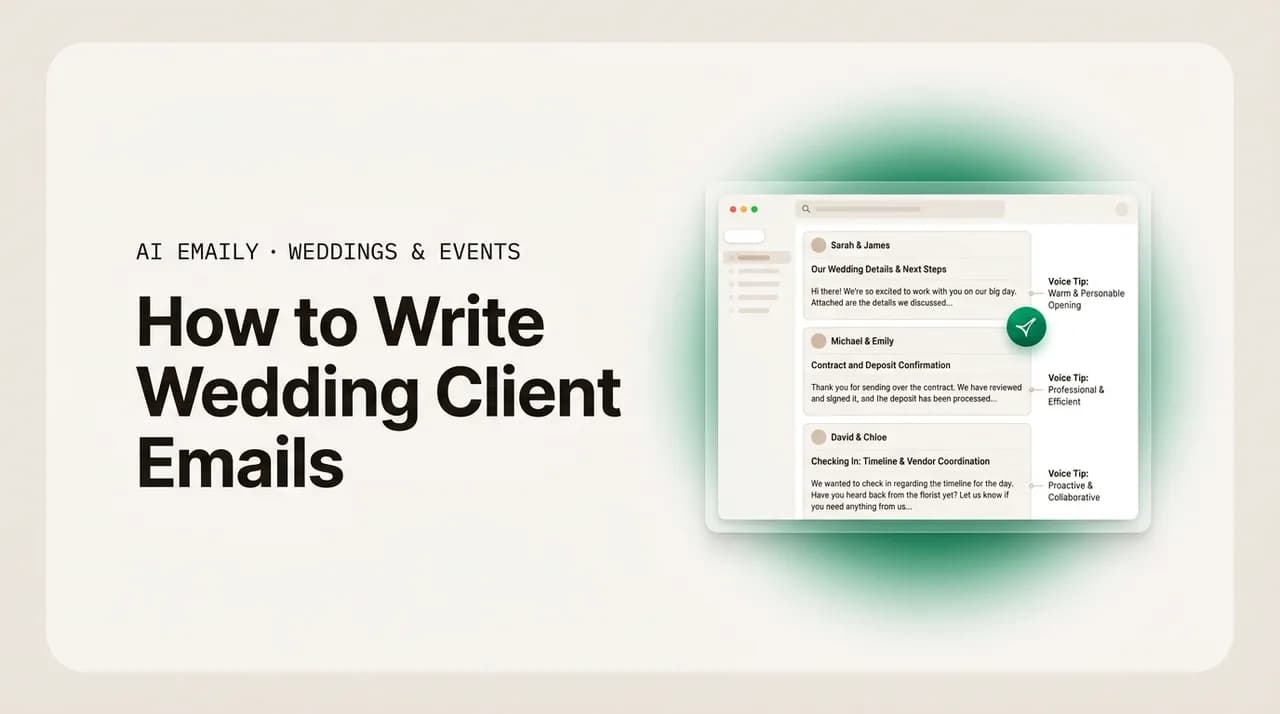
Great wedding client emails are fast, warm, and specific. Reply quickly, lead with the couple by name, set one clear next step, and keep your personality without burying the details. Use templates as a starting point, not a script, and always sound like a person who cares about their day.
How to write client emails for weddings that sound warm, on-brand, and convert. Templates for inquiry replies, pricing, booking, timelines, delivery, reviews, and hard conversations.
On this page
- 01Why knowing how to write client emails for weddings matters more than your portfolio
- 02What makes a wedding client email feel warm and on-brand?
- 03How do you reply to a wedding inquiry so it actually converts?
- 04How do you talk about pricing in an email without killing the mood?
- 05What should a booking welcome email say?
- 06How do you write timeline and logistics emails a couple can actually follow?
- 07What is the right week-of email to send before the wedding?
- 08How do you write the delivery email that makes couples want to share your work?
- 09How do you ask for a review without sounding needy?
- 10How do you handle a difficult conversation over email?
- 11Wedding client email etiquette and boundaries
- 12The most common wedding client email mistakes
- 13Tone by scenario: a quick reference
- 14How AI Emaily helps you write client emails for weddings
- 15Putting it all together
Why knowing how to write client emails for weddings matters more than your portfolio#
Here is an uncomfortable truth about the wedding and events business: the couple hiring you cannot see your talent in an inbox. They can only see your emails. Long before anyone looks at a full gallery or a signed timeline, they are reading a reply that either sounds like a warm, organized professional who has done this a hundred times, or like someone who is busy, distracted, and treating their inquiry as one more thing on a to-do list. Learning how to write client emails for weddings is not a soft skill you get to it later. For most photographers, planners, and venues, it is the actual product the couple experiences first, and it is where bookings are won and lost.
The reason is structural. Couples rarely contact one vendor. They fire off the same inquiry to five, eight, sometimes a dozen photographers or venues in a single evening, often at 10pm on a Sunday after a long day of planning. The first warm, human, well-written reply lands in an inbox that is still empty of competitors, and it does something the tenth generic quote never will: it makes the couple feel like they have already found their person. Response speed and response quality compound. A fast reply that also sounds like a real human who read their message is close to unbeatable.
This guide is about the writing itself, the words on the screen, not the CRM behind them. We will walk through the principles that make a wedding client email feel warm and on-brand instead of transactional, then move scenario by scenario through the emails you actually send: the inquiry reply, the pricing conversation, the booking welcome, timeline and logistics, the week-of note, the delivery message, the review request, and the difficult conversation nobody enjoys. Each one comes with a copy-and-adapt example. We finish with etiquette, boundaries, the mistakes that quietly cost bookings, and an honest look at how an AI email client can draft all of this in your voice so you stop starting from a blank page every time.
One number is worth sitting with before we go further. Across the wedding-venue space, the median inquiry response time runs around eleven hours, and the vendors who cut that to minutes rather than hours convert dramatically more of the couples who reach out. That gap is not a talent gap. It is a writing-and-systems gap, the difference between a vendor who can produce a warm, complete, on-brand reply on demand and one who lets inquiries sit while they are out shooting or running an event. Everything in this guide is aimed at closing it, so that the moment a couple emails you, a genuinely good message is ready to go.
The one-line test for every client email
What makes a wedding client email feel warm and on-brand?#
Warmth in an email is not fluff, and it is not exclamation points. It is a specific, learnable set of moves that signal to a couple that a real, competent human is on the other end and is happy to be part of their day. Five principles do most of the work. Get these right and almost any email you write will land well, even before you reach for a template.
- 1
Personality, on purpose
Your emails should sound like you, not like a form letter. If you are warm and a little playful in person, let that show. If you are calm and precise, lean into that. The couple is buying a relationship with you for one of the biggest days of their life, so a voice that matches your brand builds trust the moment they read it. Pick two or three phrases you actually say out loud and let them recur.
- 2
Clarity over cleverness
Warm does not mean vague. The kindest thing you can do for a stressed couple is make your emails easy to read and easy to act on. Short paragraphs, one idea each, plain language, and the important detail, price, date, next step, never buried in the middle of a paragraph. If they have to read twice to find what they owe you or when you arrive, you have added stress, not removed it.
- 3
Set expectations every time
The single biggest source of client anxiety in weddings is not knowing what happens next. Every email should answer, gently, three questions: what did I just read, what do you need from me, and when will I hear from you again. "I will send your gallery within eight weeks" and "I will follow up on Friday with the final timeline" turn a nervous client into a calm one.
- 4
Lead with them, not with you
The fastest way to sound generic is to open with your business. Open with the couple: their names, their date, something they said. "A November wedding at the Ryland barn sounds beautiful" tells them you read their note. Only after you have acknowledged them do you talk about how you work.
- 5
One clear call to action
A great client email leaves no doubt about the next step. Book a call, reply with a date, review the proposal, sign here. When you offer three possible actions, couples freeze and reply to none of them. Pick the single most useful next move and make it obvious and easy.
Subject lines deserve their own moment, because they decide whether the email gets opened at all in a crowded planning inbox. For wedding clients, the winning pattern is specific and human, not clever. "Your October 12th wedding, so glad you reached out" beats "Thanks for your inquiry!" every time, because it names the thing the couple cares about most, their date, and signals warmth. For an established client, put the topic and the action in the subject: "Your timeline for Saturday, one thing to confirm" tells them exactly what is inside and that they have a small job to do. Avoid all-caps, avoid "Re:" games, and never make a couple open an email to find out whether it needs a reply.
Underneath all five principles is a rule that saves more bookings than any template: match your tone to where the couple is in the journey. An inquiry reply is warm and inviting. A pricing email is confident and calm. A week-of note is reassuring and low-drama. A difficult conversation is honest and steady. The words change, but the through-line is that the couple always feels informed, respected, and in good hands. The table later in this guide lays out the right tone for each scenario so you never have to guess.
On-brand does not mean the same voice for everyone
How do you reply to a wedding inquiry so it actually converts?#
The inquiry reply is the most important email you will ever send, because it is the one that decides whether there is a relationship at all. The couple has emailed several vendors and is now, consciously or not, ranking the replies as they come in. Your job is to be fast, be warm, answer the obvious question, and make the next step easy to take. Speed matters enormously here, industry guidance is blunt that cutting response time from hours to minutes can roughly triple how many inquiries turn into bookings, but a fast reply that reads like a robot still loses to a slightly slower one that sounds like a human who is excited about their date.
A strong inquiry reply does five things in a handful of short lines: it thanks them by name, reflects back a detail from their message so they know you read it, confirms their date is open (or gently addresses that it is not), gives just enough about how you work to build confidence, and ends with one clear next step, usually a short call or a link. Notice what it does not do: dump your full price list, attach a fourteen-page PDF, or ask them to fill out a long form before you have said a single warm word. Here is a version that works for most photographers and planners.
Two things make this reply convert. First, the date confirmation near the top removes the couple's biggest worry immediately, which buys their attention for everything after it. Second, the call to action is a single, low-effort ask with a fallback, so a shy couple who does not want to book a call still has an easy way to keep the conversation going. When you offer only a scary next step, some couples ghost simply because replying felt like too much.
The other half of the inquiry battle is follow-up, and it is where most vendors quietly lose bookings. Experts who study the inquiry-to-booking funnel are consistent on this: one email is almost never enough, and a couple who did not reply is usually not a couple who chose someone else, they are a couple who got busy. Following up two or three times, spaced out and still warm, converts leads that a single reply would have lost. The trick is to make each follow-up feel like a helpful nudge from a person, not a nag from a sales machine.
Give them an easy "no"
How do you talk about pricing in an email without killing the mood?#
Pricing is where warm vendors suddenly go cold, and it costs them bookings. The instinct is to get clinical the moment money comes up, to send a bare number or a price sheet with no warmth around it, as if being businesslike means being distant. But a couple reading a pricing email is making an emotional decision as much as a financial one. Your job is to frame the number so it feels like an investment in their day, not a transaction, while still being completely clear and honest about what things cost. Never make a couple hunt or negotiate to find out your price; clarity here is a kindness and it filters your inquiries for you.
The structure that works: acknowledge them warmly, restate what you understand they want so the price feels tailored, present the number plainly and without apology, briefly connect it to the value they get, and end with an inviting, no-pressure next step. Do not bury the price, do not pad it with ten paragraphs of justification, and never sound like you are bracing for a fight. Confidence is warm. Here is a version that keeps the mood intact.
Notice how the number sits in a short paragraph of its own, stated plainly, with the value described right after it in concrete terms the couple can picture, ten hours, a second shooter, print rights, rather than vague adjectives. That specificity is what makes a price feel fair. The optional date hold near the end creates gentle urgency without pressure, and the closing line reopens the door for questions so a sticker-shocked couple has a low-stakes way to keep talking instead of disappearing.
When a couple pushes back on price, and some will, resist two temptations: caving instantly, and getting defensive. A calm, warm reply that holds your value while offering a genuine alternative preserves both the booking and the relationship. You might point them to a smaller collection, adjust hours rather than rate, or simply and kindly acknowledge that you may not be the right fit for their budget, which is a legitimate and professional answer. What you never want to do is make them feel small for asking or make yourself sound resentful for being asked.
Your pricing email is a filter, and that is good
What should a booking welcome email say?#
The moment a couple signs and pays their deposit, the relationship shifts, and your email should shift with it. They have just handed you one of the most important days of their life, and there is almost always a small, quiet moment of "did we make the right call?" right after they book. The welcome email exists to answer that with a resounding yes. It should feel celebratory, reassuring, and organized all at once, the first sign that they are now in genuinely good hands. This is the email that turns a customer into a fan, and fans are who leave reviews and refer their friends.
A great welcome email does four things: celebrates the decision warmly, confirms the key facts in one place so they feel secure, sets out what happens next and when so they are not left wondering, and reminds them how to reach you. It is also the perfect place to gently set expectations for the whole engagement, how often you will be in touch, when the next milestone is, so the couple relaxes into your process rather than nervously checking in. Here is a version that hits all four notes.
Front-load the reassurance
How do you write timeline and logistics emails a couple can actually follow?#
As the wedding approaches, your emails stop being about relationship-building and start being about coordination, and the writing rules change. This is the highest-stakes zone for clarity, because a confusing timeline email creates real-world chaos: a couple who did not realize they needed to be ready by 2pm, a family photo list nobody confirmed, a getting-ready address you never received. Warmth still matters, but here clarity is the warmth. The most caring thing you can do is make a complex day feel simple and make every action item impossible to miss.
The structure that saves everyone stress: open with a reassuring line, then break the logistics into scannable pieces, times, locations, what you need from them, using short labeled chunks or a clear list rather than a dense paragraph. Bold or separate the couple's action items so they do not get lost in the schedule. End by confirming when the final version is locked and inviting last questions. For planners coordinating many vendors, the same principle applies across every confirmation and status update: one email, one clear ask, no digging required.
The reason this format works is that a stressed couple, or a busy planner forwarding it to vendors, can extract exactly what they need in one pass. The times are grouped, the two action items are pulled out and given a deadline, and the promise of a "final locked timeline" tells everyone this is not the last word, which prevents premature panic. If you send logistics as a wall of prose, the action items drown and you spend the week before the wedding chasing answers you already asked for.
For planners specifically, the volume of coordination email around a fixed event date is relentless, vendor confirmations, delivery windows, arrival times, contingency plans, and each one lives or dies on the same clarity. A confirmation email should confirm one thing unambiguously and state what happens if plans change. A status update should tell the couple what is done, what is pending, and what, if anything, they need to do. The couple should never have to assemble the picture from five vague emails; you assemble it for them, every time.
Separate the schedule from the ask
What is the right week-of email to send before the wedding?#
The week before the wedding, the couple's stress peaks, and a single well-timed email from you can be the calmest thing in their inbox. The week-of note is not about new information, it is about reassurance. Its whole job is to say, in effect, everything is handled, I have you, here is the last small thing, now go enjoy your day. Get the tone right and you become the vendor the couple remembers as the one who made them feel calm. Get it wrong, or skip it, and you leave them to spin on unanswered questions during the most emotional week of the process.
Keep it short, warm, and low-drama. Confirm the essentials one last time, remind them of any final tiny action, reassure them that you have everything else, and tell them how to reach you if something changes at the last minute. Do not introduce anything new or alarming this close to the day; if there is a genuine problem, that is a phone call, not a week-of email. Here is the note that lands.
Give them a job that is not a job
How do you write the delivery email that makes couples want to share your work?#
The delivery email, when you send the gallery, the film, or the final deliverable, is a moment of pure goodwill, and it is criminally easy to waste. After weeks of anticipation, the couple opens their inbox to find their memories, and the email around the link sets the emotional frame for how they experience the work. A bare "here's your gallery, password is 1234" squanders the moment. A warm, personal note turns delivery into a small celebration and, crucially, is the point at which couples are most likely to share your work, tag you, and sing your praises, so it is also quietly your best marketing.
The delivery email should express genuine feeling about their day, deliver the practical access details clearly, gently guide them toward the actions you want, sharing, ordering prints, leaving a review, without being pushy, and thank them sincerely for choosing you. Timing helps too: telling them when the gallery arrives, and then beating that estimate, is a small delight. Here is a delivery email that makes couples want to share.
The emotional first line is doing the heavy lifting here, because it proves you saw their day as more than a job, which is exactly what makes a couple want to reciprocate by sharing and reviewing. The sharing and review asks come after the delivery, framed as a favor rather than a demand, and softened with "no rush at all," which paradoxically makes people more likely to do it. When you lead with the ask instead of the emotion, or attach conditions, the goodwill evaporates and so does the free marketing.
One structural tip for delivery: make the practical details, link, password, download instructions, impossible to miss, because a couple who cannot figure out how to access their photos will email you frustrated, which undercuts the whole warm moment. Put the access details in their own short paragraph, spell out the password exactly, and confirm they can download and keep everything. Clarity and warmth are not in tension here; the clearest delivery email is also the kindest one.
How do you ask for a review without sounding needy?#
Reviews are the lifeblood of a wedding business, they are how the next couple decides to trust you, yet most vendors either never ask or ask so awkwardly that they get nothing. The secret is timing and framing. Ask when the couple's goodwill is at its peak, right after they have received and loved their gallery, or a week or two after the wedding while the glow is fresh, and frame it as a small favor from a person, with an honest reason, rather than a corporate request. A great review ask is warm, specific, low-effort for the couple, and completely free of guilt or pressure.
The mechanics that work: thank them again, make the ask directly but gently, explain briefly why it matters (you are a small business, it genuinely helps), remove all friction by linking straight to where they should write it, and make clear that even a sentence or two is plenty. Never make a couple hunt for the review link, and never imply they owe you. Here is a review request that gets said yes to.
Point them at one specific thing to write about
How do you handle a difficult conversation over email?#
Sometimes the email you have to write is not warm-and-easy: a couple is unhappy, a deliverable is late, a request is out of scope, weather is forcing a change, or expectations have drifted apart. These are the emails that make vendors' stomachs drop, and they are exactly where your professionalism either shines or cracks. The good news is that a well-written difficult email can actually deepen a relationship, because how you handle a problem tells a couple far more about you than how you handle a smooth day. The goal is to be honest, steady, and solution-focused, warm without being a pushover, firm without being cold.
The structure that de-escalates: acknowledge their feeling or the situation genuinely, take appropriate ownership without groveling or over-apologizing, state the facts and the solution clearly, and end with a constructive next step and reassurance. Resist two instincts under pressure, the defensive one that argues and blames, and the panicked one that over-promises to make the discomfort stop. Neither serves you. Here is how to address a late gallery, a common flashpoint, in a way that calms rather than inflames.
What makes this work is that it validates the couple's frustration in the very first line, which instantly lowers the temperature, then takes ownership without collapsing into excessive apology, and crucially, ends with a concrete, dated commitment plus a goodwill gesture, the sneak peek, that gives the couple something tangible right now. A difficult email without a clear next step just leaves the couple anxious; one with a specific commitment turns the situation around. If the issue is genuinely your fault, own it cleanly; if it is a misunderstanding, clarify without making them wrong.
A boundary conversation, declining an out-of-scope request or an unrealistic timeline, follows the same spine but leans on kind firmness. Acknowledge the request, explain your position warmly and briefly, and offer an alternative where one exists. "I completely understand wanting the full gallery by Monday, and I wish I could, here is the timeline I can promise, and here is a sneak peek to tide you over" holds the line while staying human. Saying no clearly and warmly is a professional skill, not a failure of service, and couples respect a vendor who has firm, well-communicated boundaries far more than one who over-promises and under-delivers.
Do not write hard emails while you are activated
Wedding client email etiquette and boundaries#
Beyond individual emails, a few etiquette habits separate the vendors couples rave about from the ones they merely tolerate. These are the invisible rules that make you feel professional over the length of an engagement, and most of them are about consistency and boundaries rather than any single perfect message.
- Reply within your promised window, every time. The specific speed matters less than the reliability. If you tell couples you answer within one business day, answer within one business day, always. Predictability builds more trust than occasional lightning-fast replies followed by silence.
- Set communication expectations early, then honor them. Tell couples up front how and how often you will be in touch, and when you are typically unavailable. "I check email on weekday mornings and reply within a day" prevents the anxiety of unanswered weekend messages.
- Keep business hours, and protect them. You do not have to answer a 9pm inquiry at 9pm to win it; a warm reply the next morning is fine, and it models the calm professionalism couples want. Answering at all hours trains clients to expect it and burns you out.
- Match their energy, but stay the professional. If a couple is formal, be a touch more formal; if they are casual and emoji-happy, you can loosen up. But you are always the steady one, especially when they are stressed. Your calm is part of what they are paying for.
- Confirm the important things in writing. Verbal agreements about times, add-ons, or changes should always be echoed in a short confirmation email, so there is a clear record and no wedding-day surprise about what was agreed.
- Use names and get them right. Spell both partners' names correctly, every time, and use them. Nothing undercuts warmth faster than a misspelled name or a "Dear couple" where a "Hi Maya and Chris" belongs.
- Know when to pick up the phone. Email is wrong for genuinely emotional or complicated moments, a serious problem, a big disappointment, a tense negotiation. A warm two-line email to schedule a quick call beats a long, fraught email thread that spirals.
Boundaries make you more bookable, not less
The most common wedding client email mistakes#
Most email failures in the wedding business are not dramatic blunders, they are small, repeated habits that quietly cost bookings and goodwill. Here are the ones that come up again and again, with what to do instead.
- Being too slow. The single most expensive mistake. An inquiry that sits for a day while competitors reply in minutes is often lost before you ever open it. Speed, even a fast warm holding reply, beats a perfect reply that comes too late.
- Sounding like a form letter. Opening with your business, using no names, and pasting the same generic block into every inquiry tells the couple they are one of many. One specific detail from their message fixes it instantly.
- Burying the important thing. Hiding the price, the date, the deadline, or the action item in the middle of a dense paragraph. Couples miss it, then you both suffer. Lead with what matters and give it its own line.
- Only following up once, or not at all. Treating a non-reply as a rejection. Most non-replies are just busy couples; two or three warm follow-ups convert leads a single email would have lost.
- Over-apologizing or over-explaining. Especially around price and problems. A wall of justification reads as insecurity. State things plainly and confidently; warmth does not require groveling.
- No clear next step. Ending an email without telling the couple exactly what to do next, so a warm conversation just stalls. Every client email should end with one obvious, easy action.
- Getting cold when it gets transactional. Switching from warm human to robot the moment money or logistics come up. The couple feels the shift. Stay yourself through pricing, contracts, and timelines.
- Sending hard emails in the heat of the moment. Firing off a defensive reply to an upset client. Draft it, wait, reread it as them, then send a calmer version with a concrete solution.
- Inconsistent voice across the journey. A warm inquiry reply followed by cold, templated logistics emails feels like two different people. Your voice should carry from the first email to the last.
- Forgetting the couple is stressed. Writing for your own convenience instead of their peace of mind. The couple planning the biggest day of their life needs clarity and reassurance, not efficiency for its own sake.
The slow reply is the booking you never knew you lost
Tone by scenario: a quick reference#
The words change from email to email, but the underlying move is always matching your tone to where the couple is in their journey. Here is the whole guide compressed into a table you can scan before you write. Find the scenario, hit the tone, keep the goal in view, and lead with the element that matters most.
| Scenario | Tone to aim for | The goal | Lead with |
|---|---|---|---|
| Inquiry reply | Warm, inviting, fast | Start a relationship, feel human | Their name and date, then one easy next step |
| Follow-up | Gentle, helpful, low-pressure | Revive a busy, not-lost lead | A light nudge and an easy way to say no |
| Pricing | Confident, calm, clear | Frame value, filter fit | Warm context, then the number plainly |
| Booking welcome | Celebratory, reassuring | Turn a customer into a fan | Congratulations and "nothing needed right now" |
| Timeline / logistics | Clear, organized, calm | Make a complex day simple | The schedule, then separated action items |
| Week-of | Reassuring, short, low-drama | Be the calm in their week | "Everything is set" and a human send-off |
| Delivery | Warm, emotional, generous | Delight and earn sharing | How their day felt, then the access details |
| Review request | Grateful, specific, no-pressure | Earn social proof | Thanks, then a small favor with a direct link |
| Difficult conversation | Honest, steady, solution-first | De-escalate and deepen trust | Validating their feeling, then a dated fix |
How AI Emaily helps you write client emails for weddings#
If you have read this far, you have probably noticed the tension at the heart of wedding client email: the emails that convert are warm, specific, and fast, and yet you are a creative professional who would rather be shooting, planning, or running an event than sitting at a keyboard crafting the tenth thoughtful inquiry reply of the week. The reason inquiries fall through the cracks is almost never that vendors do not care, it is that the inbox becomes a to-do list, leads go cold while you are out on a wedding weekend, and a single warm reply, when there was time for one, is not enough follow-up. That gap between knowing how to write a great client email and having the time and consistency to actually send one, every time, on time, is exactly where an AI email client earns its keep.
AI Emaily is an AI-native email client that connects to Gmail, Outlook, and any IMAP account and drafts your client emails in your own voice. It learns how you actually write, the warmth, the phrases you use, the way you sign off, so the drafts that come back sound like you wrote them, not like generic templates. When a couple's inquiry lands, it can have a warm, on-brand reply ready that confirms their date, reflects a detail from their message, and offers your next step, so you can send a genuinely good response in seconds instead of letting it sit until you are back from a shoot. The same holds for pricing replies, booking welcomes, timeline notes, delivery emails, and the multi-step follow-up sequences that convert busy couples, all templated enough to draft reliably, all delivered in your voice with light matching rather than a robotic block.
Crucially, this does not mean handing your client relationships to a machine and hoping. AI Emaily works in three modes, Manual, Copilot, and Autopilot, so you decide exactly how much control to keep. In Copilot, which is where most wedding pros live, the AI drafts the reply and you review and approve every email before it goes out, so nothing reaches a couple without your eyes on it, and you keep the personal touch that wins bookings while losing the blank-page friction. For the safest, most templated messages, an instant inquiry acknowledgment, a scheduling confirmation, a checklist reminder, you can let Autopilot handle them on its own, always with undo and a full audit trail of exactly what it sent and when. The high-stakes, relationship-defining emails, a delicate pricing negotiation, a difficult conversation, a bespoke note, stay firmly in your hands.
The result is that the writing principles in this guide stop being aspirational and start being automatic. Every inquiry gets a fast, warm, on-brand reply. Every couple gets consistent follow-up instead of one email and silence. Every logistics note is clear, every delivery email is warm, and your voice carries all the way through the journey, even during the weeks you are too busy to be at your desk. You get to be the creative professional couples fell in love with, while the inbox that used to leak bookings quietly does its job in the background. You can try it free at app.aiemaily.com/signup, with a Free plan at no cost and Pro at $12.42 per month on the annual plan.
Keep the human in Copilot
Putting it all together#
Learning how to write client emails for weddings comes down to a handful of durable moves you can apply to any message a couple will ever receive from you. Be fast, because couples email many vendors and the first warm reply often wins. Be warm, by leading with the couple, their names, their date, a detail they shared, before you ever talk about yourself. Be clear, by giving the price, the date, the action item its own line and never making a stressed couple hunt for what matters. And set expectations every time, so the couple always knows what just happened, what you need, and when they will hear from you next.
From there, the scenarios take care of themselves once you match tone to moment: warm and inviting on the inquiry, confident and calm on pricing, celebratory on the booking, crystal-clear on logistics, reassuring the week of, emotional on delivery, grateful on the review ask, and honest and steady when a hard conversation lands. Use the templates in this guide as starting points, not scripts, swap in real names and real details, and let your own voice carry through. The consistency of that voice, from the first inquiry reply to the review request weeks after the wedding, is what turns couples into fans and fans into referrals.
And when the writing is right but the time is not, let your email client carry the load in your voice, so the warm, well-crafted client email is ready the moment it is needed, even on the busiest wedding weekend. Either way, the goal is the same: make every couple feel, from their very first email to their last, that they are in genuinely good hands.
Frequently asked
See it in AI Emaily
Keep reading
Sources
- HoneyBook — Client Communication Tips for Creative Businesses
- Rising Tide Society — Community and Education for Creative Entrepreneurs
- Dubsado — Blog for Client-Based Business Workflows
- Grammarly — Emailing Advice and Professional Writing Tips
- Harvard Business Review — How to Write Email with Military Precision

Written by
Nafiul HasanNafiul Hasan is an entrepreneur and AI automation system builder with 10+ years of experience turning messy, manual workflows into reliable automated systems. He designs and ships AI enterprise solutions end-to-end — the agent logic, the data plumbing, and the product people actually use — and founded AI Emaily to give busy professionals their attention back. He writes here from the builder's seat: what works, what breaks, and how to put AI to work without giving up control.