The Best AI Email Assistant for Mortgage Loan Officers (2026): Drafts, Auto-Replies & Undo

The short answer
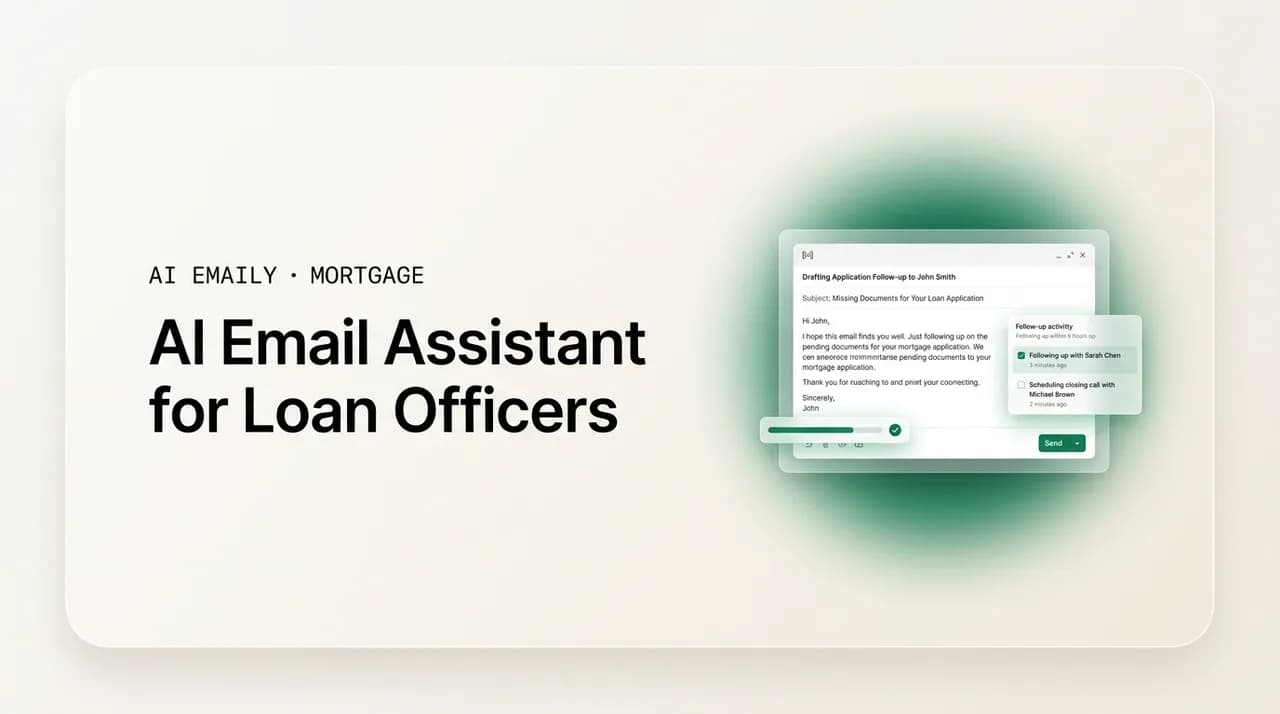
An AI email assistant for mortgage loan officers drafts replies in your voice, answers leads within seconds, and automates doc requests and status updates — while you keep an approve-before-send review on anything with rate or guideline advice. The right one is fast, sounds like you, works across Gmail, Outlook, iCloud, and IMAP, and gives you undo plus a full audit trail.
A practical guide to choosing an AI email assistant for mortgage loan officers: what to look for in voice match, instant lead reply, doc-request and status automation, approve-before-send control, and privacy — plus why AI Emaily fits.
On this page
- 01What is an AI email assistant for mortgage loan officers?
- 02What should you look for in an AI email assistant?
- 03How the three modes map to a loan officer's workflow
- 04Use case: instant lead reply on a shared lead
- 05Use case: pre-qual questions and document requests
- 06Use case: pre-approval and loan status updates
- 07Use case: rate-alert follow-ups and quiet-lead nudges
- 08Use case: realtor and referral-partner updates
- 09The honest objections (and straight answers)
- 10"Will it actually sound like me?"
- 11"What about compliance and disclosures?"
- 12"Is my borrowers' data secure?"
- 13Why AI Emaily fits loan officers
What is an AI email assistant for mortgage loan officers?#
An AI email assistant for mortgage loan officers is software that reads your inbox, understands the context of each borrower and referral partner, and does the repetitive email work you would otherwise do by hand: acknowledging a new lead the moment it lands, drafting a reply in your voice, requesting the next document on a file, sending a status update, or nudging a rate-shopper who has gone quiet. The best ones do this without turning your emails into obvious boilerplate, and without sending anything you have not approved when the message carries rate or guideline advice.
For a loan officer, the pitch is narrow and concrete. You are not trying to automate creativity. You are trying to stop losing deals to slow replies and stop spending your evenings typing the same doc-request email for the fortieth time this month. Mortgage origination is unusually repeatable at the email layer: the pre-qualification questions, the document checklists, the pre-approval status updates, the rate-alert follow-ups, and the realtor-partner updates barely change from file to file. That repeatability is exactly what an AI assistant is built to absorb.
This matters more in mortgage than in almost any other sales role because of a single, brutal dynamic: on a shared or portal lead, the borrower filled out the same form for four to seven lenders, and whoever calls and emails first, fastest, usually wins. You are frequently mid-closing when the next lead lands. The assistant's job is to make sure that lead still gets a fast, human-sounding, accurate reply even when your hands are full — and to do it in a way you can trust with your license on the line.
It helps to be precise about what an AI email assistant is not. It is not a mortgage CRM, though it should sit alongside one. It is not a compliance product, and it will not replace your compliance review or your loan officer judgment. It is not a magic lead source. What it is, done well, is a layer on top of your existing inbox that removes the manual drafting and follow-up bottleneck — the part of the day that scales linearly with your pipeline and quietly caps how many loans you can carry at once.
The rest of this guide covers what to look for when you evaluate one, how the different levels of autonomy map to a loan officer's actual workflow, the specific use cases where it earns its keep, the honest objections you should raise before you trust it, and where AI Emaily fits. We will keep the product claims accurate and the language plain, because the last thing a licensed originator needs is a vendor overpromising near a regulated transaction.
A tool, not a decision-maker
What should you look for in an AI email assistant?#
Not every AI writing tool is a fit for a licensed originator's inbox. A generic assistant that produces polished but generic prose will actively hurt you: borrowers can smell a template, and referral partners notice when your voice disappears. The features that matter for a loan officer are specific. Here is what separates a tool you will actually rely on from one you will quietly stop opening after two weeks.
- 1
It sounds like you (voice match, not boilerplate)
The assistant should learn from how you actually write — your greetings, your sign-off, whether you say "pre-qual" or "pre-approval," how warm or brisk you are — and draft in that voice. If every reply reads like a corporate autoresponder, borrowers stop trusting them and referral agents stop forwarding you clients. Voice match is the single most important feature for a relationship-driven role.
- 2
Instant lead reply, even after hours
The whole game on a shared lead is speed. The assistant should acknowledge a new inquiry within seconds — a real, personalized first touch that confirms you received it, sets a next step, and buys you time — not a generic "we got your message" bounce. This is the feature that directly protects your contact rate against faster competitors.
- 3
Doc-request and status-update automation
The most repeatable emails in the entire business are the document checklist and the pre-approval status update. A good assistant drafts these from a template you control, pulls the right borrower details in, and stages the follow-up when a document is still outstanding — so you stop personally chasing conditions.
- 4
Approve-before-send control
You must be able to review anything the AI writes before it goes out, especially anything touching rate, cost, or eligibility. The best tools stage a draft and wait for your one-click approval on sensitive replies, while letting you safely automate the truly routine ones. Control is not a nice-to-have here; it is the reason you can use the tool at all.
- 5
Undo and a full audit trail
When you do let it act, every action must be reversible and logged. You want to see exactly what was sent, to whom, and when — and be able to pull a message back inside an undo window if something looks off. An audit trail is your record and your safety net.
- 6
Works across every provider and device
Loan officers rarely live in one mailbox. You might have a company Outlook, a personal Gmail, and a forwarding address from a lead marketplace. The assistant should unify them so nothing slips between accounts, and it should run wherever you work — desk, laptop, phone between showings.
- 7
Privacy and data handling you can defend
Borrower email contains sensitive financial information. The assistant should never train models on your mail, should encrypt what it stores, and ideally should offer an on-device or bring-your-own-key option so you can tell a compliance officer exactly where the data goes. Treat any tool that is vague about this as a no.
Notice that most of these are about trust and control, not raw cleverness. A brilliant model that sends the wrong thing unsupervised is worse than useless in a regulated pipeline. The right assistant is the one that is fast and sounds like you on the routine work, and disciplined enough to stop and ask on anything that could become a commitment. When you evaluate tools, weight those two things above everything else on the marketing page.
The two-week test
How the three modes map to a loan officer's workflow#
The most useful way to think about an AI email assistant is not as a single on/off switch but as a dial of authority. AI Emaily is built around three modes — Manual, Copilot, and Autopilot — and the reason that structure fits mortgage so well is that different emails deserve different levels of trust. A doc-checklist reminder and a rate commitment are not the same risk, and they should not get the same treatment.
Here is how each mode maps to the work a loan officer actually does.
| Mode | What it does | Best loan-officer uses | Your control |
|---|---|---|---|
| Manual | A full keyboard-first email client where the AI assists only when you ask — a draft, a summary, a search. | Complex or sensitive replies: structuring a tricky file, explaining a condition, handling an upset borrower. | Total. Nothing happens without you typing or clicking it. |
| Copilot | Triage and voice-matched drafts are staged and waiting; you review and approve every send with one click. | The daily core: lead replies, pre-qual questions, doc requests, status updates, partner nudges you want eyes on. | High. It prepares; nothing leaves without your approval. |
| Autopilot | Within boundaries you define, the agent sends, schedules, and closes loops on its own — every action reversible and logged. | The truly routine: instant lead acknowledgments, standard doc-checklist reminders, "still shopping?" nudges. | Bounded. You set the rules; every action has undo and a full audit trail. |
The practical pattern most loan officers land on is a blend. Copilot handles the bulk of the inbox: it drafts in your voice, you skim and send. Autopilot is reserved for a short, carefully chosen list of categories where an instant, templated reply is clearly safe — the acknowledgment that says "got your inquiry, here is what happens next," the reminder that a pay stub is still outstanding, the polite nudge to a quiet rate-shopper. Manual is always there for the file that needs your full attention.
This is the honest answer to the question every originator asks first: do I have to hand my inbox to a robot? No. You choose, per category, how much the assistant is allowed to do. The instant-acknowledgment autosend that wins you the shared lead does not require you to also let the AI quote a rate. Those are separate decisions, and a good tool keeps them separate.
Approval before any send, by default
Use case: instant lead reply on a shared lead#
This is the use case that pays for the whole tool. When a borrower submits an inquiry through a portal or a lead marketplace, they often submitted the same details to several lenders at once. The research on lead response is stark: contacting a web lead within the first few minutes dramatically improves your odds of ever reaching that person, and the odds fall off a cliff after the first hour. The Harvard Business Review study on online sales leads found that firms responding within an hour were vastly more likely to qualify a lead than those who waited even a little longer.
The problem is that you are a human being with one pair of hands, and leads do not schedule themselves around your closings. You are on a call, in a signing, or asleep when the 11 p.m. rate-shopper fills out the form. An AI email assistant closes that gap. The moment the lead lands, it sends a personalized acknowledgment in your voice — not a robotic form receipt, but a note that names the borrower, confirms you got their inquiry, sets a clear next step ("I'll pull together a few options and follow up within the hour"), and invites them to book time or reply with a couple of details. You have now been the first lender in their inbox, and you did it while doing something else.
Two details make this work and keep it honest. First, the acknowledgment does not quote a rate or make a commitment — it confirms receipt and sets a next step, which is exactly the kind of message that is safe to send instantly. Second, because it is drafted in your voice, the borrower experiences a fast, human first touch, not an obvious autoresponder. That combination — instant and personal without overpromising — is precisely what the ICP research flags as the cleanest, highest-value autosend category in the entire mortgage world.
In AI Emaily you can run this in Copilot (the acknowledgment is drafted and waiting for your one-click approval) or, once you trust the pattern, in Autopilot for new-lead acknowledgments specifically, with undo and an audit trail on every one. Either way, you stop losing the shared-lead race to whoever happened to be at their desk.
Use case: pre-qual questions and document requests#
After the first contact comes the least glamorous and most repeated email in the business: asking the borrower for the next thing. The pre-qualification questions barely change — income, assets, the property, the timeline. The document checklist barely changes — pay stubs, W-2s, bank statements, the letter of explanation, the updated statement now that thirty days have passed. You have typed these hundreds of times, and every one is a small tax on your day.
An AI email assistant turns this into a two-second task. You keep a template for the pre-qual questions and one for the document request; the assistant fills in the borrower's name and the specific items still outstanding on their file, drafts it in your voice, and either stages it for your approval or, for standard checklists, sends it and stages the follow-up. When a document is still missing three days later, it drafts the reminder without you having to remember to. The ICP research is blunt about this: templated pre-qual and doc-checklist replies are among the cleanest autosend categories in mortgage, precisely because they are so repeatable and so low-risk.
The quiet win here is not any single email — it is the elimination of the follow-up bottleneck. Industry lore holds that most closed loans take several touches to get every document in, and the ones that stall usually stall because a busy originator forgot to send the third reminder, not because the borrower refused. The assistant never forgets. It keeps a light, polite drumbeat going on every open file, so conditions clear faster and fewer deals die in the document-gathering swamp. That is time back and pipeline saved, from the most boring corner of your inbox.
Use case: pre-approval and loan status updates#
Borrowers are anxious. A mortgage is the largest transaction of most people's lives, and silence during underwriting reads as bad news even when nothing is wrong. The status update — "here is where your loan stands, here is what is next" — is one of the highest-goodwill emails you can send, and one of the easiest to let slide when you are slammed. It is also a favorite of referral agents, who want to know their client is being taken care of without having to ask.
An AI email assistant makes proactive status updates the default instead of the exception. When a file moves a stage — submitted to underwriting, conditional approval, clear to close — the assistant can draft a plain-English update in your voice that tells the borrower what just happened and what comes next, staged for your quick approval. You review the facts (the assistant does not invent loan status; it works from what you or your system tells it), approve, and the borrower gets the reassurance that keeps them off the phone and out of a competitor's inbox.
The reason to keep these in Copilot rather than full Autopilot is judgment. "Conditional approval" means different things depending on the conditions, and you want to frame it accurately for this borrower. The assistant does the drafting, the fact that a stage changed can trigger the draft automatically, but you keep the pen on the wording. That is the right division of labor: the AI removes the blank page and the typing, you keep the judgment. The borrower gets faster, more consistent communication, and you never send a status update that misstates where the file actually is.
Use case: rate-alert follow-ups and quiet-lead nudges#
Refinance demand arrives in waves. When rates dip, the inbox floods with rate-shoppers, and manual follow-up simply cannot keep pace with the window before it closes again — mortgage rates move on their own schedule, and the borrower who is motivated today may be gone tomorrow. The same dynamic applies to purchase leads who went quiet: the borrower who stopped replying three weeks ago is not necessarily dead, they are often just waiting for a reason to re-engage.
This is where templated, time-critical follow-ups earn their keep. A "still shopping?" nudge, a note that it might be worth a fresh look at their numbers, a check-in on a pre-approval that is about to expire — these are repeatable, low-risk, and exactly the kind of thing that never gets sent when you are drowning. An AI email assistant can keep a standing follow-up sequence running in your voice across your quiet leads, so the moment there is a reason to reach back out, the outreach is already going.
Keep rate specifics behind your review
The honest framing here is important, and it is the one AI Emaily is built for: automate the reach-out, not the advice. The nudge that says "rates have been moving — worth a quick look at your file?" is safe to send at scale and gets the conversation restarted. The specific quote that follows is a Copilot draft you approve, or a phone call. Run it that way and you win the rate window without putting a number in an automated email you never read. That is the difference between a tool that helps and a tool that gets you in trouble.
Use case: realtor and referral-partner updates#
For most purchase loan officers, real estate agents are the whole business. A referral agent who trusts you sends you clients; an agent who feels out of the loop sends the next buyer to someone else. Keeping partners informed — "your buyer is pre-approved," "we're clear to close on the Maple Street file," "heads up, we're waiting on one document" — is relationship maintenance disguised as email, and it is the first thing to fall off a busy originator's plate.
An AI email assistant can carry this load. When a file tied to a referral partner hits a milestone, it drafts the partner update in your voice — concise, professional, and framed the way an agent wants it — and stages it for your approval. Over a month, that is dozens of small touches you would otherwise skip, each one reinforcing that you are the LO who communicates. For government-loan and purchase specialists whose entire pipeline runs on agent trust and repeat networks, this is not a nicety; it is the engine of the business, kept running without stealing your evenings.
The honest objections (and straight answers)#
If you are a licensed originator, you should be skeptical of any AI touching your borrower email. Good. Here are the three objections that actually matter, answered straight — because if a vendor cannot answer these plainly, you should not use their product near a regulated transaction.
"Will it actually sound like me?"#
This is the make-or-break objection, and the honest answer is: only if the tool learns from your real writing, and only if you keep the review on at first. AI Emaily drafts in a voice matched to how you actually write — your phrasing, your greetings, your level of warmth — rather than from a generic template. But no voice-match is perfect on day one. The right way to adopt it is to run in Copilot for the first couple of weeks, reading every draft. You will watch it get closer to your voice as it learns, and you will keep the handful of relationship-critical emails in your own hands. By the time you flip any category to Autopilot, you have already read enough of its drafts to trust the pattern. If it never sounds like you after a fair trial, that is your answer — and it is why the free trial exists.
"What about compliance and disclosures?"#
The clean answer is a boundary, not a promise. An AI email assistant should never be the thing that quotes a rate, determines eligibility, or makes a commitment — those are the areas where disclosure and advertising rules live, and they belong behind your review and your judgment. Mortgage communication in the United States is governed by real obligations: the Truth in Lending Act and its associated disclosure requirements shape what you can say about rates and costs, and advertising rules constrain how offers are presented. None of that changes because an AI drafted the email.
What the assistant safely automates is the speed-and-repetition layer that sits above the advice: acknowledgments, document requests, status updates that state facts you provided, scheduling, and relationship nudges. AI Emaily's design supports this directly — Copilot requires your approval before any send, so nothing advice-bearing goes out unread, and Autopilot only acts inside boundaries you define, with undo and a full audit trail on every action. You keep the disclosures, the quotes, and the eligibility calls where they belong: with the licensed human. The tool makes you faster without making you the vendor who let a robot quote a rate. Consult your own compliance team on your specific obligations — this guide is not legal advice — but the architecture is built to keep the risky categories under human control.
Not legal or compliance advice
"Is my borrowers' data secure?"#
Borrower email carries sensitive financial data, so this objection is the right one to end on. The standard you should hold any tool to has three parts: it must not train models on your mail, it must encrypt what it handles, and it should give you a way to control where inference happens. AI Emaily meets all three. It runs zero-retention AI and never trains on your email. It encrypts data in transit and at rest, and OAuth tokens and any bring-your-own-key credentials are envelope-encrypted — never logged, never left inline. And it offers an on-device option and bring-your-own-key on the Autopilot and Team plans, so you can run AI on your own model account and tell a compliance officer exactly where the data goes.
That last point is worth dwelling on. Bring-your-own-key means you paste your own Anthropic, OpenAI, or Google key, and inference runs on your account under your terms; the key is decrypted only in an isolated worker, never client-side and never in a log. Combined with the on-device option, it gives a mortgage shop a defensible answer to the "where does our borrower data go" question — which is exactly the answer an independent broker or a compliance-conscious branch needs before rolling a tool out across a team.
Why AI Emaily fits loan officers#
Plenty of tools draft email. What makes AI Emaily a fit for a mortgage loan officer specifically is the combination of the three things that matter most in this role: it is fast enough to win the shared-lead race, it sounds like you, and it keeps the risky categories under your control with undo and an audit trail. It is an AI-native email client, not a bolt-on, so the intelligence is woven through the inbox rather than sitting in a side panel.
Concretely, it connects Gmail, Outlook, iCloud, Fastmail, Proton, and any IMAP account into one unified inbox — so the company Outlook, the personal Gmail, and the lead-marketplace forwarding address all live in one place and nothing slips between them. It drafts in your voice. It runs in Manual, Copilot, and Autopilot, so you dial the authority per category: instant acknowledgments and standard reminders on Autopilot, everything advice-bearing in Copilot behind your approval, complex files in Manual. Every autonomous action is reversible and logged. And it is private by design — zero-retention AI, encryption, on-device and bring-your-own-key options — which is the part a compliance-conscious originator cannot skip.
- Instant, voice-matched lead acknowledgment — win the shared-lead race even when you're mid-closing or asleep.
- Templated pre-qual, document-request, and status-update drafting with follow-ups staged automatically.
- Three modes: keep advice in Copilot behind your approval; reserve Autopilot for safe, routine categories.
- Undo plus a full audit trail on every autonomous action — your safety net and your record.
- Unified inbox across Gmail, Outlook, iCloud, Fastmail, Proton, and IMAP, on web, macOS, and mobile.
- Private by design: zero-retention AI, encrypted tokens and keys, on-device and bring-your-own-key options.
The pricing is straightforward and the trial removes the risk of finding out. There is a Free plan at no cost with the full client and a small monthly credit allotment to try the agent, a Pro plan at $12.42 per month on the annual plan with voice-matched drafting and Copilot, and an Autopilot plan that adds bounded autonomous handling, on-device AI, and bring-your-own-key. Independent brokers and small teams tend to start on Copilot, prove the voice match against their real inbox for a couple of weeks, then turn on Autopilot for the narrow set of categories — lead acknowledgments, doc reminders, quiet-lead nudges — where instant, templated sending is clearly safe.
If you originate on shared or portal leads, run a heavy document-collection workflow, or live or die by referral-partner communication, an AI email assistant is one of the highest-leverage tools you can add — provided it is fast, sounds like you, and keeps the risky categories under your control. That combination is exactly what AI Emaily is built to be. You can try it free at app.aiemaily.com/signup and run it against your own inbox before you trust it with a single send.
Frequently asked
See it in AI Emaily
Keep reading
Sources

Written by
Nafiul HasanNafiul Hasan is an entrepreneur and AI automation system builder with 10+ years of experience turning messy, manual workflows into reliable automated systems. He designs and ships AI enterprise solutions end-to-end — the agent logic, the data plumbing, and the product people actually use — and founded AI Emaily to give busy professionals their attention back. He writes here from the builder's seat: what works, what breaks, and how to put AI to work without giving up control.