Mortgage Inbox Automation: Never Miss a Lead Again (Even Mid-Closing or After Hours)

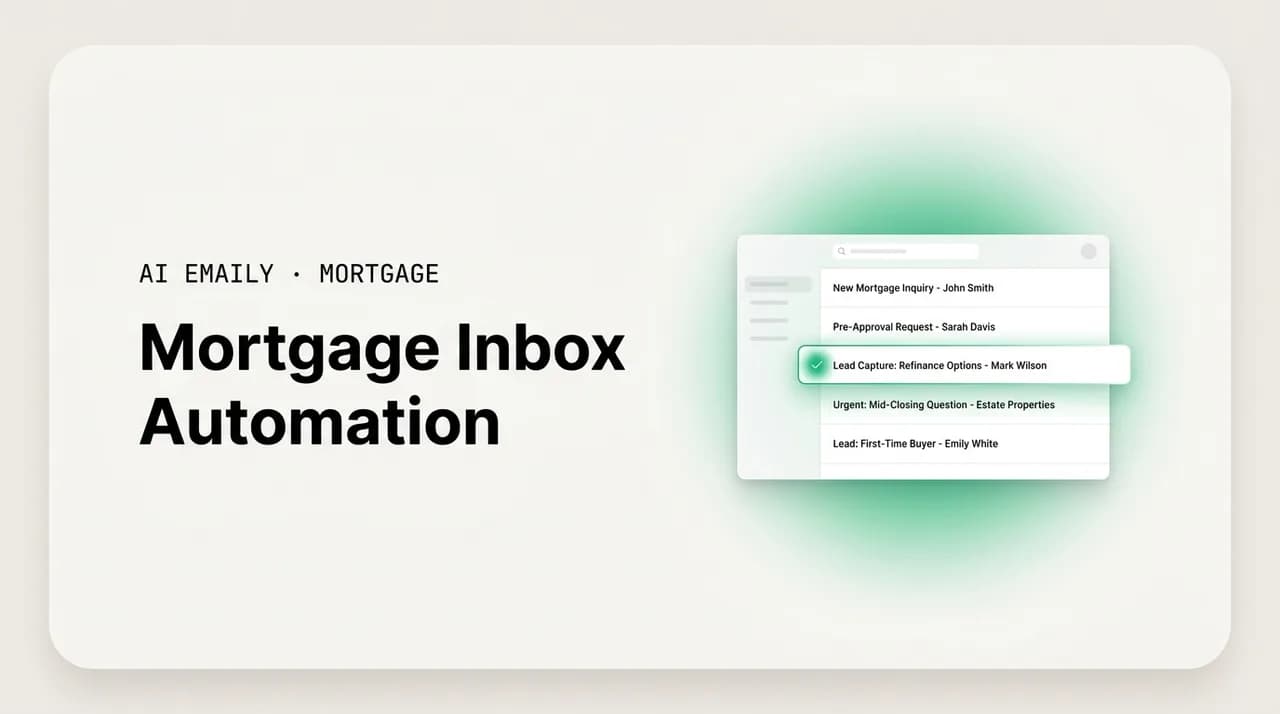
The short answer
Mortgage inbox automation means the routine parts of every borrower email — instant acknowledgment, triage, first-draft replies, follow-up cadences, doc chasing, and status updates — happen without you at the keyboard. Automate the repeatable and time-critical; keep rates, disclosures, and sensitive advice human. Done right, no lead leaks between the portal form and the closing table.
A complete guide to mortgage inbox automation for loan officers: how to capture, acknowledge, triage, draft, follow up, collect docs, and update status so no lead leaks — plus what to automate, what to keep human, and how AI Emaily runs the system.
On this page
- 01What does mortgage inbox automation actually mean for a loan officer?
- 02The eight stages of an automated mortgage inbox
- 03What to automate and what to keep human
- 04Building the system: rules, templates, cadences, and escalation
- 05Zero lead leakage: sealing every joint in the pipeline
- 06Scaling the automated inbox with an assistant or a team
- 07How AI Emaily runs your mortgage inbox
- 08A 30-day rollout for a loan officer
- 09Putting it all together
What does mortgage inbox automation actually mean for a loan officer?#
Mortgage inbox automation is the practice of letting software handle the repeatable, time-critical parts of your email so a lead never sits unanswered while you are on a call, in an underwriting meeting, or asleep. It does not mean handing your borrowers to a robot. It means the moment a lead lands, it gets acknowledged; the moment a shared lead comes in, you are already the first reply; the moment a file needs a document, the borrower gets a clean checklist instead of waiting for you to remember. The judgment stays with you. The clockwork does not.
For a loan officer, the inbox is not a side channel. It is where the business happens. Purchase leads arrive from real estate agent partners and rate-shopping portals. Refinance demand floods in the hour rates dip. Processors ping you for conditions, borrowers ask where their file stands, and agents want a status they can relay to their buyer. Every one of those threads has a clock on it, and the person who answers first, clearest, and most consistently is usually the one who closes the loan.
The problem is arithmetic. You cannot be at the keyboard when most of the leads arrive. A meaningful share of borrower inquiries land after hours or while you are mid-closing on another file — nights, weekends, lunch, the exact windows when you are least able to respond in the five minutes that matter. Manual effort, no matter how disciplined, has a ceiling. Automation raises it by doing the parts that do not need you, so your attention lands only where it does.
This guide walks the whole pipeline — capture, acknowledge, triage, draft, follow-up, doc-collect, status-update, close-the-loop — and shows exactly which stage to automate, which to keep human, and how to build a system where no lead leaks. Then it maps each mortgage-specific pain to the capability that solves it, honestly, including where automation is the wrong answer.
One clarification up front, because it matters for the rest of the piece. There are two very different things people mean by "automating email," and conflating them is how loan officers get burned.
The first is dumb automation: a blanket auto-responder that fires the same canned line at everyone, a drip sequence that keeps emailing a borrower who already funded, a rule that files a lead into a folder you never open. This is the automation that makes borrowers feel like a number and makes you look asleep at the wheel. It is worse than nothing.
The second is intelligent automation: the system reads the actual message, understands that this is a new purchase lead versus a condition request versus an agent asking for a status, drafts a reply in your voice grounded in that borrower's file, and either sends it under a rule you set or waits for your one-click approval. That is the kind this guide is about. Everywhere below, "automation" means the second kind.
Automation is not autonomy
The eight stages of an automated mortgage inbox#
A borrower email is not one event; it is a small pipeline, and a lead can leak at any joint. Map the stages first, then decide where automation earns its place. There are eight, and they run in order from the second a lead appears to the moment the loan closes and the relationship keeps paying off.
- 1
1. Capture
Every lead, from every source, lands in one place. Portal leads, agent referrals forwarded from your partner, the contact form on your site, replies to your rate-alert emails, and cold inbound all arrive as email or become email. If any source lands somewhere you do not watch, that is your first leak. Capture means one unified inbox where nothing is invisible.
- 2
2. Acknowledge
The instant a lead arrives, it gets a human-sounding acknowledgment — not a wall of boilerplate, a warm two-line note that says you saw it, you are on it, and here is the immediate next step. This is the speed-to-lead moment. On a shared lead where the borrower filled the same form for six lenders, being the first acknowledgment in the inbox is often the entire ballgame.
- 3
3. Triage
Sort what just came in. New purchase lead, refi rate-shopper, existing borrower asking a status, processor requesting a condition, agent partner, or noise. Triage decides urgency and routing. Done by hand at 60 threads a day, it eats your morning. Done automatically, your inbox is already sorted before you open it.
- 4
4. Draft
For anything needing a real reply, a first draft is written in your voice, grounded in that borrower's context — their name, their file stage, the question they actually asked. You are not starting from a blank page 40 times a day; you are editing and approving. This is where most of the reclaimed hours come from.
- 5
5. Follow-up
Most loans do not close on the first touch. A lead that goes quiet needs a cadence — a nudge in two days, another in five, a check-in the next week — that fires whether or not you remember. This is the single most-dropped stage in a busy pipeline, and the one automation protects best.
- 6
6. Doc-collect
Getting paystubs, bank statements, W-2s, and conditions out of a borrower is a slog of reminders. A clean initial checklist, then patient, escalating nudges for what is still missing, keeps files moving without you personally chasing every document.
- 7
7. Status-update
Borrowers and agents want to know where the file stands. Proactive status updates — "you're now in underwriting," "the appraisal is ordered," "we're clear to close" — cut the inbound "any news?" emails dramatically and make you look on top of every file.
- 8
8. Close-the-loop
The loan funds, but the relationship should not. Post-close thank-yous, review requests, referral asks to the borrower and their agent, and the long refinance-window watch that brings them back in two years when rates move. Automation makes sure the loop never quietly drops after funding.
Read that list again and notice something: only one stage — drafting the substantive reply — genuinely requires your judgment on every instance. The other seven are mostly clockwork. Capture is plumbing. Acknowledgment is a template with a name in it. Triage is pattern-matching. Follow-up, doc-collection, and status-updates are cadences. Close-the-loop is a schedule. That imbalance is exactly why inbox automation pays off so hard in this job: the majority of the pipeline is mechanical, and mechanical work is what machines are for.
The rest of this guide takes those stages and answers the two questions that decide whether automation helps or hurts: which parts do you hand to the machine entirely, and which parts do you keep your hands on — especially anything touching rates, disclosures, or a borrower's private financial data.
What to automate and what to keep human#
This is the decision that separates loan officers who love their automation from the ones who quietly turn it off after a bad week. Get it wrong in the aggressive direction and you send a rate quote you cannot honor, or a disclosure at the wrong time, or a tone-deaf drip to someone whose deal just fell through. Get it wrong in the timid direction and you are back to doing everything by hand and wondering what the software was for.
The dividing line is not complicated. Automate what is repeatable, low-risk, and time-critical. Keep a human on what is high-stakes, regulated, or judgment-heavy. The table below draws that line stage by stage. Read it as a starting policy, not gospel — your risk tolerance and your compliance team's rules move the line, and they should.
| Automate (send or auto-prepare) | Keep human (review before it goes out) |
|---|---|
| Instant lead acknowledgment — "Got your request, I'm on it, here's the next step." | Anything quoting a specific interest rate, APR, or lock — rates move and misquotes cost trust and money. |
| Triage and routing — sorting new leads, refis, agents, processor requests, and noise. | The Loan Estimate and other TILA-RESPA disclosures — these are time-bound legal documents, not casual email. |
| Document checklists and the reminder cadence chasing missing items. | Guideline-specific advice — FHA/VA eligibility, DTI edge cases, whether a borrower qualifies. Draft it, don't autosend it. |
| Standard status updates tied to milestones — "in underwriting," "appraisal ordered," "clear to close." | Anything containing a borrower's SSN, full account numbers, or sensitive financial figures — handle deliberately, never on autopilot. |
| Follow-up nudges to quiet leads and "still shopping?" refi check-ins. | Adverse action, denials, and any bad news — always a human, always with care. |
| Post-close thank-yous, review requests, and the long refi-window watch. | First contact with a high-value referral from a top agent partner — worth your personal touch. |
| First-draft replies to routine borrower questions, prepared in your voice for one-click send. | Emotionally weighted or trust-sensitive threads — a frustrated borrower, a family decision, a deal in trouble. |
The single most important row in that table is rates. A borrower emails at 9 p.m. asking "what rate can I get?" and the tempting automation is to fire back a number. Do not build that. Rates are live, they depend on the borrower's full profile, and a quote that is stale or wrong by the time they read it is a broken promise before you have even spoken. The right automation acknowledges instantly and routes to you for the actual number: "Thanks — I'd love to get you an accurate rate, which depends on a few details. I'll call you first thing, or grab a time here." Fast, honest, and it does not commit you to a figure a machine invented.
Disclosures are the second non-negotiable. Under the federal TILA-RESPA rules, a Loan Estimate has to reach the borrower within a set number of business days of a completed application, and there are timing and content rules around it. That is a compliance obligation with legal teeth, not a message you let an inbox assistant improvise. Automation can remind you that a disclosure is due, and it can draft the friendly cover note that accompanies the real document — but the disclosure itself, and the decision to send it, stays with a human and your compliance process.
Sensitive data is the third. A borrower's Social Security number, full bank account numbers, and detailed financials should never ride along in a message that goes out without a human looking at it. This is where an automated inbox has to be built to redact, flag, and pause rather than plow ahead. Keep autonomy away from anything that would be a disaster if it went to the wrong address.
Never let a machine invent a rate or send a disclosure
Building the system: rules, templates, cadences, and escalation#
An automated inbox is not a single switch you flip. It is four moving parts working together: the rules that decide what happens to each message, the templates that give the machine a voice, the cadences that keep follow-up alive, and the escalation paths that hand the tricky ones back to you. Build them in that order and the system holds up under real volume.
Start with rules, because rules are the nervous system. A rule is an if-this-then-that: if a message comes from a lead-portal address, tag it "new purchase lead," acknowledge instantly, and start the new-lead cadence. If it mentions "refinance" or "rate," tag it "refi," acknowledge, and route to the rate-shopper flow. If it comes from your processor's domain, mark it high-priority and surface it at the top of your inbox. Good rules are specific and few. Resist the urge to write fifty; a dozen sharp rules covering your real traffic beats a sprawling ruleset nobody trusts.
- 1
Write rules around your actual lead sources
List every place a lead or a file-related email comes from — each portal, each agent partner, your website form, your processor, your LOS notifications. Write one rule per source that tags, acknowledges, and routes. If you cannot name the source, you cannot automate its handling reliably, so start by making every source visible in one inbox.
- 2
Build templates the machine fills, not sends blindly
Draft your acknowledgment, pre-qual intro, document checklist, and status-update templates once. Leave typed variables for the parts that change — borrower name, loan stage, the specific missing document. The automation resolves those variables per file so the borrower gets a personal-sounding note, not obvious boilerplate. Write them in your real voice; stiff templates are the fastest way to sound automated.
- 3
Design cadences that stop when they should
A follow-up cadence is a sequence of nudges with timing — day 0 acknowledge, day 2 check in, day 5 add value, day 9 last touch. The critical design choice is the exit condition: the cadence must stop the instant the borrower replies, funds, or opts out. A drip that keeps firing after someone answers is the classic own-goal. Every cadence needs a clear off-switch tied to a real event.
- 4
Set escalation thresholds that pull you in
Decide in advance what forces a human. A message mentioning a rate, a complaint, a legal word, an attachment with sensitive data, or a VIP agent partner should escalate — pause the automation and put it in front of you flagged. Escalation is what makes aggressive automation safe: you can automate broadly precisely because the risky exceptions get kicked back to you every time.
- 5
Start in review mode, then graduate
Do not switch everything to hands-free on day one. Run new automation in a mode where it prepares the reply and you approve each send. Watch it for a week or two. The categories where it is consistently right — acknowledgments, checklists, standard status updates — you promote to autonomous. The categories where you keep editing, you keep on manual review. Trust is earned per category, not granted all at once.
- 6
Audit weekly and prune
Once a week, look at what the system sent and what it drafted. Kill any rule that misfires. Fix any template that reads stiff. Tighten any cadence that ran too long. Automation is not set-and-forget; it is set, watch, and refine. The loan officers who get the most from it treat the ruleset like a living pipeline, not a one-time install.
Escalation deserves a second pass because it is the part most people under-build. The instinct is to automate the happy path and hope the edge cases sort themselves out. They do not. The edge cases — the angry borrower, the rate question, the deal falling apart, the compliance-sensitive attachment — are exactly the ones where an automated reply does the most damage. So build the escalation triggers before you build the automation, not after. Every keyword, sender, or condition that should force a human pause goes on the list first. Then you can let the automation run wide on everything that is left, because you know the dangerous exceptions are caught.
The templates-plus-variables approach is what keeps automated mail from sounding automated. A borrower can tell instantly when they have received form mail, and in a trust business that costs you. The fix is not to avoid templates — you would never scale — but to write them well and let the system resolve real, specific variables into them: this borrower's name, this file's stage, this particular missing document, the agent's name on the referral. A well-built template with the right variables filled reads like you sat down and wrote it. That is the standard to aim for.
Zero lead leakage: sealing every joint in the pipeline#
"Never miss a lead" is the promise, so it is worth being precise about where leads actually get missed. A lead does not usually vanish in a dramatic way. It leaks quietly, at a joint between two stages, while you are busy being good at your job somewhere else. Seal each joint and the leaks stop.
Here is where leads leak, in order of how often it happens to busy loan officers, and the automation that plugs each one.
- Between capture and acknowledgment. A lead lands while you are on a call and sits for three hours. By the time you see it, a competitor already called. Plug it with instant automated acknowledgment that fires in seconds, not whenever you next glance at your phone.
- After hours and on weekends. A large share of mortgage inquiries arrive nights and weekends, when no human is at the desk. The lead that emails at 9 p.m. Saturday gets a warm acknowledgment and a next step immediately, so you are the one they remember Monday. Plug it with automation that does not sleep.
- Mid-closing on another file. You are heads-down finishing a closing and the next lead arrives into a black hole. Plug it with acknowledgment and triage that run regardless of what you are doing, so nothing waits on your attention to be captured.
- In the follow-up gap. The lead did not close on the first touch, went quiet, and you meant to circle back but the week ate you. This is the biggest leak of all. Plug it with a follow-up cadence that fires on schedule until the borrower replies, funds, or opts out.
- In the document black hole. You asked for a document, the borrower forgot, you forgot you asked, and the file stalls for a week. Plug it with an automated checklist and escalating reminders that track what is still missing without you keeping the list in your head.
- In the status-update vacuum. The borrower does not hear from you, gets anxious, and either floods you with "any news?" emails or quietly loses confidence. Plug it with proactive milestone updates that go out on their own as the file moves.
- After funding. The loan closes and the relationship goes cold, so the referral and the future refi both slip away. Plug it with post-close automation — thank-you, review ask, referral ask, and a long rate-window watch that brings them back.
Notice that six of those seven leaks are timing failures, not effort failures. You are not a worse loan officer for missing a 9 p.m. Saturday lead; you are a human who was not at the keyboard. That is the exact shape of problem automation is built to solve. It is not making you work harder or replacing your relationship skills. It is closing the gap between when a lead needs a response and when you are physically available to give one — a gap that manual effort can shrink but can never close, because you have to sleep, close files, and live a life.
The seventh leak, after funding, is a discipline failure more than a timing one, and it is the most expensive. A funded borrower is your warmest possible future lead and your best referral source, and letting that relationship go dark after closing wastes the hardest-won trust you have. Automating the post-close loop — a genuine thank-you, a review request while the good feeling is fresh, and a standing watch on rates so you reach out the moment a refinance makes sense for them — turns every closed loan into a renewable source of the next one.
Scaling the automated inbox with an assistant or a team#
Everything so far assumes a solo loan officer, but the automation logic changes shape the moment you add a loan officer assistant, a processor, or grow into a team or branch. The good news is that automation gets more valuable with more people, not less, because the coordination problem it solves gets bigger.
On a team, the leaks are not just timing leaks; they are handoff leaks. The LO takes the lead, the processor takes the file, and somewhere in the handoff a follow-up drops, a document request goes out twice, or the borrower gets three different tones from three different people. A shared, automated inbox fixes the handoff by making the state of every file visible to everyone who touches it and by keeping the outbound voice consistent no matter who is at the keyboard. The borrower experiences one coherent relationship instead of a relay race.
- Standardize the voice across everyone. When the whole pod's acknowledgments, checklists, and status updates come from shared templates, the borrower gets a consistent experience whether the LO, the assistant, or the processor is driving. Inconsistent voice across a team is a quiet trust leak that automation closes.
- Make handoffs explicit, not hopeful. Automation that routes a file to the processor at the right stage — and follows up if a step stalls — turns handoffs from "I assume someone picked that up" into a tracked event. The most common team leak is the follow-up nobody realized was theirs.
- Let the assistant work from prepared drafts. A loan officer assistant is far faster reviewing and sending prepared, in-voice drafts than composing from scratch. Automation that drafts and an assistant that approves is a powerful pairing — the LO's judgment, scaled by a second set of hands.
- Keep one audit trail for the whole team. When several people and an automation all touch the same inbox, you need to know who did what and be able to undo it. A shared audit trail is what makes team automation safe to run and easy to trust.
- Buy seats, not point tools. Growing teams usually accumulate a tangle of half-used tools. Consolidating the borrower and agent communication into one automated inbox for the whole team replaces fragmented spend and, more importantly, removes the seams where leads leak between systems.
There is a sequencing lesson here worth stating plainly. Do not wait until you have a team to automate. Build the automated inbox as a solo LO, get your rules and templates and cadences right at a scale where you can watch every message, and then add people to a system that already works. Teams that bolt automation onto an existing mess of manual handoffs struggle; teams that grow into a system designed to be shared from the start scale cleanly. Whether you are one person or a fifteen-LO branch, the eight stages are the same — automation just lets more of them run without a specific human being available at a specific second.
How AI Emaily runs your mortgage inbox#
Everything above is the strategy. AI Emaily is a way to run it. It is an AI-native email client — an autonomous chief-of-staff for your inbox that triages, drafts in your voice, schedules, and closes loops across every provider and device, while you stay in control. Below is an honest mapping of each mortgage pain to the specific capability that addresses it, including where the answer is deliberately to keep a human in the loop.
The core idea is three modes, so you decide how much runs without you. In Manual, you drive and the AI assists on request. In Copilot, the agent prepares everything — triage, drafts in your voice, schedules — and waits; one click sends, and nothing leaves without you. In Autopilot, you let it handle the routine categories on its own, within rules you set, and it reports back. Copilot approval before any send is the default, and Autopilot is gated and bounded — every autonomous action is reversible with a full undo and audit trail. That is exactly the review-then-graduate discipline this guide argued for, built into the product.
Here is the pain-to-capability map, mortgage-specific.
- Speed-to-lead on shared leads → instant acknowledgment. On a lead the borrower sent to six lenders, being first matters more than being eloquent. The agent acknowledges the moment a lead lands, in your voice, with a real next step — so you are the first reply in the inbox even when you are on a call or mid-closing. Acknowledgment is one of the cleanest categories to run on Autopilot.
- After-hours and weekend leads → an inbox that never sleeps. The 9 p.m. Saturday rate-shopper gets a warm, immediate acknowledgment and a next step, not silence until Monday. The system does not keep your hours, so the leak between capture and response closes around the clock.
- Refi rate windows → time-critical follow-up. When rates dip and the inbox floods with rate-shoppers, follow-up cadences and "still shopping?" nudges fire on schedule instead of waiting on you to keep pace with a wave manual effort cannot match. The rate-window watch on past borrowers brings them back the moment a refinance makes sense.
- Rate quotes → drafted, never invented. The agent never fabricates a rate. It acknowledges fast and routes the actual number to you, drafting an honest "let me get you an accurate rate" reply for one-click send. This is a keep-human line, enforced.
- Disclosures and compliance → remind and draft, human sends. AI Emaily can flag that a disclosure is due and draft the friendly cover note, but the regulated document goes through your compliance process and a human. Copilot's approve-before-send default means nothing regulated slips out autonomously.
- Doc-chasing → checklists and patient reminders. A clean initial document checklist goes out per file, and the follow-up nudges track what is still missing — with typed variables resolving the borrower's name, stage, and the specific outstanding item — so you stop personally chasing every paystub.
- Status updates → proactive, milestone-based. "In underwriting," "appraisal ordered," "clear to close" go out as the file moves, cutting the inbound "any news?" flood and making you look on top of every loan. Standard status updates are a strong Autopilot category; anything nuanced stays in Copilot.
- Realtor-partner comms → consistent and prompt. Agent referrals get acknowledged fast and agents get the status they need to relay to their buyer, in a consistent voice — the relationship maintenance that keeps referral partners sending you deals, without you writing every note by hand.
- The whole scattered inbox → one unified view. Gmail, Outlook, iCloud, Fastmail, Proton, and any IMAP account land in one inbox, on web, macOS, iOS, and Android, so no lead is invisible because it came into the account you forgot to check. Capture, sealed.
- Drafts that sound like form mail → voice-matched drafting. Because it learns how you actually write, drafts come back in your voice, grounded in the borrower's context, not generic boilerplate — the difference between mail that reads personal and mail that reads automated.
- Fear of a machine sending the wrong thing → undo and audit. Every action the agent takes is reversible, with a full audit trail of what it did and why. That is what makes it safe to let it run: you can always see, and always undo.
- Borrower privacy → private by design. AI Emaily never trains models on your email, runs cloud inference zero-retention, and envelope-encrypts tokens and any bring-your-own-key credentials with KMS — never logged, never inline. Sensitive triage and drafting can run on-device, which matters when the content is a borrower's financial life.
Two things worth being straight about. First, AI Emaily is an email client, not a mortgage CRM or an LOS — it runs the communication layer of your pipeline, the inbox itself, not your loan origination system. It pairs with the mortgage tools you already use; it does not replace your LOS. Second, the honest posture on autonomy is conservative on purpose: Copilot approval before any send is the v1 default, and the categories you let run fully hands-free are the ones you have watched and trust — acknowledgments, checklists, standard status updates. The rate quotes, the disclosures, the sensitive threads, and the bad news stay with you. That is not a limitation of the product; it is the correct way to automate a regulated, trust-driven business.
You can try it free. The Free plan is $0 with no card, giving you the full client on every provider and platform, up to five connected accounts, and 100 AI credits a month to try the agent. Pro is $12.42 per month on the annual plan, with more accounts and more credits. Autopilot adds model choice, bring-your-own-key to remove AI limits, and gated autonomous handling with undo and audit for loan officers ready to let the routine run itself. Start at app.aiemaily.com/signup.
A 30-day rollout for a loan officer#
Do not try to automate everything on day one. Here is a measured rollout that gets you to a leak-proof inbox in about a month without any scary hands-free sends until you have earned the trust.
- 1
Week 1 — capture and acknowledge
Connect every account so all leads land in one inbox, and turn on instant acknowledgment in review mode. Watch each acknowledgment before it sends for a few days. Once they are consistently right, promote acknowledgment to autonomous. You have now sealed the biggest leak — the gap between a lead arriving and getting a response — including after hours.
- 2
Week 2 — triage and templates
Set up rules for your real lead sources so the inbox sorts itself. Draft your core templates — pre-qual intro, document checklist, status updates — in your own voice with typed variables. Keep everything in Copilot, reviewing drafts before they send. This is where you feel the hours come back.
- 3
Week 3 — follow-up and doc-collection
Turn on follow-up cadences for quiet leads and the document-chasing reminders, each with a clear exit condition so nothing keeps firing after a borrower replies. Review the sends for a week. This closes the two biggest silent leaks: the follow-up gap and the document black hole.
- 4
Week 4 — status, close-the-loop, and graduate
Add proactive milestone status updates and the post-close loop — thank-you, review ask, refi-window watch. Then review the last month: promote the categories that were consistently right to Autopilot, keep the rest in Copilot, and set your rate, disclosure, and sensitive-data escalations as hard human-only lines. You now have an automated inbox you trust.
Putting it all together#
Mortgage inbox automation is not about caring less; it is about being available more. The math of the job guarantees that most leads arrive when you cannot answer them — after hours, on weekends, mid-closing on another file — and no amount of hustle closes that gap by hand. Automation closes it by handling the seven mechanical stages of every borrower email so your attention lands only on the one stage that needs it: the judgment.
Build it in the right order. Capture everything in one place, acknowledge instantly, triage automatically, draft in your voice, follow up on a cadence, chase documents patiently, update status proactively, and close the loop after funding. Automate what is repeatable and time-critical; keep a firm human hand on rates, disclosures, sensitive data, and bad news. Start in review mode, graduate categories only once you trust them, and keep an audit trail so every action is visible and reversible.
Do that, and the promise in the title stops being marketing and becomes true: no lead leaks between the portal form and the closing table, and the borrower who emailed at 9 p.m. on a Saturday gets you — or something that sounds exactly like you — before your competitor is even awake. If you would rather not wire all of that together by hand, AI Emaily runs the whole system in your voice, with Manual, Copilot, and Autopilot modes and full undo and audit, so you stay in control. Start free at app.aiemaily.com/signup.
Frequently asked
See it in AI Emaily
Keep reading
Sources
- Harvard Business Review — The Short Life of Online Sales Leads (lead-response speed research)
- Lead Response Management Study — timing of first contact and contact/qualification rates
- eCFR — 12 CFR §1026.19 (TILA-RESPA), Loan Estimate timing and disclosure rules
- National Association of Realtors — Research and Statistics

Written by
Nafiul HasanNafiul Hasan is an entrepreneur and AI automation system builder with 10+ years of experience turning messy, manual workflows into reliable automated systems. He designs and ships AI enterprise solutions end-to-end — the agent logic, the data plumbing, and the product people actually use — and founded AI Emaily to give busy professionals their attention back. He writes here from the builder's seat: what works, what breaks, and how to put AI to work without giving up control.