Speed to Lead for Loan Officers: How to Be the First Reply on Every Shared Lead

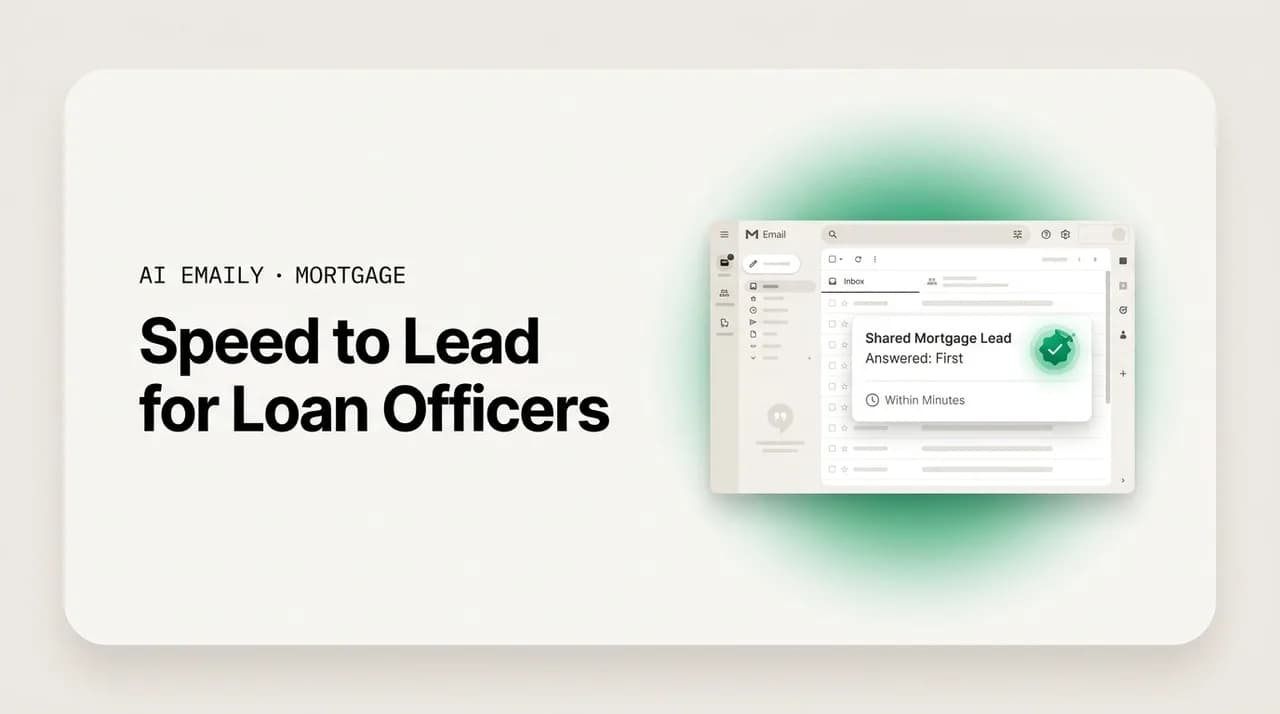
The short answer
Speed to lead for loan officers is the discipline of being first to reply on a shared mortgage lead. The borrower filled out the same form for four to seven lenders, and lead-response research shows contact odds collapse within minutes. Reply inside five minutes with an instant acknowledgment, then a personal pre-qual, and you win a far larger share of the pipeline.
Speed to lead for loan officers decides who wins a shared mortgage lead. Here is the response-time research, why LOs are slow, and a sub-5-minute system with instant first-touch templates.
On this page
- 01What is speed to lead for loan officers, and why does it decide the loan?
- 02Does response speed really win the loan? What the research says
- 03Why are loan officers so slow to respond, even when they know better?
- 04The two jobs of a first touch: instant acknowledgment vs. personal pre-qual
- 05A sub-five-minute speed-to-lead system for loan officers
- 06Instant first-touch templates for loan officers
- 07How AI Emaily helps loan officers win on speed to lead
- 08Common speed-to-lead mistakes loan officers make
- 09Putting it all together
What is speed to lead for loan officers, and why does it decide the loan?#
Speed to lead for loan officers is the practice of contacting a new mortgage lead as fast as humanly possible, ideally within a few minutes of the moment they raise their hand. It sounds like a tactical detail, a nice-to-have you get to once the important work is done. It is not. In the way most loan officers get their leads today, speed to lead is the single biggest lever on how many of those leads ever turn into applications, and it dwarfs almost everything else you could optimize, from your rate sheet to your follow-up copy to how good you are on the phone.
The reason is structural, and it comes down to one word: shared. When a borrower fills out a rate-quote form on a lead marketplace, a portal, or a comparison site, that form does not go to you alone. It goes to a list. The borrower typed their name, their email, their rough loan amount, and their phone number once, and that single submission is sold or routed to four, five, six, sometimes seven lenders at the same instant. Every one of those lenders gets the same borrower at the same second. From that moment you are not competing on who has the best pricing or the warmest personality. You are competing on who reaches the borrower first, because the first credible lender to make contact sets the frame for the entire conversation and very often closes the loan before anyone else has said hello.
That is the game speed to lead for loan officers is built to win. This guide covers why the first reply wins the shared lead, the response-time numbers that make the case, the specific reasons loan officers end up slow even when they know better, and a concrete sub-five-minute system you can run without hiring anyone. Then it gets honest about where automation helps and where it does not, with instant first-touch templates you can copy today.
It helps to picture the borrower on the other end. They are usually shopping late at night or on a lunch break, in a burst of motivation, comparing options. They hit submit and then they wait, phone in hand, curious who will call. The first lender who reaches them while that curiosity is still hot gets a real conversation. The second gets a distracted "oh, I already talked to someone." The fifth gets voicemail, if they get anything at all. Nothing about the borrower's underlying need has changed between the first call and the fifth, but their willingness to engage has fallen off a cliff, because attention is perishable and someone else already spent it.
This is why two loan officers with identical pricing, identical licensing, and identical skill can post wildly different pull-through numbers from the same lead source. One of them answers in three minutes and the other answers in three hours, and the three-minute LO quietly takes most of the pipeline while the three-hour LO blames the lead quality. The lead quality was the same. The response time was not.
Shared vs. exclusive leads
Does response speed really win the loan? What the research says#
The instinct that faster is better is correct, but the size of the effect is bigger than most loan officers assume, and it is worth internalizing the actual numbers rather than a vague sense that speed helps. The most cited body of work here is the lead-response research popularized by MIT and the Lead Response Management study, and its findings are blunt.
The headline is the five-minute rule. When you contact an inbound web lead within five minutes of the submission, your odds of actually reaching and qualifying that lead are dramatically higher than if you wait even half an hour. The Lead Response Management research found that the odds of making contact drop by orders of magnitude as the minutes tick by, and that leads contacted within roughly five minutes are far more likely to be qualified than those contacted an hour later. The often-quoted version of this finding is that responding within five minutes makes you something like twenty-one times more effective at contacting and qualifying a lead than responding after thirty minutes. The exact multiplier varies by study and by industry, but every serious analysis lands in the same place: the curve is steep, it is steepest in the first few minutes, and by the time an hour has passed you are working a materially colder lead.
Harvard Business Review put a sharper edge on the same idea in its study of thousands of companies. Firms that tried to contact potential customers within an hour of receiving an inquiry were roughly seven times more likely to have a meaningful conversation with a decision-maker than those that waited even an hour longer, and about sixty times more likely than companies that waited a day or more. The uncomfortable finding buried in that same research was that most companies were far too slow: the average first-response time ran into hours, and a large share of leads never got a response at all. In other words, the bar to beat your competition is lower than it looks, because most of them are also slow.
Now layer the shared-lead economics on top of that response curve, because that is what makes speed to lead for loan officers so decisive specifically in mortgage. Industry lead-source analysis puts the conversion rate on shared, price-shopped mortgage leads at somewhere around half a percent to two percent, while exclusive, quickly worked leads convert in the three-to-five-percent range and up. That is a several-fold difference in how many of the same-looking leads become funded loans, and a big part of what separates the two buckets is not the lead at all. It is how fast and how persistently the lead was worked.
Put those two facts together and the conclusion writes itself. On a shared lead you start at a low base conversion rate, and you are racing four to seven other lenders down a response curve that punishes every extra minute. The loan officer who answers first is not nudging their odds up a few points. They are frequently taking the borrower off the table entirely before the rest of the list even dials, converting a shared lead at something closer to exclusive-lead economics simply by being first. Speed is the one variable that turns a bad lead source into a workable one.
| Time to first response | What tends to happen | Relative outcome |
|---|---|---|
| Under 1 minute (instant acknowledgment) | Borrower is still on the page, still thinking about their loan. You set the frame before anyone else dials. | Best case — you often own the conversation |
| 1–5 minutes (personal reply / call) | Attention is still hot. Contact and qualification odds are near their peak per the five-minute rule. | Strong — the target window |
| 5–30 minutes | Odds of reaching and qualifying the lead fall sharply as the response curve steepens. | Weakening fast |
| 30–60 minutes | Roughly an order of magnitude less effective at contact than a five-minute reply; a competitor has likely reached them. | Cold — usually second in line |
| 1+ hours to next day | Most leads here go dark. HBR found contacting within an hour beats waiting a day by ~60x on reaching a decision-maker. | Mostly lost |
One caveat worth stating plainly so nobody over-rotates: speed gets you the conversation, it does not replace the conversation. Being first only matters if the first touch is competent, on-topic, and moves toward a real pre-qualification. A fast reply that is generic, obviously automated, or wrong on the details can lose the borrower just as surely as a slow one. The goal is not merely to be first. It is to be first and credible. The rest of this guide is about how to do both at once, because the two are usually in tension: the fastest replies are the least personal, and the most personal replies are the slowest. Resolving that tension is the whole job.
The one number to track
Why are loan officers so slow to respond, even when they know better?#
Almost every loan officer already believes speed matters. Very few actually respond fast, consistently, on every lead. That gap is not a knowledge problem or a motivation problem. It is a structural one, and naming the specific failure points is the first step to fixing them, because most of them have nothing to do with how hard the LO is working.
The single biggest culprit is the one that sounds like a good problem to have: you are mid-closing when the next lead lands. A loan officer's day is not a smooth queue of new inquiries. It is a stack of live files, each with a borrower who needs a signature, an underwriter asking for a condition, a Realtor texting about a closing date, and a processor flagging a missing pay stub. When a fresh lead notification arrives in the middle of that, it does not land in a calm inbox. It lands on top of six urgent things that all have real people attached to them. The lead is important, but nothing about the moment makes it feel more urgent than the loan that funds on Friday, so it waits. And ten minutes of waiting, on a shared lead, is often the whole game.
- Mid-closing collisions. The next lead reliably arrives while you are heads-down on a file that already has a borrower, a Realtor, and an underwriter depending on you. The new lead loses the priority contest every time, even though it is the most time-sensitive thing in the inbox.
- After-hours and weekend leads. A huge share of mortgage inquiries come in evenings and weekends, when borrowers finally have time to shop. If your first response waits until the next business morning, you have handed every competitor a multi-hour head start on your own lead.
- The lead is buried in a noisy inbox. New leads land in the same inbox as rate-lock confirmations, agent threads, marketing, and condition requests. Without a way to surface them instantly, they sit unread among fifty other unread things.
- Manual triage before the first reply. Many LOs feel they cannot respond until they have read the whole lead, pulled it up in the CRM, and thought about pricing. That instinct toward a thorough first touch is exactly what makes the first touch slow.
- No system, just willpower. Speed built on 'I will answer fast when I can' collapses the first busy day. Consistent speed comes from a system that fires whether or not the LO is free, not from heroics.
- Solo shops with no coverage. Independent brokers and single-LO operations have no one to catch the lead when they step into a closing, a school pickup, or a dead-zone drive. The bottleneck is one person, and that person cannot be in two places.
Notice that none of these are laziness. The slow loan officer is usually the busy one, and the busiest loan officers, the top producers running full pipelines, are often the slowest to new leads precisely because their existing files eat every spare minute. That is the cruel irony of speed to lead: the people best equipped to close the loan are the ones least able to answer the phone in time to get it. The fix has to work with that reality, not against it. Telling a top producer to 'just respond faster' ignores that the reason they are slow is the same reason they are worth talking to. What they need is a system that guarantees an instant first touch without pulling them out of a live closing.
The after-hours gap is where pipelines quietly leak
The two jobs of a first touch: instant acknowledgment vs. personal pre-qual#
The reason speed to lead feels impossible is that people try to do one thing when the moment actually calls for two, and the two things have opposite requirements. Separating them is the key move that makes a sub-five-minute system realistic even for a solo LO in the middle of a closing.
The first job is the instant acknowledgment. Its entire purpose is to plant your flag before a competitor does. It has to go out in seconds, not minutes, it has to be correct enough not to embarrass you, and it has to give the borrower a reason to hold their attention for you specifically. It does not have to be personalized in any deep way and it does not have to quote a rate. It just has to reach the borrower while they are still on the page and say, in effect: I got your request, I am a real licensed loan officer, here is what happens next, and here is how to talk to me right now. That message can be templated because its job is speed and presence, not nuance.
The second job is the personal pre-qualification reply. This is the one that actually starts the loan: it references the borrower's specifics, asks the two or three questions you need to move toward a real pre-approval, sets up a call, and starts the document conversation. It has to be genuinely personal and correct, which means it takes a few minutes to get right and often needs your judgment. But — and this is the whole trick — it does not have to be first. It just has to be good, and it has to arrive while the borrower is still warm from the acknowledgment you already sent.
Most loan officers collapse these two jobs into one and pay for it twice. They wait until they can write the good, personal reply, which means the borrower hears nothing for twenty minutes while a competitor's acknowledgment is already sitting in the inbox. Or they fire off a fast reply that is so generic it reads as spam and does nothing to differentiate them, so being first buys them nothing. The way out is to run both tracks deliberately: an instant acknowledgment that wins the speed race, immediately followed by a personal pre-qual reply that wins the credibility race. First and credible, in that order, on a short delay between the two.
This split also resolves the automation question cleanly, and it is worth being precise about it because it is where a lot of mortgage advice goes wrong. The instant acknowledgment is the cleanest thing in the entire mortgage workflow to automate or template, because its content barely changes from lead to lead and its whole value is speed. The personal pre-qual reply is where a human touch earns its keep, because it involves specifics, judgment, and anything approaching guideline-specific advice that you do not want a machine improvising. Automate the flag-planting. Keep a human close to the pre-qual. That single distinction is the backbone of the system below.
Auto-acknowledge, then personally pre-qual
A sub-five-minute speed-to-lead system for loan officers#
Here is a concrete system you can run whether you are a solo broker or a producing team, built around the two-job split. The goal is a guaranteed sub-five-minute first touch on every lead, every hour of the day, without you having to drop a live closing to make it happen. Walk through it once, set it up, and then it runs on rails.
- 1
Route every lead into one place, instantly and loudly
Get all lead sources — portals, your site, marketplaces — landing in a single inbox or CRM with a real-time, unmissable alert. If a lead can hide among fifty unread emails, it will. The clock starts the second the lead exists, not the second you notice it, so make noticing instant.
- 2
Fire an instant acknowledgment within seconds
Have a templated first-touch email (and ideally a text) go out automatically the moment a lead lands, confirming you received their request, that you are a licensed LO, and how to reach you now. This is the flag-plant. It should never wait on you being free.
- 3
Get eyes on the lead and start the personal reply within 5 minutes
The acknowledgment buys you a few minutes; use them. Open the lead, scan the specifics, and either call or send the personal pre-qual reply that references their loan amount, goal, and timeline. First and credible — the acknowledgment was first, this is credible.
- 4
Attempt a live call fast, then keep the door open
Email wins the acknowledgment race, but a live phone conversation is what actually converts a mortgage lead. Try to call quickly while attention is hot. If you miss them, your acknowledgment and pre-qual email keep you present until they call back.
- 5
Follow up persistently — most contacts take multiple touches
Being fast on the first touch is necessary, not sufficient. Lead-response research is just as clear that most contacts happen after several attempts across days. Set a multi-touch cadence so the fast start does not fizzle into a single ignored email.
- 6
Cover nights and weekends with an automated first touch
The instant acknowledgment must run 24/7, because that is when high-intent borrowers shop. An after-hours lead that gets an immediate, competent acknowledgment and a next-morning personal reply beats a competitor who does nothing until Monday.
- 7
Measure median response time per source and tune
Track median minutes-to-first-response by lead source weekly. Watch which sources reward speed most, kill the ones that never convert no matter how fast you are, and reinvest in the ones where being first clearly pays.
The reason this system works where willpower fails is that it moves the speed requirement off the loan officer and onto a process. Steps one, two, and six do not depend on you being free — they fire whether you are on the phone, in a closing, or asleep. That is what protects the first touch during exactly the moments, mid-closing and after hours, when you are guaranteed not to be watching the inbox. Your human attention then goes where it is actually valuable: the personal pre-qual, the live call, and the judgment calls, none of which have to win the speed race because the acknowledgment already did.
Instant first-touch templates for loan officers#
These are the acknowledgment and early pre-qual messages that do the work. Keep the acknowledgment short, correct, and human; it is the one that has to go out in seconds. Swap in your name, NMLS number, and details, and adapt the tone to your brand. Nothing here should quote a specific rate or make a guideline-specific promise — that stays in the human pre-qual conversation.
Start with the instant acknowledgment, the message that plants your flag before a competitor's does:
For refinance leads that arrive on a rate dip, the acknowledgment can nod to the reason they reached out without promising a number you have not priced. The point is to signal you understand the moment and are already on it.
Once the flag is planted, the personal pre-qual reply does the real work. This one references their specifics and asks for the two or three things you need to move toward a pre-approval. It should read like you, not a template, even if you start from one — the borrower can tell the difference, and telling the difference is the point.
When you cannot reach a lead on the first attempt, the persistent follow-up matters more than the perfect wording. A short, low-pressure nudge that stays useful keeps you present without nagging. Send a couple of these over the first few days rather than one and giving up.
How AI Emaily helps loan officers win on speed to lead#
Everything above is doable by hand, and plenty of loan officers grind it out that way. The problem is that the manual version depends on you being at the inbox at the exact moment a shared lead lands, which is precisely the moment you are most likely to be in a closing, on a call, or asleep. This is the specific gap AI Emaily is built to close, and it is worth being clear about exactly what it does and does not do, because honest boundaries matter more than a feature list here.
AI Emaily is an AI-native email client that connects to Gmail, Outlook, and any IMAP account and acts as an autonomous chief of staff for your inbox. On the speed-to-lead problem specifically, its job is to guarantee the instant first touch you cannot always deliver yourself. The moment a new lead lands, it can recognize it, surface it loudly, and send a templated acknowledgment in seconds — the flag-plant that wins the speed race — while you stay heads-down on the file that funds Friday. That is the instant acknowledgment track, running whether or not you are watching.
For the second job, the personal pre-qual, it drafts the reply in your voice, not in generic auto-reply boilerplate, because it learns how you actually write to borrowers. It pulls the lead's specifics into a pre-qual draft that asks your usual qualifying questions and can attach your standard document checklist, so the personal reply that used to take you ten minutes is waiting for you to glance at and send. First and credible, with the credible part pre-drafted.
The part that keeps this safe for a regulated, trust-sensitive business is that you decide how much rope the automation gets, through three modes with undo and a full audit trail behind all of them. In Manual mode nothing sends without you; the drafts are just there faster. In Copilot mode it prepares the acknowledgment and the pre-qual and holds them for your one-click approval, which is the sweet spot for most loan officers — mandatory human review before anything reaches a borrower, but with the slow part already done. In Autopilot mode, within rules you set, it can auto-send the instant acknowledgment on its own — the one category clean enough to trust to a machine, because it plants your flag without quoting a rate or making a guideline-specific promise.
The honest boundary is this: the instant acknowledgment and the templated document-checklist request are the cleanest things to hand to Autopilot, and the personal pre-qual, the pricing, and any guideline-specific advice are where a human stays in the loop. AI Emaily is built around that exact split. Every action it takes is undoable and logged, so if it sends an acknowledgment you would have worded differently, you see it, you can undo it, and you can tighten the rule. It is not trying to originate the loan for you. It is trying to make sure you are always the first credible reply in the borrower's inbox, which, on a shared lead, is most of the battle.
You can try it free at app.aiemaily.com/signup, with a Free plan at no cost and Pro at $12.42 per month on the annual plan.
Fast, but never off the rails
Common speed-to-lead mistakes loan officers make#
Even LOs who buy into speed to lead sabotage it in predictable ways. Here are the ones worth checking yourself against, because most of them are quiet and easy to miss until you look at your own numbers.
- Waiting to be 'ready' before the first touch. Reading the whole lead, pulling the CRM, and thinking about pricing before you reply turns a five-minute job into a fifty-minute one. Acknowledge first, prepare second.
- Sending one fast reply and calling it done. Speed on the first touch does not excuse skipping follow-up. Most contacts take several attempts across days; a fast start that fizzles converts no better than a slow one.
- Letting the acknowledgment be so generic it reads as spam. Being first buys you nothing if the borrower deletes your message on sight. The acknowledgment must be fast and human, not fast and robotic.
- Ignoring after-hours leads. If your speed only runs nine to five, you concede the highest-intent nights-and-weekends leads to whoever automated their first touch.
- Measuring average instead of median response time. One outlier lead can hide a pattern of slow daytime replies. Track the median, per source, weekly.
- Trying to fix speed with willpower instead of a system. 'I'll be faster' lasts until the next busy day. Put the first touch on rails so it fires without you.
- Automating the pre-qual instead of the acknowledgment. The acknowledgment is the safe thing to automate. Handing a machine your pricing and guideline advice is where automation turns into liability.
Putting it all together#
Speed to lead for loan officers is not a productivity hack. In a world where nearly every lead is shared across four to seven lenders, it is the primary variable that decides how much of your pipeline you actually get to work. The research is unambiguous: contact odds fall off a cliff within minutes, the first credible responder wins a hugely disproportionate share of conversations, and most of your competitors are slow enough that the bar to beat them is lower than it feels.
The reason speed is hard has nothing to do with effort. You are slow because you are mid-closing when the next lead lands, because leads arrive at night and on weekends, and because a good personal reply genuinely takes time. The way through is to stop treating the first touch as one job and start treating it as two: an instant, templated acknowledgment that wins the speed race, followed within minutes by a personal, specifics-referencing pre-qual that wins the credibility race. Automate the first. Keep a human close to the second.
Build that split into a system that fires whether or not you are watching the inbox, cover nights and weekends, follow up persistently, and measure your median response time per source. Do that and you stop losing shared leads you were fully capable of closing — not because your pricing improved, but because you were the first credible reply in the borrower's inbox, every time. If you would rather not depend on being at your desk at the exact right second, that is precisely the gap an AI email client is built to close.
Frequently asked
See it in AI Emaily
Keep reading
Sources

Written by
Nafiul HasanNafiul Hasan is an entrepreneur and AI automation system builder with 10+ years of experience turning messy, manual workflows into reliable automated systems. He designs and ships AI enterprise solutions end-to-end — the agent logic, the data plumbing, and the product people actually use — and founded AI Emaily to give busy professionals their attention back. He writes here from the builder's seat: what works, what breaks, and how to put AI to work without giving up control.