Refinance Rate-Alert Follow-Up Emails: Win the Rate Window Before Your Inbox Floods

The short answer
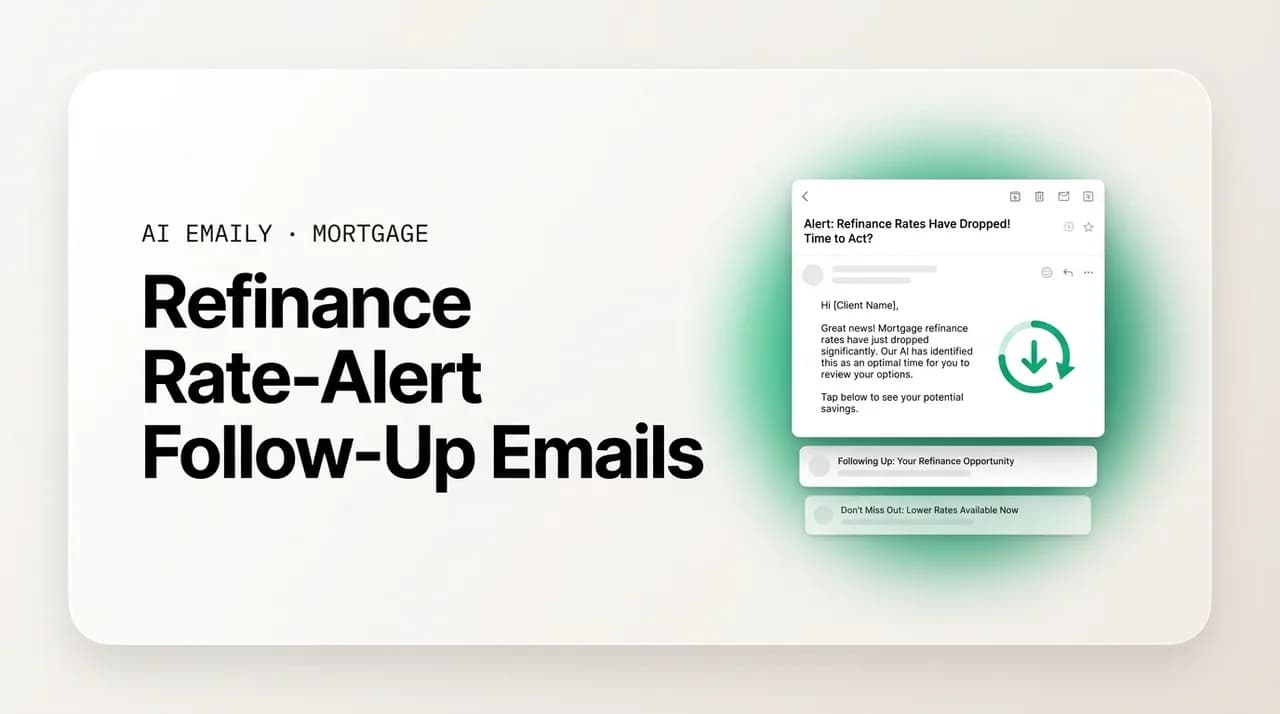
Refi demand arrives in waves. When rates dip, the window to reach a rate-motivated borrower is measured in days, and manual follow-up cannot keep pace with the flood. Mortgage refinance lead automation fixes this by segmenting your database by current rate and loan type, then firing trigger-based follow-ups the moment a rate threshold is crossed. Keep the savings math honest, quote rates only with the disclosures the law requires, and send only to people who opted in. This guide gives you the segmentation model, the trigger table, five copy-paste templates, the compliance line you cannot cross, and an honest look at where an AI email client staged drafts, rules-bound autosend, undo, and audit actually help.
Mortgage refinance lead automation: segment the database, fire rate-alert outreach the moment rates move, and reach every refi prospect before the flood.
On this page
- 01Why refinance follow-up is a timing problem, not a volume problem
- 02Build the foundation: segment your database by rate and loan type
- 03Define your triggers: which rate events start which outreach
- 04Do the savings math right, and compliantly
- 05Permission and CAN-SPAM: the rules that keep you in the inbox
- 06The templates: five refinance follow-ups that respect the window and the rules
- 07Where the manual system breaks, and what automation actually fixes
- 08How AI Emaily helps with refinance rate-alert follow-up
- 09Putting it all together
Why refinance follow-up is a timing problem, not a volume problem#
Every loan officer who has worked a refinance book knows the feeling. Rates drift down a quarter point overnight, and by mid-morning the inbox is a wall of rate-shoppers, past clients asking "should I refi?", and portal leads who filled out the same form for five other lenders an hour ago. Two days later the wave has passed, half the messages are cold, and the borrower who would have closed went with whoever answered first. This is the core of mortgage refinance lead automation: the problem is almost never that you lack leads. The problem is that refinance demand arrives in unpredictable waves, and the window to reach a rate-motivated borrower closes far faster than a human working an inbox by hand can move.
Purchase business has its own speed pressure, but it tends to spread out. A buyer under contract is on a 30-to-45-day clock, and the urgency is steady. Refinance is different. Refinance is a rate game, and rates move on a schedule nobody controls. Freddie Mac publishes its Primary Mortgage Market Survey of average 30-year and 15-year fixed rates every week, and those averages can swing meaningfully from one week to the next as the market reprices. A dip that makes a refinance worth it for a chunk of your database might last a week. It might last two days. When it opens, a borrower who was indifferent yesterday is suddenly motivated, shopping, and reachable, all at once, along with everyone else in your book who crosses the same threshold.
That is the trap. The exact moment your list becomes most valuable is the exact moment it becomes largest and most time-sensitive. If your follow-up depends on you personally reading, sorting, and replying to each message, you are structurally guaranteed to miss the tail of the window for most of the list. Not because you are lazy or disorganized, but because there are only so many hours in a rate wave and the wave does not wait.
Reframe the whole thing and the fix becomes obvious. The follow-up you send during a rate wave is not creative work. It is not a bespoke letter you compose fresh for each borrower. It is a small set of highly repeatable messages, a rate-drop alert, a break-even summary, a "you told me to reach out when rates hit X" nudge, a "still shopping?" check-in, keyed to a small set of triggers you can define in advance. The message is templated. The timing is what matters. And timing is exactly the thing software is good at and humans are bad at during a flood.
So the goal of this guide is not to teach you to type faster. It is to help you build a system that watches for the triggers, drafts the right message in your voice the moment one fires, and gets it in front of the borrower while the window is still open, without you having to be awake, at your desk, and caught up on your inbox at the precise minute the market moves. We will cover how to segment the database so the right message reaches the right borrower, how to define the triggers, how to do the savings math honestly and within the rules, the templates themselves, the compliance line you cannot cross, and where an AI email client genuinely helps versus where it should stay out of your way.
What "the window" really means
Build the foundation: segment your database by rate and loan type#
You cannot fire a trigger-based follow-up if you do not know who to fire it at. The foundation of any refinance rate-alert system is a database segmented well enough that, the instant rates move, you can answer one question in seconds: which of my past clients and prospects just became refinance candidates? If your answer to that requires opening a spreadsheet and eyeballing it, you have already lost the window.
The two fields that matter most are the borrower's current rate and their loan type. Everything else is secondary. Here is why. A rate move only opens a window for borrowers whose existing rate is high enough that the new rate saves them money after costs. If your past client locked at 4.25 percent, a market at 6 percent does nothing for them, and emailing them a rate-drop alert is noise that trains them to ignore you. But a borrower sitting at 7.5 percent from a high-rate year becomes a live candidate the moment the market dips into the low sixes. Segment by current rate and you can target exactly the borrowers a given move actually helps.
Loan type is the second axis because it changes both the trigger and the message. An adjustable-rate borrower approaching their reset date has a fundamentally different, and often more urgent, reason to refinance than a fixed-rate borrower chasing a lower coupon. An FHA borrower with meaningful equity might benefit from a conventional refinance that drops mortgage insurance entirely, which is a different pitch than a simple rate-and-term. A borrower with substantial equity might be a cash-out education candidate rather than a rate-and-term one. Same database, different windows, different messages.
- 1
Capture current rate and loan type on every record
For past clients you already have this from the file. For prospects and leads, make current rate and loan type the fields you prioritize collecting. A segment you cannot build is a segment you cannot serve. If a field is missing, that borrower falls through the trigger every time rates move.
- 2
Bucket by rate bands, not exact rates
Group borrowers into bands, for example above 7 percent, 6.5 to 7, 6 to 6.5, and so on. When the market moves, you activate whole bands at once rather than filtering to a decimal. Bands make the "who just opened?" question answerable instantly.
- 3
Tag loan type and key milestones
Tag fixed versus ARM, FHA/VA versus conventional, and for ARMs the reset or adjustment date. These tags decide which template fires. An ARM resetting in 90 days should be on a different clock than a fixed-rate borrower watching for a dip.
- 4
Record consent and contact preference
Note when and how each contact opted in to hear from you, and honor unsubscribes. This is not optional housekeeping. It is what keeps your rate-alert emails compliant and out of the spam folder. We cover the rules in the compliance section below.
- 5
Keep equity and balance roughly current where you can
Approximate equity and remaining balance sharpen your segments further, separating cash-out education candidates from rate-and-term ones and flagging FHA borrowers who could shed mortgage insurance. Rough is fine; the point is to route the right message, not to underwrite.
The payoff of this work is that segmentation turns a chaotic flood into a set of clean, pre-defined lists. When rates dip into the low sixes, you do not scramble. You already know that the "above 7 percent, fixed" band just opened, that a specific set of ARMs is inside their reset window, and that a handful of high-equity FHA borrowers are now candidates to drop mortgage insurance. The wave stops being a wall of undifferentiated messages and becomes three or four targeted sends, each to a list that was ready before the market moved. That is the difference between reacting to a rate wave and being positioned for one.
Segment before the wave, not during it
Define your triggers: which rate events start which outreach#
A trigger is a specific, observable event that starts a specific piece of outreach. Trigger-based outreach is the heart of mortgage refinance lead automation, because it removes the one thing that fails during a wave: your having to notice, in real time, that the moment has arrived. You define the triggers once, in calm conditions, and the system watches for them so you do not have to.
Good triggers share three properties. They are observable, so software or a simple rule can detect them without judgment. They are specific, so there is no ambiguity about whether they fired. And they map cleanly to a single message, so when one fires you know exactly what goes out. "Rates feel low right now" is not a trigger. "The 30-year fixed average dropped below the band threshold for my above-7-percent segment" is. The table below pairs the common refinance triggers with the outreach each one should start.
| Trigger event | Segment it applies to | Outreach that fires |
|---|---|---|
| Market rate crosses below a segment's threshold band | Borrowers in the newly-opened rate band (e.g. above 7% fixed) | Rate-drop alert email inviting a quick look at their numbers |
| Rate has held below the band for several days | Same band, non-responders to the first alert | Break-even follow-up: "here is roughly what this could mean" |
| A prospect earlier said "reach out when rates hit X" | Prospects with a stated target rate on file | Personalized "you asked me to tell you" nudge referencing their own target |
| ARM reset or adjustment date is 60 to 120 days out | Adjustable-rate borrowers approaching reset | ARM-reset outreach explaining the coming change and options |
| Borrower opened or clicked a prior rate email but did not reply | Engaged-but-silent prospects | "Still shopping?" nudge, low-pressure, offers to run their numbers |
| Borrower has significant equity and rates are favorable | High-equity past clients flagged for cash-out education | Cash-out education email (informational, not a rate pitch) |
| FHA borrower with equity, conventional rates favorable | FHA borrowers who could drop mortgage insurance | MI-removal angle: refinance to conventional to shed the premium |
| No contact in 90+ days, borrower still above market | Dormant candidates who never converted | Re-engagement check-in that re-confirms consent and interest |
Notice that most of these triggers are things a person simply cannot watch reliably. You are not going to personally check, every morning, which of six hundred past clients just crossed a break-even threshold, or which ARM is exactly ninety days from reset, or which prospect who ghosted you last month just opened your latest email. That is precisely the work that should be automated. The triggers are stable and definable in advance; only the timing is unpredictable. Define the rules once, and the unpredictable part, when the wave hits, stops being your problem to catch.
One caution on triggers: resist the urge to fire on every tiny move. A market that wiggles a few basis points is not a window, and blasting your list every time the ticker twitches will burn your sender reputation and your credibility. Set thresholds that represent a real, actionable change for the segment, the kind of move that genuinely clears a meaningful number of your borrowers' break-even points, and let the smaller noise pass. A trigger that fires too often is worse than no trigger at all.
Do not confuse a trigger with a promise to send
Do the savings math right, and compliantly#
"You could save $X per month" is the most persuasive line in refinance outreach and the easiest one to get wrong, both mathematically and legally. Get it right and you earn trust. Get it wrong and you either mislead a borrower or step into a disclosure problem, sometimes both. The savings math is worth slowing down for.
Start with the math itself. A lower monthly payment is not the same as saving money, and a good refinance email should not pretend it is. Refinancing has costs, closing costs, points, fees, and it resets the clock on the loan. The honest measure is the break-even point: how many months of lower payments it takes to recover the cost of doing the refinance. The Federal Reserve's Consumer's Guide to Mortgage Refinancings lays this out plainly, if it costs a few thousand dollars to refinance and the new loan saves a couple hundred a month, the borrower does not come out ahead until they have stayed in the loan past the break-even month. A borrower planning to sell before then loses money, even with a lower payment. Any "you could save" claim that ignores costs and break-even is not just aggressive marketing; it is arithmetic that will not survive a careful borrower's questions.
So the compliant, credible way to present savings is to frame it as an estimate that depends on their specifics and invites a real conversation, not to state a hard number as if it were a quote. "Based on rates in your range, borrowers in your situation are often seeing a meaningful drop in their monthly payment, let me run your actual numbers, including costs and break-even, so you can see whether it truly pays off for you" is honest, useful, and safe. "Refinance now and save $312 a month" is a specific claim you generally should not make in a mass email without the disclosures that legally accompany it.
Payment down is not the same as money saved
Now the compliance line, and it is a firm one. Advertising specific mortgage rates and terms triggers disclosure requirements under the Truth in Lending Act and its implementing rule, Regulation Z. Section 1026.24 governs advertising, and the short version for an email is this: certain "trigger terms", things like a specific interest rate, an amount or percentage of a down payment, the number of payments, or the amount of any payment, cannot be stated in an advertisement without also disclosing the other required terms, such as the annual percentage rate and repayment terms, clearly and conspicuously. If your rate-alert email quotes "6.25% APR" or "$1,847/month" or "3.5% down", you have almost certainly pulled trigger terms into an ad and you now owe the full set of disclosures right there in the message.
The practical takeaway is not that you can never quote a rate. It is that quoting a specific rate or specific terms in a mass email is a decision with legal weight, and it should never happen automatically or without the required disclosures attached. The safe pattern for automated rate-alert follow-ups is to talk about the fact that rates have moved and invite the borrower to get their personalized numbers, without stating a specific rate, payment, or set of terms in the email itself. When a borrower wants real numbers, you deliver those in a personalized, disclosed, human-reviewed reply, not in a broadcast. This one distinction, general invitation in the broadcast, specific quotes only in a disclosed personal reply, keeps the automated part of your system on the right side of the line.
- Do talk about rate movement in general terms and invite a personalized look. "Rates have come down; let's see what that means for your loan" is safe.
- Do lead with break-even and total cost, not just the payment drop, so your savings claims are honest.
- Don't state a specific rate, APR, payment amount, down payment, or number of payments in a mass email without the clear-and-conspicuous disclosures Regulation Z requires.
- Don't imply a borrower is approved or guaranteed a number they have not been qualified for. An estimate is an estimate, and it should read like one.
- Do keep the specific-number conversation in a personalized, disclosed reply, reviewed by a human, where you can attach the right disclosures and stand behind the figures.
Permission and CAN-SPAM: the rules that keep you in the inbox#
Rate-alert emails only work if they land in the inbox and the recipient actually wanted them. Both of those depend on doing the permission side right. Under the CAN-SPAM Act, which the FTC enforces, every commercial email you send, and a refinance solicitation is commercial, has to follow a handful of non-negotiable rules. Break them and you risk penalties and, just as damaging for a rate-alert system, a sender reputation so poor your messages never reach the people you need to reach during a window.
The core CAN-SPAM requirements are straightforward and worth committing to memory. Do not use false or misleading header information; the from, to, and routing details must accurately identify who sent the message. Do not use deceptive subject lines; the subject has to reflect the actual content, so "Your rate lock is expiring" on a borrower who has no lock is out. Identify the message as an ad, where required. Tell recipients where you are located with a valid physical postal address. Give a clear, easy way to opt out of future emails, and honor those opt-out requests promptly, within the timeframe the law sets. And keep an eye on anyone sending on your behalf, because you are responsible for what goes out under your name even if a vendor pushes the button.
- Send to people who opted in, and keep a record of when and how. Consent is the foundation of both compliance and deliverability.
- Use accurate headers and honest subject lines. A subject line that oversells or misleads is both a CAN-SPAM violation and a trust killer.
- Include a valid physical postal address and a working, one-click unsubscribe in every message.
- Honor unsubscribes promptly and permanently. Do not sell or hand off an address that opted out, and do not "re-add" someone after a wave.
- Own what goes out under your name. If a tool or teammate sends for you, you are still on the hook for compliance.
There is a business reason these rules matter beyond avoiding penalties, and it is directly tied to winning rate windows. Deliverability, whether your email reaches the inbox at all, is heavily influenced by how recipients treat your mail and how clean your sending practices are. A list built on real consent, with honest subjects and easy unsubscribes, gets opened, does not get marked as spam, and keeps your sender reputation healthy. That reputation is the thing that lets your rate-drop alert actually arrive during the two days it matters. Cut corners on permission and you may find that during the exact window you have been waiting for, your carefully-timed alerts are quietly sitting in spam folders. Compliance and effectiveness are the same discipline here, not competing ones.
The templates: five refinance follow-ups that respect the window and the rules#
Below are five templates covering the core refinance follow-up moments: the rate-drop alert, the break-even follow-up, the cash-out education note, the "still shopping?" nudge, and the ARM-reset outreach. Each is written to do the persuasion work while staying on the safe side of the rate-quoting line, general about rates in the broadcast, specific only in a personalized, disclosed reply. Swap in your details, adjust the voice to sound like you, and make sure every one carries your physical address and an unsubscribe link when it goes out.
Start with the rate-drop alert, the message you fire the moment a segment's threshold is crossed. It creates urgency around the window without quoting a number.
If the rate holds and the borrower did not reply to the first alert, follow up with the break-even angle. This is where you demonstrate that you think about their money honestly, which is the whole differentiator against the lender who just blasts a payment number.
For high-equity past clients, the cash-out education note works as a value-first touch. Keep it informational rather than a rate pitch, both because that is the honest framing and because education emails tend to build the long relationship that produces referrals.
The "still shopping?" nudge is for the borrower who engaged, opened or clicked, but never replied. It is low-pressure by design; the goal is to reopen the conversation, not to close in the email.
Finally, the ARM-reset outreach. This one is different because the urgency is real and specific: an adjustable-rate borrower's payment is about to change, and they may not have thought about it. This is arguably the highest-value refinance trigger you have, because the borrower has a concrete deadline rather than a vague sense that rates are low.
Every template ends with a clear next step
Where the manual system breaks, and what automation actually fixes#
Lay the pieces out, segmented database, defined triggers, honest math, compliant templates, and the manual failure mode becomes clear. The system is sound. The bottleneck is you. During a quiet week you could execute all of this beautifully by hand. During a rate wave, when the whole point of the system is to reach a large, time-sensitive list fast, the one component that cannot scale is a human reading and sending each message. You are mid-closing on another file. It is 9 p.m. and the rate moved after hours. You have a hundred borrowers who just crossed a threshold and a genuine physical limit on how many personal follow-ups you can send before the window closes.
This is exactly the shape of problem automation is built for, and it is worth being precise about which parts get automated and which do not. The segmentation and triggers, deciding who just became a candidate and what message they should get, is pure rules work, and software does it instantly and tirelessly. The timing, firing the moment the trigger crosses rather than whenever you next check your inbox, is where software's advantage is largest, because the trigger might cross at a time you are asleep or busy. And the drafting, producing the right templated message in your voice for each borrower, is repeatable enough to automate the first draft while leaving you in control of what actually sends.
What should not be fully automated is the specific-number conversation. Anything that quotes a rate, a payment, or borrower-specific terms carries disclosure weight and should be reviewed by a human before it goes out. That is not a limitation of the tools; it is the correct division of labor. Let automation handle the timing and the routine, general-language follow-ups, and keep yourself in the loop for the messages that carry legal or financial specifics. Done this way, automation does not replace your judgment, it removes the mechanical work that was preventing your judgment from reaching every borrower in time.
How AI Emaily helps with refinance rate-alert follow-up#
AI Emaily is an AI-native email client that connects to Gmail, Outlook, iCloud, Fastmail, Proton, and any IMAP account, and it is built for exactly this kind of timing-critical, high-volume, rules-bound follow-up. It is not a rate-feed or a pricing engine, and it will not quote borrowers a rate on its own; those decisions stay with you. What it does is take the mechanical work off your plate so that when a window opens, you reach the whole list in time instead of the fraction you could handle by hand.
Because it learns how you actually write, the rate-alert and follow-up drafts come back in your voice rather than in generic template boilerplate, so a borrower who has heard from you before still recognizes you. When a trigger fires, a rate band opening, an ARM approaching reset, a prospect who asked you to reach out at a target, it can stage the right voice-matched draft for that borrower and hold it for your review. You read it, tweak anything you want, and send, so the borrower gets a timely message that reads like you wrote it, without you starting from a blank page a hundred times during a wave.
It runs in three modes so you control exactly how much it does on its own. In Manual, nothing sends without you. In Copilot, it drafts and stages everything and waits for your approval, which is the right default for anything touching rates or specific numbers. In Autopilot, you can let it handle the genuinely routine, rules-safe categories, the general-language rate-drop alert to a consented segment, the low-pressure "still shopping?" nudge, within limits you set, while keeping every message that would quote a rate or specific terms squarely in the human-review lane. Whatever the mode, every action has undo and a full audit trail, so you can see exactly what went out, to whom, and when, and reverse anything that should not have. That combination, voice-matched drafts staged for the rate moments, rules-bound autosend for the routine nudges, and undo plus audit over all of it, is how you win the window without giving up control or stepping over the compliance line. You can try it free at app.aiemaily.com/signup, with a Free plan at no cost and Pro at $12.42 per month on the annual plan.
Automation earns trust when it stays inside the rules
Putting it all together#
Refinance is a timing business, and the loan officer who wins the rate window is rarely the one who works the hardest during the flood. It is the one who prepared before it. Segment your database by current rate and loan type so you know instantly who a rate move helps. Define your triggers in advance so the system, not your memory, catches the moment the window opens. Do the savings math honestly, leading with break-even rather than a bare payment drop, and keep specific rates and terms out of your broadcasts unless you are attaching the disclosures Regulation Z requires. Send only to people who opted in, honor every unsubscribe, and keep your sender reputation clean so your alerts actually reach the inbox during the days that matter.
That system reaches its limit at exactly one point: the human reading and sending each message during a wave. Mortgage refinance lead automation removes that limit by handling the segmentation, the triggers, the timing, and the first draft, while keeping you in control of everything that carries a specific number or a legal disclosure. Let an AI email client stage the voice-matched drafts the instant a trigger fires, run the routine nudges on rules-bound autopilot, and give you undo and a full audit trail over all of it. Do that, and the next time rates dip overnight, you will not wake up to a flood you can only partly answer. You will wake up to a set of ready, on-voice, compliant follow-ups already reaching the borrowers who just became candidates, while the window is still open and before your competitors have finished their coffee.
Frequently asked
See it in AI Emaily
Keep reading
Sources

Written by
Nafiul HasanNafiul Hasan is an entrepreneur and AI automation system builder with 10+ years of experience turning messy, manual workflows into reliable automated systems. He designs and ships AI enterprise solutions end-to-end — the agent logic, the data plumbing, and the product people actually use — and founded AI Emaily to give busy professionals their attention back. He writes here from the builder's seat: what works, what breaks, and how to put AI to work without giving up control.