How to Automate Mortgage Follow-Up Emails Without Sounding Like a Robot

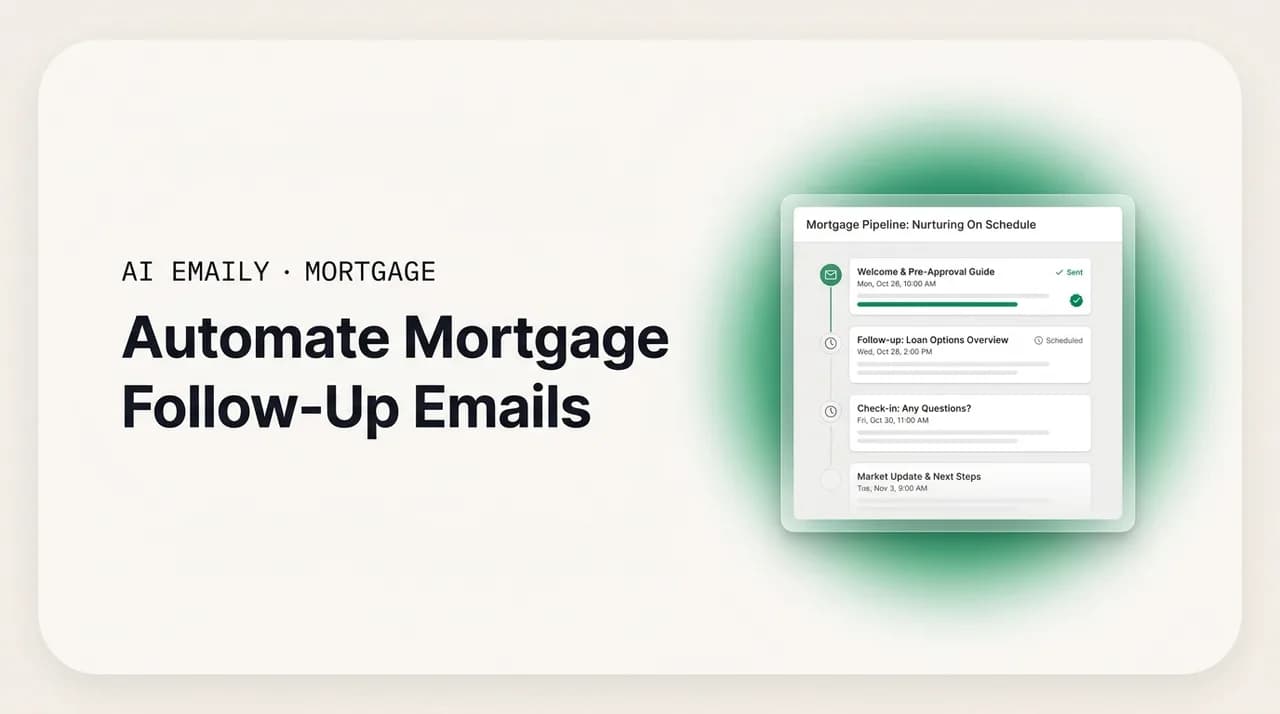
The short answer
To automate mortgage follow-up emails without sounding robotic, build one cadence per pipeline stage (new lead, pre-approved-not-shopping, in-process, past client/refi, realtor partner), write each touch in your own voice, and let software send only what is safe to send unattended. Instant acknowledgment, doc-checklist reminders, and status updates are the cleanest to automate; anything with a rate quote or a guideline judgment call should be drafted for you and sent after you approve. The point of automation is to never drop a follow-up, not to sound like a mail merge.
A practical guide to automate mortgage follow-up emails for loan officers: why multi-touch follow-up wins loans, the real cost of dropped follow-up, five cadences with templates, and when to auto-send versus approve.
On this page
- 01Why bother to automate mortgage follow-up emails at all?
- 02Why does multi-touch follow-up win mortgage loans?
- 03What does a dropped follow-up actually cost?
- 04The five cadences every loan officer should automate
- 05Cadence 1: the new-lead sequence
- 06Cadence 2: pre-approved but not yet shopping
- 07Cadence 3: the in-process file
- 08Cadence 4: past clients and refinance
- 09Cadence 5: realtor and referral partners
- 10The follow-up cadence at a glance
- 11Automation versus personalization: where's the line?
- 12When should you auto-send versus approve first?
- 13How AI Emaily helps you automate mortgage follow-up emails
- 14Putting it all together
Why bother to automate mortgage follow-up emails at all?#
Most loans are not won on the first email. They are won on the fifth, the eighth, the one you sent three weeks after the borrower went quiet, the one that landed the morning rates dipped. A mortgage is one of the largest financial decisions a person makes, and the decision cycle stretches from days to many months. A first-time buyer might sit pre-approved for a season before they find a house. A rate-shopper fills out the same form for half a dozen lenders in one afternoon. A past client is a refinance waiting for the right week. None of those deals close because you replied once and hoped. They close because someone followed up, on time, again and again, until the timing finally lined up.
That is exactly the part that breaks when you are busy. The intent is always there. You mean to circle back with the borrower who asked about a jumbo option, you mean to nudge the pre-approval that has gone cold, you mean to send the realtor partner a status update before they have to ask. Then a file goes into underwriting, three conditions come back at once, two new leads hit the inbox, and by Friday the follow-up you meant to send on Tuesday is buried under forty other messages. The loan does not fall through because you were bad at your job. It falls through because manual follow-up does not scale past a certain pipeline size, and every loan officer eventually hits that ceiling.
This is the case for automation, and it is narrower than the hype suggests. The goal is not to replace you with a drip machine that blasts strangers with canned copy. The goal is to make sure the right follow-up goes out at the right time whether or not you remembered, in language that reads like you wrote it, with the sensitive touches held back for your approval. When you automate mortgage follow-up emails properly, you are not outsourcing the relationship. You are building a safety net under it so that no borrower ever slips through because you were mid-closing when they needed you.
It helps to separate two things people lump together. There is the follow-up that has to happen fast, and there is the follow-up that has to keep happening. Speed-to-lead is the first: the borrower who just submitted an inquiry expects an answer in minutes, not hours, and whoever replies first usually gets the conversation. Cadence is the second: the borrower who is not ready today needs to hear from you at a sane rhythm for weeks or months until they are. Automation earns its keep on both, but it earns it differently. On speed, it removes the lag between a lead landing and a human touching it. On cadence, it removes the memory tax of tracking dozens of half-live conversations and firing the next touch on schedule.
This guide is about both, with the weight on cadence, because cadence is where the most loans quietly leak out of a pipeline. We will walk through why multi-touch follow-up wins mortgage loans, what a dropped follow-up actually costs, five cadences you can copy for the stages every loan officer works, where the line sits between automation and personalization, and when a message is safe to auto-send versus when it should be drafted and approved first. At the end, we will be honest about how an AI email client helps and, just as important, where it should stay out of the way.
Automate the reminder, not the relationship
Why does multi-touch follow-up win mortgage loans?#
Sales research has said the same thing for years, and mortgage is a textbook case of it: most deals need multiple follow-ups, and most salespeople quit long before they get there. A widely cited pattern in sales data is that the majority of closed business comes after the fifth contact, while a large share of reps stop after one or two. Whatever the exact figures in any given study, the shape is consistent. Persistence, spaced sensibly and delivered without nagging, is what separates the loan officer who converts a pipeline from the one who works the same leads and watches them drift to a competitor.
Mortgage amplifies this for three specific reasons. First, the buying cycle is long. Unlike an impulse purchase, a home loan is tied to life events, house-hunting timelines, rate movements, and paperwork that takes weeks. A borrower who is genuinely a great fit might not be ready to act for months, and the only way to still be the lender they call is to have stayed politely present the whole time. One touch at the start of that window and silence for the rest of it is how you hand a warm borrower to whoever kept showing up.
Second, the borrower is comparison-shopping by default, especially on rate. Portal and marketplace leads in particular are shared: the same person submitted their information to several lenders at once and is now fielding calls and emails from all of them. In that scenario the winner is rarely the lowest rate by a basis point. It is the lender who responded first, answered clearly, and then kept following up while the others went quiet after the first bounce. Multi-touch follow-up is not just nurture in that world, it is how you out-last the competition for a borrower who was never exclusively yours.
Third, the value of a past relationship compounds. A borrower you closed two years ago is not a finished transaction, they are a future refinance, a future purchase, and a referral source. When rates move, that database is the highest-converting audience you will ever email, but only if you have kept in light, useful contact rather than vanishing the day the first loan funded. The loan officers who win the next rate wave are the ones who followed up with their book of business all along, so that a single rate-drop note lands on people who already trust them instead of strangers.
Put those three together and the conclusion is uncomfortable but clear: in mortgage, the follow-up is the job. The application, the pricing, the guideline knowledge all matter enormously, but they only get to matter if you are still in the conversation when the borrower is finally ready. And staying in dozens of conversations, on the right schedule, for weeks or months at a time, is precisely the kind of work human memory is worst at and software is best at.
None of this means more email is better. A borrower who gets a mechanical message every day will unsubscribe or resent you, and that is worse than silence. The skill is cadence: enough touches, spaced with judgment, each one carrying something the reader actually wants, whether that is reassurance, a next step, a status update, or a genuinely relevant rate. Automation should enforce that cadence, not flatten it into spam. Everything that follows is about building cadences that feel like attention, not pressure.
The compliance reminder that never goes away
What does a dropped follow-up actually cost?#
It is easy to treat a missed follow-up as a small thing, one email among hundreds, no harm done. The math says otherwise. Start with acquisition. You paid for that lead, whether in marketplace fees, agent-partner effort, ad spend, or the years of relationship behind a past client. When a follow-up is dropped and the borrower closes with someone else, you did not just lose a possible deal. You paid full price for a lead and delivered the resulting loan to a competitor for free. The cost of a dropped follow-up is not zero, it is the acquisition cost plus the lost commission plus the referrals that borrower would have sent.
Then compound it across a pipeline. If you carry sixty live-ish conversations at various stages and even a handful go cold each month purely because the next touch never went out, that is several loans a quarter evaporating for reasons that have nothing to do with pricing or product. Loan officers rarely see this loss because it is invisible: there is no bounce, no rejection, no angry email. The borrower simply drifts, answers a competitor who happened to follow up that week, and you never find out why the file went quiet. Dropped follow-up is the leak you cannot see in the pipeline you thought was healthy.
The speed version of this is even starker. The borrower who submits an inquiry and hears nothing for a few hours has, in many cases, already started a conversation with a faster lender by the time you reply. The classic research on online sales leads found that the odds of a productive contact fall off a cliff within minutes, not hours, of a lead coming in. In a shared-lead market where the borrower is fielding several lenders at once, a slow first follow-up is often a lost deal before the race even started. Automation of that first acknowledgment is the single highest-return thing most loan officers can do, because it converts a lag you cannot beat by hand into an instant, reliable touch.
There is a quieter cost too, and it lands on you rather than the pipeline. Carrying dozens of open follow-up loops in your head is exhausting. Every borrower you meant to circle back to is a small background worry, a nagging sense that you are forgetting something, and often you are. That cognitive load makes the work heavier than it needs to be and pushes good loan officers toward burnout in a job that is already relentless. Offloading the tracking and the timing to a system is not just a conversion play, it is a sanity play. You stop being the pipeline's memory and get to be its expert instead.
So when we talk about the cost of dropped follow-up, we are really talking about four things at once: the acquisition dollars wasted, the commission handed to a competitor, the referral network that never forms because the relationship faded, and the mental tax of trying to hold it all by hand. Automation addresses every one of them, not by sending more, but by making sure the touches you already intend to send actually go out, on time, without you having to remember.
The most expensive email is the one you meant to send
The five cadences every loan officer should automate#
A cadence is just a planned sequence of touches for a specific situation: what you send, in what order, spaced how far apart. Rather than inventing follow-up on the fly for every borrower, you build a handful of cadences once and reuse them across your pipeline, personalizing the details each time. Five cover the vast majority of a loan officer's follow-up work. We will walk through each with a purpose, a rough rhythm, and a sample touch you can adapt. Treat every template as a starting skeleton, not a script to send verbatim, because the whole point is that it reads like you.
The five cadences, and what each one is for:
- 1
New lead (speed-to-lead)
For a fresh inquiry, portal lead, or agent referral. The job is to acknowledge instantly, then follow up persistently for the first week or two while the borrower is actively deciding. Speed on the first touch matters more here than anywhere else.
- 2
Pre-approved, not yet shopping
For a borrower who is pre-approved but has not found a house or is not ready to act. The job is to stay warmly present without pressure over weeks or months, so you are the lender they call when they finally write an offer.
- 3
In-process (active file)
For a loan already in the pipeline. The job is proactive status updates and clean document requests, so the borrower feels informed and conditions get cleared without you chasing the same paperwork three times.
- 4
Past client and refinance
For closed borrowers in your database. The job is light, useful, periodic contact plus a fast, relevant nudge when rates move, so your book of business is warm the moment a refinance makes sense.
- 5
Realtor and referral partner
For the agents and partners who send you business. The job is consistent value, prompt status updates on shared clients, and staying top-of-mind, so referrals keep flowing and you look reliable in front of their buyers.
Cadence 1: the new-lead sequence#
This is the cadence where speed does the heavy lifting, and it is the one most worth automating first. A new lead is time-sensitive and often shared, so the first touch should be instant and the following touches should be persistent for the window during which the borrower is actively shopping. The rhythm below is a common, sane starting point: an immediate acknowledgment, a same-day follow-up, then a tapering sequence over the next week to ten days.
The very first message should go out within minutes of the lead landing, whether or not you are at your desk. Keep it short, human, and focused on making it easy to reply or book time. This is the single best candidate for automation in the entire mortgage follow-up world, because a machine can send it in thirty seconds and a busy human cannot.
If the borrower does not reply, the following touches keep the door open without piling on. A good pattern is one more nudge the same day or next morning, a value-focused touch a couple of days later, and a final, low-pressure check-in near the end of the window. Each should carry something useful, a next step, a reassurance, a genuinely helpful piece of context, rather than just repeating please reply.
Automate the send, personalize the hook
Cadence 2: pre-approved but not yet shopping#
This borrower is one of the most valuable and most neglected in a pipeline. They are qualified, they want to buy, and they are simply not ready today, maybe they are still house-hunting, waiting on a lease to end, or building confidence. The failure mode here is silence: the loan officer moves on to hotter leads, the pre-approval lapses, and when the borrower finally writes an offer they call whoever stayed in touch. The whole cadence is designed to keep you warmly present over a long window without ever applying pressure.
The rhythm is slow and steady, not urgent. Think a check-in every couple of weeks stretching to monthly, each touch offering something genuinely useful, a market note, a reminder that their pre-approval has an expiration, an offer to re-run numbers if their situation changed. The tone is helpful neighbor, not chasing salesperson.
Because this cadence runs for weeks or months, it is the one most prone to being dropped by hand, which makes it a strong automation candidate, with a caveat. The scheduling and the reminder should absolutely be automated so the borrower never falls off your radar. But the content should stay flexible: if you learn they went under contract, found a house, or hit a snag, the next touch should react to that, not blindly fire the next scheduled note. The right setup automates the trigger to reach out and then lets you, or an assistant that drafts in your voice, decide what the reach-out actually says.
Cadence 3: the in-process file#
Once a loan is in the pipeline, follow-up shifts from winning the borrower to keeping them calm and moving the file forward. Two things drive borrower anxiety during processing: not knowing what is happening, and not knowing what you need from them. A good in-process cadence attacks both with proactive status updates and clean, specific document requests. Done well, it means the borrower feels looked after and you spend far less time chasing the same three documents across five emails.
Status updates are the underrated half. Most borrowers will not email to ask how it is going, they will just quietly worry, and that worry is where you lose trust and referrals. A short, scheduled update at each milestone, submitted, in underwriting, conditions received, clear to close, does enormous work for very little effort, and it is highly repeatable across every file, which makes it excellent for automation.
Document requests are the other half, and the trick is to make them impossible to misread. Vague asks (send me your bank statements) produce the wrong file, the wrong month, or a blurry photo, and then you follow up three more times. A specific, checklist-style request, with exactly what, for which period, and how to send it, cuts the back-and-forth dramatically. Because the categories repeat on nearly every file, a well-built request template with the specifics filled in is both a big time-saver and a safe thing to automate the reminder cadence around.
Reminders can automate; the numbers should not
Cadence 4: past clients and refinance#
Your closed borrowers are the highest-value, lowest-cost audience you will ever email, and most loan officers barely touch them until a rate wave hits, at which point they are competing with everyone else for attention. The cadence here has two gears. The first is slow, year-round relationship maintenance: a handful of genuinely useful or human touches a year, a loan anniversary note, a holiday message, a market update, so that you stay a familiar, trusted name rather than a stranger who only shows up to sell. The second is fast and reactive: the moment rates move enough to matter for a given borrower, a prompt, relevant note that they could benefit from a refinance.
The relationship gear is easy to automate and easy to get wrong. Automate the timing so the anniversary and check-in touches actually go out, but keep them warm and specific enough that they do not read like a form letter. A note that remembers the borrower closed on a home two years ago and asks how they are settling in lands completely differently from a generic newsletter blast.
The rate gear is where automation and caution meet head-on. When rates drop, the temptation is to blast the entire database with a rate-alert. Resist the blast; be relevant instead. The strongest version watches for a rate move that actually benefits a specific borrower given their current loan, then triggers a tailored note. The trigger and the draft can be automated. The claim, this rate could save you money, must be accurate for that borrower and compliant in how it states any numbers, which is exactly why a rate-driven touch should be reviewed before it sends rather than fired blindly.
Never fire rate claims on autopilot
Cadence 5: realtor and referral partners#
For most purchase-focused loan officers, agents are the pipeline. A steady referral relationship is worth more than any single lead, and it is built on the same thing as borrower trust: reliable, timely communication. The partner cadence has two jobs. The first is proactive status updates on shared clients, so the agent never has to email you asking where their buyer's loan stands, because nothing frays an agent relationship faster than feeling out of the loop on their own deal. The second is staying top-of-mind between deals with genuine value, so you are the lender they think of first for the next buyer.
The shared-client update is the highest-return touch and a natural fit for automation, because it fires off the same file milestones you are already tracking for the borrower. When a shared client hits a milestone, the agent should hear about it without having to ask.
The stay-in-touch gear keeps you present between transactions: a periodic note with something the agent can actually use, a market update, a co-branded resource for their buyers, an offer to do a quick pre-qual for a client on the fence. Automate the cadence so these go out consistently rather than only when you happen to remember, but keep them specific to that partner. An agent can tell instantly whether a message was written for them or copied to a hundred agents at once, and the generic version does more harm than good in a relationship built on trust.
Across all five cadences, the pattern is the same: automate the timing and the trigger, keep the words in your voice, and hold the sensitive touches for a human check. That balance, cadence enforced by software, content kept human, is the whole art of following up at scale without sounding like a robot.
The follow-up cadence at a glance#
Here is the whole system compressed into one reference. Use it as a starting map, then adjust the rhythm to your market and your production level. The right column is the honest call on what is safe to send unattended versus what should be drafted and approved first.
| Cadence | Trigger | Rhythm | Sample touches | Auto-send or approve? |
|---|---|---|---|---|
| New lead (speed-to-lead) | Inquiry, portal lead, or agent referral arrives | Instant, then day 1, day 2–3, day 5–7, day 10–14 | Acknowledgment, book-a-call nudge, value note, low-pressure check-in | Auto-send the instant acknowledgment; approve anything with pricing |
| Pre-approved, not shopping | Pre-approval issued, no active offer | Every 2–4 weeks, tapering to monthly | Warm check-in, pre-approval expiry reminder, offer to re-run numbers | Auto-schedule the reminder; keep content flexible to their situation |
| In-process (active file) | Loan submitted and moving through milestones | At each milestone, plus document requests as needed | Status update, specific doc checklist, condition reminder | Auto-send status and reminders; review anything stating figures |
| Past client / refinance | Loan funded (relationship) or rate move (refi) | A few times a year, plus reactive on rate triggers | Anniversary note, market update, tailored rate-drop nudge | Auto-send relationship touches; always approve rate claims |
| Realtor / referral partner | Shared client milestone or between deals | Per milestone on shared clients, plus periodic value | Shared-client status update, market resource, pre-qual offer | Auto-send milestone updates; personalize value touches by partner |
Automation versus personalization: where's the line?#
The fear that stops most loan officers from automating follow-up is a fair one: they do not want to sound like a robot. They have received the mortgage drip emails everyone gets, the mechanical Hi FIRST_NAME, just following up blasts that convert no one and cheapen the sender. If that is what automation means, they are right to avoid it. But that is a failure of execution, not of automation, and the line between the two is clearer than it looks.
The useful distinction is between automating the logistics and automating the language. Logistics, when to send, whom to send to, which trigger fired, tracking who has not replied, remembering the pre-approval that expires next month, are exactly what software should own. This is the memory-and-timing work that humans do badly at scale and that has nothing to do with sounding personal. Automating it does not make you a robot, it makes you reliable. Nobody has ever felt insulted that a message arrived on time.
Language is where it gets risky. A message that reads like it came off an assembly line, generic phrasing, no reference to anything specific about the borrower, obvious mail-merge seams, signals that you did not actually pay attention, which is the opposite of what a follow-up is supposed to convey. The fix is not to write every email by hand, it is to make sure the automated content is specific and in your voice. A single tailored detail near the top, the property type, the lead source, the agent who referred them, where they are in their search, transforms a template from a drip into something that reads like a person who remembers them.
This is where modern AI email tools change the calculus, and it is worth being precise about why. Older automation forced a hard trade-off: personalize by hand and it does not scale, or template it and it sounds generic. AI removes the trade-off on the content side by drafting each touch in your actual writing voice and adapting it to what is known about the borrower, so a hundred follow-ups can each read like you wrote them without you writing a hundred emails. The logistics stay automated; the language stops being generic. That combination, automated timing plus personalized-feeling content, is what it means to automate mortgage follow-up emails without sounding like a robot.
A practical test keeps you honest. Read any automated message you are about to schedule and ask: if a borrower forwarded this to a friend and said look what my loan officer sent, would it read as attentive or as spam? If it would embarrass you, it is too generic, and either the template needs a real personal hook or the touch should be drafted fresh. Automation should raise the floor on your follow-up, never lower the ceiling on how personal it feels.
The forward test
When should you auto-send versus approve first?#
Automation is not one setting. The most important decision in a mortgage follow-up system is not whether to automate but how much control to keep on each type of message, and the answer differs by stakes. Think of it as a spectrum. At one end, messages so safe and repetitive that a human review adds nothing, these should send themselves. At the other, messages carrying real financial or compliance weight, these should always pass a human before they go. Most of a loan officer's follow-up lives cleanly at one end or the other, and knowing which is which is the whole game.
Safe to auto-send are the touches whose content is stable, factual, and low-risk: the instant lead acknowledgment, a milestone status update (your file is in underwriting), a document reminder that lists exactly what is needed, a warm relationship check-in with no numbers in it. These are repeatable across every file, hard to get wrong, and most valuable precisely because they go out reliably and instantly. Holding them for manual approval would defeat the point, the acknowledgment that waits in a review queue for three hours is no longer a speed-to-lead advantage.
Approve first, always, are the touches that state a rate, a payment, an APR, a closing figure, an approval status, or any guideline judgment. A refinance nudge that quotes savings, a message that implies a borrower is approved, anything a specific borrower could act on financially, these carry both compliance risk and relationship risk if they are wrong, and automation sends a mistake to everyone before you can catch it. The right pattern is to let software do all the work up to the send, find the right borrowers, draft the tailored message, queue it, and then let you glance at it and approve, so you get the speed of automation without ever letting an unreviewed number leave your outbox.
The best systems make this a per-category choice rather than an all-or-nothing switch. You decide, once, that acknowledgments and status updates send automatically while anything touching a rate waits for your approval, and the system honors that rule across every borrower forever. A safety net underneath both is undo: even on an auto-sent message, being able to pull it back within a short window turns a small mistake into a non-event. And an audit trail, a record of what was sent, to whom, and when, matters more in mortgage than in almost any other field, both for your own peace of mind and for the compliance reality that regulated lending demands you be able to show what went out.
Framed this way, the auto-send-versus-approve question stops being scary. You are not handing your borrower relationships to a machine and hoping. You are deciding, deliberately and per category, which routine touches you trust to fire on their own and which sensitive ones you want to see first, then letting the system enforce that judgment consistently. That is control, not abdication, and it is the only responsible way to automate follow-up in a field where the messages carry this much weight.
Undo and audit are not optional in mortgage
How AI Emaily helps you automate mortgage follow-up emails#
Here is where AI Emaily fits, described honestly, including where it should stay out of the way. AI Emaily is an AI-native email client that works as an autonomous chief of staff for your inbox, and it is built around exactly the balance this guide argues for: automate the timing and the tracking, keep the language in your voice, and hold the sensitive touches for your approval. It connects to Gmail, Outlook, and other providers, so it works with the inbox you already use rather than asking you to move your mortgage business into yet another tool.
On the never-forget-a-follow-up problem, it does the remembering for you. It tracks which borrowers are waiting on a next touch, which pre-approvals are going cold, which files just advanced a milestone, and it surfaces or sends the right follow-up on schedule, so the cadences above run whether or not you had a chaotic week. On the sounding-like-a-robot problem, it drafts each touch in your actual writing voice, learned from how you really email, and adapts it to the specific borrower, so an automated acknowledgment or status update reads like you wrote it rather than like a mail-merge. That is the combination that lets you follow up at scale without the drip feel.
The part that makes it safe for regulated lending is the three-mode control: Manual, Copilot, and Autopilot. In Manual, nothing sends without you. In Copilot, it drafts the follow-up and you approve before it goes, which is the right setting for anything touching a rate, a figure, or an approval. In Autopilot, you let it handle the genuinely routine, within rules you set, the instant lead acknowledgment, the milestone status update, the plain document reminder, so those fire reliably and instantly while the sensitive touches still come to you. You choose which categories live in which mode, and it holds that line consistently.
Two safeguards run under all of it, and they are the reason to trust automation with something as consequential as borrower communication. The first is undo: even on an auto-sent message, you have a window to pull it back, so a wrong send is a shrug rather than a crisis. The second is a full audit trail: a record of what was sent, to whom, when, and in which mode, which is both peace of mind for you and the kind of documentation a compliance-heavy field like mortgage actually needs. Automation you cannot reverse or account for is a liability. Automation with undo and audit is a tool you can lean on.
And to be clear about the boundary, because it is the honest part: this is not a spam cannon and it should not be used as one. It will not fire rate claims on autopilot, and you should not configure it to. The design intent is that anything carrying real financial or compliance weight passes through your approval, while the safe, repetitive touches, the ones you already wish would just happen on their own, do. Used that way, it does exactly what a good chief of staff does: it takes the follow-up work you keep meaning to get to off your plate, in your voice, on time, without ever letting an unreviewed number out the door.
If your pipeline has grown past what you can follow up with by hand, that is not a discipline problem, it is a signal you have outgrown manual follow-up. You can try it free at app.aiemaily.com/signup, connect the inbox you already use, and start with everything in Copilot so nothing sends without your approval until you have decided exactly what you trust to run on its own.
Putting it all together#
Follow-up is not a nice-to-have in mortgage, it is where the loans are actually won: across a long buying cycle, against lenders shopping the same shared borrower, and inside a past-client database that is a refinance wave waiting for the right week. The loans you lose to dropped follow-up are the most expensive of all, because you paid for the lead and handed the deal, the commission, and the referrals to whoever happened to follow up when you did not.
The way out is not to send more email, it is to build a small set of cadences, one per pipeline stage, and let software enforce the timing while you keep the language human. Automate the instant acknowledgment, the milestone status update, the specific document reminder, and the warm relationship touch, because those are safe, repetitive, and most valuable when they fire reliably. Draft-and-approve anything that quotes a rate or makes a guideline call, because those carry weight that belongs in front of a human before it sends. Keep undo and a full audit trail underneath all of it, because in regulated lending you need to be able to reverse a mistake and show your work.
Do that and you get the outcome that matters: no borrower slips through because you were mid-closing, no pre-approval goes cold because you forgot, no rate wave catches your database unwarmed, and none of it reads like a robot. That is what it means to automate mortgage follow-up emails well, and it is the difference between a pipeline you chase and one that quietly, reliably, converts.
Frequently asked
See it in AI Emaily
Keep reading
Sources

Written by
Nafiul HasanNafiul Hasan is an entrepreneur and AI automation system builder with 10+ years of experience turning messy, manual workflows into reliable automated systems. He designs and ships AI enterprise solutions end-to-end — the agent logic, the data plumbing, and the product people actually use — and founded AI Emaily to give busy professionals their attention back. He writes here from the builder's seat: what works, what breaks, and how to put AI to work without giving up control.