How to Automate Proposal & Client Follow-Up Emails as a Freelancer (Without Sounding Robotic)

The short answer
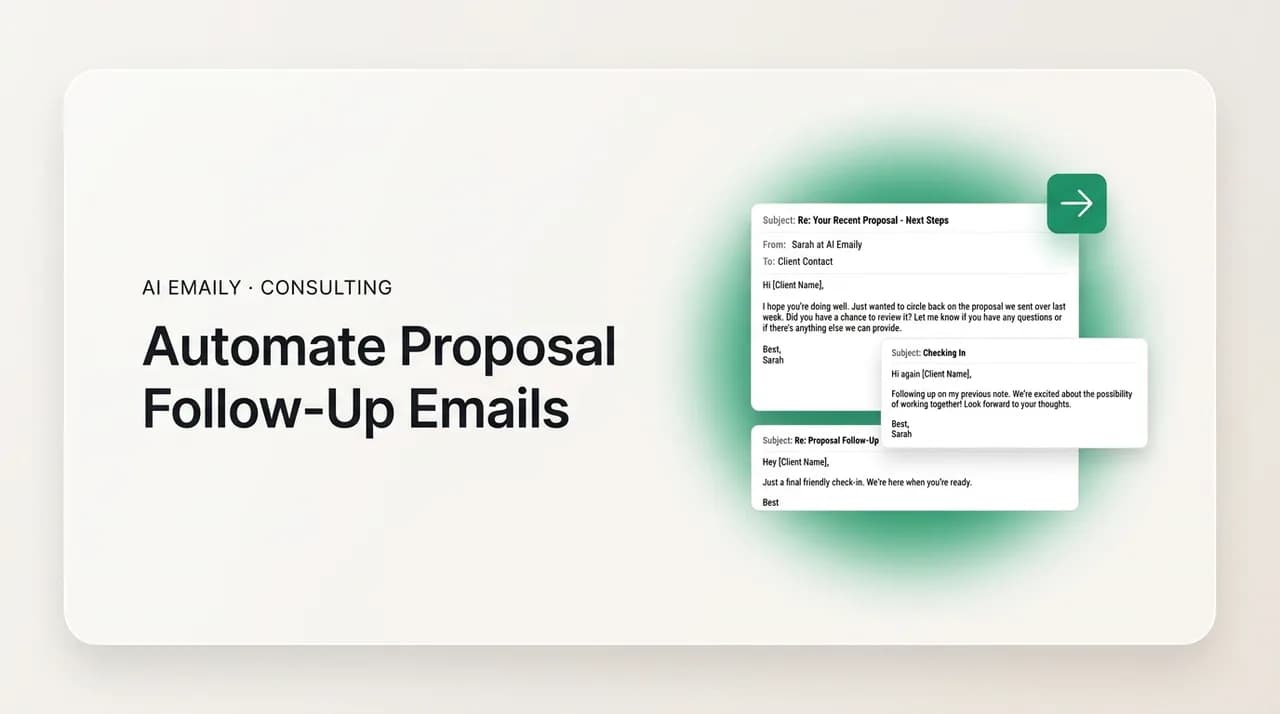
Consultant follow-up automation is the practice of scheduling and drafting proposal and client follow-ups so none slip while you are heads-down on delivery. Most deals are lost to silence, not a firm no. A four-to-six touch sequence over two to three weeks, drafted in your voice and approved before it sends, recovers the revenue you are currently leaving in the inbox.
A practical guide to consultant follow-up automation: why proposal follow-up wins the deal, a timed follow-up sequence with templates, and how to automate client follow-ups without sounding robotic.
On this page
- 01Why proposal follow-up wins the deal (and why silence loses it)
- 02The real cost of dropped follow-up
- 03A proposal follow-up sequence that closes (with timing and templates)
- 04Nurturing the slow leads that aren't dead, just not ready
- 05Automation versus personalization: the false choice
- 06Auto-send or approve first? Drawing the line
- 07How AI Emaily helps with consultant follow-up automation
- 08Putting a follow-up system in place this week
Why proposal follow-up wins the deal (and why silence loses it)#
Here is the uncomfortable truth about running a services business: you almost never lose a deal because the client said no. You lose it because nobody said anything. The proposal goes out, you get a warm "thanks, looks great, let me run it by the team," and then the thread goes quiet. You are three days into a delivery sprint, the client is buried in their own week, and the follow-up that would have closed the deal never gets sent. That is where consultant follow-up automation earns its keep: it is the system that keeps sending the right nudge at the right time so a deal that was yours to win does not quietly evaporate into an unanswered inbox.
This matters more for freelancers, consultants, and small agencies than for almost anyone else, because for you the follow-up is not a task a sales team owns. It is a task that competes directly with billable delivery time. Every hour you spend chasing a proposal is an hour you are not shipping the work that pays this month's invoice, and every hour you spend shipping is an hour a warm lead cools off. That tension, delivery versus follow-up, is the exact reason leads die in the inbox during busy weeks. You are not lazy or disorganized. You are one person doing sales, delivery, and admin at once, and follow-up is the thing that always loses when time is scarce.
The firms that win are not the ones with the best proposals. They are the ones that keep showing up in the prospect's inbox with a clear, low-friction next step while the competitors go silent after touch one. In a marketing or creative agency deal, where the prospect is evaluating three or four providers at the same time, the firm that responds first and stays present shapes the whole evaluation in its favor. Follow-up is not nagging. It is how you stay in the running.
It helps to be precise about what "follow-up" actually covers, because it is broader than most people think. Proposal follow-up is the obvious one: the sequence of touches after you send a quote or scope. But there is also lead follow-up, the nudges that turn an inbound inquiry into a discovery call before the interest fades. There is nurture, the slow, low-pressure keeping-in-touch with a prospect who is real but not ready. And there is client follow-up, the check-ins, status updates, and "any feedback on the draft?" messages that keep an active engagement moving. All four repeat constantly, all four are easy to forget under delivery pressure, and all four are exactly what automation is built to catch.
This guide is about building a follow-up system that runs whether or not you remember to run it, without turning your carefully-built relationships into a stream of obviously-automated spam. We will cover the real cost of dropped follow-up, a proposal follow-up sequence you can copy with specific timing and templates, how to nurture the slow leads that are not dead but not ready, where the line sits between automation and personalization, when to auto-send versus approve first, and an honest account of how an AI email client fits into all of it. The goal is that the next time you go heads-down for two weeks of delivery, not a single warm lead goes cold behind your back.
The real cost of dropped follow-up#
It is easy to treat a missed follow-up as a small thing, one email you did not send. But the arithmetic of dropped follow-up is brutal once you actually look at it, because the losses compound in three separate directions: the deals themselves, the wasted effort that produced them, and the slow erosion of your reputation.
Start with the deals. The persistence research is remarkably consistent and remarkably ignored. Most sales require multiple follow-ups after the first contact, yet a large share of people give up after one or two touches, which means the majority of deals are abandoned by the seller long before the buyer has actually decided. Put those two facts next to each other and the picture is stark: the point at which most freelancers quit following up is roughly the point at which most deals would have started to close. You are not losing to a better proposal. You are losing to your own second, third, and fourth email that never got sent.
Now layer on the wasted effort. A dropped follow-up is not a neutral non-event, because a real cost was already sunk before the drop. You took the discovery call. You scoped the work. You wrote the proposal, priced it, formatted it, and sent it. All of that time is spent whether or not the deal closes, and a single unsent follow-up can be the difference between that effort turning into revenue and it turning into nothing. In services, where your inventory is your hours, an abandoned warm lead is one of the most expensive things you can do, because you already paid the acquisition cost in unbillable time and then threw away the return.
The third cost is the quietest and the most damaging over a career: what silence does to how prospects see you. When a proposal goes unanswered and you never circle back, the prospect does not think "they must be busy." They think "if this is how responsive they are while they are trying to win my business, what happens once they have it?" Slow or absent follow-up reads as a preview of the working relationship, and for a service where responsiveness is a core part of what you are selling, that preview can sink you before the engagement even starts. The firm that follows up promptly and clearly is not just chasing a deal; it is demonstrating, in real time, exactly the reliability the client is trying to buy.
Silence is a decision you are making by accident
There is a compounding effect too, one that busy weeks make worse. The leads most likely to be dropped are the ones that arrive when you are slammed, which is precisely when you are least able to give them attention and most in need of the pipeline they represent. Feast-or-famine, the classic freelancer curse, is partly a follow-up problem: you are heads-down and drop the follow-ups during the feast, the pipeline empties, and the famine that follows is the delayed bill for the leads you let go cold weeks earlier. A follow-up system that runs during your busy weeks is not a productivity nicety. It is the mechanism that smooths the cycle, because it keeps working the exact pipeline you would otherwise abandon at the worst possible time.
A proposal follow-up sequence that closes (with timing and templates)#
The antidote to dropped follow-up is a defined sequence: a fixed set of touches, on a fixed cadence, that you decide once and then run every time you send a proposal. The value of a sequence is that it takes the decision out of the moment. You are not asking yourself, mid-delivery-sprint, "is it too soon to follow up? too pushy? did I already?" The sequence has already answered. Your only job is to let it run and to jump in when a real reply arrives.
A good proposal follow-up sequence for a freelancer or consultant runs four to six touches across two to three weeks, and every touch obeys two rules. First, each message adds something rather than just asking "did you see this?" A reason to reply, a piece of value, a question, a deadline. Second, the tone stays helpful and low-pressure throughout, because you are a peer offering to solve a problem, not a vendor begging for a signature. Here is the anatomy of the sequence, touch by touch.
- 1
Touch 1 — The send-day confirmation (day 0)
The moment you send the proposal, send a short note that frames it and lowers the barrier to replying. Do not just attach a PDF and vanish. Summarize the outcome in one line, point to where the price and scope live, and end with a specific, easy question. "I've attached the proposal for the site redesign — the summary and timeline are on page one, pricing on page three. Happy to walk through any of it on a quick call this week. Does Thursday or Friday work better for you?" A concrete next step converts far better than "let me know your thoughts."
- 2
Touch 2 — The gentle nudge (day 3)
If there is no reply after two to three business days, send a brief, friendly bump. Keep it genuinely short and assume the best: they are busy, not uninterested. "Just floating this back to the top of your inbox — no rush at all. Any early reactions to the proposal, or questions I can answer?" This single touch recovers a surprising number of deals, because the proposal was often read, liked, and then buried under the prospect's own week.
- 3
Touch 3 — The value add (day 7)
A week in, change the shape of the message. Instead of asking again, give something. Share a relevant example, a quick idea for their project, a short case study, or an answer to an objection you can guess is forming. "Was thinking about your launch timeline and pulled together a rough phase plan that might de-risk the first month — attached. Happy to talk it through whenever suits." Value-forward touches keep you present without the thread feeling like a countdown to a no.
- 4
Touch 4 — The direct check-in (day 12)
Around the two-week mark, it is fair to ask directly and give them an easy out. "I want to make sure I'm not chasing something that's no longer a fit — totally fine if priorities have shifted. If it's still live, what would be most useful from me to help you decide?" Offering the out is not weakness; it prompts the honest reply that either revives the deal or frees you to stop spending energy on it.
- 5
Touch 5 — The soft deadline or scarcity (day 16, optional)
If your calendar genuinely warrants it, a true deadline creates motion. Only use it when it is real. "Quick heads-up: I'm booking projects for next quarter and holding a slot for this through the end of the month. After that I can't guarantee the same start date. No pressure — just wanted to be transparent about timing." A manufactured fake deadline damages trust; a real one respects it.
- 6
Touch 6 — The graceful breakup (day 21)
When the sequence is exhausted, close the loop rather than trailing off. The breakup email is famously effective precisely because it is the one that gets replies. "I'll stop following up so I'm not cluttering your inbox — but the offer stands. If the timing changes, just reply here and we'll pick it right back up. Wishing you a great quarter either way." This leaves the door wide open and often surfaces the "actually, let's talk" you had given up on.
A few principles make this sequence work in practice. Space the touches so they breathe: every two to three business days early on, stretching to weekly toward the end, never two in a day. Vary the format so it does not feel like a machine repeating itself, which is exactly what the value-add and check-in touches are for. And always, always let a genuine reply stop the sequence dead. Nothing torches a relationship faster than an automated "just checking in!" landing the morning after the prospect wrote back to book a call. Your follow-up system's single most important job, after sending on time, is to shut itself off the instant a human responds.
The exact cadence should flex with the deal. A hot lead evaluating several agencies at once compresses the timeline: you follow up faster and closer because a competitor is in there right now. A high-value fractional or advisory engagement, where the person is the product and the sale is relationship-led, stretches out and softens, because pressure reads as desperation in that context. The table below gives you a default cadence to adapt rather than a law to obey.
| Touch | Timing | Purpose | What it says |
|---|---|---|---|
| 1. Confirmation | Day 0 (send day) | Frame the proposal, invite a next step | Here's what I sent and here's an easy way to move forward |
| 2. Gentle nudge | Day 3 | Resurface without pressure | Floating this back up — any early reactions? |
| 3. Value add | Day 7 | Give, don't ask | Here's something useful for your project |
| 4. Direct check-in | Day 12 | Ask plainly, offer an out | Still a fit? What would help you decide? |
| 5. Soft deadline | Day 16 (optional) | Create real, honest motion | Holding a slot through month-end — transparent on timing |
| 6. Graceful breakup | Day 21 | Close the loop, leave the door open | I'll stop here, but the offer stands |
Nurturing the slow leads that aren't dead, just not ready#
Not every lead fits a two-to-three-week sequence, and treating the slow ones as if they do is a good way to lose them. A large share of the prospects who say "not right now" are telling the truth: the budget resets next quarter, the internal champion is mid-reorg, the project is real but three months out. These leads are not a no. They are a not-yet, and the freelancer who stays lightly present when the timing finally arrives is the one who wins the eventual deal, usually without competing for it at all.
This is where nurture comes in, and it is a fundamentally different motion from the proposal sequence. The proposal sequence is a sprint with a clear finish line. Nurture is a slow, low-frequency, low-pressure drumbeat that runs for months. The cadence is monthly or every few weeks, not every few days. The goal is not to push for a decision; it is simply to stay top-of-mind so that when the prospect's timing changes, your name is the one already in their head. The data on this is encouraging: nurtured relationships and multi-touch sequences consistently outperform one-and-done outreach by a wide margin, because most buying decisions happen on the buyer's timeline, not the seller's.
The trap in nurture is that "just checking in" with no substance, repeated monthly, reads as needy and adds nothing. Effective nurture always carries a small gift of value, so each touch is welcome rather than tolerated. A few reliable formats:
- Send something genuinely useful and relevant — an article, a tool, a benchmark, or an idea that maps to a problem they mentioned. "Saw this piece on onboarding retention and thought of your Q3 goal — no agenda, just useful."
- Share a relevant result or case study when you finish work like theirs. "Just wrapped a project close to what we discussed — happy to share what worked if it's helpful for your planning."
- Mark the natural timing triggers you already know about. If they said "revisit in Q4," a note in early Q4 that references their own words lands as attentive, not pushy.
- Acknowledge milestones — a funding round, a launch, a new hire, an award. A short, specific congratulations with no ask keeps the relationship warm and human.
- Re-engage after a long gap with a low-pressure open door. "It's been a while — no idea if this is still on your radar, but I've got capacity opening up next month if the timing's better now."
The reason automation matters so much for nurture is that nurture is the follow-up you are most likely to drop and least likely to notice dropping. A proposal follow-up has urgency; you feel the deal slipping. A nurture touch three months out has no urgency at all, so it loses every scheduling contest against today's delivery work, and the lead you carefully qualified in March goes silent by June simply because nobody set a reminder. A system that quietly holds these long-horizon touches, surfaces them when their moment arrives, and drafts them with the specific context you logged months ago is the difference between a nurture list that compounds into a pipeline and one that is really just a graveyard of good intentions.
Log the reason, not just the date
Automation versus personalization: the false choice#
The instinctive objection to automating follow-up is that it will make you sound robotic, and that objection deserves to be taken seriously, because a badly automated follow-up is worse than none at all. Everyone has received the mail-merge follow-up with the visible {FirstName} token, the generic "I wanted to circle back!" that clearly went to five hundred people, the fourth identical nudge that arrives after you already replied. That is not follow-up. That is spam wearing follow-up's clothes, and it actively damages the relationship it was supposed to build.
But the framing of automation-versus-personalization is a false choice, and seeing why is the key to doing this well. What actually makes a follow-up feel personal is not that a human physically typed it in the moment. It is that the message is timely, relevant, specific to the recipient, and shaped like something a thoughtful person would send. All four of those qualities can be systematized. The timing is the sequence. The relevance and specificity come from context you already have — their name, their project, what they said on the call, the objection they raised. The shape and tone come from writing in your actual voice rather than in generic template-speak. None of that requires you to be at your desk when the message goes out. It requires the system to know enough, and to sound enough like you, that the recipient cannot tell and would not care.
The right mental model is to separate the two things automation actually does, because they are not equally sensitive. The first is scheduling and triggering: deciding that a follow-up is due, remembering to send it, stopping when a reply arrives. This is pure logistics, it carries zero relationship risk, and you should automate it aggressively and without guilt. No prospect has ever been offended that a follow-up arrived on schedule. The second is composing the words. This is where the risk lives, and where judgment matters, and where the difference between a warm human note and generic sludge is decided.
So the honest answer is not "automate everything" or "automate nothing." It is: automate the logistics completely, and automate the drafting as far as it can go while keeping the words genuinely yours. A follow-up that is triggered automatically, drafted from real context in your voice, and given a two-second human glance before it sends is indistinguishable from one you wrote by hand — because, in every way the recipient can perceive, you did. The machine handled the remembering. You kept the meaning. That is the whole game.
- Personalize the layer that's visible: their name, their specific project, a detail from your conversation, the exact objection or timeline they raised. Generic openers and closers are fine; a generic middle is what gets you caught.
- Systematize the layer that's invisible: the cadence, the triggers, the reply-detection that halts the sequence. Nobody perceives your scheduling logic — they only perceive whether the words felt written for them.
- Match your real voice, not a template's. If you write in short, warm, lowercase-friendly notes, an automated follow-up in stiff corporate boilerplate will read as fake precisely because it doesn't sound like the person they've been talking to.
- Never let volume show. The instant a recipient can tell they're one of many, the personal illusion — and the trust behind it — is gone. One visibly-mass follow-up undoes a dozen good ones.
Auto-send or approve first? Drawing the line#
Once you accept that the logistics should be automated and the words should stay yours, one decision remains, and it is the one that determines whether you will actually trust the system enough to use it: for any given follow-up, does it send automatically, or does it wait for you to approve it first? Get this line right and automation feels like a superpower. Get it wrong and you either drown in approval prompts or wake up to an email you would never have sent going out under your name.
The useful way to draw the line is by risk and repetition. Some follow-ups are high-volume, low-stakes, and nearly identical every time — the day-0 proposal confirmation, the "got your inquiry, here's my calendar" acknowledgment, the routine "any feedback on the draft?" client nudge. These are the safest possible candidates for auto-send: the downside of a slightly-imperfect one is negligible, and the upside of instant, reliable delivery is large, because for a first-response acknowledgment, speed is most of the value. Other follow-ups are lower-volume and higher-stakes: a re-engagement with a major prospect, anything touching price or scope negotiation, a message where a wrong word could cost a relationship. These should always pause for your review, because the judgment is the point and the cost of a mistake dwarfs the cost of a ten-second glance.
This is exactly why a single global switch — "automation on" or "automation off" — is the wrong design, and why the strongest follow-up systems offer a spectrum instead. You want to hand off the boring, repetitive, low-risk touches entirely while keeping a firm hand on the sensitive ones, and you want to move individual categories along that spectrum as your trust grows. Most people start by approving everything, watch the drafts for a couple of weeks, notice that the routine acknowledgments are consistently good, and graduate just those to auto-send while keeping the high-stakes messages under review indefinitely. That earned, gradual handoff is how you get the leverage of automation without the anxiety.
Two safeguards make the auto-send end of the spectrum genuinely safe rather than merely convenient. The first is a short delay or undo window: even an auto-sent message should be catchable for a minute or two after you hit go, so a typo or a wrong-recipient scare is recoverable. The second is a complete, honest record of what went out — every automated follow-up logged, timestamped, and readable after the fact, so you are never surprised by a message sent in your name and can always see exactly what your inbox did while you were heads-down. Automation you cannot review is not a time-saver; it is a liability you have not noticed yet. Automation with undo and a full audit trail is one you can actually build a business on.
The one thing auto-send must never do
How AI Emaily helps with consultant follow-up automation#
Everything above is doable by hand: you can keep a spreadsheet of open proposals, set calendar reminders for each touch, and hand-write every nudge in your voice. Plenty of disciplined consultants do exactly that, and it works right up until a busy delivery week, which is precisely when the manual system collapses and the leads you most needed go cold. The point of an AI email client is to make the follow-up system survive your busy weeks, because those are the weeks it exists for. Here is an honest account of where AI Emaily fits, and where it deliberately does not.
AI Emaily is an AI-native email client that connects to Gmail, Outlook, iCloud, Fastmail, Proton, and any IMAP account, so it works with whatever inbox you already run your business from — no migration, no new address to hand out to clients. Because it sits inside your actual email, it can see the proposal you sent and the thread it lives in, which is what lets it follow up with real context instead of generic filler. It learns how you actually write, so the drafts come back in your voice, warm and specific, rather than in the template-speak that gets follow-up automation caught and resented.
The part that maps most directly to this guide is the follow-up handling itself. AI Emaily can draft the touches in a proposal sequence for you, timed the way the cadence above describes, each one written from the specifics of that deal — the project, the name, the objection, the thing the prospect said mattered. It watches the thread and halts the sequence the moment a genuine reply comes in, which is the safety catch that makes the whole thing trustworthy. And for the slow leads, it holds the long-horizon nurture touches and the context you logged, then resurfaces them in your voice when their moment arrives, so the March lead does not silently die by June.
Crucially, it runs on the auto-send-or-approve spectrum this guide argues for, not a single on/off switch. Its three modes — Manual, Copilot, and Autopilot — let you decide per category how much to hand off. In Manual you write everything yourself with AI as a drafting aid. In Copilot, the default and the right starting point, every follow-up is drafted for you and waits for your one-tap approval before it sends, so nothing goes out in your name that you have not seen. In Autopilot, you graduate the routine, low-risk touches — the inquiry acknowledgment, the day-0 confirmation, the standard status nudge — to send on their own, while keeping the sensitive, high-stakes messages in Copilot for review. You move each category along that spectrum as your trust grows, exactly the earned, gradual handoff described earlier.
And it is built so that handing off does not mean losing control. Every automated action is reversible with undo, and everything the agent does is written to a full audit trail you can read after the fact, so you always know exactly what your inbox sent while you were deep in delivery. The email content the agent reads is treated as untrusted input, so a booby-trapped message can't hijack it into doing something you didn't authorize, and in v1 nothing sends on Autopilot that you have not explicitly graduated to it. The design goal is the one this whole guide is about: the leverage of never dropping a follow-up, without the anxiety of an automation you cannot see or take back.
None of this replaces your judgment on the deals that matter, and it is not meant to. The strategy call, the pricing negotiation, the delicate re-engagement with the client you almost lost — those stay human, because the judgment is the product you sell. What AI Emaily takes off your plate is the remembering and the routine drafting: the logistics that have no business competing with billable work, and that you were losing to delivery pressure anyway. It is the same idea behind the rest of the product, which acts as an autonomous chief of staff for your inbox — triaging, drafting, and handling the busywork so you spend less time managing email and more time on the work only you can do. You can try it free at app.aiemaily.com/signup, with a Free plan at no cost and Pro at $12.42 per month on the annual plan.
Putting a follow-up system in place this week#
You do not need to overhaul your whole business to stop losing deals to silence. The change that moves the needle is small and specific: decide your sequence once, so the follow-up decision stops living in the worst possible place — your memory during a busy week. Pick a default cadence (the four-to-six touches over two to three weeks above is a proven starting point), write the templates in your own voice, and separate the touches you are happy to send automatically from the ones you want to see first.
Then let the system carry it. Whether that is a spreadsheet and calendar reminders or an AI email client that drafts and times the touches for you, the principle is identical: the follow-up should happen whether or not you remember it, and it should stop the instant a human replies. Automate the logistics completely, keep the words genuinely yours, hand off the routine and guard the sensitive, and keep an audit trail so you always know what went out. Do that, and the next time you disappear into two weeks of delivery, your pipeline keeps working in the background instead of quietly draining behind you.
The deals you have been losing were never lost to a better competitor or a firm no. They were lost to a follow-up that competed with delivery and lost. A system fixes that — and the firm that keeps showing up, clearly and helpfully, while everyone else goes quiet is the one that wins the work.
Frequently asked
See it in AI Emaily
Keep reading
Sources

Written by
Nafiul HasanNafiul Hasan is an entrepreneur and AI automation system builder with 10+ years of experience turning messy, manual workflows into reliable automated systems. He designs and ships AI enterprise solutions end-to-end — the agent logic, the data plumbing, and the product people actually use — and founded AI Emaily to give busy professionals their attention back. He writes here from the builder's seat: what works, what breaks, and how to put AI to work without giving up control.