How Solo Freelancers Can Follow Up on Every Lead (Even Heads-Down on Client Work)

The short answer
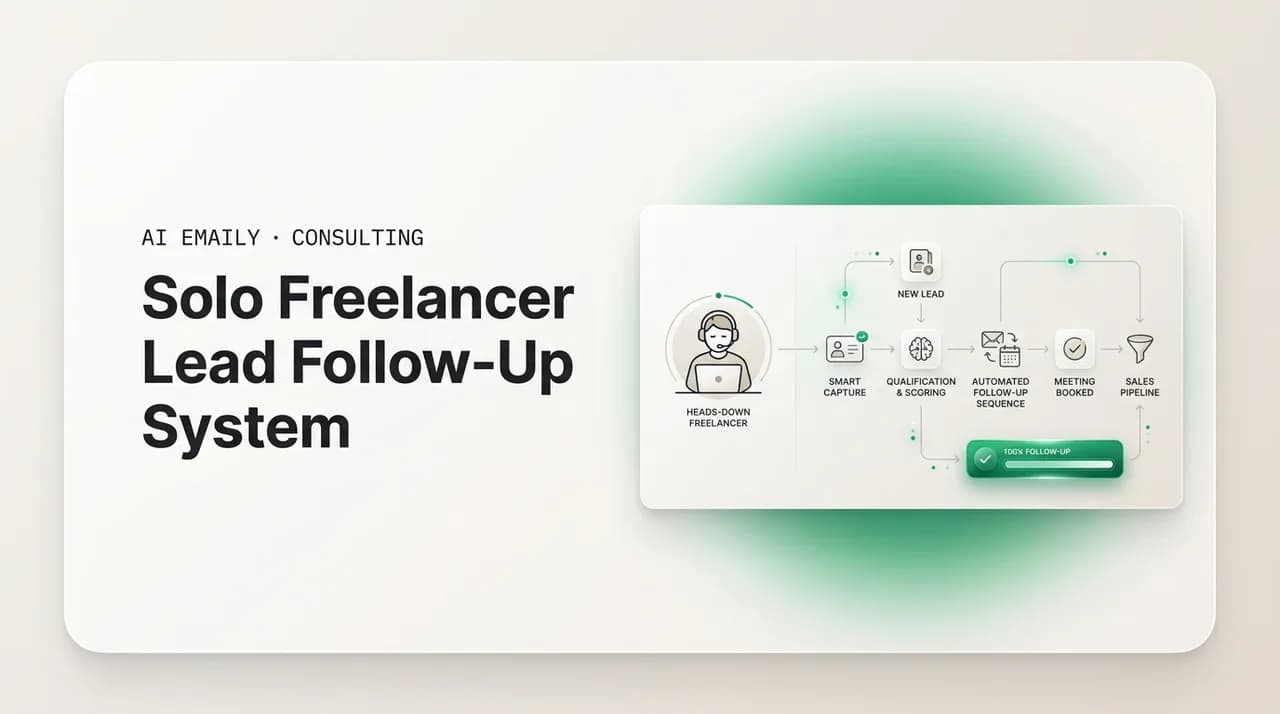
A solo freelancer lead follow up system comes down to three habits: reply to every new inquiry within an hour, run a fixed five-to-seven-touch cadence from saved templates, and never let a delivery week silence your inbox. Do the reply and the first follow-up manually; automate the reminders and the routine nudges so warm leads stop dying while you work.
A solo freelancer lead follow up system you can actually run alone: reply fast, use a simple cadence and templates, protect billable time, and let AI Emaily follow up in your voice so no lead goes cold while you are heads-down on client work.
On this page
- 01Why solo freelancer lead follow up is the hardest part of running a one-person shop
- 02The solo bottleneck: why leads die in your inbox during delivery weeks
- 03What a solo freelancer lead follow up system actually needs
- 04Step one: reply fast, because the first response usually wins
- 05Step two: run a simple follow-up cadence you decide once
- 06Step three: build a small library of follow-up templates
- 07Step four: use reminders so no follow-up depends on your memory
- 08Step five: protect your billable time while you run the system
- 09How AI Emaily helps a solo freelancer follow up on every lead
- 10Putting the system together
Why solo freelancer lead follow up is the hardest part of running a one-person shop#
When you are a solo freelancer, you are the entire company. You are the salesperson who answers the inquiry, the consultant who scopes the project, the person who writes the proposal, the delivery team that does the actual work, and the bookkeeper who chases the invoice. There is no sales assistant catching leads while you are on a call, no account manager sending the polite second nudge, no ops person keeping the pipeline warm. Every one of those jobs runs through one inbox and one pair of hands. That is what makes solo freelancer lead follow up so uniquely brutal: the moment you go heads-down on paid work, the part of the business that finds the next paid work goes quiet.
This is not a discipline problem. It is a structural one. A new lead lands in your inbox on Tuesday afternoon, right in the middle of a delivery sprint for a client who is paying you today. You glance at it, think "I will reply properly tonight," and then tonight becomes tomorrow, tomorrow becomes the weekend, and by the time you surface for air the lead has already hired someone who answered in twenty minutes. You did not choose to ignore them. You were simply doing the work that was already on your plate, which is exactly what a good freelancer is supposed to do.
The cruel math is that the two things you have to do well, delivering great work and winning the next project, compete for the same finite resource: your attention. And attention is a zero-sum game for one person. Every hour you spend replying to a cold-ish lead is an hour you are not billing. Every hour you spend billing is an hour a warm lead sits unanswered. This tension is the real reason freelance leads die in the inbox, and no amount of "just be more responsive" advice fixes it, because being more responsive by hand means stealing time from the work that pays your rent this month.
This guide is about building a solo freelancer lead follow up system that survives your busiest delivery weeks: fast enough to win the deals that go to whoever replies first, simple enough that one person can actually run it, and structured enough that it keeps working when you are too buried to think about sales at all. We will cover the solo bottleneck and why feast-or-famine happens, the anatomy of a follow-up system a one-person shop can run, the exact cadence and templates to use, how to protect your billable time while you do it, and an honest look at where an AI email client like AI Emaily takes the repetitive parts off your plate without turning your voice into robot boilerplate.
One number worth holding in your head for the rest of this piece: research on sales follow-up consistently finds that a large share of deals go to whoever responds first, and that most inquiries are never followed up more than once or twice. For a solo operator, that is not a tragedy. It is an opening. If the freelancer you are competing against replies in two days and gives up after one email, then simply replying fast and following up a few times, reliably, puts you ahead of most of the field before you have even talked price.
What counts as a "lead" here
The solo bottleneck: why leads die in your inbox during delivery weeks#
To fix the problem you have to see it clearly, so let us name the mechanics of the solo bottleneck rather than blaming willpower. There are three forces that combine to kill leads, and they are strongest in exactly the weeks when you most need the next project lined up.
The first force is single-threading. A team can parallelize: while one person delivers, another sells. A solo freelancer cannot. Your sales pipeline and your delivery pipeline run on the same thread, and that thread can only do one thing at a time. When delivery spikes, sales does not slow down gracefully; it stops. This is why the inbox goes silent during a big project and floods with regret afterward.
The second force is context-switching cost. Replying well to a lead is not a thirty-second task when you do it cold. You have to reload who they are, reread the inquiry, remember the relevant work, and compose something that sounds like you and moves the deal forward. In the middle of deep delivery work, that switch is expensive, and your brain knows it, so it defers the task. The deferral feels rational in the moment and is disastrous over a week.
The third force is the invisibility of the cost. A missed deadline screams; a client emails, a project stalls, you feel it immediately. A missed lead is silent. Nobody emails you to say "I was going to hire you but you never replied, so I went with someone else." The lead simply evaporates, and because you never see the loss, it never feels urgent enough to fix. The whole point of a system is to make the silent cost visible and to handle it before it becomes a loss.
Now stack those three forces on top of the feast-or-famine cycle that defines solo freelancing, and you can see why the bottleneck is self-reinforcing. During a feast, you are so busy delivering that you neglect the pipeline. A few weeks later the project ends, and because you neglected the pipeline, there is nothing lined up, so you crash into a famine. In the famine you finally have time to sell, so you hustle, land new work, and swing back into a feast where you again go heads-down and neglect the pipeline. Round and round it goes. The single most effective way to flatten that cycle is to keep the pipeline warm during the feast, which is precisely when it is hardest to do by hand and precisely where a system earns its keep.
Notice what the feast-or-famine cycle does to your negotiating position, too. When you are in a famine and a lead finally shows up, you are tempted to say yes to anything, at any price, on any terms, because you need the money. When your pipeline stays warm because your follow-up never stopped, you get to be selective. You can hold your rate, choose better-fit clients, and walk away from bad ones. A follow-up system is not just about winning more work; it is about winning the right work from a position of calm rather than desperation.
The delivery-week test
What a solo freelancer lead follow up system actually needs#
A follow-up system for a one-person shop has to clear a much higher bar than the sales machinery a funded team can run. It has to be light enough to survive your worst week, because your worst week is exactly when you need it most. If a system requires you to be calm, rested, and at your desk to function, it is not a system, it is a hobby. So before we get to the specific cadence, here are the properties a solo system must have.
- Fast first reply. The single highest-leverage move is acknowledging a new lead quickly, ideally within an hour during business hours. You do not need a full proposal in that first reply; you need to prove you are alive, engaged, and easy to work with before a competitor does.
- A fixed cadence, not a decision. The follow-up schedule should be decided once, in advance, so that during a busy week you are executing a plan rather than making a judgment call every time. Willpower is unreliable; a schedule is not.
- Reusable templates. You should never write a follow-up from a blank page. Ninety percent of your follow-ups say a version of the same few things; save those as templates and personalize the top line.
- Reminders that survive you. The system has to remember the follow-ups you owe even when you have completely forgotten. If the only reminder is your memory, delivery weeks will erase it.
- Billable-time protection. Sales admin should be batched and boxed into small, predictable windows, never allowed to bleed across your whole day and fragment the deep work that actually pays.
- Your voice, preserved. Everything that goes out has to sound like you. The moment your follow-ups read like a generic drip sequence, they stop building the relationship that makes a solo freelancer worth hiring in the first place.
Those six properties are the design brief. Most freelancers have zero, one, or two of them and wonder why leads keep slipping. The good news is that you do not need enterprise software or a hired assistant to get all six. You need a repeatable first-reply habit, a written cadence, a small folder of templates, a reliable reminder mechanism, a batching discipline, and, optionally, an AI email client that handles the fast reply and the routine nudges in your voice so the system keeps running when you cannot. We will build each piece.
Step one: reply fast, because the first response usually wins#
If you do only one thing from this entire guide, do this: reply to every new lead fast. Speed is the closest thing to a cheat code that solo freelancers have, because most of your competition is slow. Broad benchmarks on business response times are genuinely bleak, and that is your opportunity: while the average shop takes many hours, sometimes days, to respond to an inbound inquiry, and a large share never respond at all, you can win a meaningful edge simply by being the one who answers within the hour.
The reason speed works is partly psychological and partly logistical. Psychologically, a fast reply signals competence and respect; a prospect reasons, correctly, that a freelancer who is responsive during the sales conversation will be responsive during the project. Logistically, a lead who is shopping around is often contacting several providers at once, and the one who replies first gets to shape the conversation, book the call, and set the frame before anyone else is in the room. By the time the slow freelancer answers, the fast one is already talking scope.
Here is the crucial reframe for a busy solo operator: a fast reply is not the same as a complete reply. You are not obligated to send a full proposal, a detailed quote, or a scoped plan within the hour. You are obligated to send a warm, human acknowledgment that opens the loop and moves toward a next step. That first reply can be short. Its whole job is to say "I got this, I am interested, here is what happens next," and to do it before the trail goes cold.
Notice what that reply does and does not do. It does not quote a price, promise a timeline, or commit to anything you would regret. It acknowledges the lead by name, expresses genuine interest, and proposes exactly one clear next step: a short call. It also plants a follow-up seed at the end, so if they go quiet, your next message is expected rather than pushy. This is the shape almost every good first reply takes, which is precisely why you can and should templatize it.
The practical challenge, of course, is that during a delivery week you may not see the lead for hours, and by the time you do, the window is closing. This is the exact seam where automation earns its place, and we will come back to it: an AI email client can send that first acknowledgment for you the instant a lead lands, in your voice, with your calendar link, so the clock starts on your behalf while you stay heads-down. For now, the principle stands on its own even if you do it entirely by hand: make the fast, short acknowledgment your default, and you will out-respond most of your competition on effort alone.
Pin your first-reply template where you cannot lose it
Step two: run a simple follow-up cadence you decide once#
A fast first reply gets you in the game. A cadence is how you actually win it, because most deals are not closed on the first message; they are closed on the third, fourth, or fifth. The uncomfortable truth that follow-up research keeps surfacing is that the majority of leads require several touches to convert, yet most people give up after one. For a solo freelancer, that gap is pure opportunity. If you simply keep showing up, politely and helpfully, over a couple of weeks, you will close deals that your one-and-done competitors abandoned.
The key word is simple. You do not need a sophisticated multi-branch sequence with behavioral triggers. You need a short, fixed cadence you decide once and then follow without thinking. Here is a cadence that works for the vast majority of freelance and consulting leads. Adjust the spacing to your world, but keep the spirit: prompt at first, then progressively more spaced out, always adding a little value, always with a clear ask, and always with a graceful exit at the end so you never become the freelancer who nags.
| Touch | Timing | Purpose | What you send |
|---|---|---|---|
| 1. Instant reply | Within 1 hour | Prove you are alive and interested; propose a next step. | Short warm acknowledgment + call link or a couple of questions. |
| 2. First follow-up | Day 2–3 (if no reply) | Gently resurface; make replying easy. | "Bumping this to the top of your inbox" + repeat the one clear ask. |
| 3. Value nudge | Day 5–6 | Give a reason to re-engage that is not just "any update?" | A relevant example, a quick tip, or a link to related work of yours. |
| 4. Proposal or scope check | Day 8–10 | Move the deal forward or surface the real objection. | Recap what you understand + a proposed next step or draft scope. |
| 5. Timing check | Day 12–14 | Separate "not now" from "not ever." | "Is this still a priority, or should I check back next quarter?" |
| 6. Graceful close | Day 18–21 | End the thread with dignity; keep the door open. | "I will stop following up for now, reach out any time" (the breakup email). |
Two design choices in that cadence deserve a word. First, notice that every touch has a distinct purpose. This matters because a follow-up that just says "any update?" adds nothing and slowly annoys people, whereas a follow-up that brings a relevant example, checks the timing, or proposes a concrete next step gives the prospect a fresh reason to respond. Nurture-style messages that add value consistently outperform bare bumps, so make each touch carry a little something.
Second, notice the graceful close at the end. The breakup email is the most underrated message in the whole cadence. Counterintuitively, telling a prospect you are going to stop following up often gets the fastest reply of all, because it triggers a gentle loss aversion and removes any pressure. And even when it does not revive the deal, it ends the thread cleanly and leaves the door open, so when their timing changes in three months, you are the freelancer they remember warmly rather than the one who pestered them into silence. A good follow-up system knows when to stop, and stopping well is part of the system.
Decide the cadence once, then stop deciding
Step three: build a small library of follow-up templates#
Templates are what make the cadence survivable for one person. If every touch in that six-step sequence required original writing, you would never keep up during a busy stretch, and the whole system would collapse exactly when you need it. The fix is to write each message once, well, and save it as a reusable template that you personalize with a single custom line at the top. Below are working versions of the core touches. Keep them in a notes file, a canned-responses menu, or your email client's template library, and treat the bracketed parts as the only things you change.
Start with the first follow-up, the day-two bump. Its job is to resurface the thread without a hint of guilt-tripping. Short, warm, and easy to answer.
Next, the value nudge. This is the touch most freelancers skip, and it is the one that separates a follow-up that builds a relationship from one that merely pesters. Instead of asking for something, you give something: a relevant example, a small insight, or a piece of your work that shows you understand their problem. It re-earns their attention.
Then the timing check, near the end of the cadence. Its job is to force a gentle fork in the road: is this a live deal that just needs a nudge, or is it a "not right now" that you should stop chasing and revisit later? Either answer is useful. What kills your pipeline is the ambiguous middle where you keep half-following-up on something that was never going to happen.
Finally, the graceful close, the breakup email. Send it without resentment and mean it: you really will stop for now. The tone is light, respectful, and door-open. As noted earlier, this message often gets the fastest reply of the whole sequence, and even when it does not, it leaves the relationship intact.
Personalize the top line, template the rest
Step four: use reminders so no follow-up depends on your memory#
You now have a fast first reply, a fixed cadence, and a library of templates. There is still one fatal gap: remembering to actually send each follow-up on the day it is due, during a week when your brain is completely full of client work. Memory is the weakest link in every solo system. The lead you followed up with once and meant to bump again on Thursday is the exact lead that vanishes, not because you decided to drop it, but because Thursday arrived buried under a client deadline and the follow-up never surfaced in your mind.
So the system needs a reminder mechanism that lives outside your head. The specific tool matters less than the principle: every open lead must have a next action and a date attached to it, sitting somewhere that will resurface it whether or not you remember. There are several ways to do this, in rough order of how much they survive a chaotic week.
- Snooze the thread. The lightest option: after each touch, snooze the email thread to reappear in your inbox on the day the next follow-up is due. When it pops back up, the template goes out. Your inbox becomes the reminder.
- A simple pipeline tracker. A one-page tracker (spreadsheet or a lightweight tool) with columns for lead, last touch, next touch date, and status. Scan it once a day and act on anything due. Low-tech, reliable, fully yours.
- Calendar or task reminders. After each send, drop a task or calendar item for the next touch. Crude but effective, because it nags you at a specific time rather than waiting for you to check a list.
- Automated follow-up. The most robust: an email client or tool that watches for a reply and, if none comes by the follow-up date, either drafts or sends the next touch for you. This is the only option that does not depend on you remembering at all, which is exactly why it survives your worst weeks.
Whichever mechanism you choose, the non-negotiable rule is this: a lead is never allowed to exist without a next action and a date. The instant you send any message in the cadence, you set the trigger for the following one. A lead with no scheduled next touch is a lead you have already begun to lose, because you have handed its fate back to your memory, and your memory is the one part of the system guaranteed to fail during a delivery crunch. Close that loop every time and the pipeline stops leaking.
Step five: protect your billable time while you run the system#
Here is the tension we have been circling the whole way through: a follow-up system takes time to run, and your time is the exact thing that is scarce, because it is also the thing you bill. If running the system fragments your day into a dozen little sales interruptions, you will resent it, do it badly, and eventually abandon it. So the system has to be designed to protect your deep, billable work, not erode it. That is a design constraint, not an afterthought.
The core discipline is batching. Do not process leads and follow-ups reactively throughout the day, the moment each notification arrives. That is the surest way to shatter your focus and turn a two-hour deep-work block into fragments too small to do real client work in. Instead, box your sales admin into one or two short, fixed windows a day, and defend the rest of your calendar for delivery.
- Two windows a day. A short window in the morning and one late afternoon is enough for most solo pipelines. In each window you send every follow-up due, reply to new leads, and update your tracker, then you close the inbox and get back to work.
- Turn off email notifications during deep work. The lead that arrived at 10:14 does not need a reply at 10:15; it needs a reply by lunch. Silence the pings so a single inquiry cannot detonate a focus block. (The one exception, discussed below, is an instant auto-acknowledgment that goes out without pulling you in.)
- Time-box each window. Give yourself twenty or thirty minutes, not an open-ended stretch. A hard stop forces you to use templates and move fast rather than agonizing over each message.
- Separate "reply" from "resolve." In your window, the goal is to move each lead one step, not to fully solve it. A quick acknowledgment now beats a perfect proposal three days from now. Fast and good enough wins over slow and perfect, every time.
The hardest case for billable-time protection is the fast first reply, because speed and focus seem to be in direct conflict. If you truly answer every lead within the hour by hand, you have to check your inbox constantly, which destroys deep work. If you protect deep work by ignoring the inbox, you lose the speed advantage. This is the genuine dilemma at the heart of solo follow-up, and it is the one place where doing it purely by hand forces a real trade-off. It is also the cleanest example of what automation is actually for: not replacing your judgment, but resolving a conflict between two things you cannot do at once. Let an instant acknowledgment go out the moment a lead lands, so the clock starts and the prospect feels attended to, while you stay heads-down and handle the substance in your next batching window. You get the speed and the focus, instead of trading one for the other.
Do not let "always available" become your brand
How AI Emaily helps a solo freelancer follow up on every lead#
Everything above works without any special software; plenty of freelancers run a version of it with saved templates, snoozed threads, and a spreadsheet. But you will have noticed the recurring seam: the system is strongest exactly where a human alone is weakest, at instant response during a busy week and at reliable follow-up when your memory is full. That seam is what an AI-native email client is built to close, and it is worth being honest and specific about what it does and does not do.
AI Emaily is an AI email client that connects to Gmail, Outlook, iCloud, Fastmail, Proton, and any IMAP account, and acts as an autonomous chief of staff for your inbox. For a solo freelancer, the relevant part is simple: it can send the fast first reply and run the routine follow-ups in your voice, so no lead goes cold while you are heads-down on client work. Because it learns how you actually write, a follow-up it drafts sounds like you wrote it, not like a generic drip sequence, which matters enormously when the thing a client is buying is you.
The reason it is safe to hand this over is the control model. AI Emaily works in three modes, and you decide which applies to what. In Manual, you write everything yourself and it just helps. In Copilot, it drafts the reply or the follow-up and waits for your one-tap approval before anything sends, so you stay the final human check on every message that leaves your name. In Autopilot, you let it handle the genuinely routine touches on its own, within rules you set, for the categories where a templated response is high-value and low-risk.
The trick is matching the mode to the message, and the solo follow-up cadence maps onto it cleanly. The instant acknowledgment, the polite day-two bump, the timing check, these are the templated, high-ROI, low-judgment touches that are ideal to automate, because they say roughly the same helpful thing every time and their whole value is that they go out promptly and reliably. The messages that carry real judgment, the actual scope, the price, the strategic pitch, the nuanced answer to a tricky question, are exactly the ones you keep human, in Copilot or Manual, because that judgment is the product a client is paying for. A good rule of thumb: automate the touches whose job is to keep the conversation alive, and keep human the touches that decide the deal.
Crucially, none of this is a fire-and-forget black box. Every action the agent takes is reversible and logged: there is undo on what it does and a full audit trail of every send, so you can always see exactly what went out, to whom, and when, and pull it back if something is off. That combination, delegated speed on the routine stuff, a human gate on the important stuff, and undo plus audit over all of it, is what lets a one-person shop safely act like it has a sales assistant without hiring one. You are not surrendering your voice or your judgment; you are automating the part of follow-up that was only ever failing because you are a single human who has to sleep and do client work.
Automate the cadence, keep the judgment
Concretely, here is how a delivery week looks once the system and the tool are working together. A lead lands at 10:14 on a Tuesday while you are deep in a client build. Within a minute, an acknowledgment goes out in your voice, thanking them, expressing interest, and offering your calendar, so the clock starts and the prospect feels attended to, without a single notification breaking your focus. That afternoon, in your batching window, you see the new lead already warmed up and spend three minutes sending the real substance. Two days later, if they have gone quiet, the day-two bump drafts itself for a one-tap approval, or sends on its own if you have told it to. You never opened a blank page, never relied on your memory, and never let the delivery sprint go silent to the outside world. That is the whole promise: the pipeline keeps breathing while you keep working.
You can try it free at app.aiemaily.com/signup, with a Free plan at no cost and Pro at $12.42 per month on the annual plan. It connects to the email account you already use, so there is nothing to migrate; you point it at your inbox, tell it which touches to handle and which to leave for your approval, and it starts closing the seam where your leads used to die.
Putting the system together#
A solo freelancer lead follow up system is not complicated, but it has to be deliberate, because the default, doing it by hand, in your head, whenever you get a minute, is precisely the thing that fails during the weeks that matter most. The whole system reduces to a short chain of habits: reply fast, follow a fixed cadence, send from saved templates, attach a reminder to every open lead, batch your sales admin to protect billable time, and keep every message sounding like you.
Layer those habits correctly and the feast-or-famine cycle starts to flatten. Because your pipeline stays warm even during a feast, the famine that used to follow every big project softens into a manageable dip, and eventually into a steady hum. Because leads no longer die silently in your inbox, more of them convert, which means you can be choosier about which ones you take and firmer on your rate. The follow-up system, in other words, is not just a way to win more work; it is the thing that lets a one-person business feel stable instead of frantic.
And where the pure-willpower version of the system breaks, at instant response and reliable memory during your busiest weeks, is exactly where an AI email client like AI Emaily quietly takes over: sending the fast acknowledgment, running the routine follow-ups in your voice, keeping the important messages under your approval, and giving you undo and an audit trail over all of it. Start with the habits; they work on their own. Then let the tool handle the parts that were only ever failing because you are one person. Either way, the goal is the same: never again lose a lead just because you were doing the work.
Frequently asked
See it in AI Emaily
Keep reading
Sources

Written by
Nafiul HasanNafiul Hasan is an entrepreneur and AI automation system builder with 10+ years of experience turning messy, manual workflows into reliable automated systems. He designs and ships AI enterprise solutions end-to-end — the agent logic, the data plumbing, and the product people actually use — and founded AI Emaily to give busy professionals their attention back. He writes here from the builder's seat: what works, what breaks, and how to put AI to work without giving up control.