How to Respond to Leads Faster as a Freelancer or Consultant (Speed-to-Lead in 2026)

The short answer
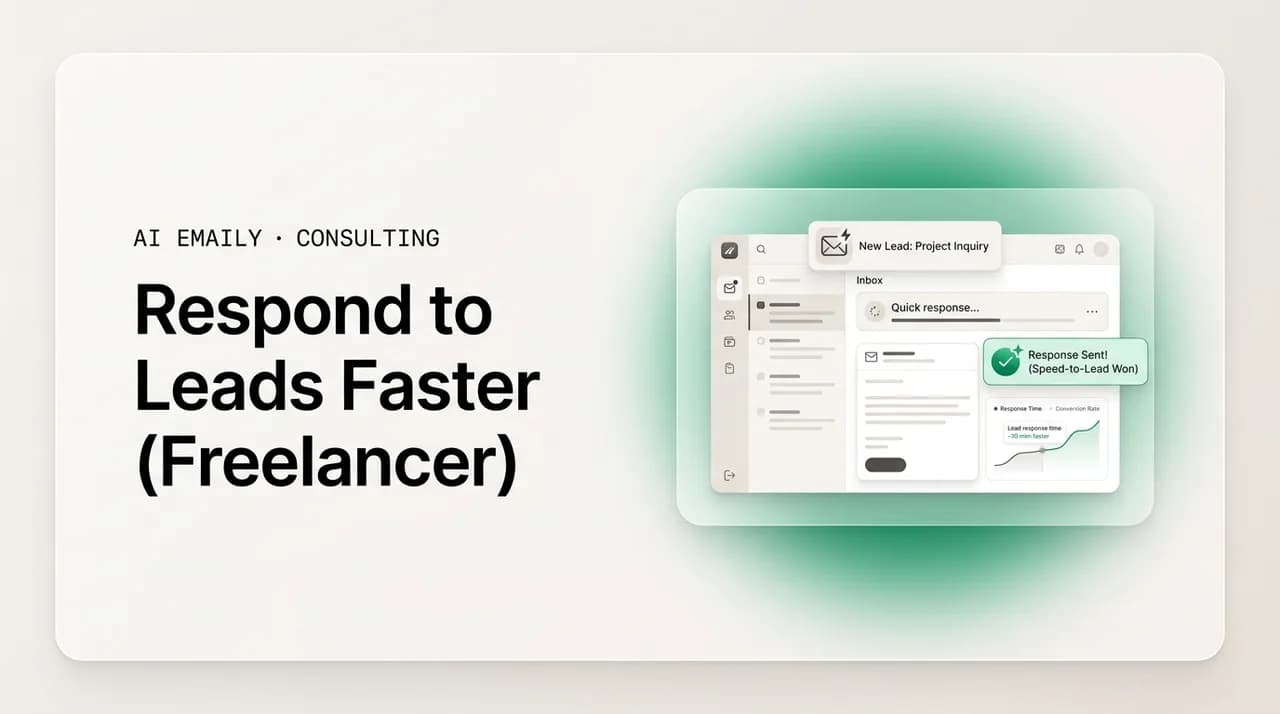
Freelance lead follow up is won on speed: roughly 35 to 50 percent of projects go to whoever responds first, yet the average business reply takes many hours or days. Solo operators are slow because every inquiry competes with billable work. The fix is a two-layer system, an instant acknowledgment that arrives in minutes and a considered personal reply that follows, so no lead goes cold while you deliver.
A practical guide to freelance lead follow up: why response speed wins projects, why solo operators are slow, and a fast-response system with instant-ack and reply templates that works even when you are heads-down on client work.
On this page
- 01Why does response speed decide which freelancer wins the project?
- 02What does the research actually say about lead response time?
- 03How fast is fast enough for a freelance lead?
- 04Why are solo operators so slow to respond, when they know speed matters?
- 05What does a fast-response system look like for a freelancer?
- 06Instant acknowledgment vs. personal reply: why you need both
- 07What should you actually say? Inquiry and discovery-call templates
- 08How do you protect deep work while still replying fast?
- 09How AI Emaily helps you respond to leads faster (honestly)
- 10Putting it all together
Why does response speed decide which freelancer wins the project?#
Here is the uncomfortable truth about winning work as an independent: most of the time, the best freelancer does not get the project. The fastest one does. When someone sends an inquiry, they are rarely emailing only you. They found three or four names through a referral, a directory, a search, or a Slack recommendation, and they fired off the same message to all of them within a few minutes of each other. From that moment, a quiet race is running that you cannot see. The person who replies first, with a clear next step, does not just get considered, they get to frame the entire evaluation. That is what freelance lead follow up is really about, and it is the single highest-leverage skill an independent operator can build.
The numbers behind this are stark and have held up for well over a decade. Research on B2B selling has repeatedly found that a large share of deals, on the order of 35 to 50 percent, goes to the vendor that responds first. It is not that the first responder is more qualified. It is that speed reads as competence, availability, and interest, and it gets you into the conversation while the buyer's intent is still hot. By the time the second freelancer replies a day later, the prospect has often already had a call, formed an impression, and started mentally narrowing the field.
For a freelancer or consultant, this dynamic is amplified by two things that do not apply to a big company with a sales team. First, you are the product. There is no SDR to catch the lead while you are busy, no shared inbox with someone always watching it. Second, your leads and your delivery work come from the same finite pool of hours, so the exact moments when leads arrive, mid-week, mid-project, mid-deadline, are the moments you are least able to stop and reply. The result is a gap between how fast you should respond and how fast you actually do, and that gap is where projects quietly leak to competitors.
It helps to picture what happens on the buyer's side. A marketing director needs a freelance designer for a rebrand. She asks two peers for names, gets four, and emails all four on a Tuesday afternoon between meetings. Three of them are heads-down on client work and do not surface until Thursday or the weekend. One of them, you, has a system that fires back a warm acknowledgment within ten minutes and offers two times for a short call. By Wednesday morning you are on that call. You are no longer one of four names on a list; you are the person she is talking to, the one who set the agenda, the default choice unless something goes wrong. The other three are now trying to unseat an incumbent they did not know they were competing with.
That is the whole game. Speed does not just improve your odds at the margin; it changes your position in the deal from applicant to frontrunner. And because so few independents do it well, being reliably fast is one of the most durable competitive advantages available to a solo operator, no better portfolio or lower price required.
Speed is a position, not just a metric
What does the research actually say about lead response time?#
It is worth being precise here, because the folklore around speed-to-lead is often vaguer than the evidence. A few findings come up again and again and are stable enough to plan around.
The classic study on online lead response, run across thousands of companies, found that the odds of qualifying a lead drop off a cliff with time. Firms that reached out within an hour were far more likely to have a meaningful conversation than those that waited even a few hours, and the average firm took vastly longer than an hour to make first contact. In other words, the behavior that wins is rare, which is exactly why it is an edge. The same body of research popularized the idea that the first five minutes matter disproportionately, and that after the first hour your chances of a productive connection fall sharply.
Layer on top of that the reality of how slow the typical business actually is. Studies of business email response times consistently show averages measured in many hours, and a meaningful share of inquiries that are never answered at all. When you hear that the average B2B lead response stretches into dozens of hours, that is not an argument that slow is fine, it is the size of the opening. Most of your competitors are slow. You do not have to be instant to win; you have to be reliably, noticeably faster than the field, and the field has set a low bar.
The other piece worth internalizing is that follow-up, not just first response, is where most freelancers lose. A single reply that goes unanswered is not a dead lead; it is a lead that needs a second and third touch. Most independents send one email and stop. The ones who quietly win send a short, polite follow-up a few days later and again after that, and a large fraction of positive responses come on those later touches rather than the first. Speed gets you into the race; persistence keeps you in it.
The bar is lower than you think
How fast is fast enough for a freelance lead?#
The honest answer is: faster than you are now, and the improvement from your current baseline matters more than hitting any magic number. That said, it helps to have targets, so here is a way to think about the tiers without pretending a solo operator can staff a five-minute desk.
There are really two clocks running, and confusing them is where a lot of advice goes wrong. The first clock is time-to-acknowledgment: how long until the prospect knows their message landed with a real person who is engaged and will respond properly. The second is time-to-substantive-reply: how long until you send the considered, personal answer, the one that proposes a call, asks the right qualifying questions, or sketches an approach. These do not have to be the same email, and for a busy freelancer they usually should not be.
The insight that makes speed survivable is that the acknowledgment clock is the one that matters most for winning position, and it is the easy one to win. A warm, specific acknowledgment within a few minutes buys you hours, sometimes a full day, on the substantive reply. The prospect who gets "Thanks, this sounds like exactly the kind of project I take on, I'll send some times for a quick call by end of day" is no longer shopping. They are waiting for you. You have converted a race into a scheduled conversation, and you did it in the thirty seconds it takes an acknowledgment to go out.
Here is a realistic tiering to aim for as a solo operator, framed as targets rather than rules. The point is not to obsess over the exact minutes; it is to notice that even the top tier is achievable without hovering over your inbox all day, because the fast part is the acknowledgment, not the essay.
| Time to first response | What it signals | Rough effect on win rate | Realistic for a solo operator? |
|---|---|---|---|
| Under 5 minutes | Elite. Prospect feels chosen; you frame the whole evaluation. | Best-in-class; you are almost always first in the door. | Only with an automated instant acknowledgment. |
| Under 1 hour | Strong. You beat the vast majority of competitors. | Large lift over the field; usually first or second in. | Yes, with a system; hard by hand mid-project. |
| 1 to 4 hours | Good. Still ahead of the average business. | Solid; you are in contention but may not lead. | Yes, if you check the inbox a few times a day. |
| 4 to 24 hours | Average. You look responsive but not eager. | Modest; a faster competitor often gets there first. | The default when you reply "when you get to it." |
| Over 24 hours | Slow. The prospect assumes you are unavailable or uninterested. | Poor; the deal is often decided before you reply. | The trap busy solo operators fall into constantly. |
Read that table with one thing in mind: the jump from the bottom rows to the top is not a jump in effort, it is a jump in system. Nobody sensible expects a solo consultant to hand-write a thoughtful proposal in five minutes while sitting in a client workshop. But an instant acknowledgment that goes out in five minutes and buys you a day to write the real reply is entirely achievable, and it moves you from the bottom of that table to the top without stealing time from delivery. That distinction, acknowledge instantly, reply well soon after, is the backbone of the system in the rest of this guide.
Why are solo operators so slow to respond, when they know speed matters?#
Almost every freelancer already knows, in the abstract, that fast replies win work. Very few respond fast. That gap is not laziness or ignorance; it is structural, and naming the real causes is the first step to fixing them. If you treat slowness as a willpower problem, you will keep failing at it. If you treat it as a system problem, you can engineer it away.
The root cause is simple and brutal: for a solo operator, every lead reply competes directly with billable delivery. When you are heads-down finishing a client's deliverable on a deadline, an incoming inquiry is not a welcome interruption, it is a tax on the work that is actually paying you this month. So you flag it, tell yourself you will reply properly this evening, and by evening you are drained, the moment has cooled, and the email has slid three screens down your inbox. The lead did not die because you did not care. It died because caring about it meant stealing focus from the paying work in front of you, and that trade felt wrong in the moment.
- Context-switching cost. Replying well means stopping deep work, loading the prospect's context, and writing something considered. Mid-project, that switch is expensive, so you defer it, and deferral is where leads go cold.
- The perfectionism trap. You feel a lead reply has to be polished and complete, a mini-proposal, so a two-minute acknowledgment never gets sent because you are waiting for the hour you will never quite find to write the perfect one.
- No inbox coverage. A company has someone always watching the inbox. You have you, and you are frequently in a meeting, on a call, or offline delivering. There is no safety net, so leads that arrive during focus time simply wait.
- Batching at the wrong cadence. Many freelancers process email once a day, which is great for focus and terrible for speed. A once-a-day inbox guarantees an average response time measured in many hours, right when speed is deciding the deal.
- Follow-up fatigue. Even when the first reply goes out, remembering to nudge a quiet prospect two, three, four times sits at the bottom of a mental list that is already full of client commitments, so warm leads fade after one touch.
- Feast-or-famine attention. In a busy delivery week, leads are least likely to get answered, which is precisely when a strong pipeline matters most for the quieter week coming. The times you most need to reply fast are the times you are least able to.
Notice that none of these are solved by trying harder. You cannot willpower your way out of a structural conflict between delivery and sales when you are the only person doing both. What you can do is change the structure: separate the fast, easy part of responding, the acknowledgment, from the slow, considered part, the real reply, and remove yourself as the bottleneck on the fast part. Once acknowledgment is handled without your attention, the pressure comes off. You no longer have to choose between the client work in front of you and the lead in your inbox, because the lead has already been greeted warmly and told when to expect you. The rest of this guide is about building exactly that.
The "I'll reply tonight" trap
What does a fast-response system look like for a freelancer?#
A system beats good intentions every time, because it works on your busy days, not just your calm ones. The goal is not to make you sit on your inbox; it is the opposite, to let you stay heads-down on client work while every lead still gets a fast, professional response. Here is the whole system as a set of steps you can set up once and run for years. It has two layers, an instant acknowledgment that requires none of your attention, and a considered personal reply you send on your own schedule, plus the follow-up and routing that keep leads from slipping.
- 1
Define what a lead looks like and where it lands
First, get every inquiry into one predictable place. Point your contact form, your directory profiles, your referral intros, and your booking links at a single inbox or a single address you actually watch. Decide, plainly, what counts as a lead worth a fast response: a project inquiry, a referral intro, a "do you have availability" note. The clearer the definition, the easier it is to trigger the right instant reply automatically instead of hand-judging each message mid-project.
- 2
Send an instant acknowledgment within minutes, automatically
This is the load-bearing step. The moment a qualifying inquiry arrives, a warm, specific acknowledgment should go out without you touching it, confirming you received it, signaling genuine interest, and stating when the real reply will come. This is not an out-of-office autoresponder that reads like a machine; it is a short, human note that wins you position and buys you time. Two or three sentences is plenty. It should never feel like a form letter.
- 3
Offer a next step in that first touch
The best acknowledgments do not just say "got it," they propose the path forward: a link to book a short discovery call, or an offer to send times. A prospect who books a call in the acknowledgment has effectively chosen you before your competitors have even replied. Make the next step one click, not a negotiation, and you convert a race into a scheduled conversation on your terms.
- 4
Batch your considered replies at a fast-enough cadence
Now that acknowledgment is handled, you can protect deep work. Check leads two or three times a day, not fifteen, at natural breaks, and write the substantive reply then, the one that qualifies the project, answers questions, and confirms the call. Because the prospect already got a warm acknowledgment, a considered reply a few hours later feels attentive, not slow. You get speed and focus at the same time.
- 5
Build a small library of reusable replies
You answer the same first inquiries over and over: availability, scope, rate range, how you work, next steps. Write your best version of each once, as a starting template you personalize in thirty seconds rather than composing from scratch each time. This is what makes the considered reply fast enough to keep up without sounding canned, because you edit rather than write.
- 6
Sequence your follow-ups so no warm lead fades
A large share of positive replies come on the second, third, or fourth touch, not the first, yet most freelancers stop after one. Set up a light follow-up rhythm, a short nudge a few days after the first reply, another a week later, then a final check-in, so a busy or distracted prospect gets gently re-engaged instead of forgotten. This is the step that quietly doubles pipeline for most solo operators.
- 7
Route, do not blast: keep judgment where it belongs
Automate the parts that are safely repeatable, acknowledgment, scheduling, gentle follow-up, and keep the parts that need you, the actual scope conversation, the pricing, the creative or strategic judgment, firmly human. The system exists to make sure a person always shows up fast; it does not replace the person for the parts of the relationship that win the work.
- 8
Review the funnel and tighten the weak link
Once a month, glance at how many inquiries turned into calls and how many calls turned into projects. If lots of inquiries never become calls, your acknowledgment or scheduling step is weak. If calls do not convert, the problem is downstream of speed. Fix the actual leak instead of assuming faster replies alone will solve everything, because speed opens the door but does not close the deal.
The beauty of this structure is that the hard, judgment-heavy parts stay with you, while the parts that were killing your response time, the acknowledgment and the follow-up nudges, stop depending on you finding a free moment. You become reliably fast not by working harder on your inbox, but by removing yourself as the bottleneck on the two steps where being human adds the least and being instant adds the most.
Instant acknowledgment vs. personal reply: why you need both#
This is the distinction that makes fast response survivable for a solo operator, so it is worth slowing down on. Most advice treats "respond fast" as a single act, which is why it feels impossible: you cannot write a thoughtful, tailored reply in five minutes while you are in the middle of a client's work. But responding fast is really two separate jobs with two different speeds, and once you split them, the impossible becomes routine.
The instant acknowledgment is a fast, low-content, high-warmth touch whose entire job is to win position and set expectations. It does not need to qualify the project or answer hard questions. It needs to confirm receipt, convey genuine interest, and promise a real reply by a specific time. Because its content is nearly the same for every inquiry, it can and should be automated, and because it goes out in minutes, it does the heavy lifting on the response-speed clock that decides your position in the deal.
The personal reply is the opposite: slower, content-rich, and unmistakably human. This is where you engage with the specifics, ask the qualifying questions, sketch how you would approach the work, confirm the call, and let your judgment and voice come through. It is the email that actually wins the project on merit. It does not need to be instant, because the acknowledgment already secured your position and bought you time; it needs to be good, and it needs to arrive when you said it would.
Confusing these two is the core mistake. Freelancers who try to make every fast reply a personal reply end up sending neither fast, because the personal one is too heavy to fire off in minutes. Freelancers who try to make the personal reply do the acknowledgment's job, by rushing a shallow, generic response out the door, look careless and lose on merit. Keep them separate: acknowledge instantly and automatically, reply personally and well on your own cadence. Here is what each layer looks like in practice.
Notice how much that acknowledgment accomplishes in three short sentences it took no live effort to send. It confirms receipt, signals real enthusiasm for this specific project, sets a clear expectation for the real reply, and offers a one-click path to a call. The prospect who reads it is no longer shopping four names; they are waiting for you, or already on your calendar. Now the personal reply can take its time and land well.
The acknowledgment buys the reply time
What should you actually say? Inquiry and discovery-call templates#
Templates are not about sounding scripted; they are about never starting from a blank page when a lead lands mid-project. You write your best version once, then personalize it in seconds. The goal is a reply that reads as if you wrote it fresh, because you did tailor the specifics, you just did not reinvent the structure each time. Here are the ones a freelancer or consultant reaches for most, covering the moments where speed matters most.
Start with the instant acknowledgment for a cold or referral inquiry, the highest-leverage message you will send. Keep it short, warm, specific, and forward-moving.
For a warm referral, a small tweak acknowledges the mutual connection, which raises trust immediately and makes the prospect feel personally handled rather than processed.
Next, the discovery-call scheduling reply, sent as the considered follow-up. Its job is to qualify lightly, set context for how you work, and make booking frictionless. Offering two concrete times plus a link converts far better than "let me know what works," which puts the scheduling work back on the prospect.
You also need a graceful availability reply for when you are booked but want to keep a good lead warm rather than turning it away flat. Losing a lead because you were full this month is a shame when a future slot or a light waitlist could have kept the door open.
Finally, the follow-up sequence, the part most freelancers skip and the part that recovers the most pipeline. Keep each touch short, friendly, and easy to reply to, and always add a small piece of value or a clear question rather than just "checking in."
Follow-up is not pestering
How do you protect deep work while still replying fast?#
This is the objection every serious freelancer raises, and it is the right one: if I am constantly watching my inbox to reply fast, my client work suffers, and my client work is what pays me and earns the referrals that generate more leads. It is a real tension, and the wrong resolution, hovering over your inbox all day, would trade your most valuable asset, focused delivery, for a bit of response speed. The good news is that the two-layer system exists precisely to dissolve this tension rather than force a choice.
The key move is that fast response and deep focus only conflict if you personally handle the fast part. The instant acknowledgment, by design, requires none of your attention, so it happens whether you are in a workshop, on a call, or deep in a design file. That means the response-speed clock, the one that decides your position in the deal, is already being won while you never look up from your work. What is left for you, the considered reply, is exactly the kind of task that batches well and does not need to be instant. You have decoupled the thing that must be fast from the thing that must be you.
Here is how to run it without letting your inbox erode your focus.
- Let acknowledgment run untouched. The instant reply should require zero live action. If replying fast depends on you seeing the email, you will fail on exactly your busiest days. Set it up so a warm greeting goes out whether or not you are looking.
- Batch considered replies at two or three fixed points a day. A natural break between deep-work blocks, mid-morning, after lunch, end of day, is enough to keep your substantive replies feeling attentive, because the acknowledgment already covered the speed.
- Turn off inbox notifications during deep work. You do not need a ping for every email when acknowledgment is automated. Notifications fragment focus for no speed benefit, because the fast response already went out without you.
- Use a clear signal for what is actually a hot lead. Filter or label qualifying inquiries so that when you do check, you go straight to the leads that matter instead of triaging a full inbox. Keep the review short and targeted.
- Protect one deep block per day as sacred. Even the fastest responder should have a stretch, ideally your peak-focus hours, where the inbox is fully closed. Acknowledgment covers you; the personal reply can wait an hour or two without cost.
- Schedule follow-ups instead of remembering them. Do not hold your follow-up cadence in your head, where it competes with client work and loses. Queue the nudges so they fire on their own and re-engage quiet leads without any ongoing attention from you.
The mindset shift underneath all of this is that being fast is not the same as being always-on. An always-on freelancer answering every email the instant it lands is not impressive; they are unfocused, and their delivery quality, the thing referrals are built on, will suffer for it. A fast freelancer, by contrast, has a system where the speed-critical touch is automatic and the judgment-critical touch is batched and protected. They look more responsive to prospects and more focused to clients at the same time, which is the whole point. You are not choosing between winning leads and doing great work; you are building the structure that lets you do both.
Responsiveness is a system, not a personality trait
How AI Emaily helps you respond to leads faster (honestly)#
Everything above is a system you can build by hand with your existing email, a booking link, some saved templates, and the discipline to check leads a few times a day. Plenty of freelancers run exactly that and win. The reason a tool helps is narrow and specific: the two hardest parts to sustain by hand are the instant acknowledgment that has to fire whether or not you see the email, and the follow-up cadence that has to run for weeks without you remembering it. Those are the parts that quietly break down in a busy delivery week, which is precisely when you most need them working. That is the gap AI Emaily is built to close, and it is worth being straight about what it does and does not do.
AI Emaily is an AI-native email client that connects to Gmail, Outlook, iCloud, Fastmail, Proton, and any IMAP account, so it works with whatever inbox you already use, no migration. Because it learns how you actually write, the drafts it produces come back in your voice, not in generic boilerplate, which is what makes an automated acknowledgment read like a real note from you rather than an autoresponder. It can recognize an inbound inquiry, draft a warm acknowledgment with your booking link, and keep a polite follow-up sequence running so a quiet lead gets gently nudged instead of forgotten, the two exact tasks that are hardest to keep alive by hand.
Crucially, it is designed around the same split this whole guide argues for: fast, low-judgment touches should be automatic, and high-judgment work should stay human. AI Emaily runs in Manual, Copilot, and Autopilot modes, so you decide where the line sits. The high-ROI, repeatable categories for a freelancer, instant inquiry acknowledgment, discovery-call scheduling, and proposal or lead follow-ups, are exactly the ones that suit automation, while the strategy, scoping, pricing, and creative conversations stay with you where your judgment is the product. You can have it draft everything and approve each send yourself in Copilot, or let it autosend the routine acknowledgments and follow-ups in Autopilot once you trust it, always with undo and a full audit trail of every action it took on your behalf.
What it does not do, and should not, is replace you in the parts of the relationship that actually win the work. It will not invent scope, negotiate a rate, or make the creative and strategic calls that are the reason a client hires you specifically. It makes sure a fast, professional, on-brand touch always goes out, so no lead goes cold while you are heads-down on delivery, and then it gets out of the way so you can do the considered reply and the real work. That is the honest pitch: it wins you the position instantly and keeps the follow-up alive, so you can win the project on merit. You can try it free at app.aiemaily.com/signup, with a Free plan at no cost and Pro at $12.42 per month on the annual plan.
Putting it all together#
Freelance lead follow up is not a mysterious skill; it is a system with two moving parts. Roughly a third to half of projects go to whoever responds first, most of your competitors are slow or silent, and the prospect who reaches out to you is almost always reaching out to others at the same moment. That combination means the first, fast, clear response is the highest-leverage email in the entire deal, because it moves you from one name on a list to the frontrunner everyone else has to displace.
The reason solo operators struggle with this is structural, not personal: every lead reply competes with billable delivery, and the busiest weeks, when speed matters most, are when you can least afford to stop and write a considered reply. The fix is to stop treating fast response as one act and split it in two. An instant, automated acknowledgment wins your position and buys you time, requiring none of your attention on your busiest day. A considered, personal reply, batched at a fast-enough cadence and drawn from a small library of templates, wins the project on merit when you actually have the focus for it. Add a light follow-up sequence so no warm lead fades, and route the judgment-heavy conversations to yourself where they belong.
Build that system, by hand or with a tool that keeps the acknowledgment and follow-up alive for you, and you get the rare thing: you look more responsive to every prospect and stay more focused on every client at the same time. No lead goes cold while you deliver, and the work that earns your next referral never suffers for the sake of the last one. That is what winning on speed actually looks like for a freelancer, and it is entirely within reach.
Frequently asked
See it in AI Emaily
Keep reading
Sources

Written by
Nafiul HasanNafiul Hasan is an entrepreneur and AI automation system builder with 10+ years of experience turning messy, manual workflows into reliable automated systems. He designs and ships AI enterprise solutions end-to-end — the agent logic, the data plumbing, and the product people actually use — and founded AI Emaily to give busy professionals their attention back. He writes here from the builder's seat: what works, what breaks, and how to put AI to work without giving up control.