Best Email Client for DevOps Engineers (2026): 6 Compared


The short answer
For a DevOps engineer whose inbox is alert firehose plus vendor renewals plus incident comms, AI Emaily is the strongest all-round pick — one inbox across Gmail, Outlook, and IMAP with an AI classifier that separates monitoring email from real mail. Fastmail wins on deterministic server-side Sieve rules; Front is the fair pick for a shared on-call inbox.
Best email client for DevOps engineers in 2026: six picks compared on alert-versus-human separation, on-call mobile triage, and server-side filtering.
On this page
- 01The short answer: best email client for each DevOps situation
- 02What is the job an email client for DevOps engineers has to do?
- 03How we compared these clients
- 04Six DevOps email clients at a glance
- 051. AI Emaily — best overall for DevOps engineers on any provider
- 062. Superhuman Mail — fastest keyboard triage during a paging storm
- 073. Shortwave — best AI client for a Google Workspace SRE team
- 084. Fastmail — best for filtering alert email at the server, before it hits any device
- 095. Front — best for a team on-call inbox with rotation and assignment
- 106. Thunderbird — best open-source client for Linux and cross-platform DevOps workstations
- 11How to choose for your situation
- 12The verdict
A DevOps or SRE inbox is not a normal inbox. It is monitoring alerts from Datadog and Grafana, PagerDuty escalations, CI/CD failures, cloud billing anomalies, security vulnerability disclosures, vendor renewal notices, incident post-mortems, and the occasional human email from an engineer, a customer, or your finance team that actually needs a reply. The problem is not writing responses. The problem is being on call at 2am on a phone and finding the one alert that means production is down inside a stream of nine hundred that mean nothing.
This guide ranks six email clients and one adjacent shared-inbox platform on that specific job: separating alert noise from real mail, surviving on-call mobile triage, and letting a team hand off incident comms without dropping the thread. We compare AI-native clients, a strong server-side filtering host, and one shared inbox platform, because the honest answer for a lot of DevOps teams is a combination rather than a single tool.
One disclosure up front: we build AI Emaily, and it is the top pick here. That colours the ranking, which is why every entry states its limits, and why we concede one dimension outright by name — on deterministic server-side rules that fire before mail hits any device, Fastmail's Sieve engine beats what we ship, and it always will while our filter runs client-side.
The short answer: best email client for each DevOps situation#
Find your line first, then read only those entries in detail.
- Best overall for a DevOps engineer who wants alert-versus-human separation across Gmail, Outlook, and IMAP: AI Emaily — an AI classifier that recognises PagerDuty, Datadog, and monitoring email as distinct categories from real mail.
- Best for the fastest possible manual triage of a Gmail or Outlook inbox during a paging storm: Superhuman Mail — every action one keystroke, no chording, no menu diving on a laptop at 3am.
- Best AI-native client if your team lives entirely in Google Workspace and searches post-mortem threads constantly: Shortwave — semantic search over the Gmail archive built by ex-Google engineers.
- Best for aggressive server-side filtering of alert email that runs before it hits any device: Fastmail — Sieve rules and per-service aliases on your own domain, the strongest deterministic rule engine here.
- Best for a team that shares an on-call inbox with rotation, assignment, and SLA tracking: Front — shared-inbox platform, not a mail client, and we say what that means for a solo SRE below.
- Best cross-platform open-source client for engineers who need Linux support and a durable client they can keep for a decade: Thunderbird — free, extensible, and the honest pick where AI Emaily has no build.
What is the job an email client for DevOps engineers has to do?#
Four jobs, in this order. First, separate machine alert email from real human mail on arrival — the failure mode is not writing a slow reply, it is missing a paging email from a customer because it was buried under a hundred Datadog notifications from the same monitor flapping. Second, survive on-call mobile triage — a phone at 2am is the working environment, and any client that requires a mouse, a settings menu, or a laptop to acknowledge or file an alert is the wrong tool for that shift. Third, keep vendor renewal and incident-comms email retrievable, because the AWS reserved-instance email from six months ago and the post-mortem thread from the last outage both need to be findable in the moment a director asks. Fourth, let the team share an on-call inbox without dropping the thread on rotation change.
The IETF's RFC 5322 Internet Message Format means every alert carries headers a rule engine can match — PagerDuty ships `X-PagerDuty-*` headers, Datadog ships `X-Datadog-*`, GitHub uses `List-ID`, AWS billing has a consistent sender address, and Google Workspace admin notifications ship `X-Google-*` for policy actions. What varies is which clients let you write rules against those headers, whether the rules run server-side or client-side, and how quickly you can move a rule from idea to running when a new alert source appears.
Narrow at the source before switching clients
How we compared these clients#
This is a capability comparison built from vendor documentation and public product pages, verified in August 2026. We did not run six clients on a live SRE workload for a month, and any roundup claiming that should be read with that in mind. What we can compare honestly is what each product says it does, what its architecture makes possible, and where a hard ceiling exists that is not a matter of taste.
No competitor prices appear in this guide on purpose. Grammarly restructured Superhuman's tiers after the July 2025 acquisition and the October 2025 rename of the parent to Superhuman. Shortwave's packaging has narrowed in the past year. Front's AI Copilot moved between add-on and included on different tiers. Any figure printed here would be stale before you finished reading. Describe the packaging shape; check the current number on the vendor's own page at the time you evaluate.
- Provider coverage — Gmail only, Gmail plus Outlook plus IMAP, or a hosted mail platform with its own web client.
- Alert-versus-human classification — server-side Sieve, client-side rules, an AI classifier, or none.
- Mobile on-call triage — real native iOS and Android apps, PWA, or web only, and what one-tap actions ship.
- Shared inbox and rotation — assignment, comments, SLA reminders for a team on-call channel.
- Where it runs — native macOS or Windows binary, cross-platform Electron, Linux, or web only.
- What leaves with you — rules, filters, and folder structure if you switch or the vendor closes.
Six DevOps email clients at a glance#
Use this table to identify two candidates, then read only those entries in detail.
| Client | Works with | Alert filtering | On-call mobile | Best DevOps fit |
|---|---|---|---|---|
| AI Emaily | Gmail, Outlook / Microsoft 365, IMAP | AI classifier + rules; Copilot needs approval, Autopilot is gated with audit | Native iOS app; Android is a PWA | Cross-provider inbox that separates monitoring email from real mail on arrival |
| Superhuman Mail | Gmail, Outlook | Splits + client-side filters; AI suggests, you execute | Native iOS and Android; single-key actions on mobile | Fast manual triage of a Gmail or Outlook inbox during a paging storm |
| Shortwave | Gmail / Google Workspace only | AI triage + labels; semantic search across the archive | Native iOS and Android | Gmail-only DevOps team that searches post-mortems constantly |
| Fastmail | Fastmail (own hosting) + IMAP fetch | Server-side Sieve rules — the strongest deterministic engine here | Native iOS and Android; simple push | Aggressive server-side filtering of alert email that fires before any device |
| Front | Gmail, Outlook, IMAP as connected channels | Rules, macros, and paid AI Copilot add-on on lower tiers | Native iOS and Android with assignment | Team on-call inbox with rotation, assignment, and SLA — not a personal client |
| Thunderbird | Gmail, Outlook, IMAP, POP | Message filters, add-ons; no AI classifier | Thunderbird for Android; no first-party iOS app | Cross-platform open-source client including Linux |
1. AI Emaily — best overall for DevOps engineers on any provider#
AI Emaily is an AI email client that connects Gmail, Outlook, Microsoft 365, and standard IMAP accounts into one inbox. We build it, which is why it appears first — and why its limits paragraph is the longest in this roundup.
For a DevOps engineer, the agent works in the window between when an alert arrives and when you look at it. PagerDuty escalations get one classification, Datadog and Grafana monitoring email another, cloud billing anomalies a third, security vulnerability disclosures a fourth, and mail from a human — a coworker, a customer, your finance team — gets flagged as the thing that actually needs you. Rules in the Rules Brain sit on top of the AI classifier — you can pin `List-ID` matches, custom `X-PagerDuty-*` header rules, per-service aliases, or a plain-English rule like 'anything from AWS Health about a production region, mark unread and keep in inbox' and the classifier respects it. Nothing sends until you approve it in Copilot mode. Autopilot is gated with an undo window and an audit log recording every action and the reason for it — useful when the agent has filed a monitoring thread you needed to see, because you can trace why and adjust once.
The limits, stated plainly. AI Emaily ships a downloadable macOS app (Apple Silicon only, Electron shell around the web codebase, not in the Mac App Store) and a Windows installer. iOS is a real native app, which matters for on-call mobile triage. Android is a PWA — installs to the home screen, works offline for reading and drafting, gets push, but is not a native Android app. There is no Linux build at all, which is a real gap for engineers who run their workstation on Ubuntu; Thunderbird is the honest pick there and we say so below. Voice matching is not learned from your past mail — it is a Personal Context brain plus per-contact profiles you write and control, which some engineers prefer for auditability and others find heavier to set up than a black-box learner. Packaging is a 7-day free trial on Pro (card required, no charge if you cancel before day 7), then paid — check current plans on our pricing page. We build AI Emaily.
2. Superhuman Mail — fastest keyboard triage during a paging storm#
First, the naming, because half the reviews online are wrong. Grammarly acquired Superhuman, the email client, in July 2025, then renamed the parent company to Superhuman in October 2025. Today, Superhuman Mail refers to the client; the Superhuman Suite refers to the wider bundle. Any article treating Superhuman as an independent startup is describing a structure that no longer exists.
The client itself is built for volume processed by hand at speed. Every action is one keystroke — no cmd, no shift, no chording — and the mobile apps carry the same discipline over to iOS and Android. For an SRE working through a wall of Datadog alerts and forty human threads before standup on the morning after an incident, Superhuman Mail is faster than we are at pure manual triage. It works with Gmail and Outlook.
What it does not do is act on threads while you are heads-down in an incident. The AI drafts and suggests; you execute every action yourself. If you want an agent to draft the customer status-update follow-ups while you are on the incident bridge, that is a different architecture. Packaging is trial-then-paid, and after the acquisition AI features moved into higher tiers — verify that the tier you are evaluating contains the features you intend to use, because comparing the wrong tier is the most common mistake made in this category.
3. Shortwave — best AI client for a Google Workspace SRE team#
Shortwave is an AI-native Gmail client built by former Google engineers. Its standout capability for DevOps is semantic search: you can ask the archive a plain-language question — 'what did the platform team decide about the RDS failover retry policy after the March outage' — and retrieve the relevant thread. That is more powerful than Gmail keyword search when you know the topic but not the words that were used, which is exactly the position you are in during a post-incident review.
Two limits matter. First, Shortwave works with Gmail and Google Workspace only. If any of your team's monitoring email or vendor mail lands in an Outlook or Fastmail box you want in the same inbox, Shortwave is out of scope. Second, as of 2026 the packaging has narrowed and the founding team's public focus has shifted toward a separate agent product. That is a signal, not a confirmed shutdown, and we are not predicting one — but an SRE team picking a client to live in for years is entitled to weigh signals before committing. Check current plans on Shortwave's own pricing page.
On the Gmail-archive-search dimension, Shortwave has built harder than we have. If your primary job is retrieving old post-mortems and design decisions from a large Gmail archive and you have no non-Gmail accounts, that is the honest recommendation.
4. Fastmail — best for filtering alert email at the server, before it hits any device#
Fastmail is a paid email hosting service with a client, and for DevOps engineers the point is the server-side rule engine. Fastmail uses Sieve — a standard email filtering language — and every rule runs on their servers before mail reaches any device. That means a rule that files `[PagerDuty] Resolved` into a folder runs whether you are on the web client, on iPhone, on Android, or in a terminal client fetching over IMAP. Your phone never buzzes for a resolved page you do not need to know about.
For DevOps engineers who want to shred alert email, a server-side rule engine is architecturally the right answer. An AI classifier is a guess a system makes about a category; a Sieve rule matching `X-PagerDuty-Incident-Id` is not. Fastmail also offers per-address aliases on your own domain, which SREs use to route different alert sources to different addresses — `datadog@yourdomain`, `pagerduty@yourdomain`, `aws-billing@yourdomain` — and it supports IMAP, JMAP, and standard OAuth for external clients, so you can pair Fastmail-the-hosting with AI Emaily-the-client as an IMAP account and get both the server-side rule engine and the AI classifier on top.
The concession we owe up front: on deterministic server-side rules that fire before mail hits any device, Fastmail beats what we ship, and it always will while our filter runs client-side. What Fastmail does not sell is AI drafting or an autonomous agent — no reply written for you, no follow-up chased. Packaging is per-user, monthly or annual, no permanent free tier, with a trial. Check current plans on Fastmail's site.
5. Front — best for a team on-call inbox with rotation and assignment#
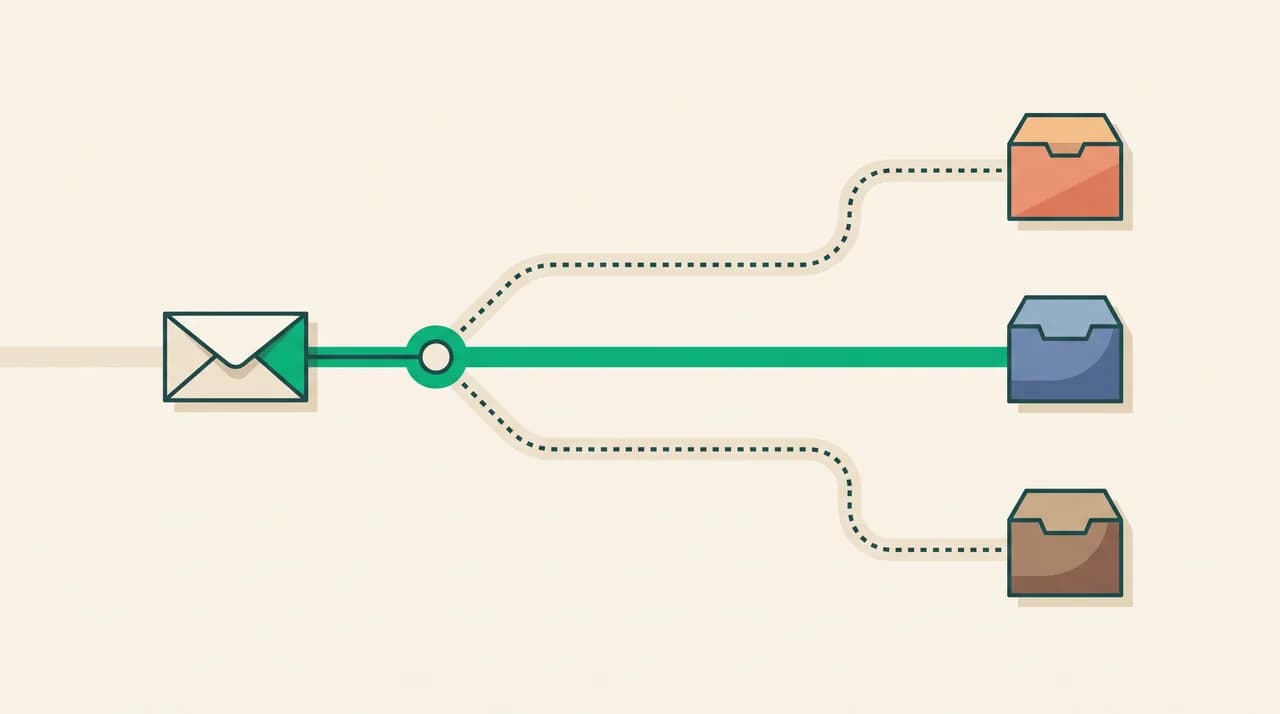
Front is a shared-inbox platform, not a personal email client, and for a DevOps team that runs an on-call rotation through a shared address — `sre@yourdomain`, `incident@yourdomain`, `oncall@yourdomain` — the point is that Front lets multiple engineers see the same inbox, assign threads to whoever is on shift, comment internally on a thread before replying, and hand off cleanly on rotation change. Verified on Front's public pricing page as of July 2026: three tiers — Starter, Professional, Enterprise — with Starter capped at one channel type and ten seats, Professional omnichannel with more automation rules and up to fifty seats, and Enterprise uncapped. AI Copilot, QA, and CSAT are paid add-ons on the lower tiers and included on Enterprise.
This is the honest scoping for Front: if you are a solo SRE looking for a personal email client to triage your own inbox, Front is the wrong tool and it will feel like a support system trying to be an email client. If you are a team of four or more engineers who share an on-call address and need rotation, assignment, and SLA reminders, Front is what a mail client cannot be. That is a real distinction most DevOps roundups blur.
Where AI Emaily fits alongside Front: personal inbox triage for each engineer's own mail, the shared on-call address handled in Front. That is the pattern most teams we see actually run, and neither product replaces the other. Packaging is per-seat, contracted; annual billing runs meaningfully below monthly. There is no Front 'Growth' tier despite what some older roundups still say — the tiers are Starter, Professional, and Enterprise. Check the current shape on front.com.
6. Thunderbird — best open-source client for Linux and cross-platform DevOps workstations#
Thunderbird is the veteran open-source cross-platform email client, developed by MZLA Technologies with backing from Mozilla. It runs on macOS, Windows, and Linux — which matters, because half the clients in this list have no Linux build at all — supports IMAP, POP, Gmail via OAuth, and Microsoft 365 with the Owl or built-in Exchange work in progress, and has an add-on ecosystem for calendar, PGP, and specialised rule engines. It is free.
For a DevOps engineer, Thunderbird's message filter engine can sort alert email by `List-ID` header, split PagerDuty escalations from resolutions, and quiet the Datadog folder to unread-count only. The last two years brought a meaningful redesign, better cross-platform performance, and the Thunderbird for Android app on top of Thunderbird desktop — so an SRE running Ubuntu on the workstation and Android on the phone gets a coherent client across both. There is no first-party iOS app.
Where it does not compete: there is no AI classifier, no agent, and search over a large archive is slower and less semantic than Shortwave or AI Emaily. If you want an inbox that recognises 'this is a new alert source I have not seen before, and here is what it looks like' without a hand-written filter, that is not Thunderbird's job. If you are on Linux, want an open-source client you can keep for a decade, and can hand-write filters against alert headers, Thunderbird is the right pick and we ship a dedicated comparison against it.
How to choose for your situation#
Match your situation first, then evaluate two tools at most. Evaluating six clients in parallel is how a decision gets pushed to the end of a sprint and never made.
| If this is you | First pick | Second look |
|---|---|---|
| You have Gmail, Outlook, and IMAP mail from monitoring vendors in one personal inbox | AI Emaily | Fastmail if you want server-side Sieve rules on top |
| You are Gmail-only and want the fastest possible manual triage during a paging storm | Superhuman Mail | AI Emaily in Copilot mode for drafted incident status updates too |
| You are on Google Workspace and search post-mortems constantly | Shortwave | AI Emaily if you want the same across Outlook and IMAP too |
| You want alert email filtered at the server, before it hits your phone at 2am | Fastmail | Any IMAP client on top — AI Emaily, Thunderbird, or a terminal client |
| Your team of four or more engineers shares an on-call address with rotation | Front for the shared inbox | AI Emaily for each engineer's personal inbox alongside it |
| You run Linux as your workstation and want an open-source client | Thunderbird | Fastmail's web client if you can move to hosted mail as well |
| You want an agent that drafts customer status updates while you are on the incident bridge | AI Emaily in Copilot mode | Nothing else in this list does this — that is why it is the pick |
The verdict#
AI Emaily is our pick for most DevOps and SRE engineers, and the reason is specific enough to check: it is the only entry here that connects Gmail, Outlook, and IMAP in one inbox while combining an AI classifier that recognises PagerDuty, Datadog, AWS Health, and monitoring email as distinct categories with rules that respect header matches, and it keeps approval, undo, and an audit log between the agent and your recipients. That combination is what an engineer with mail across a company Google Workspace, a client's Microsoft 365, and a personal Fastmail box actually needs when they are on call.
The verdict is scoped honestly. We are not the fastest keyboard client — Superhuman Mail is on Gmail and Outlook, and it beats us on chord-free single-key actions during a manual triage sprint. We are not the strongest Gmail archive search — Shortwave is, for a Google Workspace-only team. We are not a hosted mail platform with a server-side Sieve engine — Fastmail is, and on deterministic pre-device filtering that beats what we ship. We are not a shared-inbox platform with rotation, assignment, and SLA — Front is, and for a team on-call address it is the honest recommendation. We have no Linux build; if you are on Ubuntu, Thunderbird is the fair pick and we ship a dedicated comparison against it because we owe that reader a real answer.
If your situation is a single provider and a keyboard-first workflow, one of the specialists above is the better fit. If your situation is cross-provider mail with monitoring email swamping human mail and you want the machine half classified and the human half drafted for your approval — including customer status updates during an incident — AI Emaily is what we built for that job. Start a 7-day trial on our pricing page — card required, no charge if you cancel — and connect a real account before deciding.
Frequently asked
See it in AI Emaily
Keep reading

Written by
Nafiul HasanNafiul Hasan is an entrepreneur and AI automation system builder with 10+ years of experience turning messy, manual workflows into reliable automated systems. He designs and ships AI enterprise solutions end-to-end — the agent logic, the data plumbing, and the product people actually use — and founded AI Emaily to give busy professionals their attention back. He writes here from the builder's seat: what works, what breaks, and how to put AI to work without giving up control.