Best Tools to Cover Your Inbox While on Vacation (2026)


The short answer
An out-of-office reply is a notice, not coverage. Real coverage combines three moves: delegate the inbox to a named colleague, route by topic with server-side rules, and let an AI agent triage and draft while you are away for review on return. AI Emaily, Cora, Fyxer, Serif, Shortwave, native Gmail and Outlook delegation, and the plain vacation responder each solve one slice.
Best tools to cover your inbox while on vacation, compared on delegation, topic-based routing, and agents that triage and draft while you are away.
On this page
- 01The short answer: best tools to cover your inbox on vacation
- 02How we compared these tools
- 03Coverage tools for vacation, compared
- 04The axis that decides this purchase
- 051. AI Emaily — best overall coverage for a client-facing inbox
- 062. Cora — best re-entry brief, and the sharper answer for a certain reader
- 073. Fyxer — best for people who cannot switch client
- 084. Serif — best for graduated autonomy over successive trips
- 095. Shortwave — best backlog search on return
- 106. Google and Microsoft native delegation — best true handoff
- 117. Outlook Automatic Replies with Inbox rules, or Gmail filters — best server-side routing
- 128. The plain vacation responder — the honest floor
- 13How to choose for your situation
- 14The verdict
The question buyers actually ask on this page is not which vacation responder is the best. It is who covers my email while I am away, and what does the backlog look like on the Monday I come back. An out-of-office reply is a courtesy notice for the sender. It is not coverage of anything.
The tools below split into three shapes, and most confusion in this category is that people compare across shapes without noticing. Delegation hands the keys to a named human. Routing rules reassign mail by topic to a colleague or a shared queue. Agents triage and draft in your name while you are away, and hold the drafts for review when you land. Real coverage is usually a combination of two of the three, chosen by how much authority you can give away and how much of the backlog you are willing to read.
Disclosure up front: we build AI Emaily, it is entry one below, and we say plainly where the honest first move is native delegation rather than us.
The short answer: best tools to cover your inbox on vacation#
Ranked for the reader who wants their inbox to be manageable on the day they return, not just quiet while they are away. Each pick names the shape it belongs to so you can tell whether it competes with the others or complements them.
- Best overall coverage for a client-facing inbox: AI Emaily — Copilot drafts everything that needs a reply while you are away, holds the queue with a reason on each row, and Autopilot can send routine confirmations to allow-listed senders behind a cancellable countdown.
- Best re-entry brief: Cora — twice a day it summarises everything you did not need to answer and leaves drafts in your Gmail drafts folder for the ones you do. Your Monday is a brief, not an inbox.
- Best overlay for people who cannot switch client: Fyxer — categorises the inbox and drafts replies inside the Gmail or Outlook you already use, so the coverage runs behind whatever your assistant or colleague already sees.
- Best for graduated autonomy over successive trips: Serif — draft-only on the first vacation, opt-in autonomy per scenario on the next, so the tool's remit grows only where you have watched it work.
- Best backlog search on return: Shortwave — Gmail-native, strong semantic search and pinned tabs, so a query like anything I promised before I left surfaces the actual threads rather than keyword matches.
- Best true handoff: Google Workspace and Microsoft 365 native delegation — grants another person the ability to read, send and delete as you, for the shape of coverage no agent replaces.
- Best server-side routing: Outlook Automatic Replies with Inbox rules, or Gmail filters that forward — auto-reassigns by topic to a shared mailbox or a named colleague, running on the server whether or not any client is open.
- The honest floor: the plain vacation responder in Gmail or Outlook — no coverage of anything, but a fair notice that buys you the week. If your inbox tolerates that, buy nothing.
How we compared these tools#
The comparison is built from vendor documentation and public product pages checked in August 2026, plus the native features documented by Google and Microsoft. We did not run every tool through a live two-week absence. Where a vendor documents nothing on a dimension, the cell says not documented, and that should be read as unknown, not as absence.
No prices or ratings — several products in this category repackaged in the last year, and any number printed here would be wrong on the day you read it. Check the vendor page for the current figure.
- Shape — is the tool delegation, server-side routing, or an agent that drafts while you are away.
- What happens during the trip — does something act on your behalf, does it merely notify, or does it hold everything for later.
- What the backlog looks like on Monday — one triaged queue, a digest brief, a normal inbox, or somebody else's problem.
- Cross-provider — does it cover Gmail and Outlook and old IMAP addresses under one login, or one provider only.
- Approval and audit — is any sent action logged with the reason it was written, and can you require approval for some senders and not others.
- Set-up cost — can you turn this on before Friday afternoon, or does it need training a colleague, writing filters and briefing an assistant.
Coverage tools for vacation, compared#
AI Emaily leads the table because it is our product and our pick. Each row after names where another option is the sharper answer for a specific kind of reader.
| Tool | Shape | Acts while you are away | What Monday looks like | Providers | Approval and audit |
|---|---|---|---|---|---|
| AI Emaily | Agent triage plus optional autonomy | Copilot drafts every reply; Autopilot sends routine confirmations to allow-listed senders behind a countdown | Agent drafts queue with a reason on each row; audit log of anything Autopilot did | Gmail, Microsoft 365, Outlook, standard IMAP under one login | Copilot is the default; append-only audit log names actor and reason |
| Cora | Agent with a Brief | Drafts replies into your Gmail drafts folder; never sends | Twice-daily Brief summarises everything you did not need to answer; drafts wait in Gmail | Gmail and Google Workspace | No autonomous send; your sent folder is the record |
| Fyxer | Overlay on your existing client | Categorises the inbox and drafts replies for review | Drafts inside your normal Gmail or Outlook drafts folder | Gmail, Outlook | Review-and-send by construction; no purpose-built audit surface documented |
| Serif | Agent with opt-in autonomy | Draft-only by default; autonomy per scenario if you opted in | Drafts to review, or a scenario-specific action log if opted in | Google Workspace, Microsoft 365 | Autonomy is scenario-scoped opt-in; queue and log not documented publicly |
| Shortwave | Gmail-native client | Recommends actions; drafts through triggers you define | Split-inbox tabs plus semantic search over the backlog | Gmail, Google Workspace | You stay in control at each step; Gmail is the record |
| Google or Microsoft delegation | Native handoff | A delegate reads, sends and deletes as you | The colleague handled it, or a slim residue | Google Workspace or Microsoft 365, same tenant | The delegate is named; sends show as sent on your behalf |
| Outlook Automatic Replies plus Inbox rules or Gmail filters | Server-side routing | Reassigns by sender, subject or address to a colleague or shared mailbox | The routed slice went to someone else; the rest is a normal inbox | Any Gmail or Outlook account | No AI in the loop; rules are the record |
| Plain vacation responder | Notice only | Sends an auto-reply; nothing else | The full inbox, plus a week of it | Any provider | There is nothing to approve |
The axis that decides this purchase#
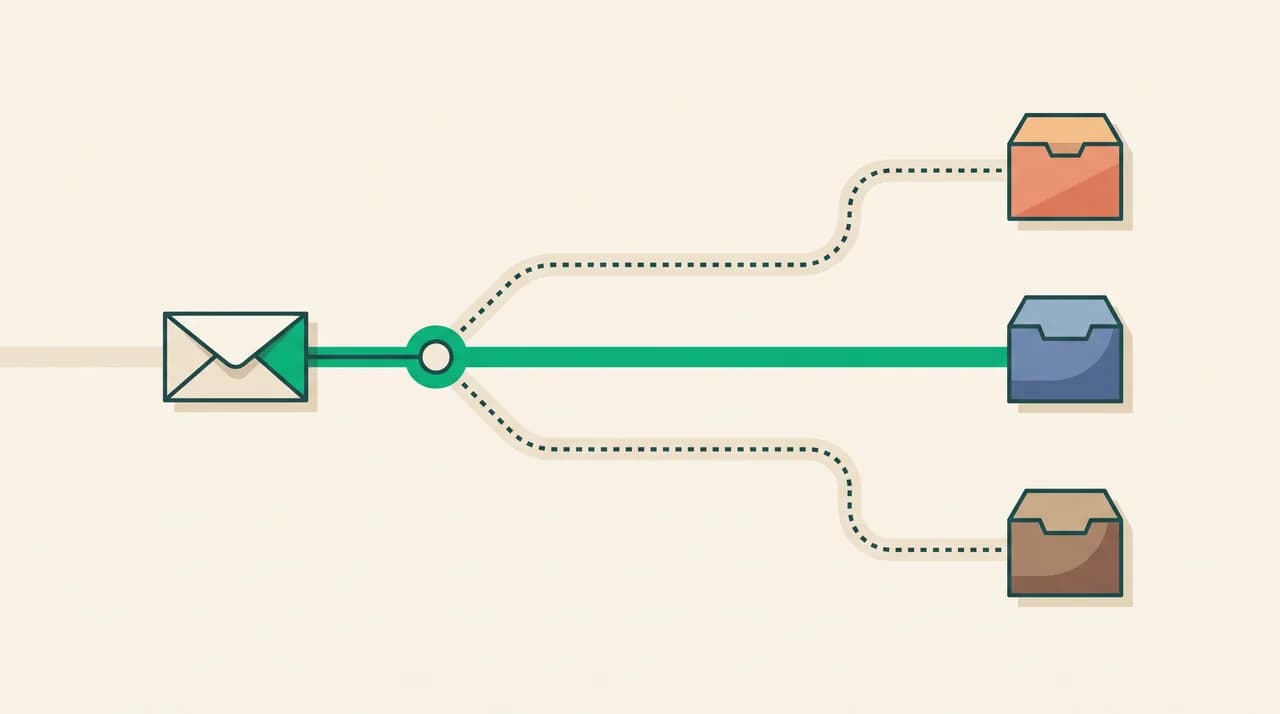
Most vendor pages compare features. The choice underneath is simpler than that: what shape of coverage does your absence actually need. Delegation and routing move authority out of your account. Agents keep it inside your account and prepare the work for your return. The picture below is the fork.
1. AI Emaily — best overall coverage for a client-facing inbox#
AI Emaily is an AI-native email client rather than an overlay, connecting Gmail, Microsoft 365, Outlook and standard IMAP accounts under one login. We build it. Which is why this section leads the ranking, and why the caveat below is stated in full instead of pushed into a footnote.
The coverage story has two modes and a queue. Copilot is the default: while you are away, the agent triages incoming mail, sets categories, files what you have taught it to file, and drafts a reply on every thread that warrants one. Nothing leaves. Each draft lands in the Agent drafts queue with a confidence score, a one-line reason for what the agent wrote, and a Send now, Review and edit, or Dismiss option. Your Monday is a stack of curated drafts on the threads that need you, not an inbox.
Autopilot is the second mode, and the honest description of it is a cancellable window, not an approval gate. You allow-list specific senders — a scheduling assistant, a support form, an internal notification — and Autopilot will send routine confirmations to those addresses behind a cancellable countdown, five minutes by default, with a confidence floor and escalate-if keywords stopping anything ambiguous. Every action lands in an append-only audit log that names the matched rule, the recipient, the confidence and the reasoning, and can be reverted from the log.
The voice on the drafts is not built by watching the mail you sent last quarter. It comes from a Personal Context brain you fill in and client profiles you write yourself, so the agent has the same document your colleague would have read before covering for you. Start free for seven days on Pro or Autopilot, then per-seat monthly or annual on aiemaily.com — see the current figures at /pricing.
2. Cora — best re-entry brief, and the sharper answer for a certain reader#
Cora works alongside Gmail rather than replacing it, and its stated position is that it will never send email for you. Twice a day it sends you a Brief that summarises everything you did not need to reply to. On the threads that do need a reply, it drafts one in your voice into your normal Gmail drafts folder. Your Monday is a single Brief and a folder of prepared drafts.
Cora is the sharper answer if what you actually want from a coverage tool is a digest rather than an inbox. Where the AI Emaily queue is optimised for you working through drafts one at a time with a reason on each, Cora's Brief is optimised for you skim-reading a week in ten minutes, then dispatching the drafts it prepared. That is closer to the shape of returning from leave, and it is a legitimate axis on which Cora has built harder than we have.
The limit is scope. Cora is Gmail and Google Workspace as of August 2026 — an Outlook or an old IMAP account has nowhere to go — and the app you open each morning is still Gmail. If your coverage problem spans providers, this is the wrong shape.
3. Fyxer — best for people who cannot switch client#
Fyxer is an overlay, not a client. It attaches to the Gmail or Outlook account you already have, categorises the inbox and drafts replies for you, and the interface and phone app your colleagues, assistant and delegates already use stays untouched. Its own instruction is that you review and send.
The relevant thing for vacation coverage is that Fyxer runs behind whatever coverage you have already arranged. If a delegate is in your inbox, they see the same categorised view and the same drafts, and can review-and-send them under your name. If your executive assistant is covering, nothing about their workflow changes. If nobody is covering, the drafts wait for you.
What you do not get on Fyxer is a purpose-built approval queue with reasons on each draft, a cross-provider inbox, or a documented audit surface for what the AI wrote. Approval is the default by construction — the tool has no send path that avoids you — but there is no formal record of the AI's decisions beyond your sent folder. Fyxer also meters incoming email volume, and coverage weeks tend to be the ones that push a metered inbox over.
4. Serif — best for graduated autonomy over successive trips#
Serif is honest about the fact that autonomy is a graduation, not a switch. Its own framing: it starts by drafting replies you can review and tweak, and when you are ready you let it handle low-risk scenarios while the rest still comes to you. That maps neatly onto how coverage usually rolls out — draft-only for the first vacation, autonomy on the meeting-confirmation scenario the next, autonomy on the invoice-acknowledgment scenario after that.
It runs on Google Workspace and Microsoft 365 through the official APIs, and can run a dedicated address such as an info@ line autonomously. Before handing anything off for a trip, verify queue mechanics, per-action logging and undo — those are not fully documented publicly as of August 2026. Serif also describes matching your tone from mail you have already sent; the honest way we do the same job is a user-set Personal Context brain and client profiles, and if the difference matters to you it is worth asking each vendor which shape they take.
5. Shortwave — best backlog search on return#
Shortwave is an AI-native Gmail client from former Google engineers. On the vacation coverage question specifically, its strongest feature is not the drafting — it is the semantic search and the split-inbox tabs, both of which are aimed at exactly the problem of finding what matters in a large backlog.
Semantic search takes a question like anything I promised before I left, or which threads mention the renewal, and returns the actual conversations rather than keyword matches. Pinned tabs let you split the backlog into slices — Waiting on me, Newsletters, Everything else — so a Monday triage is a walk through three focused columns instead of one long list. Shortwave has built harder on Gmail-native search than we have, and for a reader whose vacation coverage is really about handling a big backlog fast on return, this is the sharper tool.
The trade is scope. Shortwave is Gmail and Google Workspace only, so a coverage problem that spans Outlook or IMAP does not fit. And its documented posture on the agent is to recommend actions and keep you in control at each step, not to draft-and-hold while you are away — that is a client-side triage shape, not an away-coverage shape.
6. Google and Microsoft native delegation — best true handoff#
This is the option most people forget to name, and it is the honest first move for anyone whose absence needs a human, not an assistant. Both platforms let you delegate your account to another person in your organisation — real handoff, not routing.
Google Workspace does it under Settings, Accounts and Import, Grant access to your account. A delegate can read, send and delete mail in your account; when they send, their address appears on the message. What a delegate cannot do is change your password, reach Google Account settings, or use the Gemini, Smart Compose or Smart Reply features that require sensitive scopes. Microsoft 365 offers the equivalent through folder delegation and shared mailboxes, plus Send As and Send on Behalf permissions.
A client-side triage layer like ours does not replace this. If the true answer for your role is that a colleague must handle client mail in your voice for a week, and reply in their own name where they must, native delegation is the shape you want and no agent should be first on that page. Where we sit alongside it: delegation handles the inbox the colleague can cover, and the agent drafts the residual mail the colleague is not going to touch.
7. Outlook Automatic Replies with Inbox rules, or Gmail filters — best server-side routing#
Outlook Automatic Replies is more than an out-of-office message when you use its Rules panel. You can set a rule that, while auto-replies are on, forwards mail from a specific sender or subject to a colleague, redirects to a shared mailbox, or moves to a folder someone else watches. Rules run on the server, so they fire whether or not any client is open.
Gmail does not have Automatic Replies rules in the same panel, but ordinary Gmail filters do the same job — a forward to a colleague based on sender or subject, an add-label that a shared inbox reads from, a skip-inbox on the noise you do not want the delegate to see. Combined with the vacation responder, this covers the routing half of the problem cleanly and for free.
The limit is that this is topic-shaped routing, not judgement. A rule that forwards anything from acme.com to your colleague is precise; a rule that forwards anything that looks like a client request is a rule you cannot write. When the interesting mail is defined by intent rather than a header, this is where you either delegate the whole inbox or add an agent that can read the thread.
8. The plain vacation responder — the honest floor#
Worth saying clearly on a coverage roundup: for many inboxes, the plain out-of-office is fine. Set the dates, name a contact for genuine emergencies, and let the backlog wait. Nothing sent under your name that you did not write. No delegate to brief. No rules to unwind. No subscription to cancel.
The reason to buy anything above is that your inbox does not tolerate a week of pause — because clients expect a reply inside a day, because leads go cold, because a support alias will lose someone if a message sits for four days, or because the backlog itself takes two days to clear when you return. If none of those describe your inbox, the honest recommendation is to set the vacation responder, close the laptop, and buy nothing.
The two-question test before you buy a coverage tool
How to choose for your situation#
Match your line, then combine the two shapes it names. Coverage is rarely one tool — it is delegation plus routing, or routing plus an agent, run together for one week.
| If this is you | First pick | Second look |
|---|---|---|
| Solo founder, cross-provider inboxes, no colleague to hand off to | AI Emaily on Copilot for the week | Cora if you would rather return to a Brief than a queue |
| A trusted colleague inside the same Google or Microsoft tenant | Native delegation to that colleague | Outlook rules or Gmail filters to trim what the delegate sees |
| Client-facing inbox where nothing may send unread | AI Emaily on Copilot only, Autopilot off | Cora, if Gmail-only and you want a stronger literal guarantee |
| You cannot change email client this week | Fyxer running behind whoever covers | Gmail filters or Outlook rules to redirect one slice |
| Returning to a large backlog matters more than what happens during | Shortwave for the backlog search on Monday | AI Emaily so the return is a curated queue, not a search |
| First trip using any agent for coverage | Serif in draft-only mode | AI Emaily on Copilot, Autopilot deferred until the next trip |
| A week of silence would cost nothing | Plain vacation responder | Nothing |
The verdict#
AI Emaily is our pick for a client-facing inbox that has to keep moving during a week away, because Copilot drafts every reply that warrants one and holds them in a queue with a reason on each row, so the Monday is a stack of curated drafts on the threads that actually need you rather than an inbox you have to open cold. Autopilot is available and honestly what it is — a cancellable window on routine confirmations to senders you explicitly allow-listed, gated by a confidence floor and a countdown, and reversible from an append-only log.
The concession stands. Cora has built harder on the twice-daily Brief than we have, and for a reader whose ideal return-from-leave is a digest rather than a working queue, Cora is the sharper answer inside Gmail. Shortwave has built harder on Gmail-native semantic search than we have, and for a reader whose vacation coverage is really the shape of the backlog on Monday, its split-inbox tabs and question-shaped search win on that axis. And for anyone whose absence genuinely needs a human handling client mail in your name, no agent replaces native Google or Microsoft delegation, and delegation should be the first thing you turn on.
Whatever you pick, decide the shape before the tool. The plain vacation responder is not coverage of anything — it is a notice. Coverage means someone or something handled the mail, and the honest choice is between a person you trust and an agent you can watch. We build AI Emaily to be the second half of that answer, and to say clearly when the first half is the right call instead.
Frequently asked
See it in AI Emaily
Keep reading
Sources

Written by
Nafiul HasanNafiul Hasan is an entrepreneur and AI automation system builder with 10+ years of experience turning messy, manual workflows into reliable automated systems. He designs and ships AI enterprise solutions end-to-end — the agent logic, the data plumbing, and the product people actually use — and founded AI Emaily to give busy professionals their attention back. He writes here from the builder's seat: what works, what breaks, and how to put AI to work without giving up control.