cPanel Forwarder vs Mailbox: Which One Do You Actually Need?

The short answer
Use a cPanel forwarder when nobody needs to send from the address — role aliases like info@ or sales@ that route to a mailbox someone already reads. Create a full mailbox when the address must send its own replies, store its own mail, or be handed to a specific person. Forwarding to Gmail also weakens SPF.
cPanel email forwarder vs mailbox: forwarders use no mailbox quota but break SPF. The decision rule per address type, and how to fix forwarded mail.
On this page
- 01The verdict up front
- 02cPanel forwarder vs mailbox at a glance
- 03What cPanel actually gives you
- 04Where a forwarder wins
- 05Does email forwarding break SPF?
- 06Why DKIM usually survives when SPF does not
- 07cPanel forwarder to Gmail not working: what to check
- 08Where a mailbox wins
- 09Can you reply from a forwarded address?
- 10Can you have a cPanel forwarder and mailbox at the same time?
- 11What each one costs
- 12Who each is genuinely for
- 13A third option, honestly
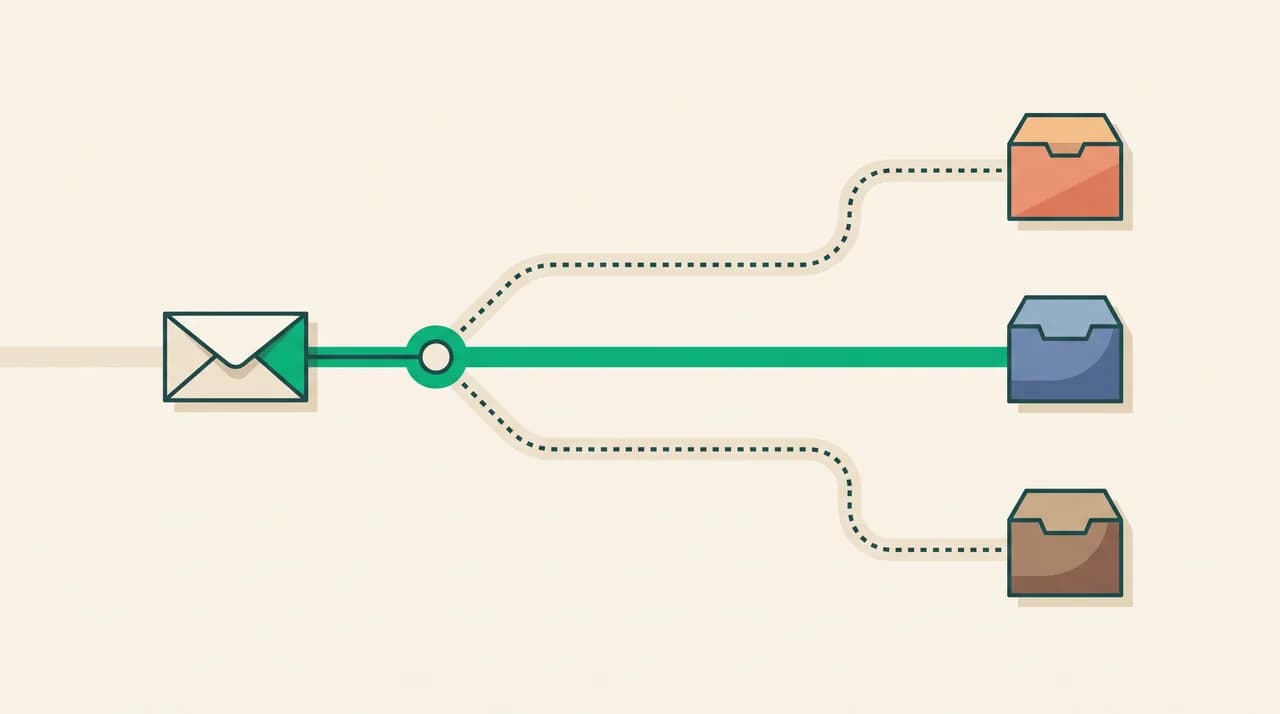
The cPanel email forwarder vs mailbox decision looks like a storage question and is really a sending question. A forwarder is a routing rule. A mailbox is an account with a password, a quota and its own outbound identity.
That difference decides everything downstream: whether anyone can reply as that address, whether the mail survives a provider change, and whether Gmail trusts what arrives. Everything below was checked against cPanel's documentation, RFC 7208 and Google's published guidance in September 2026 — but cPanel interfaces are host-customisable, so your own control panel gets the last word.
The verdict up front#
Create a forwarder when the address is a label rather than a person. Role addresses — info@, sales@, billing@, careers@ — exist so outsiders have somewhere obvious to write. Nobody needs to log in as info@. They need the mail to land where someone already looks.
Create a mailbox when the address has to act. If a human will reply as that address, keep a sent-items history under it, or hand it over when they leave, it needs credentials — and a forwarder is not an account, so it has none.
The honest complication is that forwarding to an external provider such as Gmail or Outlook.com weakens SPF, which is why forwarded mail so often lands in spam. That does not make forwarders wrong. It makes them something you configure deliberately.
The one-line test
cPanel forwarder vs mailbox at a glance#
Two rows carry the weight. "Can send as the address" is the decision; "SPF alignment" is what breaks quietly three weeks later.
| Forwarder | Mailbox | |
|---|---|---|
| What it is | A routing rule for an address | An account with a password |
| Can send as the address | No — no credentials exist | Yes, via SMTP |
| Storage on the server | None of its own | Uses the account's storage quota |
| Counts toward your account allowance | No | Yes |
| Can be edited after creation | No — delete and recreate | Yes, via Manage |
| Survives leaving the host | No — the rule is host-side | Mail can be downloaded first |
| SPF alignment when relayed onward | Breaks on a plain forward | Intact — mail is delivered, not relayed |
| Good for | Role aliases, short-lived addresses | People, teams, anything that replies |
What cPanel actually gives you#
cPanel documents two different objects that both get called forwarders. An account forwarder maps one address to one or more destinations. A domain forwarder is a fallback for a whole domain: cPanel states they "only forward email when the system cannot deliver it to an address or autoresponder", and that a domain forwarder overrides the domain's default address. So a cPanel domain forwarder setup does not redirect mail a real address can already receive — it catches the rest.
The account forwarder form offers two destinations directly and three more under Advanced Options.
- Forward to Email Address — one or more addresses, comma-separated
- Discard and send an error to the sender (at SMTP time) — with a custom failure message, default "No such person at this address"
- Forward to a system account — delivers to the cPanel user's own account
- Discard (Not Recommended) — silently drops the mail with no bounce
- Pipe to a Program — hands the message to a script on STDIN
Forwarders cannot be edited
Where a forwarder wins#
A forwarder has no password to rotate, no client to configure and no inbox to go stale. For an address that exists purely so strangers have somewhere to write, that is the whole job.
It also collapses several addresses into one place to read. cPanel describes the interface as letting one account receive mail addressed to multiple addresses "without having an account for each" — exactly what you want when info@, hello@ and contact@ all mean the same thing. The same logic covers temporary addresses that do not justify an account, a quota and a credential to clean up later.
And Pipe to a Program turns an address into an input: mail piped to a script arrives on STDIN, which is how ticket systems get fed by email. cPanel notes the script must be executable with a shebang and permissions of 0700, and warns that any output at all, even a blank line, becomes a bounce message.
Does email forwarding break SPF?#
Yes, on a plain forward, and the reason is structural rather than a misconfiguration you can fix on your side. SPF checks the sending server against a DNS record belonging to the envelope sender's domain. RFC 7208 puts it plainly: "The authorization check is performed during the SMTP transaction at the time of the MAIL command, and uses the MAIL FROM value and the client IP address." When your host forwards a message onward without changing that envelope, the receiving provider tests your host's IP against the original sender's SPF record — a record that has never heard of your host.
DMARC.org's FAQ states the outcome directly: "In the case of forwarding emails, SPF is likely to fail, in a DMARC sense, at the receiver", because "it is unlikely your sending IP is in the SPF record of the domain contained in the from header of the email."
RFC 7208 handles this under the heading "Mediators" in Section 10.3, with Appendix D titled "SPF/Mediator Interactions". The remedy it describes for the forwarding side is to rewrite the envelope sender into the forwarder's own domain — the technique usually implemented today as SRS, Sender Rewriting Scheme, though the RFC itself describes the mechanism without using that name.
Why DKIM usually survives when SPF does not#
DKIM signs the message itself, so it does not care which server relayed it. DMARC.org is blunt: "However there is no reason for DKIM to fail" — provided "your mail server does not drastically modify the message." That matters because DMARC does not require both. Google's sender guidelines state that "To pass DMARC authentication, messages must be authenticated by SPF or DKIM, or both", and that "The authenticating domain must be the same domain that appears in the message From: header."
So a forwarded message whose DKIM signature is intact and aligned still passes DMARC even after SPF fails. The practical risk is anything in the path that rewrites the message — a spam filter appending a footer, a re-encoding step, a modified Subject or MIME boundary. Google's forwarding guidance lists exactly those as signature-breakers, which is the argument for keeping a forwarding path boring.
cPanel forwarder to Gmail not working: what to check#
The complaint is always the same shape — the forwarder is configured correctly, cPanel's Trace tool shows the route, and the mail either lands in spam or never appears. That is an authentication symptom, not a routing one. Google is explicit that receiving is a fresh judgement: "Gmail doesn't automatically authenticate forwarded messages that previously passed authentication. Gmail does its own authentication check on forwarded messages."
- 1
Confirm the route first
The Trace action shows where a message will go; a green globe means delivery to a different server, which is what an external forward should look like. cPanel cautions that Trace returns invalid results if the server uses a third-party mail service such as MailScanner.
- 2
Rewrite the envelope sender
Google's advice for forwarding services is to "Change the envelope sender to reference your forwarding domain." On shared hosting this is a host-level setting, not something in your cPanel — ask your provider whether SRS is enabled.
- 3
Cover the forwarding host in SPF, and sign with DKIM
Google advises including every server that forwards mail for your domain in your SPF record, and always setting up DKIM alongside it. DKIM is the half that survives the hop.
- 4
Add the forwarding headers, and filter first
Google suggests an X-Forwarded-For: or X-Forwarded-To: header so receivers can tell the message was forwarded rather than spoofed. And filter spam before the forward — everything you relay counts against your host's reputation with the destination.
Where ARC fits, and where it does not
Where a mailbox wins#
A mailbox is an identity. It has a password, so a person or a mail client can authenticate as it and send. It has storage on the server, so the mail exists somewhere you control rather than only inside someone else's account. cPanel's account creation form documents a Storage Space setting where you either enter a custom disk size or select Unlimited, and the Email Accounts page shows how many accounts your plan allows — an infinity icon meaning unlimited — while stating that "Your hosting provider manages your email account quotas."
Mailboxes are also the only option that survives a move: a mailbox can be downloaded or synced over IMAP before you migrate hosts, while a forwarder is a rule on a server you are leaving with nothing to export. The trade is that cPanel states deleting an email account "permanently delete[s] all mail and data for the account" and "You cannot undo this action." Deleting a forwarder costs a routing rule; deleting a mailbox costs the mail.
Can you reply from a forwarded address?#
Not from the forwarder itself. A forwarder has no password, and sending requires authenticating to an SMTP server. There is nothing to authenticate with.
What people usually mean is the workaround: add the address as an alternate sending identity in Gmail or Outlook, so replies appear to come from [email protected]. That still requires working SMTP credentials on your domain — which means either a real mailbox for that address, or your provider's SMTP with another account's credentials. Providers change the exact steps and the verification requirements periodically, so follow your provider's current documentation rather than a blog screenshot.
Sending through another account's credentials also ties your outbound alignment to that account's domain and configuration, and a mismatch between the visible From: address and the authenticated domain is exactly the condition DMARC exists to catch. If an address needs to send regularly, the simplest correct answer is to make it a mailbox.
Can you have a cPanel forwarder and mailbox at the same time?#
Yes, and cPanel documents it precisely: "If a forwarder shares an address with an email account, both will receive mail." The order it gives is create the account first, then add a forwarder for it.
The mechanism has a consequence people miss. cPanel states that "When you forward emails from an existing email account on the server, the system stores the emails in the account, then forwards them", and that forwarding accounts "keep a copy of the emails that they forward."
So this arrangement is not free. Every forwarded message also accumulates in the server-side mailbox, against its storage quota, indefinitely unless something empties it. Teams set it up as a safety net, forget the local copy exists, and meet it again as a full mailbox that has started rejecting mail. It is a good pattern when you want a server-side archive plus day-to-day reading elsewhere, and a bad one when you never look at the quota again.
What each one costs#
Forwarders are generally not billed and not counted, because there is no account behind one. Mailboxes consume two separate allowances: the number of accounts your plan permits, and the disk storage each one uses.
cPanel itself publishes no prices, no default quota figure and no account limit — those are set by your hosting provider. cPanel's documentation says so repeatedly, noting that providers can customise the options each interface displays and can disable whole interfaces in WHM's Feature Manager.
So any specific number you read about cPanel mailbox limits is a claim about one host, not about cPanel — check your own Email Accounts page before assuming either a limit or the absence of one. The documentation cited throughout this post was current at cPanel version 130, last modified July 2026. The rule of thumb that survives the variation: spend the accounts on people, spend the forwarders on labels.
Who each is genuinely for#
The last row is where cPanel runs out. Forwarding one address to two inboxes gives both people the mail and neither of them any idea what the other did with it.
| Situation | Use | Why |
|---|---|---|
| info@, sales@, hello@ on a small site | Forwarder | Nobody replies as the address; one person reads it |
| A named employee's address | Mailbox | They send, they keep a sent history, the account is handed over when they leave |
| An address for a three-week campaign | Forwarder | Nothing to provision, nothing to clean up |
| An address that must send invoices or contracts | Mailbox | Outbound authentication and a retrievable record |
| Email into a ticket system or script | Forwarder (Pipe to a Program) | The address is an input, not an inbox |
| Anything you may need to migrate to another host | Mailbox | A forwarding rule cannot be exported |
| A shared address two people both answer | Mailbox, or a shared inbox tool | Two forwarded copies means two people replying to the same message |
A third option, honestly#
Both of these choices solve routing. Neither solves the problem you have once the mail arrives, which is that a role address like sales@ collects a stream of mixed-priority messages into an inbox that already has its own.
That is the job AI Emaily does, and we build it — worth saying plainly, because this is our site. It is a mail client, not a hosting control panel: it connects over IMAP and SMTP to the mailbox you created in cPanel, alongside Gmail, Outlook and any other account, and triages the merged stream. It drafts replies from a Personal Context brain and per-client profiles you set yourself, rather than from anything it read in your old mail, and nothing sends without your approval.
What it does not do is change the arithmetic above. It cannot make a forwarder capable of sending, cannot fix SPF alignment on a relayed message, and cannot create a mailbox on your host. Those stay cPanel and DNS problems.
Where it earns its place is the shared-address row of that table: connect the real mailbox once, and the address gets triage, drafting and an audit trail instead of two people forwarding each other the same email. There is a 7-day free trial if you want to test it against your own cPanel mailbox.
Frequently asked
See it in AI Emaily
Keep reading
Sources
- cPanel Documentation — Forwarders
- cPanel Documentation — Email Accounts
- cPanel Documentation — Create an Email Account
- cPanel Documentation — Default Address
- RFC 7208 — Sender Policy Framework (SPF)
- DMARC.org — FAQ
- Google — Best practices for forwarding email to Gmail
- Google — Email sender guidelines
- RFC 8617 — Authenticated Received Chain (ARC)

Written by
Nafiul HasanNafiul Hasan is an entrepreneur and AI automation system builder with 10+ years of experience turning messy, manual workflows into reliable automated systems. He designs and ships AI enterprise solutions end-to-end — the agent logic, the data plumbing, and the product people actually use — and founded AI Emaily to give busy professionals their attention back. He writes here from the builder's seat: what works, what breaks, and how to put AI to work without giving up control.