Email and Work-Life Balance: How to Log Off Without Falling Behind

The short answer
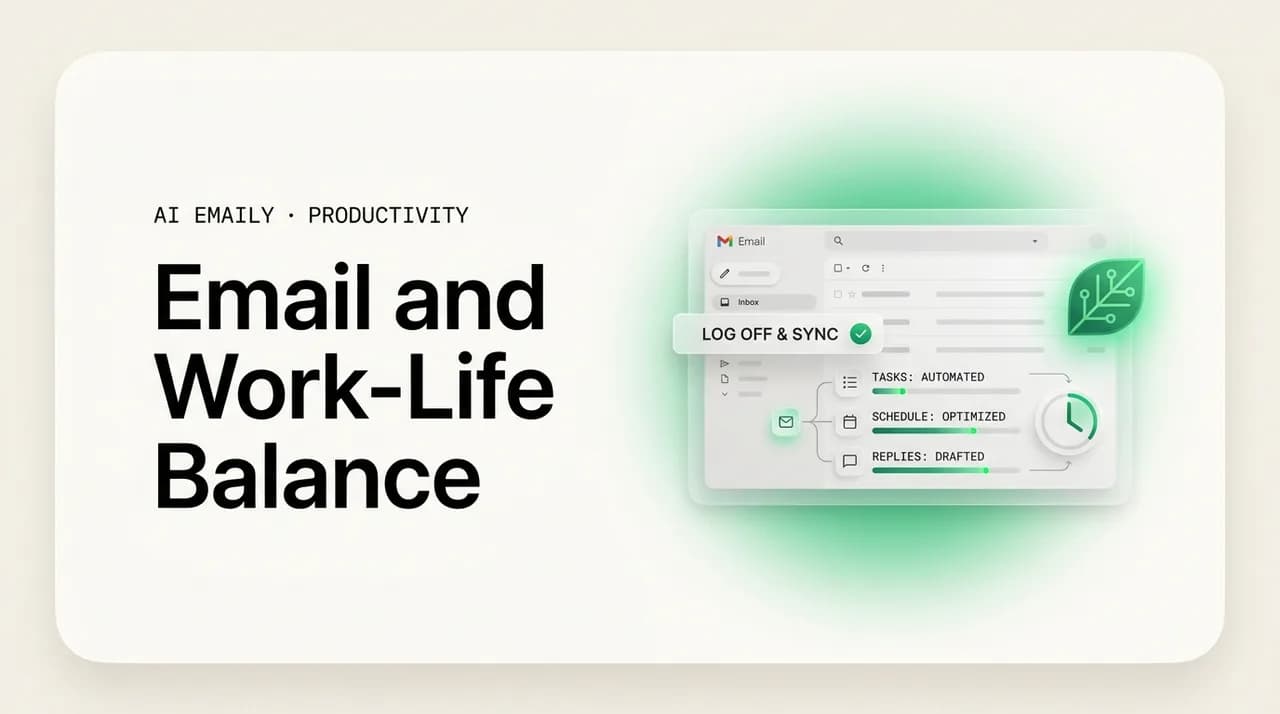
Email and work-life balance comes down to one habit: deciding when the inbox is allowed to interrupt you and when it is not. Set quiet hours, mute after-hours notifications, keep work and personal accounts separate, and let only genuine emergencies through. The point is to log off without dread — knowing nothing urgent is silently waiting.
Email and work-life balance starts with after-hours boundaries: quiet hours, separate accounts, VIP-only alerts, and manager modeling — plus example boundary messages and how to log off without falling behind.
On this page
- 01Why does after-hours email hurt work-life balance so much?
- 02What do right-to-disconnect laws actually say?
- 03How do you set email boundaries that actually hold?
- 04What are example boundary messages you can copy?
- 05Should you separate your work and personal email accounts?
- 06How do you build quiet hours into your inbox?
- 07What is a manager's role in email and work-life balance?
- 08How do you protect weekends and vacations from email?
- 09Does technology help or hurt email work-life balance?
- 10How does AI Emaily help you log off without falling behind?
- 11The bottom line on email and work-life balance
It is 9:40 on a weeknight. You are not working — you finished hours ago. But your phone is on the arm of the couch, and a notification flashes: a new email. You glance at it without meaning to. The subject line is vague, the sender is a colleague, and now you are half-reading it, half-watching the show, and fully unable to stop thinking about whether it needs a reply tonight. You will not actually answer it. But the inbox just reached into your evening anyway, and the cost is not the thirty seconds of reading — it is the low hum of work that follows you to bed.
This is the quiet way email erodes work-life balance. It is rarely one dramatic late-night fire. It is the steady leak: the reflexive check at dinner, the Sunday-evening scroll "just to see what Monday looks like," the vacation that is technically time off but spent triaging from a beach chair. None of it feels like much in the moment. Added up over months, it is the difference between a job that ends when you close the laptop and one that never quite does — and it is one of the most reliable on-ramps to burnout in knowledge work.
The good news is that this is a solvable problem, and not by working harder at willpower. The people who actually log off are not more disciplined than you; they have set up their email so that switching off is the default, not a constant decision. They have boundaries that hold without being policed. They have quiet hours their tools enforce. They have separated the things that genuinely cannot wait from the overwhelming majority that easily can. And increasingly, they have help — laws in many countries now back a right to disconnect, and software can carry the boundary so you do not have to.
This guide is the practical playbook. We will cover why after-hours email drives burnout and what the research actually shows, the right-to-disconnect laws spreading across the world and what they mean for you, and then the concrete moves: setting boundaries that stick, building quiet hours, separating work and personal accounts, what managers owe their teams, and how to handle weekends and vacations without the dread of return. There is a table of boundary tactics, example boundary messages you can copy, and an honest look at the part technology plays. Near the end we look at how an AI-native email client lets you disconnect without falling behind — the whole point of all of this.
Why does after-hours email hurt work-life balance so much?#
The instinct is to think the harm is the time: an hour of evening email is an hour stolen from your life. That is real, but it is the smaller cost. The bigger one is psychological, and it shows up even when you do not answer a single message. The mere expectation that you might need to check — that an email could land and demand a response — keeps a part of your mind on the job after hours. Researchers have a name for this: the cost is not the work itself but the anticipatory stress of being reachable.
A widely cited study from Lehigh University, Virginia Tech, and Colorado State coined the term "telepressure" and an "always-on" expectation, and found something striking — the organizational expectation that employees monitor email after hours predicted worse well-being and more burnout, and the damage came largely from the anticipation rather than the actual hours spent. Employees who merely believed they were expected to be available reported emotional exhaustion and reduced ability to detach from work, even controlling for how much time they actually spent on email. The boundary you do not have is more harmful than the email you do not answer.
This connects to a concept psychologists call psychological detachment: the ability to mentally switch off from work during non-work time. Detachment is what lets you recover — it is when your stress hormones settle, your attention resets, and you come back the next day with capacity restored. After-hours email is corrosive precisely because it blocks detachment. You cannot recover from work while a thread of it is still open in your head. Over weeks and months, the failure to detach is one of the clearest predictors of burnout, sleep disruption, and the resentment that makes good people quit jobs they otherwise like.
There is also a compounding social effect. When one person answers email at 11pm, it quietly resets the norm for everyone who sees it. Colleagues infer that late replies are expected; some feel they must match it; the team's collective baseline of availability creeps later and later. This is why after-hours email is not just a personal habit — it is a team culture problem, and why the most effective fixes work at both levels: what you do for yourself, and what your team agrees to together.
The core finding in one line
What do right-to-disconnect laws actually say?#
If after-hours availability feels less like a personal choice and more like an unspoken obligation, you are not imagining it — and a growing number of governments have decided it is worth regulating. The "right to disconnect" is the legal principle that employees should be able to switch off from work communications outside working hours without penalty. It is not a single global law but a wave of national and regional rules, and the shape varies a lot by country, so treat the specifics here as general orientation rather than legal advice.
France was the pioneer. Its 2017 law required companies above a certain size to negotiate the terms under which employees can disconnect — when email is and is not expected — and made the conversation itself mandatory, even where the exact rules are left to each company. Several countries have since adopted their own versions. Italy and Spain built disconnection rights into broader labor and remote-work legislation. Belgium, Portugal, and Ireland have introduced rules or codes that discourage or restrict out-of-hours contact, with Portugal's framing notably putting some onus on employers not to contact staff after hours except in genuine emergencies. Australia introduced a right-to-disconnect provision giving employees the ability to refuse unreasonable out-of-hours contact. The European Parliament has pushed for an EU-wide right, and the broad direction of travel across many jurisdictions is toward more, not less, protection.
The common thread across these laws is not a blanket ban on evening email — almost none of them say "no email after 6pm, ever." What they consistently establish is that being reachable after hours should be the exception, not the assumed default, and that employees should not be penalized for being unavailable on their own time. They legitimize the boundary. Even if you live somewhere with no such law, the principle is useful as a personal standard: out-of-hours contact is for genuine emergencies, everything else waits, and "I did not see it until morning" is a completely acceptable answer.
The practical takeaway is that the cultural ground has shifted. A decade ago, drawing an email boundary could feel like you were the problem. Today, in much of the world, it is increasingly recognized as the healthy, and in some places legally backed, default. That makes it far easier to set the boundaries below — you are no longer swimming against the current.
Use the principle even without the law
How do you set email boundaries that actually hold?#
Boundaries fail when they rely on willpower. "I will not check email after 7pm" lasts about three days, because the phone is right there and the pull is constant. Boundaries that hold are the ones built into your environment and your communication, so staying off email is easier than checking it. The goal is to make the boundary the path of least resistance, not a thing you have to win against yourself every night.
Start with the environment. Take work email off your personal phone entirely, or at least remove the account from the always-on mail app so it cannot push notifications at you. If you keep it on your phone, turn off badges and banners for it outside working hours. Move the work mail app off your home screen so it is not the thing your thumb finds by reflex. Every layer of friction you add between you and the after-hours inbox is a layer that protects your evening — because most checking is not deliberate, it is habit, and habit responds to environment far more than to resolve.
Then make the boundary visible to others, because half of after-hours pressure comes from not knowing whether a fast reply is expected. State your norms plainly. Put your working hours in your signature or your status. Use a recurring or scheduled note that sets expectations: when you are reachable, how to reach you if something is genuinely urgent, and that routine email will be answered the next working day. When people know the rule, they stop expecting the 9pm reply, and you stop feeling you owe it. The table below lays out the boundary tactics that work, from least to most assertive.
| Boundary tactic | What it looks like | Best for |
|---|---|---|
| Remove work email from personal phone | Delete the work account from your phone's mail app | Anyone whose checking is reflexive rather than required |
| Mute after-hours notifications | No badges, banners, or sounds for work mail outside set hours | Keeping the app but killing the interruption |
| Set explicit working hours | State "I reply 9–6, Mon–Fri" in signature or status | Stopping the unspoken expectation of instant replies |
| Define an emergency channel | "For anything urgent, call or text" — not email | Letting genuine fires through without monitoring email |
| Delay-send overnight drafts | Write at night if you must, schedule to send next morning | Night owls who don't want to reset the team's norm |
| Auto-responder for off-hours | Note that the message was received and when you'll reply | High-volume inboxes and external senders |
| VIP-only after-hours alerts | Notifications only from a named short list of people | People who genuinely can't go fully dark but want quiet |
A few notes on using the table. The tactics stack — most people combine three or four. The single highest-leverage move for the majority of people is the first one: getting work email off the personal phone, or at least silencing it after hours, because it removes the trigger entirely rather than asking you to resist it. The delay-send tactic deserves special mention: if you genuinely do your best thinking at night, write the email then, but schedule it to land in the morning. You get the thought out of your head, and you do not reset your team's expectation that people answer at 11pm. The boundary protects them as much as you.
The most common objection is fear — that a boundary will make you look uncommitted, or that something will blow up while you are unreachable. Both are usually overstated. The fix for the second is the emergency channel: explicitly tell people that for true emergencies they should call or text, not email. That single sentence does two things at once. It gives genuine fires a fast path, and it reframes everything that arrives by email as, by definition, not an emergency. Once email is no longer the urgent channel, ignoring it after hours stops feeling risky — because anything that truly could not wait would have reached you another way.
Separate the urgent channel from the inbox
What are example boundary messages you can copy?#
Setting a boundary is easier when you have the words ready. The hard part is rarely the decision — it is the worry that saying it will sound rigid or unhelpful. It will not, if you frame it warmly and pair the boundary with a path for genuine urgency. The pattern that works is the same every time: state your norm, offer the emergency route, keep it brief and friendly. Here are templates for the situations that come up most, from an auto-responder to a reply that politely resets an after-hours expectation.
The tone to aim for is calm and matter-of-fact, never defensive or apologetic. You are not asking permission to have a life outside work; you are simply telling people how to work with you effectively. A boundary delivered with a clear apology ("so sorry, I know this is annoying") invites pushback; the same boundary stated plainly is almost always accepted without comment. Copy these, swap in your own hours and channel, and keep them on hand.
State the boundary, don't apologize for it
Should you separate your work and personal email accounts?#
Yes — and it is one of the most underrated boundaries you can set. When work and personal email live in the same app, on the same phone, behind the same notification, there is no off switch. Checking your personal mail for a delivery update means seeing five work threads. Opening the app to reply to a friend means a work subject line catches your eye. The two contexts bleed into each other, and the work one always wins, because it carries more urgency and more anxiety. Separation gives you a clean line: when you are in your personal account, work is not there to pull you back.
The practical setup is straightforward. Keep distinct accounts — a work address and a personal one — and, ideally, keep them in separate places: work email on your work device or a clearly bounded app, personal email wherever you actually live online. If you must have both on one phone, at minimum put them in separate apps or separate profiles so that opening one does not surface the other, and so you can silence work notifications wholesale while leaving personal ones on. The friction of switching is the feature: it makes checking work email a deliberate act rather than an accident of opening your phone.
There is a privacy and ownership dimension too. Mixing personal life into a work account means your employer's systems hold your personal correspondence, and mixing work into a personal account means company material sits outside their controls — neither is ideal. Clean separation protects both: your private life stays private, and work stays where work belongs. When you leave the job, the line is already drawn. The boundary that protects your evenings turns out to also protect your data.
| Setup | Separation quality | Trade-off |
|---|---|---|
| Work email on work device only | Strongest | Need a work device; not ideal for genuine mobility |
| Separate apps on one phone | Strong | Both present, but switching is deliberate and mutable |
| Separate work/personal phone profiles | Strong | Setup effort; one profile can be silenced entirely |
| Both accounts in one mail app | Weak | Convenient, but no real off switch — they bleed together |
| One inbox for everything | None | Maximum bleed; work is always visible in personal time |
If you can only do one thing
How do you build quiet hours into your inbox?#
Boundaries you state are good; boundaries your tools enforce are better, because they do not depend on you remembering or resisting. Quiet hours are exactly this: a defined window — evenings, nights, weekends — during which your inbox does not notify you at all. The mail still arrives; it just waits silently until you choose to look. You decide once, when you are calm and rested, and the rule holds every night after, so you never have to make the "should I check" decision in the moment of temptation.
Most platforms give you the raw materials. Phone-level focus or do-not-disturb modes can silence an app on a schedule. Mail apps increasingly offer notification scheduling or per-account quiet hours. Calendar tools let you mark working hours so others see when you are and are not available. The trick is to set them deliberately rather than fiddling case by case: pick your hard edges — say, no work notifications before 8am, after 6:30pm, or on weekends — and configure them once so the boundary is automatic. Below is a simple, durable quiet-hours setup you can adapt.
- 1
Pick your hard edges
Decide the windows when work email may never interrupt you — e.g. before 8am, after 6:30pm, and all weekend. Be specific; a vague "evenings" is too easy to erode.
- 2
Schedule notification silence
Use your phone's focus mode or your mail app's notification schedule to mute all work-email alerts during those windows. No badges, no banners, no sounds.
- 3
Name your exceptions
Decide who, if anyone, may break through — a manager, a key client, an on-call rotation. Allow alerts only from that named short list, and leave everything else silent.
- 4
Set a public availability window
Mark your working hours on your calendar and state them in your signature, so colleagues see when you're reachable and stop expecting replies outside it.
- 5
Add one daily off-hours check, if you must
If going fully dark feels impossible at first, allow yourself one brief, timed look in the evening — then close it. A single deliberate check beats constant reflexive ones.
- 6
Review after two weeks
Notice what actually broke through and whether anything genuinely urgent slipped. Tighten or loosen the exception list based on reality, not fear.
Quiet hours silence the alert, not the mail
The hardest part of quiet hours is the first two weeks, when the absence of pings feels like risk. Your brain has learned to associate the notification with safety — at least I know nothing's on fire — and silence can read as anxiety. The fix is the exception list plus the emergency channel: once you trust that anything truly urgent will reach you another way, the silence stops feeling like exposure and starts feeling like rest. Give it two weeks. Almost everyone finds that the catastrophe they feared never arrives, and that mornings spent catching up calmly are far better than evenings spent half-watching the inbox.
It also helps to protect the morning edge as deliberately as the evening one. Many people set evening quiet hours but then reach for email the instant they wake, which hands the first and freshest part of the day to other people's priorities. A quiet-hours window that runs until you have actually started your workday — not the moment your eyes open — keeps the morning yours. The boundary works at both ends of the day, and the morning end is often where the most focus is reclaimed.
What is a manager's role in email and work-life balance?#
Individual boundaries only go so far if the culture undercuts them. If a manager emails at 10pm and expects a quick reply, no amount of personal quiet hours will fully protect the team — people will check anyway, because the perceived cost of being unavailable is too high. This is why work-life balance around email is, at its core, a leadership problem. Managers set the norm whether they intend to or not, and the single most powerful lever they have is not a policy but their own behavior.
The mechanism is modeling. Teams watch what their manager does far more closely than what they say. A manager who sends email at all hours signals that all hours are fair game, even if they add "no need to reply tonight" — because the team sees the timestamp and infers the standard. A manager who keeps their own visible email activity inside working hours, and who delay-sends anything written late so it lands in the morning, sends the opposite signal: this is when we work, and the evening is yours. The delay-send habit is the most concrete thing a manager can do, because it lets them work when they want without imposing that schedule on anyone else.
Beyond modeling, managers can set explicit team norms: response-time expectations that are measured in hours-during-the-workday rather than minutes, a clear statement that email outside hours does not require a reply, and a designated channel for true emergencies so that email never has to be the urgent one. Crucially, they should make it safe to be unavailable — explicitly praising people who take real time off and disconnect, rather than rewarding the always-on responder. When the visibly-available employee is not the one who gets ahead, the late-night arms race stops.
"No need to reply tonight" doesn't undo the timestamp
How do you protect weekends and vacations from email?#
Weekends and vacations are where balance is either protected or quietly surrendered. The pattern is familiar: you mean to be off, but you check "just once" Saturday morning, see something that nags, and spend the weekend with one foot at work. Or you set an out-of-office, then check from your phone anyway, so the vacation is technically time off but never actually feels like it. The thing that makes time off restorative is not the absence of work — it is the genuine detachment from it, and detachment requires not peeking.
Weekends respond well to the same quiet-hours machinery, extended across the two days. Silence work notifications entirely from Friday evening to Monday morning. If you cannot go fully dark, allow yourself one short, timed weekend check at a fixed hour rather than an open-ended drift in and out, which is far more disruptive because it keeps you partly tethered the whole weekend. Better one deliberate ten-minute look than ten reflexive glances. And resist the Sunday-night "prep" check that ostensibly readies you for Monday but actually just ends your weekend early and seeds the anxiety you were hoping to avoid.
Vacations need a real plan, not just an auto-responder. The components are simple: a clear out-of-office that states you have no email access and names a colleague for genuine needs; removing the work account from your phone for the duration, so checking is not even possible; a deputy who is genuinely empowered to handle things so people are not just waiting on your return; and a deliberate re-entry plan for the backlog, because the fear of the post-vacation inbox is often what keeps people checking during the trip in the first place. If you trust that you have a sane way to handle the pile-up when you return, you can actually let go while you are away.
| Situation | What undermines it | What protects it |
|---|---|---|
| Weekend | Open-ended "just checking" drifting through both days | Full notification silence Fri eve–Mon, or one timed check |
| Sunday evening | "Prepping" for Monday by reading the inbox | Leave it; let Monday morning be Monday morning |
| Short vacation | Auto-responder on, but phone still checked daily | Remove work account from phone; trust the OOO |
| Long vacation | No deputy, so the pile-up forces you to monitor | Empowered deputy + clear re-entry plan for the backlog |
| Return day | Drowning in a backlog with no triage plan | Block the first morning for triage; reply by priority, not order |
The fear of the backlog keeps you checking
Does technology help or hurt email work-life balance?#
Technology is what created the always-on inbox — the smartphone put work email in your pocket and erased the line between the office and everywhere else. So it is fair to be skeptical that more technology is the answer. But the honest picture is that technology cuts both ways, and the difference is whether a tool is designed to demand your attention or to protect it. Most mail apps are built to maximize engagement: badges, instant push, the red dot that pulls you back. Those tools hurt balance by default, because their incentive is to keep you opening the app.
The tools that help are the ones designed around the opposite goal — letting you stay informed without staying tethered. Notification scheduling, quiet hours, do-not-disturb, delay-send, and per-account controls are all small features that shift power back to you, turning the inbox from something that summons you into something you check on your own terms. The deeper version of this is software that does the triage you would otherwise do compulsively, so the only reason you ever felt you had to check — to find out whether anything important landed — is handled for you.
That is the real unlock. Most after-hours checking is not about answering email; it is about reassurance. You check to confirm nothing is on fire. If a tool can reliably tell you that nothing urgent has arrived — and surface the one thing that has, if it genuinely cannot wait — then the compulsion loses its fuel. You can log off because you actually know there is nothing waiting that needs you, rather than logging off and wondering. The next section is about exactly that kind of tool.
Most after-hours checking is reassurance, not work
How does AI Emaily help you log off without falling behind?#
Here is the bind at the center of all of this. You want to disconnect, but you are afraid that if you do, you will miss something that matters or return to a wall of email you cannot face — so you keep one eye on the inbox, and never fully switch off. AI Emaily is an AI-native email client built to dissolve that bind: to let you log off completely, in the confidence that nothing important is silently waiting and that catching up will be quick rather than crushing.
It starts with quiet hours and VIP-only after-hours alerts. You set the windows when the inbox may not interrupt you — evenings, nights, weekends — and AI Emaily holds the line, staying silent for everything except the short list of people or situations you decide genuinely warrant a notification. Routine email arrives and waits; only a true exception reaches you. Because the triage that decides what is an exception is handled for you, you do not have to monitor anything to know nothing urgent slipped through — the whole reason you used to keep checking is gone.
Then there is the brief, which is what lets you disconnect without dread. Instead of a backlog you have to wade through, AI Emaily reads what arrived while you were off and gives you a short, prioritized summary of what actually needs you — the few real decisions, separated from the noise. You can get that brief delivered where you already are, so coming back from an evening, a weekend, or a vacation means reading a tidy digest and acting on a handful of things, not opening an inbox of hundreds and feeling your stomach drop. The fear of the pile-up — the thing that kept you checking on vacation — is replaced by a calm, manageable catch-up. It works across every account you connect, so your work and personal mail can stay properly separated while still being handled in one place.
And you stay fully in control. In its default Copilot mode, AI Emaily drafts and triages but sends nothing without your approval — so logging off never means losing oversight, and coming back never means a queue of things sent in your name you have to check. You can start free at app.aiemaily.com/signup: the Free plan is $0 and connects your inbox with AI triage and drafting, and Pro is $12.42/month billed annually when you want quiet hours and the brief across everything. The point is not that a machine runs your inbox while you are gone — it is that you can genuinely log off, knowing the one thing that matters will find you and everything else will be waiting, briefed and calm, when you choose to return.
Try logging off for one evening
The bottom line on email and work-life balance#
After-hours email erodes balance less through the hours it takes and more through the expectation it creates — the sense that you must stay reachable, which blocks the detachment your mind needs to recover. The research is consistent: it is the always-on pressure, not the occasional reply, that drives burnout. And the world is increasingly on your side, with right-to-disconnect laws across many countries legitimizing the boundary that out-of-hours contact should be the exception, not the default.
The fix is not more discipline; it is better defaults. Take work email off your personal phone or silence it after hours. Set quiet hours your tools enforce. Separate work and personal accounts so one cannot pull you into the other. Route genuine emergencies to a non-email channel so the inbox is never the urgent one. State your boundaries plainly, without apology, and have the example messages ready. If you manage people, model the hours you want them to keep and delay-send your late-night work. And protect weekends and vacations with a real plan — a deputy, a re-entry block — so the fear of the backlog stops keeping you tethered.
Do that, and logging off stops being a thing you fight for every evening and becomes simply how your inbox works. If you would rather not assemble all of it by hand, that is exactly what AI Emaily is for — quiet hours, VIP-only alerts, and a calm brief of what actually needs you — so you can disconnect without dread and come back without drowning, while keeping final say over everything. Either way, the principle holds: decide when the inbox is allowed to interrupt you, make that boundary the default, and let yourself genuinely log off.
Frequently asked
See it in AI Emaily
Keep reading
Sources

Written by
Nafiul HasanNafiul Hasan is an entrepreneur and AI automation system builder with 10+ years of experience turning messy, manual workflows into reliable automated systems. He designs and ships AI enterprise solutions end-to-end — the agent logic, the data plumbing, and the product people actually use — and founded AI Emaily to give busy professionals their attention back. He writes here from the builder's seat: what works, what breaks, and how to put AI to work without giving up control.