How to Respond to Candidates Faster: Win the 10-Day Placement Race

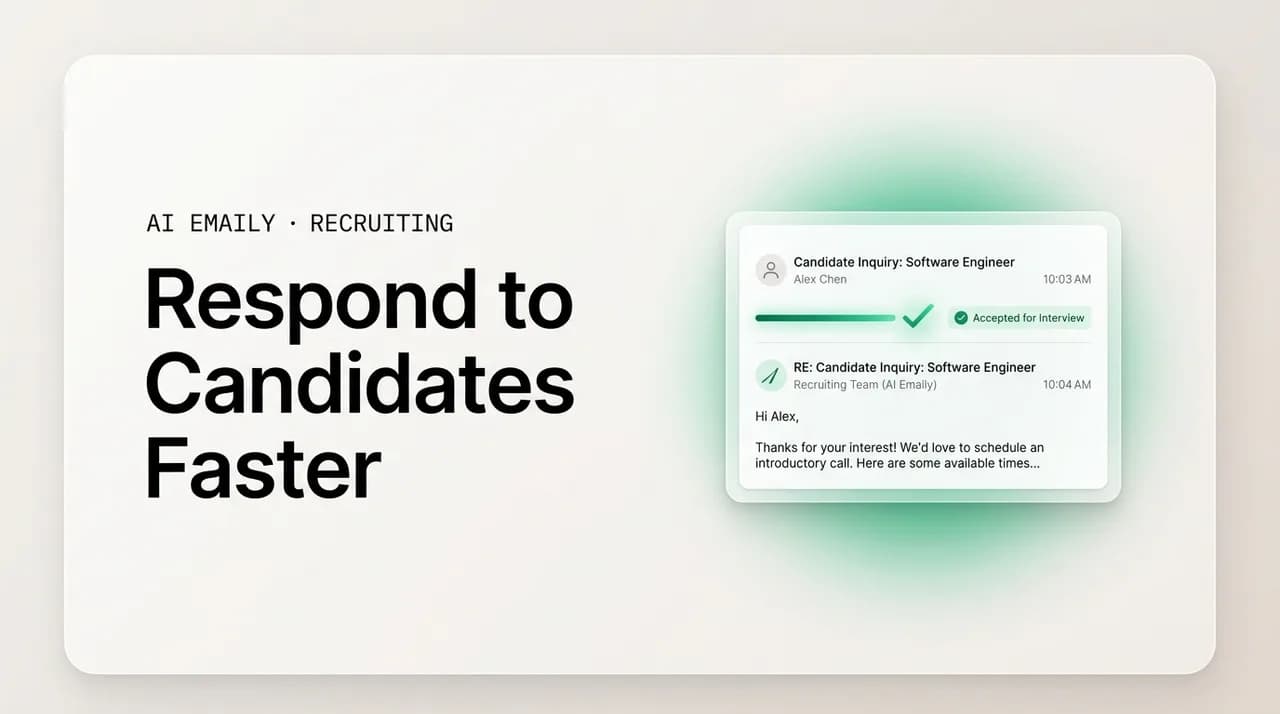
The short answer
The best candidates are off the market in roughly ten days, so the recruiter who replies, presents, and schedules fastest usually wins the placement. To respond to candidates faster, standardize an instant acknowledgment within minutes, keep a personal reply to same-day, cut scheduling to a single link, and automate the templated follow-ups that eat your day.
Learn how to respond to candidates faster and win more placements: why the 10-day window and competing offers reward speed, why recruiters fall behind, and a fast-response system with templates and scheduling built to beat the clock.
On this page
- 01Why does responding to candidates faster win placements?
- 02How fast should recruiters reply to candidates?
- 03Why are recruiters so slow to respond in the first place?
- 04What does a fast candidate-response system look like?
- 05Instant acknowledgment versus the personal reply: when to use each
- 06What are the fastest candidate-response templates?
- 07How do you cut interview scheduling from days to minutes?
- 08Response time versus placement outcomes: the pattern at a glance
- 09How does AI Emaily help recruiters respond to candidates faster?
- 10Putting it all together
Why does responding to candidates faster win placements?#
If you want to know how to respond to candidates faster, start with the number that governs your entire desk: the best candidates are off the market in roughly ten days. That is not a soft benchmark or a motivational poster. It is the practical clock that runs from the moment a strong candidate becomes available to the moment they accept an offer somewhere. Inside that window, several recruiters and hiring managers are competing for the same person, and the one who moves fastest through reply, present, and schedule almost always wins. Speed is not a nice-to-have in agency recruiting. It is the product.
This is the single hardest thing for recruiters to feel in the moment, because slowness never announces itself. A candidate does not email to say "I accepted another offer because you took two days to reply." They simply go quiet, and you assume they lost interest, or the role was not a fit, or the market was tough. In reality, a large share of the candidates who ghost a recruiter did not lose interest at all. They lost patience, or a faster competitor got to them first while your reply sat in a draft. The lost fee is invisible, so the lesson never lands, and the slow habit survives to cost you the next placement too.
Consider what actually happens in those ten days. A software engineer updates their status to open. Within hours they are contacted by four recruiters and two in-house teams. Two of those recruiters reply to the engineer's first question the same afternoon and offer three interview slots for the next morning. The other four take a day or two to respond, ask for a resume the engineer already sent, and propose a call "sometime next week." By the time the slow four are ready to present the candidate to a client, the fast two have already run a screen, submitted, and scheduled a first-round interview. The placement is effectively decided before the slow recruiters even realize the race started.
That is the mechanism behind speed to lead in recruiting. It is not that fast recruiters are smarter or have better roles. It is that every hour of delay is an hour in which a competing offer can form, a candidate's enthusiasm can cool, or a client's urgency can drift to another vendor. Responding faster does not just improve one metric. It compounds: a faster first reply earns a faster screen, which earns an earlier submission, which earns the first interview slot, which earns the inside track on the offer. You are not shaving minutes for their own sake. You are buying position in a race where position is everything.
There is a client-side version of the same story. Agencies are measured on time-to-fill, and the national average sits at roughly forty-four days from open req to accepted offer. When a candidate is gone in ten days but the average fill takes forty-four, the math is brutal: you cannot afford to spend the candidate's entire availability window just getting your first reply out the door. The recruiters who consistently beat the average are not working longer hours. They are removing the delay between "candidate responds" and "recruiter responds," because that gap is where placements quietly die.
None of this means you should fire off careless, generic replies just to be first. Fast and sloppy loses too, because a candidate who gets a wrong-name, wrong-role blast reply trusts you less, not more. The goal of this guide is faster and good: a system where the instant, low-stakes touches happen automatically within minutes, the judgment-heavy touches happen the same day in your real voice, and nothing that matters waits on you finding a free hour. That combination is how you win the ten-day race without lowering your standards.
The number that runs your desk
How fast should recruiters reply to candidates?#
The honest answer is: faster than you currently do, and faster than feels necessary. "How fast should recruiters reply to candidates" is a question with two different answers depending on which kind of reply you mean, and conflating them is where most recruiters go wrong. There is the acknowledgment, and there is the substantive response. They have completely different speed targets, and the trick to responding to candidates faster is to stop treating them as the same task.
The acknowledgment is the fast lane. When a candidate applies, replies to your outreach, or answers a screening question, they should hear something back within minutes, not hours. This reply does not need to move the process forward. It needs to close the loop: "Got it, thank you, here is what happens next and roughly when." That single automatic touch does more for candidate experience than most recruiters realize, because the worst part of job searching is not rejection. It is silence. A candidate who gets an instant, human-sounding acknowledgment will wait patiently for a real reply. A candidate who hears nothing for a day assumes they have been ignored and starts entertaining the recruiter who did answer.
The substantive response is the same-day lane. This is the reply that answers a real question, presents a role, proposes interview times, or delivers feedback. It requires your judgment, so it cannot be fully automated, but it should still land the same business day whenever humanly possible, and within a few hours for a hot candidate. The mistake is letting substantive replies pile into a "when I have a free block" queue that never comes, because the free block is a myth on a busy desk. If the substantive reply consistently slips to the next day, you are losing the ten-day race one candidate at a time.
- 1
Acknowledgment: within minutes
An automatic, personalized confirmation that you received their application or reply, with a clear next step and rough timing. This closes the loop instantly and buys you patience for the real answer. It should never wait on you being at your desk.
- 2
Screening reply: same business day
The answer to a candidate's first real question, or your first screening questions back to them. Aim for a few hours. This is where speed to lead is won or lost, because it is the first exchange a competitor is also trying to have.
- 3
Presentation and scheduling: same day, ideally same hour
Once a candidate is qualified, present the role and offer interview times in the same message. Every hour between "qualified" and "scheduled" is an hour a competing offer can form. Send times, do not ask for availability.
- 4
Status updates: on a promise you keep
After a submission or interview, tell the candidate exactly when they will hear from you, then hit that time. A predictable update on Thursday beats a vague "soon" that arrives Monday. Silence between stages is the leading cause of ghosting.
Notice that only one of these four lanes truly requires you. The acknowledgment can be automatic. The scheduling can be a link. The status update can be a scheduled, templated nudge. Only the screening and presentation replies genuinely need your judgment in the moment, and even those can be drafted for you so you are editing rather than composing from a blank page. The recruiters who reply fastest are not typing faster. They have moved three of the four lanes off their own hands entirely, so their limited human attention goes only where it actually changes the outcome.
One more calibration: your speed target should scale with candidate scarcity. A common, high-supply role gives you a little more slack. A scarce senior engineer, a credentialed nurse, or a hard-to-find niche specialist gives you almost none, because that person is being contacted by everyone and will accept the first credible, fast-moving process. The scarcer the candidate, the more the ten-day window compresses toward five, and the more a same-hour reply separates you from the field.
Why are recruiters so slow to respond in the first place?#
If speed is so obviously valuable, why does almost every desk struggle with it? The answer is not laziness or a lack of care. It is structural. Recruiters are slow to respond for reasons baked into how the job works, and you cannot fix a structural problem with a resolution to "try to be faster." You fix it by removing the friction that makes slowness the default. Here is where the delay actually comes from.
The first cause is req load. A full-desk recruiter is often carrying a dozen or more open roles at once, each with its own pipeline of candidates at different stages. Every one of those candidates generates messages, and every message competes for the same finite attention. When you are sourcing for one role, screening for a second, submitting for a third, and prepping a debrief for a fourth, the incoming candidate reply on the fifth role waits, not because it is unimportant, but because there is a human bottleneck and it is you. The more reqs you carry, the longer the average reply takes, and the load rarely goes down.
The second cause is administrative overhead. A staggering share of a recruiter's day is not spent recruiting. It is spent on the connective tissue around recruiting: logging notes, updating the ATS, formatting resumes, chasing availability, rescheduling calls, sending the same status update to five candidates, and copying the same three paragraphs into a new email with a different name. Each of these is small. Together they consume the exact hours you would otherwise spend replying to candidates. The admin does not feel like the enemy of speed, but it is, because every minute formatting a resume is a minute a candidate is waiting.
The third cause is the blank page. Even when a recruiter has ten free minutes, composing a good reply from scratch is slower than it looks. You have to recall the candidate's context, strike the right tone, avoid promising a timeline you cannot keep, and get the details right. Multiply that by dozens of daily messages and the cognitive cost of starting from zero, over and over, becomes a real drag on throughput. Recruiters do not procrastinate on replies because they are hard to send. They procrastinate because each one is a small writing task, and the pile of small writing tasks is genuinely large.
Slowness is a system problem, not a willpower problem
The fourth cause is the scheduling black hole. An enormous amount of recruiter delay is not in writing replies at all. It is in the back-and-forth of finding a time. You propose three slots, the candidate is free at none of them, the client changes the panel, someone reschedules, and a placement that was moving crisply on Monday is still not on a calendar by Thursday. Every one of those round-trips is a day the candidate spends drifting toward a faster competitor. Scheduling friction is one of the biggest silent killers of speed, and it is almost entirely solvable.
The fifth cause is the follow-up you forget. The best time to move a candidate is often two days after the last touch, with a gentle nudge. But nudges are exactly the kind of low-stakes, easy-to-drop task that falls off a busy desk. You mean to send the "still interested?" note. It never happens, because nothing reminded you, and the candidate, hearing nothing, assumes the role fell through. Dropped follow-ups do not feel like slow responses, but from the candidate's side they are identical to being ignored, and they cost placements just as surely.
Add these together and a picture emerges. Recruiters are not slow because they do not value speed. They are slow because req load, admin, the blank page, scheduling round-trips, and forgotten follow-ups form a system that produces delay no matter how motivated the person is. The rest of this guide is about dismantling that system, one friction point at a time, so that fast becomes the path of least resistance.
What does a fast candidate-response system look like?#
The recruiters who reliably win the ten-day race do not have more discipline than you. They have a system that makes fast the default. The core idea is simple: separate the touches that need your judgment from the touches that do not, automate or template everything in the second group, and protect your human attention for the first. Here is the system, built lane by lane, so you can respond to candidates faster without lowering the quality of the replies that actually matter.
Work through it as a sequence. Each step removes one of the delay causes from the previous section, and together they collapse the gap between "candidate responds" and "recruiter responds" from a day or two down to minutes for the automatic touches and hours for the human ones.
- 1
Set an instant acknowledgment for every inbound touch
The moment a candidate applies or replies, an automatic, personalized confirmation goes out closing the loop and setting a next step. This alone removes the worst part of the wait, silence, and buys you a grace period for the substantive reply. It costs nothing per message once it is set up.
- 2
Keep ready-to-send templates for every stage
Outreach, screening questions, presentation, submission update, interview prep, reference request, offer, and rejection. Each should be a personalized template, not a rigid form letter, so your reply starts at ninety percent done and you spend your minutes on the ten percent that is specific to this candidate.
- 3
Reply to real questions the same business day
Protect two or three short blocks a day to clear substantive replies rather than waiting for a mythical free hour. Because the templates and acknowledgments carry the routine load, these blocks stay small and the hot candidates get answered in hours, not days.
- 4
Collapse scheduling into a single link or send-times reply
Never ask 'what times work for you?' and start a round-trip. Send bookable slots or a scheduling link in the same message that presents the role. This is the single biggest speed unlock on most desks because it removes the multi-day calendar back-and-forth entirely.
- 5
Automate the follow-up cadence
Set the 'still interested?' nudge, the post-interview check-in, and the status update to fire on a schedule rather than relying on your memory. The candidate hears from you on a predictable rhythm, which prevents ghosting, and you never lose a placement to a follow-up you forgot to send.
- 6
Keep one source of truth for candidate context
Your replies are only fast if you are not hunting for the last conversation. Whether it is your ATS or your inbox, make sure the context you need to answer, resume, stage, last touch, is one click away, so composing a reply never means reconstructing the history first.
The reason this system works is that it matches the right speed to the right task. The instant acknowledgment is fast because it is automatic. The templated reply is fast because it starts nearly finished. The scheduling is fast because it removes a negotiation. The follow-up is fast because it does not depend on you remembering. And your genuine human attention, the scarce resource, is spent only on the screening and presentation replies where your judgment actually changes whether the candidate says yes. You are not trying to be superhuman. You are arranging things so that being fast does not require it.
A useful way to audit your own desk is to take your last twenty candidate messages and sort each into one of two buckets: 'needed my judgment' or 'could have been automatic or templated.' Most recruiters are startled to find that the majority fall in the second bucket, which means most of their response delay is spent on messages that never needed to wait on them in the first place. Every message you move from the first bucket to the second is a message that now gets answered faster, and a sliver of attention returned to the placements that decide your month.
Instant acknowledgment versus the personal reply: when to use each#
The heart of responding to candidates faster is knowing which replies to automate and which to keep personal, because getting this wrong in either direction costs you. Automate the wrong thing and a candidate feels processed by a machine at exactly the moment they needed a human. Fail to automate the right thing and you drown in routine messages while your hot candidates wait. The line between the two is clearer than it looks, and drawing it well is what lets you be both fast and good.
Automate the instant acknowledgment. This is the touch that confirms receipt and sets expectations, and it is the single highest-return thing to make automatic, because its value comes entirely from speed and consistency, not from bespoke wording. A candidate does not need your personal reflection on their application at 11 p.m. the moment they hit apply. They need to know it landed and what happens next. An automatic, personalized acknowledgment that goes out in seconds does that perfectly, and it does it every single time, which no human can promise on a busy desk. This is the lane where a machine genuinely serves the candidate better than a rushed human would.
Keep the judgment replies personal. When a candidate asks whether the role is remote, negotiates comp, expresses hesitation, or shares that they have a competing offer, that is not a moment for a template to fire on its own. That is a moment for your read of the situation, your reassurance, your ability to sense what is really being asked. These replies can still start from a draft to save you time, but a human, you, should be in the loop before they send. The candidate can tell the difference, and at the high-stakes moments, the difference is the placement.
The test for what to automate
There is a middle category worth naming: the reply that is templated but human-sent. Presentation emails, submission updates, and interview prep notes are highly repeatable, so they should live as templates you personalize in seconds, but they still benefit from a human glance before they go, because a wrong detail in a presentation email is more damaging than a wrong detail in an acknowledgment. Treat these as draft-and-review: the template does ninety percent of the work, you supply the specific ten percent and hit send. This is where most of a recruiter's daily volume actually sits, and it is why fast templating matters as much as full automation.
The scarcer and more senior the candidate, the more you shift toward the personal end of this spectrum. A high-volume light-industrial desk can safely automate application acknowledgments, screening questions, and scheduling at scale, because the communication is standardized and the candidate expects efficiency. An executive or retained search runs almost entirely on personal, judgment-heavy touches, with automation confined to internal coordination and scheduling. Most recruiting desks live in between, automating the loop-closing touches and keeping the relationship touches human. Know where your desk sits, and set the line accordingly.
What are the fastest candidate-response templates?#
You cannot respond to candidates faster if every reply starts from a blank page. The single most practical speed upgrade for most recruiters is a small library of stage-based templates, each personalized enough to feel human but complete enough that you send it in under a minute. Below are the core patterns that carry the majority of a recruiter's daily volume. Copy them, swap in your details, and keep them where you can fire them off in one click. The goal is to start every reply at ninety percent done.
First, the instant acknowledgment, the one touch you should make fully automatic. Its job is to close the loop and set the next step, nothing more.
Next, the screening reply, sent the same day to keep the candidate moving. This one is templated but human-sent, because you are confirming genuine interest and asking real questions.
Now the highest-leverage speed move of all: the presentation-and-schedule email that offers times in the same message instead of asking for availability. This one message can save two or three days of round-trips.
Finally, the follow-up nudge, the touch that prevents ghosting and that you should schedule rather than trust yourself to remember. Sent two or three days after silence, it re-opens the conversation without pressure.
Templates should read like you, not like a form
How do you cut interview scheduling from days to minutes?#
Scheduling is where more recruiter speed leaks out than almost anywhere else, and it is the most fixable. The classic pattern is a slow-motion disaster: you email the candidate asking what times work, they reply two days later with three slots, you check the client's calendar and none of them fit, you propose new ones, the candidate is now traveling, and a full week has evaporated on a call that should have taken thirty seconds to book. In a ten-day window, a week of scheduling round-trips is often the entire race, lost to logistics rather than to a better competitor.
The fix is to invert the default. Stop asking for availability and start offering it. Every time you present a candidate or a client wants to talk, the same message should contain either specific bookable slots or a scheduling link that shows your, or the client's, real availability. The candidate picks one and it is booked, no negotiation. This single change routinely removes two to three days from the process, which on a scarce candidate can be the difference between an interview and an acceptance somewhere else. Ask-for-availability is a habit; send-the-times is a system.
For high-volume desks, take it further and let scheduling run without you in the loop at all for the routine stages. An application acknowledgment can carry a self-service booking link for the screening call. A qualified candidate can book their own first-round slot from a set the client pre-approved. You only step in when a human judgment call is genuinely required, a VIP candidate, a sensitive reschedule, a complex panel. Everything else books itself while you work on the placements that need your attention, which is exactly how fast desks handle far more volume without adding hours.
Send times, don't ask for them
Response time versus placement outcomes: the pattern at a glance#
The relationship between how fast you respond and whether you place the candidate is not subtle, but it is easy to lose sight of in the daily grind. The table below lays out the pattern, from the same-hour recruiter who tends to control the process to the multi-day recruiter who is usually reacting to an offer someone else already made. Read it as a spectrum you can move yourself along, not a fixed fate. Every lane you speed up shifts you toward the top row.
| Your response speed | What the candidate experiences | Likely placement outcome |
|---|---|---|
| Same hour (acknowledge in minutes, reply within hours) | Feels prioritized and in a process that is clearly moving; rarely tempted to look elsewhere. | You usually control the timeline and get the first interview slot — strongest position to place. |
| Same business day | Feels respected; assumes you are engaged and organized. | Competitive. You stay in the race and often win if the role and pitch are strong. |
| Next day | Starts to wonder if the role is real or if you have moved on; begins entertaining faster recruiters. | Slipping. You are now reacting to competitors rather than setting the pace. |
| Two to three days | Assumes low priority or that the role fell through; often already talking to someone faster. | Usually too late for scarce candidates; you frequently learn they accepted elsewhere. |
| Silence between stages (dropped follow-up) | Experiences it as being ghosted, regardless of your intent; disengages and moves on. | Placement quietly lost with no signal — the most common invisible way fees disappear. |
The bottom row deserves special attention, because it is the one recruiters underestimate most. A dropped follow-up does not feel like a slow response; it feels like nothing, because from your side nothing happened. But from the candidate's side, silence between stages is indistinguishable from being ignored, and it produces the same outcome: disengagement and departure. This is why automating the follow-up cadence is not a nice extra. It is the safety net that catches the placements you would otherwise lose to your own busyness, and it is the cheapest fee protection available to any desk.
The encouraging read of this table is that you do not need to live in the top row on every candidate to win more. You need to stop living in the bottom two rows on the candidates who matter. Move your acknowledgments to minutes, your substantive replies to same-day, and your follow-ups to automatic, and you have pulled your whole desk up two rows without working a longer day. That is the entire game.
How does AI Emaily help recruiters respond to candidates faster?#
Everything above is a system, and systems are exactly what an AI-native email client is built to run. AI Emaily is an AI email client that acts as an autonomous chief of staff for your inbox, and for a recruiting desk that means it targets the precise friction points that make you slow: the from-scratch drafting, the forgotten follow-ups, the scheduling round-trips, and the routine acknowledgments that pile up while your hot candidates wait. It connects to Gmail, Outlook, and any IMAP account, so it works on the inbox you already run your desk from.
Consider the four lanes from the fast-response system. The instant acknowledgment is exactly the kind of highly templated, loop-closing touch AI Emaily can send automatically the moment a candidate applies or replies, so no candidate ever sits in silence. The substantive screening and presentation replies come back to you as drafts written in your own voice, because it learns how you actually write, so you are editing a near-finished message instead of composing from zero, which is the difference between a same-day reply and a next-day one. The follow-up nudges, the 'still interested?' note, the post-interview check-in, the status update, can be set to fire on a schedule so a dropped follow-up never costs you a placement again.
The reason this is safe for a business as relationship-sensitive as recruiting is the three-mode design: Manual, Copilot, and Autopilot, always with undo and a full audit trail. In Manual, you write everything yourself with AI assistance on tap. In Copilot, AI Emaily drafts every reply and you review and approve before anything sends, which is the natural home for screening, presentation, and any negotiation, because a human stays on the judgment touches. In Autopilot, you let it handle the genuinely routine, templated volume on its own, the outreach follow-ups, the interview-scheduling nudges, the application acknowledgments, the exact repetitive categories that are safe to automate, while everything it does remains reviewable and reversible. You decide, per category, how much to hand over, and you can tighten or loosen that line as your trust grows.
The practical effect on the ten-day race is direct. The touches that were making you slow, the acknowledgment you did not have time to send, the follow-up you forgot, the reply you were dreading writing from scratch, either happen automatically or arrive pre-drafted, so the gap between 'candidate responds' and 'you respond' collapses. Your finite human attention stops being spent on routine messages and goes where it changes outcomes: the screening call, the presentation, the reassurance to a hesitant candidate with a competing offer. You are not replacing your judgment with a machine. You are removing everything that was standing between your judgment and the candidate.
That is the whole promise for a recruiting desk: never drop a candidate to a missed follow-up, never lose the ten-day race to a reply that sat in a draft, and get your evenings back because the templated volume no longer depends on you finding the time. You can try it free at app.aiemaily.com/signup, with a Free plan at no cost and Pro at $12.42 per month on the annual plan. The best candidates are still off the market in about ten days. The point is to make sure you are the recruiter who got to them first.
Putting it all together#
Responding to candidates faster is not a personality trait or a matter of trying harder. It is a system that separates the touches needing your judgment from the ones that do not, automates or templates the second group, and protects your human attention for the first. The best candidates are gone in roughly ten days, and inside that window the recruiter who acknowledges in minutes, replies the same day, schedules in one click, and never drops a follow-up is the one who presents first, interviews first, and places the candidate. Speed is the product, and it is a system you can build.
Start with the highest-return moves. Make one acknowledgment automatic so no candidate ever sits in silence. Build a small library of stage-based templates so no reply starts from a blank page. Send interview times instead of asking for availability so scheduling stops eating days. Put your follow-ups on a schedule so a forgotten nudge never quietly loses you a fee. Each of these removes one of the structural causes of slowness, and together they pull your whole desk up two rows on the response-time table without adding an hour to your day.
And if running that system by hand still sounds like a lot of small tasks competing for the same limited hours, that is exactly what an autonomous email client is for. Let it send the acknowledgments, draft the replies in your voice, and fire the follow-ups on schedule, while you review the judgment touches and keep the undo and audit trail that make it safe. Win the ten-day race not by working faster, but by never letting a reply wait on you finding the time.
Frequently asked
See it in AI Emaily
Keep reading
Sources

Written by
Nafiul HasanNafiul Hasan is an entrepreneur and AI automation system builder with 10+ years of experience turning messy, manual workflows into reliable automated systems. He designs and ships AI enterprise solutions end-to-end — the agent logic, the data plumbing, and the product people actually use — and founded AI Emaily to give busy professionals their attention back. He writes here from the builder's seat: what works, what breaks, and how to put AI to work without giving up control.