How to Address Multiple People in an Email

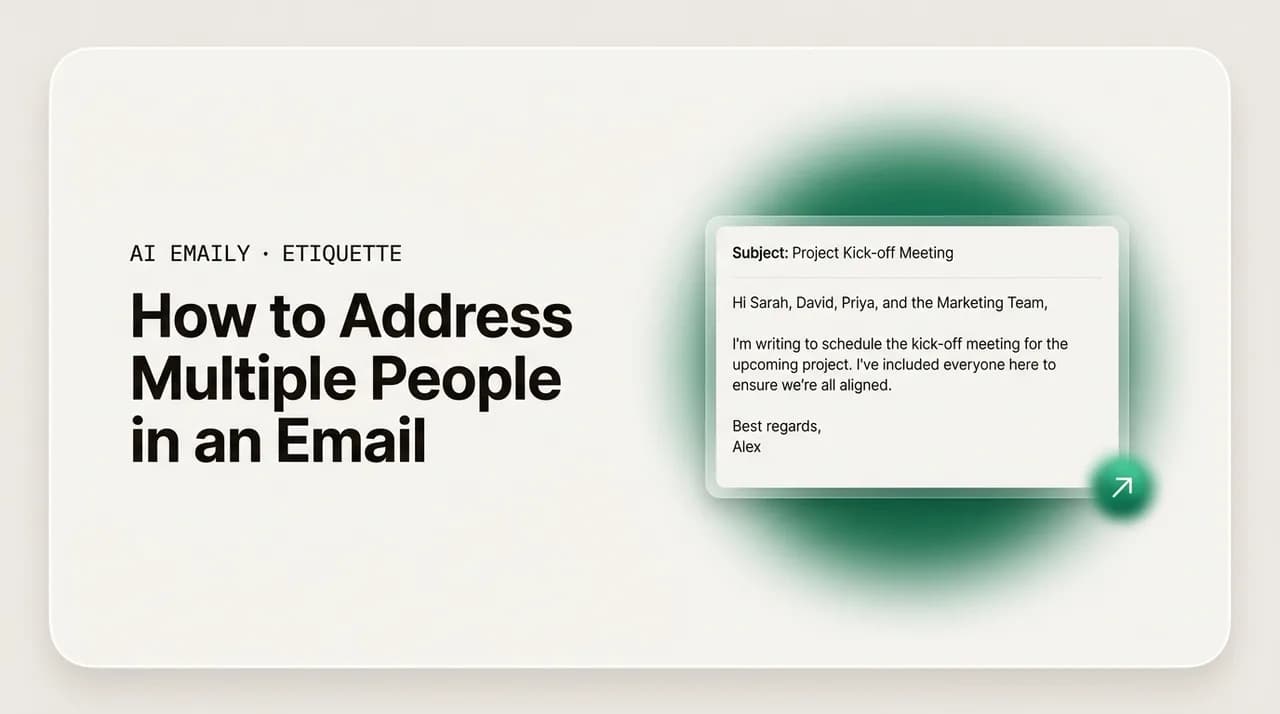
The short answer
How to address multiple people in an email comes down to group size and familiarity: name two or three recipients ("Hi Sam and Priya,"), use "Hi team," or "Hi all," for a known group, and "Hello everyone," for a larger or mixed audience. Match the formality to the most senior reader.
Name two or three recipients, use 'Hi team,' or 'Hi all,' for a known group, and 'Hello everyone,' for a larger one. Match formality to the senior reader.
On this page
- 01Why does addressing multiple people feel harder than one?
- 02How should you address an email to multiple recipients, by group size?
- 03How do you address two or three people in an email?
- 04How do you greet a team or known group?
- 05How do you address a large group or people you don't all know?
- 06How do you address a group with mixed seniority or roles?
- 07When should you use "Hi all" versus "Hi team" versus naming people?
- 08What are the common mistakes when addressing a group?
- 09Does the greeting change with the email's purpose?
- 10How does AI Emaily get group greetings right for every thread?
- 11The bottom line on addressing multiple people
You hit reply, the To field has three names in it, and the cursor parks on the first line. "Hi" — and then what? "Hi Sam," ignores the other two. "Hi everyone," feels oversized for three people you all know. "Hi all," feels right but a little lazy. "Dear Sam, Priya, and Jordan," is correct but reads like a wedding invitation. So you type something, delete it, type it again, and lose ninety seconds on a greeting for an email that takes forty seconds to write. Multiply that by every group thread in a week and it adds up to a surprising amount of low-grade friction.
Addressing one person is easy — you say their name. The moment a second name lands in the To field, the simple greeting breaks, and the bigger the group, the less obvious the answer gets. Two close colleagues, a five-person project team, a forty-person all-hands, a mixed external group where some people are senior and some you have never met — each one wants a different opening, and getting it wrong sends a small signal. Name only the first person and the rest feel like an afterthought. Use a stiff "Dear all," with your own team and it reads like you forgot who you were talking to. Use a breezy "Hey everyone!" with a client's leadership and it reads as too casual for the room.
This guide is the complete reference for greeting more than one person at once. You will get a clear rule for the two- and three-person case, the right way to greet a team you know, what to do when the group is large or you do not know everyone, and how to handle the hardest case — a mixed group spanning juniors and executives, internal and external, where one greeting has to work for all of them. There is a master table that maps group size and context straight to the greeting to use, worked examples for the common situations, and a plain breakdown of when to reach for "Hi all," versus "Hi team," versus naming people one by one.
We will keep it practical: a default you can fall back on, the specific reasons to deviate, and the mechanics that quietly signal care — name order, comma placement, first names versus titles. Near the end we look at the part nobody mentions: that you make this call on every group email, all day, and what an AI-native email client does so the right greeting lands without you stopping to choose it.
Why does addressing multiple people feel harder than one?#
A greeting to one person carries no real decision. You write their name, you move on. The difficulty in a group greeting is that a single line now has to do several jobs at once, and those jobs can pull in different directions. Understanding the jobs is what lets you pick the right opening fast instead of cycling through three drafts.
First, the greeting has to acknowledge everyone, or at least not exclude anyone. The reason "Hi Sam," feels wrong on an email to three people is that it quietly tells Priya and Jordan they are along for the ride — copied, not addressed. People notice when they are greeted and notice more when they are not. A group greeting either names each person or uses a collective term ("team," "all," "everyone") that genuinely includes them. What it cannot do is single one person out as the real recipient while the others watch.
Second, it has to set one tone for a room that may not be uniform. With a single reader you match the greeting to that one relationship. With a group you are matching it to a mix — and the safe move is to pitch to the most formal person present, not the most familiar. A greeting that is comfortable for your two teammates can be too loose for the director also on the thread. The group greeting sets the register for the whole message, so it has to clear the bar of the most senior or least familiar reader in the To field.
Third, it has to scale. The greeting that is warm and correct for two people ("Hi Sam and Priya,") becomes absurd at fifteen — you are not going to list fifteen names — and the collective term that is perfect for fifteen ("Hi everyone,") feels oddly impersonal for two people you talk to daily. So the right answer genuinely changes with the size of the group, which is why a one-size greeting does not exist and why people stall. The good news is that the size-to-greeting mapping is simple once you see it laid out, which is the next section.
There is a fourth, quieter job: the greeting signals how you see the group. Naming people individually says "I am writing to you, specifically." A collective "Hi team," says "I am addressing this as a unit." Neither is better in the abstract, but they send different signals, and the mismatch is what reads as off. Pick the form that matches how the group actually functions, and the greeting lands as natural.
The core idea in one line
How should you address an email to multiple recipients, by group size?#
Almost every group greeting decision comes down to two things: how many people are in the To field, and how well you know them. Hold those two variables together and the right greeting falls out. The table below is the master map — group size and context on the left, the greeting to use on the right. If you read one part of this guide, read this.
The rule of thumb underneath it: name people while it is still reasonable to (roughly up to three, sometimes four), switch to a collective term once a list would be unwieldy, and lift the formality of that collective term to match the most formal reader present. When you are genuinely unsure, "Hi all," for a known group and "Hello everyone," for a larger or mixed one are the two defaults that are hard to get wrong.
| Group size / context | Greeting to use | Why |
|---|---|---|
| 2 people you know | Hi Sam and Priya, | Small enough to name; naming both shows you are writing to each of them |
| 2–3 people, formal | Dear Dr. Reyes and Ms. Okafor, | Names with titles when the relationship or context is formal |
| 3 people you know | Hi Sam, Priya, and Jordan, | Still nameable; list all three with an Oxford comma before the last |
| 4–5 people, your team | Hi team, / Hi all, | Too many to name comfortably; a collective term fits a known group |
| A defined project group | Hi team, / Hi project team, | "Team" suits a group that functions as a unit |
| 6–15 people, mixed | Hi everyone, / Hello all, | Collective and neutral; works when you do not know each person equally |
| Large list / all-hands | Hello everyone, / Hi all, | The only sensible option at scale; warm but not over-familiar |
| Mixed seniority | Hello everyone, / Hi all, | Neutral collective avoids ranking people or singling anyone out |
| External / first contact | Dear all, / Hello everyone, | Slightly more formal collective for people you do not yet know |
| Formal, named, external | Dear Mr. Adeyemi and Ms. Chen, | Name with titles for a small formal external group |
A few notes on reading the table. The dividing line that matters most is the jump from "nameable" to "too many to name" — somewhere around three or four people. Below it, naming each person is warmer and more correct. Above it, a collective term is not lazy; it is the right call, because a wall of names reads worse than a clean "Hi everyone,". The second line that matters is formality: every collective term has a warmer and a cooler version ("Hi all," vs "Dear all,"; "Hi everyone," vs "Hello everyone,"), and you pick the one that fits the most formal person in the group. We break down each band — two and three people, known teams, large and mixed groups — in the sections that follow.
The two defaults worth memorizing
How do you address two or three people in an email?#
When the group is small enough to name — two people, three, sometimes a stretch to four — naming each person is the warmest and most correct choice. It tells every recipient you are writing to them specifically, not copying them on something aimed at someone else. The mechanics are simple but worth getting right, because the small errors (wrong order, missing comma, one name out of place) are exactly the kind of thing an attentive reader notices.
For two people, join the names with "and": "Hi Sam and Priya,". For three, list them with commas and an "and" before the last name, using the Oxford comma for clarity: "Hi Sam, Priya, and Jordan,". Keep it to first names when the relationship is informal, and use titles and last names when it is formal: "Dear Dr. Reyes and Ms. Okafor,". Do not mix registers within one greeting — "Hi Sam and Ms. Okafor," reads as if you respect one person more than the other, so either go first-name for both or title-for-both, matched to the more formal of the two.
Order matters more than people think. The default is to list names in order of seniority when there is a clear hierarchy — the most senior person first — which reads as respectful and is the safe choice for external or formal groups. Among peers where no hierarchy applies, alphabetical order or the order people joined the thread both work and avoid any appearance of ranking. The one order to avoid is putting the most junior person first while a senior recipient waits, on a formal email, because some readers do read significance into it. Here is the small-group set laid out.
The judgment call at three or four people is whether the list still reads cleanly or has started to feel like a recitation. "Hi Sam, Priya, and Jordan," is comfortable. "Hi Sam, Priya, Jordan, Alex, and Morgan," is a mouthful the reader skims past — at that point a collective "Hi all," is genuinely better. A useful test: if you would not say all the names out loud when greeting the group in person, do not list them all in the email.
Two mechanical points that signal care. First, capitalize names and the first word of the greeting, and put a comma after the greeting before you drop to the body: "Hi Sam and Priya," then a new line. Second, double-check spellings — getting a recipient's name wrong in the greeting, especially the first time you write to them, undercuts the whole message no matter how good the content is. On a group email this risk multiplies, because you now have several names to get right, and the one you misspell is the one who will notice.
List names in a defensible order
How do you greet a team or known group?#
Once the group is too large to name comfortably — roughly five people and up — but you all know each other, a collective greeting is the right move. It is not a fallback; it is the correct form for addressing a group as a unit. The question becomes which collective term, and the two everyday workhorses are "Hi team," and "Hi all,". They are close, but they carry slightly different signals.
"Hi team," works when the group genuinely functions as a team — a project pod, a department, people with a shared goal and an ongoing working relationship. It is warm and a little rallying; it says "us." Use it for your own team and for groups that think of themselves as one. The risk is using it for a group that is not actually a team — a random collection of people copied on one thread, or an external mix — where "team" can ring slightly false, like you are assuming a closeness that is not there.
"Hi all," is the more neutral, broadly safe collective for a known group. It does not assume the recipients are a unit; it simply addresses everyone present. It works for your team, for a cross-functional group, for a thread that pulled several people together, and it never overreaches. "Hi everyone," is its slightly warmer, slightly larger-feeling sibling — natural for a bigger known group and for an all-hands tone. For a known internal group, any of these three is fine; the choice is mostly about whether the group is a true "team" and how warm you want to land. Here is the known-group set.
One thing to avoid with team greetings: do not over-personalize a collective. "Hi team — and especially Sam," or singling out one person in a group greeting makes everyone else feel secondary and is better handled by addressing that person in the body ("Sam, could you take the first item?"). The greeting includes everyone equally; the body is where you direct specific people to specific things. Keeping that split clean is what lets a group email feel both inclusive at the top and actionable in the middle.
A note on warmth versus efficiency. Some writers worry a collective greeting feels impersonal next to naming people. For a known group it does not — "Hi team," reads as perfectly warm because the relationship carries the warmth, not the greeting. A collective only feels cold with a group that does not know you, which is the external and mixed case we cover next. For your own people, trust the collective: the closeness is already there, and a clean "Hi all," beats an awkward list of seven names every time.
Team vs all vs everyone
How do you address a large group or people you don't all know?#
When the To field holds a dozen people, or a distribution list, or a group where you genuinely do not know everyone, naming is off the table and warmth-by-relationship cannot carry the greeting. Here the job is to address everyone neutrally, clearly, and without singling anyone out — and to pitch the formality a notch up, because some readers do not know you and a too-casual opening reads as presumptuous from a stranger.
The reliable choices are "Hello everyone," and "Hi all," — both include the whole room and neither assumes a closeness that is not there. "Hello everyone," is the slightly more formal and broadly safe pick for a large or unfamiliar group; "Hi all," is its warmer, more internal-feeling cousin. For a more formal external audience, "Dear all," or "Dear colleagues," raises the register appropriately. Avoid "Hey everyone!" and other breezy openings with a large or unfamiliar group — what reads as friendly to your team reads as too loose to people deciding whether to take you seriously.
Two collective greetings to retire: "Dear Sirs," and "Dear Gentlemen," assume the group is all men and read as both dated and exclusionary — "Dear all," or "Hello everyone," does the same job without the problem. And "To whom it may concern," is for when you do not know who will read the message at all (a general inbox, an unknown department); it is not a greeting for a group of actual people whose names you have, where it reads as cold and impersonal. Here is the large-and-unfamiliar set.
A practical caution on large groups: who is in the To field versus the CC field changes the greeting. The people in To are the ones you are addressing and asking to act; the people in CC are kept in the loop but not directly addressed. So your greeting should speak to the To recipients, and if you need someone in CC to see a specific thing, name them in the body ("Adding Priya in CC for visibility on the timeline"). Greeting the CC line as if they were the audience confuses who owns the action. If you are unsure how To, CC, and BCC should split a large group, that is its own decision worth getting right — and it directly shapes who your greeting is even for.
And mind the privacy mechanics on large external lists. If you are emailing a group of people who do not know each other — customers, applicants, a list of external contacts — putting them all in To or CC exposes everyone's address to everyone else, which is both awkward and, in some places, a data-protection problem. For that case you address the group with a collective greeting and put the recipients in BCC, so each person sees a clean message addressed to "Hello everyone," without the others' emails on display. The greeting stays collective; the privacy is handled by the field you use.
Use BCC for large external lists
How do you address a group with mixed seniority or roles?#
The hardest case is a group that is not uniform — a thread with your peer, your manager, and a client's VP all on it; a message to a project group that mixes junior contributors and senior stakeholders; an external audience where some people you know well and some you have never met. One greeting has to work for all of them, and the temptation to rank people or to pitch to the friendliest reader is exactly what gets you in trouble.
The rule is simple and saves you every time: pitch the greeting to the most senior or least familiar person in the group, and use a neutral collective that does not rank anyone. "Hello everyone," and "Hi all," are ideal here precisely because they treat the group as equals — no one is named first, no one is left out, no one is implicitly ranked above another. A collective greeting sidesteps the entire problem of order and title that naming a mixed group would create. If you tried to name a mixed-seniority group, you would have to decide whether the VP or your manager comes first, whether to use titles for some and first names for others — all of it fraught. The collective greeting makes that decision disappear.
When you do need to name people in a mixed group — say it is small and formal — lead with the most senior person, use titles consistently, and keep the register formal throughout: "Dear Dr. Adeyemi, Ms. Chen, and the project team,". Notice the move at the end: when a few named seniors sit atop a larger group, you can name the leaders and fold the rest into a collective ("and the project team," "and colleagues,"), which respects the hierarchy without forcing you to list everyone. Here is how the mixed-group cases break down.
| Mixed situation | Greeting to use | Why it works |
|---|---|---|
| Peers + your manager | Hi all, / Hi everyone, | Neutral collective; no one is ranked or singled out |
| Internal + a senior external | Hello everyone, / Hello all, | Slightly formal collective clears the bar for the external reader |
| Small, formal, named | Dear Dr. Reyes and Ms. Okafor, | Name by seniority with consistent titles when the group is small |
| Named leaders + a wider team | Dear Dr. Adeyemi and the project team, | Name the seniors, fold the rest into a collective |
| Client side + your side | Hi everyone, / Hello all, | One register for both companies; avoids favoring either side |
| You know some, not others | Hello everyone, | Neutral and warm enough; does not assume closeness you lack with some |
The deeper principle behind the mixed-group rule is that a greeting is a public act — everyone on the thread sees how everyone else was addressed. With a single reader it is between you and them; with a group it is a small piece of theater the whole room watches, and any unevenness shows. That is why "Hi Sam, and hello to the rest of the team," reads badly: it visibly tiers people. The neutral collective is not just convenient — it treats the visible audience fairly, which is exactly what a mixed group needs.
When should you use "Hi all" versus "Hi team" versus naming people?#
These three forms cover almost every group email, and the choice between them is the decision people actually stall on. Here is the clean way to decide, in order. Start with size: if the group is small enough to name without it feeling like a recitation — two, three, occasionally four — name them, because naming is the warmest, most specific greeting and it tells each person you are writing to them. "Hi Sam and Priya," beats "Hi all," for two people every time.
Once naming would be unwieldy, switch to a collective and pick between "team" and "all" by what the group is. Use "Hi team," when the recipients genuinely are a team — a pod, a department, a group with a shared goal and an ongoing relationship — because "team" signals unity and only rings true when the unity is real. Use "Hi all," when the group is a known collection of people who are not necessarily a unit — a cross-functional thread, a mix of folks pulled together for one thing — because "all" addresses everyone without assuming closeness. And step up to "Hello everyone," or "Dear all," when the group is large, mixed-seniority, external, or includes people who do not know you, where neutrality and a touch more formality serve you better than warmth.
The whole decision in one pass: name a small known group; "Hi team," for a real team; "Hi all," for a known mixed group; "Hello everyone," or "Dear all," for large, formal, or unfamiliar. The steps below walk it in order so you can run it in a couple of seconds on any group email.
- 1
Count the addressable recipients
Look only at the To field — the people you are actually addressing, not CC. Two to three or four? Lean toward naming them. Five or more? Use a collective greeting.
- 2
If small, name them in a defensible order
List by seniority when there is a hierarchy, alphabetical or thread order among peers. Join two with "and," three with commas plus an Oxford comma. Match titles or first names to the more formal recipient.
- 3
If larger, ask whether the group is a real team
If they function as a unit with a shared goal, "Hi team," fits and reads warm. If they are a known but loose collection of people, "Hi all," is the neutral, safe collective.
- 4
Check the most senior or least familiar reader
Pitch the formality to that person, not to your friendliest contact on the thread. A senior or external presence pushes you from "Hi all," toward "Hello everyone," or "Dear all,".
- 5
Confirm the greeting includes everyone equally
No one named ahead of the group, no one singled out in the greeting line. Direct specific people to specific tasks in the body, never in the salutation.
The fast version
A few patterns worth internalizing so the decision becomes reflex. "Hi all," is the single most useful group greeting for everyday internal email — warm enough for people you know, neutral enough that it never overreaches, the closest thing to a universal collective. "Hi team," is its more specific cousin: better when the group is a real team, slightly off when it is not. Naming people is reserved for genuinely small groups, where it adds warmth rather than friction. And the moment a group goes external, large, or mixed-seniority, you trade a little warmth for neutrality and step toward "Hello everyone," or "Dear all,". Hold those four moves and you will never stall on a group greeting again.
One more practical note: time-of-day greetings ("Good morning all," "Good afternoon everyone,") are a friendly, human option for groups, especially internal ones, but they assume the reader opens the email roughly when you sent it — which often is not true. For a same-region team sending in the morning, they read warmly. For a distributed group across time zones, a plain "Hi all," avoids the small dissonance of "Good morning" landing in someone's evening. A small thing, but in a global, asynchronous 2026 inbox it is worth a half-second of thought.
What are the common mistakes when addressing a group?#
Most group-greeting errors are not exotic — they are the same handful of mistakes, repeated. Knowing them by name lets you catch them before you hit send, which matters more on a group email because more people see the slip. Here is the honest list, with the reason each one lands wrong and the fix.
The most common is naming only the first person on a multi-recipient email — "Hi Sam," when Priya and Jordan are also in To. It tells the others they are copied, not addressed, and it is the error people feel most. The fix is to name everyone (small group) or use a collective (larger group). Close behind is leaving the greeting off entirely and diving into the body, which reads as curt to a group exactly as it does to an individual — a quick "Hi all," costs nothing and fixes it. Then there is mismatching the register across names — "Hi Dr. Reyes and Sam," — which signals you respect one recipient more than another; pick one register for the whole greeting.
Other frequent ones: using "Hi team," for a group that is not a team (a one-off thread of unrelated people), which rings false; over-formalizing your own colleagues with "Dear all," when "Hi all," is the natural fit; using dated or exclusionary openings like "Dear Sirs," on a mixed group; greeting the CC line as if they were the audience; and exposing a large external list's addresses by putting everyone in To or CC instead of BCC. The table lays out the mistakes and the swaps.
| Mistake | Why it lands wrong | Do this instead |
|---|---|---|
| "Hi Sam," on a three-person email | Tells Priya and Jordan they are copied, not addressed | Name all three, or use "Hi all," |
| No greeting at all | Reads curt to a group, same as to one person | Hi all, / Hello everyone, |
| Mixed register: "Hi Dr. Reyes and Sam," | Signals you respect one recipient more than another | One register for both: first names or titles throughout |
| "Hi team," for a non-team | Assumes a closeness/unit that is not there | Hi all, / Hi everyone, |
| "Dear all," for your own colleagues | Over-formal for a familiar internal group | Hi all, / Hi team, |
| "Dear Sirs," / "Dear Gentlemen," | Dated and assumes the group is all men | Dear all, / Hello everyone, |
| Greeting the CC line | Confuses who is being addressed and asked to act | Greet the To recipients; name CC folks in the body |
| External list all in To/CC | Exposes everyone's email address to the whole list | BCC the list; greet with "Hello everyone," |
| Naming a 15-person group | A wall of names reads worse than a clean collective | Hi everyone, / Hello all, |
| Singling one person out in the greeting | Makes the rest of the group feel secondary | Greet everyone equally; direct people in the body |
The pattern across the whole list is the same as with any greeting: the form is fine somewhere, just not where it was used. "Hi team," is right for a team and wrong for a random thread. "Dear all," is right for an external group and over-formal for your pod. Naming people is right for three and absurd for fifteen. So the fix is never to memorize banned phrases — it is to read the two variables (how many, how well you know them), pick the form that fits both, and pitch the formality to the most senior reader. When in doubt, the neutral collective ("Hi all," for known, "Hello everyone," for larger or mixed) is the one that is hard to get wrong.
The first-name-only trap
Does the greeting change with the email's purpose?#
Size and familiarity decide the form of the greeting; purpose tunes the warmth and what comes right after it. The same group can get a slightly different opening depending on what the email is doing, and matching that makes the whole message read as deliberate.
If you are asking the group to do something, keep the greeting clean and move quickly to the ask — "Hi all," then the request and the deadline — and use the body to direct specific people to specific items rather than crowding the greeting. If you are sharing news or an update, the collective greeting sets a we-are-all-in-this tone that fits: "Hi everyone," then the update. If you are thanking a group — after a launch, a push, a favor from several people — a warm collective plus genuine thanks lands well: "Hi team — thank you all for the effort this week." And if the email is sensitive (a change, a setback, an apology to a group), keep the greeting neutral and the tone calm — "Hello everyone," rather than a breezy "Hey all!" — so the opening matches the weight of the message.
The through-line is consistency: the greeting, the body, and the sign-off should sit at the same level of formality, and that level is set by the most senior or least familiar person in the group. A warm "Hi team," pairs with a friendly close like "Thanks, all" or "Cheers"; a formal "Dear all," to an external group pairs with "Best regards" or "Kind regards." Pick the register once — at the greeting — and carry it through so the whole email sounds like one voice addressing one room.
Greeting and close should match
How does AI Emaily get group greetings right for every thread?#
Here is the part nobody talks about. None of this is hard once — the hard part is doing it on every group thread, all day. Two-person replies, five-person project threads, an all-hands, a mixed external group with a VP and two people you have never met — they all land in the same inbox, each wanting a slightly different opening, and you are making the size-and-formality call dozens of times a day, mostly on autopilot. That is exactly where "Hi Sam," slips onto an email to three people, where a breezy "Hey everyone!" lands on a client's leadership, and where the greeting eats ninety seconds you did not have.
AI Emaily is an AI-native email client built to take that decision off your plate. When it drafts a reply, it reads who is actually in the thread — how many people, who is internal versus external, who is senior — and opens with the greeting that fits: it names a small group, uses "Hi team," or "Hi all," for a known group, and lifts to "Hello everyone," or a more formal collective when the room is large or mixed. It learns your voice from the emails you have actually sent, so the warmth matches how you genuinely write — and it keeps the greeting, body, and sign-off in one consistent register so the whole message reads as you, addressing that specific group.
It works across every email account you connect — Gmail, Outlook, and any IMAP provider — in one place, so the same judgment applies wherever you write. And it is private by design: your mail is yours, used to draft for you, not to train models for anyone else.
You stay in control the whole time. In its default Copilot mode, AI Emaily drafts the reply with the right group greeting and tone and waits — nothing sends until you approve it, so you can tweak the opening or swap a name before it goes. You can start free at app.aiemaily.com/signup: the Free plan is $0 and connects your inbox with AI drafting, and Pro is $12.42/month billed annually when you want it across everything you send. The point is not that a machine writes your greetings — it is that the right one lands without you stopping to count names and weigh seniority on every group email.
Try it on your own group threads
The bottom line on addressing multiple people#
Addressing a group is two variables, not a hundred rules: how many people are in the To field, and how well you know them. Below three or four, name everyone — it is the warmest, most specific greeting and it tells each person you are writing to them. Above that, switch to a collective, because a wall of names reads worse than a clean "Hi all,". Then pick the collective by what the group is — "Hi team," for a real team, "Hi all," for a known mixed group, "Hello everyone," or "Dear all," for large, formal, or unfamiliar — and pitch the formality to the most senior or least familiar person on the thread.
From there, the rest is mechanics that signal care: list names in a defensible order, keep one register across the whole greeting, greet the To recipients (not the CC line), BCC large external lists so you do not expose addresses, and keep the greeting, body, and sign-off in the same voice. Skip the openings that read dated or exclusionary, never single one person out in the greeting line, and never leave the greeting off — to a group it reads just as curt as it does to one person.
Do that consistently and the group greeting stops being a thing you stall on. If you would rather not count names and weigh seniority on every thread, that is exactly what AI Emaily handles — reading who is in the room and opening with the greeting that fits your voice and the group, while you keep final say. Either way, the principle holds: address everyone, set one tone for the room, and let the size of the group choose the form.
Frequently asked
See it in AI Emaily
Keep reading
Sources

Written by
Nafiul HasanNafiul Hasan is an entrepreneur and AI automation system builder with 10+ years of experience turning messy, manual workflows into reliable automated systems. He designs and ships AI enterprise solutions end-to-end — the agent logic, the data plumbing, and the product people actually use — and founded AI Emaily to give busy professionals their attention back. He writes here from the builder's seat: what works, what breaks, and how to put AI to work without giving up control.