How to Respond to Med Spa Leads Faster: Win the 5-Minute Window

The short answer
Med spa lead response speed decides who books the consult. Leads answered within about five minutes convert far better than ones answered an hour later, and paid-social inquiries are comparison-shopping in real time. Send an instant acknowledgment, follow with a voice-matched personal reply, cover after-hours, and keep clinical or PHI content human.
A practical guide to faster med spa lead response: why the 5-minute window decides who books the consult, why clinics are slow, and a fast-response system that stays HIPAA-safe.
On this page
- 01Why med spa lead response speed decides who books the consult
- 02What is the 5-minute lead response window, and why does it matter?
- 03Why are med spas so slow to respond to leads?
- 04What does a fast med spa lead response system look like?
- 05Instant acknowledgment vs. the personal reply: how they work together
- 06What should your instant med spa lead reply say?
- 07How do you handle med spa leads after hours and on weekends?
- 08Response time vs. booking rate: what the numbers show
- 09How AI Emaily helps med spas respond faster (without crossing the clinical line)
- 10Putting it all together
Why med spa lead response speed decides who books the consult#
A prospective client fills out your form at 8:47 on a Tuesday night. She saw your Instagram ad, tapped through, typed her name and number, and asked about lip filler. In that moment she is not loyal to your clinic. She is curious, a little nervous, and she has four other tabs open, because the same ad platform that showed her your ad showed her three competitors' ads too. Whoever replies first, clearly and warmly, gets to shape the conversation. Whoever replies Monday morning is answering a lead who already booked somewhere else. Med spa lead response is not a customer-service nicety; it is the single biggest lever on whether a paid lead ever becomes a paying client.
This guide is about closing that gap. Not with a bigger front desk or a stern policy about checking email, but with a system: an instant acknowledgment that goes out in seconds, a personal reply that follows in minutes, a plan for nights and weekends, and a hard line around clinical content so speed never becomes a compliance problem. We will look at why the five-minute window matters so much, why clinics that know it still miss it, and exactly how to build a response process that a solo injector or a multi-location group can both run.
The uncomfortable truth underneath all of it: most med spas lose more revenue to slow replies than to bad ads. You can pour money into cost-per-lead, tighten your targeting, and refresh your creative every two weeks, and none of it matters if the leads you buy sit unanswered while a competitor two miles away answers theirs in ninety seconds. Speed is the cheapest growth lever you have, because you already paid for the lead. All that is left is to pick it up.
It helps to be concrete about the money. In injectables, cost-per-lead often runs somewhere in the range of a few dollars to the mid-twenties, and a single visit can be worth several hundred to a couple thousand dollars. So a lead is cheap to acquire and expensive to waste. When you let a form fill go cold, you are not just losing a reply; you are throwing away the ad spend that produced it and the lifetime value of a client who might have come back four times a year. Faster med spa lead response is the rare improvement that raises revenue without raising your ad budget by a dollar.
There is also a quieter reason speed wins: it signals competence. A prospect judging two clinics she has never visited has almost nothing to go on. She cannot compare your injecting technique from a form. What she can compare is how each clinic treats her the moment she raises her hand. A fast, human, reassuring reply reads as "this place is organized and cares." Silence, or a canned message three days later, reads as "this place is chaotic." You are being interviewed for the job of putting a needle near her face, and the first question is: do you answer the phone?
What is the 5-minute lead response window, and why does it matter?#
The five-minute window is a well-documented finding from lead-response research: the odds of actually connecting with and qualifying an inbound lead collapse fast in the first hour, and the drop-off is steepest in the first several minutes. The classic analysis of thousands of inbound leads found that contacting a lead within five minutes made you dramatically more likely to reach and qualify them than waiting even thirty minutes, and the advantage over waiting an hour or a day was enormous. A widely cited summary of that work puts it starkly: leads reached within about five minutes are on the order of a hundred times likelier to convert than leads reached after thirty.
Why is the curve so steep? Two reasons, and both apply hard to aesthetics. First, intent decays. The moment someone submits a form is the moment their interest peaks. Five minutes later they have moved on to the next tab, the next task, the next distraction. An hour later they may not remember which clinic they even filled out. You are not fighting to be chosen; you are fighting to still exist in their attention. Second, and specific to paid social, they are comparison-shopping in parallel. They did not fill out one form. They filled out several, because the ad platforms served them a row of similar clinics, and the fastest, warmest responder gets to frame the decision before anyone else shows up.
For a med spa, this compounds. The treatments you sell are considered, a little scary, and highly personal. A prospect wants reassurance more than information. The clinic that reaches her while she is still in the anxious, curious, ready-to-be-reassured state gets to be the calm voice that answers her question and offers a consult. The clinic that reaches her two days later is interrupting a decision she has already made. Same lead, same ad, wildly different outcome, and the only variable that changed was the clock.
"Five minutes" is a target, not a magic number
It is worth separating two things the window is often confused with. The first is the instant acknowledgment: an immediate reply that tells the lead "we got your message, a real person is coming." That can and should be automatic and near-instant. The second is the personal, qualifying response: a human, or a human-approved draft, that actually engages with what she asked and moves her toward booking. The five-minute research is really about that second one, the meaningful contact. But the acknowledgment buys you room, because a lead who has heard from you in ten seconds is far more willing to wait five minutes for the substantive reply than a lead who has heard nothing at all.
So the practical goal is a one-two: acknowledge in seconds, respond in minutes. Most clinics do neither. They respond in hours or days, if at all, and lose the window twice over. The rest of this guide is about building the one-two so it happens reliably, even when the provider is elbow-deep in a treatment and there is no one at the desk.
Why are med spas so slow to respond to leads?#
If speed is this valuable and this well-known, why do so many clinics miss the window? Not because owners are lazy or do not care. They miss it because of the specific, structural way a med spa runs. The person best equipped to answer a lead is almost never free at the moment the lead arrives. Understanding exactly where the delay comes from is the first step to designing around it.
- The provider is in a treatment. In a solo or small clinic, the injector or aesthetician is the front desk, and they are inside a treatment room with gloved hands for most of the day. A lead that lands at 2:15 sits until the appointment ends, the room is cleaned, and someone finally glances at the phone, by which point the window is long gone.
- The front desk is busy with in-chair clients. In a larger clinic there is a coordinator, but that person is checking clients in, taking payments, answering the phone, and managing the schedule. A web form is a background task that loses every time to a person standing at the counter, so it gets triaged to "later," and later is often tomorrow.
- Leads arrive after hours. Paid-social inquiries skew toward evenings and weekends, precisely when the clinic is closed. A Friday-night form fill has no one to catch it until Monday, and by Monday the lead has visited three competitors and booked one of them.
- The inbox is fragmented. Leads come in through the website form, Instagram DMs, a Facebook lead ad, a Google form extension, and email, all landing in different places. No single person owns all of them, so leads slip between the cracks of tools that do not talk to each other.
- Nobody owns the clock. Even clinics that intend to respond fast rarely have a written rule about how fast, who is responsible, or what happens after hours. Without an owner and a target, "respond quickly" quietly becomes "respond when someone gets to it."
- Fear of saying the wrong thing. Aesthetic staff know they are handling medical-adjacent inquiries, so they hesitate to fire off a quick reply about a treatment, worried about promising a result or crossing into clinical advice. That caution is correct, but without a safe default reply it turns into delay.
Notice that almost none of these is a motivation problem. They are all logistics problems. The provider wants to answer the lead; she is just holding a syringe. The coordinator wants to answer the lead; there is just a client at the counter. This matters because logistics problems have logistics solutions. You do not fix slow response by telling a busy team to "be faster," which only adds guilt. You fix it by removing the human from the critical path for the parts that do not need a human, so that the acknowledgment goes out whether or not anyone is free, and the personal reply is teed up and ready the instant someone is.
The solo provider case is the sharpest version of this. A single injector with no front desk cannot, by definition, answer a lead during a treatment. There is no one else. For that clinic, an instant automatic acknowledgment is not a nice-to-have; it is the only way a 2 p.m. lead hears anything before 5 p.m. And in the hours after a booking, the same gap opens again: the pre-visit stretch where an anxious client goes quiet and, without any nurture, quietly cancels or no-shows. Speed of first response and consistency of follow-up are the same muscle, and solo clinics feel the ache most.
Diagnose your own lag first
What does a fast med spa lead response system look like?#
A reliable fast-response system is not one heroic habit; it is a short chain of steps where each link removes a common way leads go cold. The goal is that any inquiry, on any channel, at any hour, gets an instant acknowledgment and then a real, personal reply as fast as a human can send it, without depending on anyone remembering to check a form between clients. Here is the system, step by step.
- 1
Consolidate every lead into one inbox
Route the website form, Facebook and Instagram lead ads, DMs, and Google inquiries so they all surface in a single place a person actually watches. You cannot respond fast to leads scattered across five tools nobody owns. One inbox, one owner, one queue.
- 2
Fire an instant acknowledgment in seconds
The moment a lead arrives, send an automatic reply that confirms you received it, sounds like your clinic, and sets expectations: a real person will follow up shortly, and here is how to book faster in the meantime. This runs whether or not anyone is free, which is the whole point.
- 3
Send the personal reply within minutes
Follow the acknowledgment with a human, or human-approved, reply that engages with what they actually asked and offers a specific next step, usually a consult time or a booking link. This is the contact the five-minute research is really about, so protect it fiercely.
- 4
Default every reply toward booking a consult
The job of a first response is not to quote a price or diagnose anything; it is to book the consult. Every reply should make the next step obvious and easy: two or three suggested times, or a link that lets them self-book in ten seconds. Ambiguity is friction, and friction is delay.
- 5
Assign an owner and a target time
Write down who is responsible for lead response and the number they are held to, for example an acknowledgment in under a minute and a personal reply in under ten. A target nobody owns is a wish. Put a name and a clock on it.
- 6
Cover nights and weekends explicitly
Decide in advance what happens to a 9 p.m. Friday lead. An instant after-hours acknowledgment plus a first-thing-Monday personal reply beats silence by a mile, and it holds the lead through the gap when competitors are also dark.
- 7
Keep clinical content out of the fast lane
Speed applies to acknowledgment, scheduling, and general reassurance, never to medical advice or anything involving a specific person's health information. Automated and templated replies stay marketing-and-booking; anything clinical waits for a qualified human. Fast and safe are not in tension if you draw this line clearly.
- 8
Measure and tune
Track response time and consult-booking rate the way you track cost-per-lead. When you can see the number, you can improve it, and small speed gains compound across every lead you have already paid to acquire.
The system works because it separates the two jobs that used to be tangled together. The acknowledgment is instant and automatic, so the lead is never left in silence. The personal reply is fast but human-owned, so the actual conversation stays warm, specific, and safe. Most clinics try to do both jobs with one overworked person and fail at both. Split them, and a solo provider can hit response times that used to require a full front desk.
It also works because it is boring. There is nothing clever here, no growth hack, no secret script. It is a queue, an owner, a clock, and a bright line around clinical content. The clinics that win the five-minute window are not the ones with the best tactics; they are the ones that made fast response a system instead of a hope, so it happens on the busiest, most chaotic day exactly as reliably as on a slow one.
Instant acknowledgment vs. the personal reply: how they work together#
The most useful mental model for med spa lead response is a relay with two runners. The first runner is the instant acknowledgment. Its only job is to make sure the lead is never met with silence. It goes out in seconds, it is automatic, and it can be the same message every time because its content matters less than its speed and warmth. The second runner is the personal reply. Its job is to actually engage, and it can take a few minutes because the first runner already bought that time. Confuse the two, or try to make one runner do both jobs, and you drop the baton.
Here is why the acknowledgment matters more than it looks. A lead who hears absolutely nothing for twenty minutes assumes she was ignored and starts investing in the next clinic. A lead who got a warm, instant "Thanks for reaching out, one of our team will follow up shortly, and if you'd like to grab a consult time now here's the link" feels seen. She is now willing to wait for the real reply, and she may even self-book before it arrives. The acknowledgment does not replace the personal touch; it protects the runway so the personal touch can land.
The personal reply is where the actual persuasion happens, and it is worth doing well rather than fast-and-sloppy. It should reference what she asked, answer the safe part of it, offer reassurance, and propose a concrete next step. "Hi Maria, thanks for asking about lip filler, it's one of our most popular treatments and the consult is complimentary so we can talk through what you're looking for. I have Thursday at 5 or Saturday at 11, would either work?" That is fast, human, specific, and it moves her toward a booking without making a single clinical claim. The acknowledgment kept her warm; the personal reply closes.
Never let the acknowledgment pretend to be a person
What should your instant med spa lead reply say?#
The instant acknowledgment carries a lot of weight for a message you send every time, so it is worth getting the pattern right once and then reusing it. A good one does four things: confirms receipt, sounds like your clinic rather than a system, sets a clear expectation for the real reply, and offers a faster path for anyone ready to move now. It should never make a clinical claim, quote a firm price, or ask for any health details. Here is the shape, with an example you can adapt.
The personal reply that follows should feel like it was written for this person, because it was, even if a template got it most of the way there. Lead with their name and their question, keep it warm and reassuring, answer only the parts you safely can, and end on a specific, easy next step. The template below is a starting point; the value is in swapping in the real treatment they asked about and offering real times.
A few principles hold across every template. Always default toward the consult rather than answering everything in email, both because the consult is where you convert and because it keeps you out of clinical territory. Keep pricing to ranges or "we'll cover that in your consult" unless you have a fixed, published price, because a specific quote by email is easy to get wrong and hard to walk back. And keep the tone unmistakably yours; a prospect who gets a warm, human note is being told something a competitor's cold template cannot say, which is that this clinic pays attention.
Build a small library of these: an acknowledgment, a personal reply, a version for price questions, a version for "just researching" leads, and an after-hours variant. Five or six templates cover the overwhelming majority of inquiries, and having them ready is the difference between a ten-minute reply and a ten-hour one. Templates are not the enemy of a personal touch; they are what makes a personal touch fast enough to matter.
How do you handle med spa leads after hours and on weekends?#
After-hours is where most med spa lead response quietly dies, and it is also where the biggest, cheapest wins hide. Paid-social inquiries cluster in the evenings and on weekends, exactly when the clinic is closed and no human is watching. A lead that arrives at 9 p.m. Friday and hears nothing until Monday has spent an entire weekend being courted by every other ad in her feed. The clinic that at least acknowledges her Friday night, and reaches her first thing Monday, is playing a completely different game than the one whose form goes to a dark inbox.
The good news is that after-hours coverage does not require staffing the front desk at midnight. It requires an instant acknowledgment that runs on its own and a disciplined first-thing follow-up. The acknowledgment holds the lead through the gap: it tells her she was heard, sets the expectation for a real reply, and, crucially, offers a self-booking link so a motivated prospect can lock in a consult without waiting for anyone. Some of your best after-hours leads will book themselves before a human ever touches the thread, but only if you gave them the link.
- Send an honest after-hours acknowledgment. Something like "Thanks for reaching out, our clinic is currently closed but a team member will follow up first thing [next open day]. To book a consultation now, here's our link." It sets expectations and offers a shortcut in one message.
- Always include a self-booking link after hours. The motivated evening lead is your most valuable and most impatient. Let her convert herself instead of forcing her to wait until Monday, when she may be gone.
- Have a first-open-hour ritual. The first thing the responsible person does when the clinic opens is clear the overnight and weekend lead queue with personal replies, before the day's in-chair chaos begins. Owning the clock means owning the morning.
- Do not overpromise availability. If you are closed, say so plainly rather than implying someone is standing by. Honesty in the acknowledgment protects trust; a fake "we'll reply in minutes" at 11 p.m. only disappoints.
- Keep after-hours replies free of clinical content. The temptation to answer a treatment question at night, unsupervised, is exactly when a bright line matters most. Acknowledge, offer to book, and leave anything clinical for a qualified human during hours.
The Friday-night lead is the one you are losing
Response time vs. booking rate: what the numbers show#
It helps to see the relationship laid out. The exact figures vary by study and by clinic, but the shape is consistent everywhere lead response has been measured: the faster the meaningful contact, the higher the odds of connecting and converting, and the decline in the first hour is steep. The table below is illustrative of that well-documented pattern rather than a promise of specific outcomes for your clinic, and it is meant to make the stakes of each extra minute tangible.
| Time to meaningful response | What the lead is doing | Relative likelihood of booking |
|---|---|---|
| Under 5 minutes | Still on your page, intent at its peak, ready to be reassured | Highest, the target window |
| 5 to 30 minutes | Comparison-shopping competitor tabs, attention fading | Strong, but slipping fast |
| 30 to 60 minutes | Moved on to other tasks, may not recall your clinic | Sharply lower than the first five minutes |
| 1 to 24 hours | Likely contacted or booked with a faster competitor | Low, mostly salvage |
| Over 24 hours / next business day | Decision usually already made elsewhere | Very low, near cold |
Two things are worth pulling out of that table. First, the biggest gains are at the very top: the difference between five minutes and thirty is far larger than the difference between one hour and two. That is why an instant acknowledgment plus a fast personal reply matters so much more than, say, shaving your daytime replies from ninety minutes to sixty. You want to move leads out of the bottom rows entirely, not optimize within them. Second, most clinics live in the bottom two rows without realizing it, especially for after-hours leads. If your honest average is "next business day," you are converting the leftovers of your own ad spend. Moving to the top row does not require better leads; it requires a faster system for the leads you already buy.
For a rough sense of the funnel, med spas commonly see somewhere in the range of a fifth to a third of consults convert further down the line, so the consult booking is the hinge the whole economy turns on. Everything upstream, the ad, the click, the form, exists to produce a booked consult, and response speed is the last, cheapest, most-neglected step that decides whether it happens. Win the five-minute window and you are simply keeping more of the consults you already paid to create.
How AI Emaily helps med spas respond faster (without crossing the clinical line)#
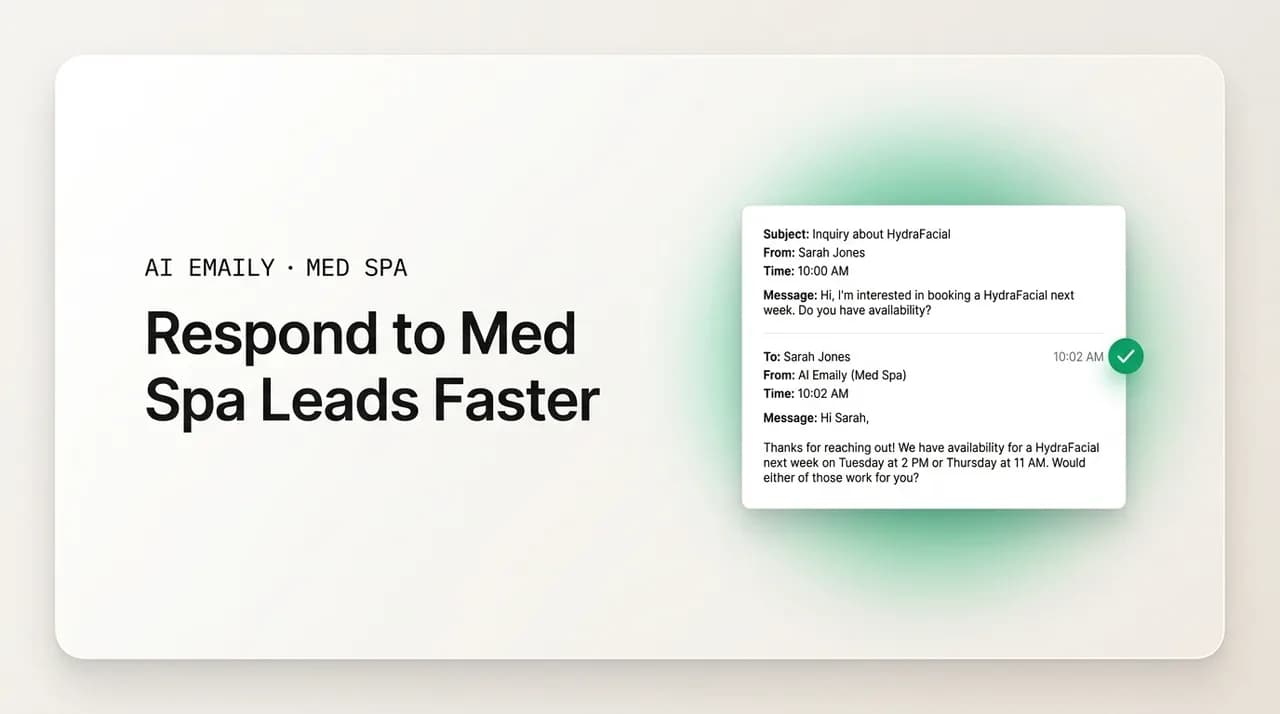
Everything above is doable by hand, and plenty of disciplined clinics run a version of it on willpower and templates. The problem is that willpower is exactly what runs out on the busiest day, which is the day the leads are most valuable. This is the gap an AI-native email client is built to close. AI Emaily connects to Gmail, Outlook, and any IMAP mailbox your clinic uses, watches every lead that lands there, and makes the fast one-two, instant acknowledgment then personal reply, happen automatically instead of hopefully, so a lead that arrives while the injector is in a treatment still hears back in seconds.
Concretely, it does three things that map directly onto the system in this guide. It sends the instant acknowledgment the moment a lead arrives, in your clinic's voice rather than generic boilerplate, so no inquiry is ever met with silence, day or night. It then drafts the personal, booking-focused reply for you, matched to how your clinic actually writes and pointed at getting a consult on the calendar, so the substantive response is teed up and ready the instant a human can glance at it. And because it learns your voice, those drafts do not read like a robot; they read like your best front-desk person on their best day, every time.
The part that matters most for aesthetics is control, and this is where Copilot comes in. AI Emaily runs in Manual, Copilot, and Autopilot modes. For a med spa, the sensible default is Copilot: the acknowledgment can go out instantly on its own, while every personal reply is drafted for you and waits for one tap of approval before it sends. You get the speed of automation and the safety of a human in the loop, with undo and a full audit trail of everything the assistant did. Routine, safe, high-volume messages can graduate to Autopilot when you trust them; anything you want a human to see stays in Copilot. You decide where the line sits, and you can move it as your confidence grows.
The HIPAA guardrail is the point, not an afterthought
The result is that a solo injector with no front desk can respond to leads as fast as a clinic with a dedicated coordinator, and a multi-location group can make fast, on-brand response consistent across every site instead of hoping each front desk hits the window on its own. The assistant is the thing that is always watching the inbox, always ready with a voice-matched draft, and never too busy with an in-chair client to acknowledge the lead who just raised her hand. It is, in the product's own framing, an autonomous chief of staff for your inbox: it triages, drafts, and handles the busywork so your team spends its attention on clients in the room and consults on the calendar, not on refreshing a form between appointments.
You can try it free at app.aiemaily.com/signup, with a Free plan at no cost and Pro at $12.42 per month on the annual plan. The fastest way to feel the difference is to point it at whatever inbox your leads already land in and watch the next after-hours inquiry get a warm, instant reply while you are nowhere near your phone.
Putting it all together#
Med spa lead response comes down to a single, cheap, repeatable idea: reach the lead while she is still warm, and never let her sit in silence. The five-minute window is real, the decay in the first hour is steep, and paid-social leads are comparison-shopping the instant they submit a form, so the clinic that answers first, warmly and clearly, usually gets to book the consult. None of that requires better ads or a bigger team. It requires a system.
That system is the one-two: an instant acknowledgment in seconds that keeps the lead from ever hearing nothing, followed by a fast, personal, booking-focused reply from a human or a human-approved draft. Consolidate every lead into one watched inbox, put a name and a clock on the response, cover nights and weekends with an honest after-hours acknowledgment and a self-booking link, and draw a bright line so clinical content and PHI stay with a qualified person while acknowledgment and scheduling move fast. Measure your response time the way you measure cost-per-lead, because the leads you already paid for are the cheapest growth you will ever find.
And if the willpower to do all of that reliably on the busiest day is exactly what tends to run out, that is precisely the work an AI email client can carry: instant acknowledgment, voice-matched consult-booking drafts, Copilot approval, and a hard guardrail keeping the clinical conversation human. Win the five-minute window and you stop losing consults you already bought. That is the whole game.
Frequently asked
See it in AI Emaily
Keep reading
Sources

Written by
Nafiul HasanNafiul Hasan is an entrepreneur and AI automation system builder with 10+ years of experience turning messy, manual workflows into reliable automated systems. He designs and ships AI enterprise solutions end-to-end — the agent logic, the data plumbing, and the product people actually use — and founded AI Emaily to give busy professionals their attention back. He writes here from the builder's seat: what works, what breaks, and how to put AI to work without giving up control.