Injectables Clinics: How to Answer Botox & Filler Leads Before a Competitor Does

The short answer
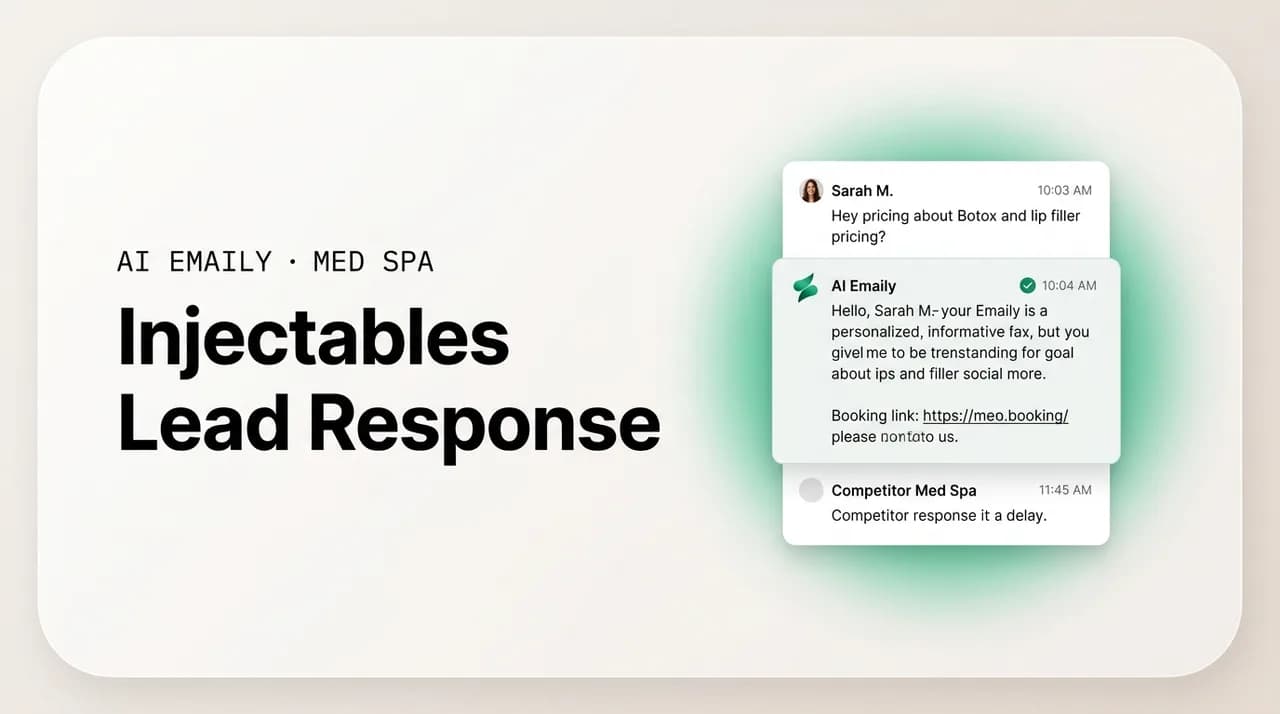
Botox and filler leads from Meta and Instagram ads go cold in minutes, and the clinic that replies first usually books the consult. Set up an instant acknowledgment plus a fast path to a consultation, handle price-shoppers by inviting them to a consult instead of quoting treatment advice, and keep anything clinical or personal-health-related handled by a human. Speed and follow-up win these leads, not the lowest price.
A practical guide to injectables clinic lead response: win the 5-minute window on Botox and filler inquiries, build an instant-reply and consult-booking system, and convert price-shoppers into consultations without quoting medical advice.
On this page
- 01Why injectables leads are the easiest leads to win and the easiest to lose
- 02Where do injectables leads come from, and how should you answer each one?
- 03Is the five-minute window real, and what actually happens inside it?
- 04How do you build an instant-response and booking system for injectables leads?
- 05What should the first reply to a Botox or filler lead actually say?
- 06How do you follow up without being annoying or losing the lead?
- 07What about rebooking and membership? The retention side of lead response
- 08How do you convert price-shoppers into consultations without quoting medical advice?
- 09How does AI Emaily help injectables clinics respond faster (and where does it stop)?
- 10Putting it all together
Why injectables leads are the easiest leads to win and the easiest to lose#
If you run an injectables clinic, you already know the shape of the problem even if you have never named it. You spend real money getting someone to raise their hand about Botox or filler. They see an ad on Instagram, tap the form, and for about five minutes they are as interested in you as they will ever be. Then life resumes. They open three more tabs, glance at two competitors, get a reply from one of them, and book. By the time your front desk sees the inquiry the next morning, the person who was ready to spend three hundred to two thousand dollars has already put down a deposit somewhere else. Nothing was wrong with your clinic, your injector, or your prices. You were simply second.
This guide is about winning that race. Injectables clinic lead response is a specific discipline, different from how a boutique or a law firm handles inquiries, because three things are true at once for this niche. The leads are cheap and plentiful, so you get a lot of them. The intent is high but fragile, so it evaporates fast. And the competition is dense, so someone nearby is almost always ready to answer before you are. Get the response system right and injectables leads are the most forgiving, highest-volume leads in aesthetics. Get it wrong and you are paying for interest you never cash in.
There is one guardrail that runs through everything below, and we will keep coming back to it: the fast, automatable part of this is the marketing and booking conversation, not the clinical one. Confirming an inquiry, answering "where are you and what does a consult look like," and getting someone onto the calendar can and should be instant. Anything about a specific person's medical situation, suitability for treatment, dosing, or health history is a human conversation, held with appropriate privacy, and nothing in this guide is medical or legal advice. Speed on the marketing layer; care on the clinical one. That separation is what lets you move fast without ever pretending software is your injector.
Before we build the system, it helps to be honest about why this niche is so speed-sensitive in the first place. The economics are unusual. In most of aesthetics, an injectables inquiry is the cheapest lead you can buy, often in the range of a few dollars to a couple dozen dollars from paid social, because the offer is easy to understand and the audience is broad. That low cost is exactly why volume is high and why so many clinics are fishing in the same pond with the same lures. The lead is cheap because everyone can generate it. The consult is valuable because not everyone can convert it. The entire game sits in the gap between those two facts.
The rest of this piece walks through that gap end to end: where these leads actually come from and how each source should be answered, why the five-minute window is real and what happens inside it, how to build an instant-response and booking system that runs even when your injector is mid-treatment, the exact templates to use for the first reply and the follow-ups, how to turn a price-shopper into a consultation without ever quoting a number as advice, and finally, honestly, where a tool like AI Emaily fits and where it deliberately does not.
Where do injectables leads come from, and how should you answer each one?#
Not every lead is the same temperature, and answering them all with one generic reply leaves conversions on the table. The bulk of injectables volume comes through a handful of channels, and each one tells you something about how ready the person is and how fast you have to move. The single most useful thing you can do before writing a single template is to map your sources to a response, so the right message fires for the right lead the moment it lands.
The table below is that map. It is not exhaustive, and your mix will differ, but it captures the channels most injectables clinics actually see and the response each one deserves. Read it as a starting configuration, then adjust the timing and tone to your market.
| Lead source | What it tells you | Right response and speed |
|---|---|---|
| Meta / Instagram lead ad (in-app form) | Highest volume, lowest intent per lead, cheapest. Person never left the app, so they are still browsing. Contact info is pre-filled, so it can be low-effort. | Instant automated acknowledgment within minutes, with a clear next step to book a consult. Speed matters most here because intent decays fastest. Follow up if no reply. |
| Website contact / "book a consult" form | Warmer. They chose to visit your site and fill a form, so intent is higher than an in-feed ad tap. | Instant acknowledgment plus an immediate booking link or offer of times. These convert well if answered fast; treat as priority. |
| Instagram / Facebook DM or comment | High intent, conversational, often a specific question (price, availability, "do you do lip filler"). | Fast, human-feeling reply that answers the surface question and pivots to a consult. Keep it social in tone; move to email or booking for details. |
| Google search "botox near me" / GMB inquiry | Strong intent, actively shopping right now, comparing nearby clinics in real time. | Reply the fastest of all. This person is choosing between you and a competitor in the next few minutes. Instant acknowledgment plus a booking path. |
| Referral / word-of-mouth email | Warmest lead you get. Pre-sold by someone they trust; price is rarely the objection. | Personal, prompt reply that acknowledges the referrer and makes booking effortless. Less templated, more human. |
| Existing client rebooking / "time for my next appointment?" | Retention, not acquisition. Already sold on you; just needs a nudge and a slot. | Proactive reminder before they lapse, plus an easy way to rebook. Cheapest revenue you have. |
A few patterns fall out of that map. The cheapest, highest-volume source, the in-app lead ad, is also the one where speed matters most and intent is most fragile, which is the worst possible combination for a clinic relying on a busy front desk to notice the notification. The warmest sources, referrals and rebooking, tolerate a slower, more human touch, but they are also the ones clinics most often forget to systematize, leaving easy revenue on the table. And the search-driven sources, someone typing "botox near me" and filling a form, are the ones where being second is most fatal, because that person is comparing live.
The takeaway is not that you need six completely different systems. It is that your first response should be aware of where the lead came from, so a live "botox near me" searcher gets the fastest, most booking-focused reply and a referral gets a warmer, more personal one. Later in this guide, when we talk about how AI Emaily handles this, that source-awareness is exactly the kind of routing an inbox agent can do for you without you sorting anything by hand.
Is the five-minute window real, and what actually happens inside it?#
The five-minute window gets repeated so often in aesthetics marketing that it is worth grounding in where the idea comes from and what it really claims. The underlying research is not about med spas at all; it is about online sales leads in general. A widely cited study by James Oldroyd, later written up in Harvard Business Review, found that companies that tried to contact a web-generated lead within an hour were far more likely to have a meaningful conversation than those who waited longer, and that the odds of even reaching the lead dropped sharply as the minutes passed. Follow-on analysis of large lead datasets by lead-response researchers pushed the same finding to a finer resolution: responding within roughly the first five minutes, versus even thirty, produces a dramatic difference in the odds of qualifying that lead.
The often-quoted "about 100 times more likely to connect if you respond within five minutes versus thirty" figure comes from that lineage of research. You should treat the exact multiplier as directional rather than a precise law of nature, because it varies by industry, source, and dataset. But the direction is not in dispute, and it is intuitive: a person who just filled out a form is, for a few minutes, sitting there, phone in hand, expecting something to happen. Reach them then and you are talking to someone in a buying mindset. Reach them an hour later and you are interrupting someone who has moved on, possibly to a competitor who did not make them wait.
Directional, not a guarantee
For injectables specifically, the window matters more than for almost any other service, and the reason is the density of the competition. When someone searches "lip filler near me" or taps a Botox ad, they are rarely looking at one clinic. In most metro areas there are dozens of injectors within a short drive, many running the same ads, many offering similar introductory pricing. The person is not deciding whether to get treatment; they have already decided that. They are deciding where. In that situation, the first clinic to respond with a warm, easy, low-friction path to a consult has an enormous advantage, because they have converted an abstract intention into a concrete next step before anyone else even said hello.
Picture the realistic version of losing this race. It is 8:47 on a Friday night. Someone who has been thinking about Botox for months finally taps your ad and fills the form. Your front desk went home at six. The lead sits in a spreadsheet or a CRM tab, unread. Over the weekend, that person gets a text back from the second clinic they inquired with, books a Tuesday consult, and stops thinking about it. On Monday at 9:15 your coordinator opens the inbox, sees the Friday-night lead, and sends a friendly reply. It bounces off someone who is already scheduled elsewhere. You paid for that lead. You did everything right except the one thing that mattered, which was being there when they raised their hand.
This is the exact scenario the injectables niche is defined by, and it is why the rest of this guide is about building a system that answers at 8:47 on a Friday night without anyone being at the desk. Not with a human working around the clock, which is neither realistic nor healthy, but with an instant, honest, automated first response that holds the lead's attention and opens a booking path, so the human conversation can happen on Monday from a position of strength instead of from behind.
How do you build an instant-response and booking system for injectables leads?#
An instant-response system sounds like a big project. It is not. It is a small number of pieces arranged so that the moment a lead arrives, three things happen automatically: the person hears back, they are given a clear way to book, and your team is notified so a human can pick up the thread. Everything else is refinement. Here is the anatomy, in the order you should build it.
- 1
Consolidate every lead source into one inbox
Meta lead ads, your website form, DMs, and search inquiries should all land in one place your team actually watches, not five scattered tabs. Most Meta lead ads can be routed to an email address or CRM automatically; do that first. The single biggest cause of slow response is that the lead landed somewhere nobody was looking.
- 2
Fire an instant acknowledgment on arrival
The moment a lead lands, an automatic reply should go out that confirms you received them, sounds like your clinic, and points to the next step. This is the piece that wins the five-minute window even when no human is available. It is marketing and logistics, not clinical advice, so it is safe to automate. Keep it warm, short, and specific to your clinic.
- 3
Put a real booking path in that first message
The acknowledgment should not dead-end. Include a link to book a consult, or offer two or three concrete windows, so the person can act while their intent is hot. The goal of the first reply is not to close a sale; it is to convert a fragile online intention into a scheduled consult before it cools.
- 4
Notify a human and set the handoff
Automation opens the conversation; a person carries it. The system should alert your coordinator or injector that a lead came in and, ideally, surface it at the top of the queue by source and recency, so the hottest leads get the fastest human touch during working hours.
- 5
Sequence the follow-ups
Most leads do not reply to the first message. A short, polite follow-up sequence over the next few days, spaced sensibly, recovers a large share of leads that would otherwise vanish. This is where the money quietly is: the second and third touch, sent reliably, on leads everyone else gave up on after one try.
- 6
Keep clinical questions on a human track
Build the system so that anything touching a specific person's health, suitability, or treatment plan is routed to a human rather than auto-answered. The automation confirms, books, and reminds. The injector or a trained coordinator handles the clinical conversation with appropriate privacy. Draw that line deliberately and the whole system stays both fast and responsible.
Notice what this system does and does not promise. It does not promise to sell anyone Botox from a chatbot, quote a treatment plan, or replace your injector's judgment. It promises something narrower and more valuable: that no lead ever again sits unanswered from Friday night to Monday morning, that every inquiry gets an immediate, on-brand acknowledgment and a path to book, and that your team spends its human hours on real conversations instead of on noticing and typing the same first reply forty times a week.
The reason to build it as a system rather than as a heroic effort is durability. A coordinator who is diligent about fast replies is wonderful right up until they are on vacation, out sick, slammed with in-chair clients, or leave for another clinic. A system does not have those failure modes. It answers at the same speed at 2 a.m. as at 2 p.m., on the busiest Saturday as on the quietest Tuesday. That consistency, not any single fast reply, is what compounds into more booked consults over a quarter.
Speed on the outside, calm on the inside
What should the first reply to a Botox or filler lead actually say?#
The first message does more work than any other, so it is worth getting exactly right. It has to feel human even though it is automatic, it has to sound like your clinic and not a generic form response, it has to open a booking path, and it has to stay entirely on the marketing side of the line, no advice, no assessment, no treatment specifics. Here is a strong, all-purpose version for a lead that came in through a Meta or Instagram ad. Swap in your clinic name, your booking link, and your voice.
That message works because of what it leaves out as much as what it includes. It does not quote a price, promise a result, name a treatment as right for them, or ask about their medical history in an automated channel. It simply confirms, welcomes, and books. Everything a person needs to take the next step is there; nothing that belongs in a private clinical conversation is.
For a warmer source, a website consult request or a referral, you can lean more personal and less templated. The person has shown more intent or arrived pre-trusted, so the reply should feel like it was written for them, even if it is still automatic under the hood.
When the inquiry arrives as a direct message or a comment rather than a form, the tone shifts again. Social messages want to feel like a person replied, not like a template fired. Keep it short, answer the surface of whatever they asked, and pivot gently to booking, moving anything detailed off the public thread.
Keep the automated first reply on the marketing side of the line
How do you follow up without being annoying or losing the lead?#
The uncomfortable truth of lead response is that the first message usually does not get a reply, and the clinics that win are the ones that follow up more than once without becoming a nuisance. Most clinics send one message, hear nothing, and quietly write the lead off. The follow-up sequence is where a large share of your bookable consults actually live, sitting in leads that were interested but distracted, and that just needed a second or third gentle nudge at the right moment.
The art is in the spacing and the tone. Too frequent and you feel desperate; too sparse and the intent goes cold. A sensible rhythm for injectables leads is a same-day acknowledgment, a next-day nudge, a value-add touch a couple of days later, and a final soft close about a week out, then stop. Each message should be short, warm, and easy to say yes to, and each should offer a clear path to book rather than just asking "are you still interested?", which puts the work on the reader.
Here is a second-touch nudge for a lead who got the acknowledgment and went quiet. It assumes life simply got in the way, which is almost always true, and makes rebooking effortless.
A few days later, a value-add message often works better than another straight ask. Instead of pushing for the booking again, give the person a reason to re-engage that is about them, not about your calendar. For injectables, that might be an invitation to a consult framed around getting their questions answered, or a note about a current membership or new-client offer if you run one. Keep any offer factual and never frame it as clinical guidance.
The final message in the sequence should be a graceful soft close. Its job is to make it effortless for the person who was almost-but-not-quite ready to raise their hand one last time, while giving everyone else a clean, low-pressure exit. Say you will step back from the inbox, leave the door open, and stop. A good soft close often recovers the lead who kept meaning to reply and never did.
The money is in the second and third touch
What about rebooking and membership? The retention side of lead response#
Lead response is usually framed as an acquisition problem, but for injectables the same instinct, reach the person at the right moment with an easy next step, applies just as powerfully to keeping the clients you already have. Botox and many filler results are not permanent; they fade on a fairly predictable timeline. A client who was thrilled with their results three months ago is, right now, watching those results soften and thinking vaguely about coming back. The clinic that reaches them at that moment with a warm, easy rebooking nudge captures that revenue. The clinic that waits for them to remember to call often loses them to whoever advertised most recently.
This is the cheapest revenue in your business and the most neglected, because it requires proactively reaching out on a schedule rather than reacting to inbound. A simple, well-timed rebooking reminder, sent as the previous treatment approaches the point where a client typically returns, does for retention what the instant acknowledgment does for acquisition: it converts a vague intention into a booked appointment before it drifts. Keep it about scheduling and warmth, never about pushing a specific clinical decision.
Memberships deserve a mention because they change the whole tenor of lead response. If your clinic offers a membership, a monthly or annual arrangement that bundles treatments or gives members preferred pricing, then a first-time lead is not just a single consult; they are a potential recurring relationship. That reframes the follow-up sequence: you are not chasing one sale, you are inviting someone into an ongoing relationship, which justifies a warmer, more patient, more relationship-oriented tone. It also gives your value-add follow-up a genuine hook that is about logistics and pricing structure, not clinical advice.
Here is a membership-oriented touch you can slot into a follow-up sequence or send after a first consult, describing the arrangement factually and inviting a conversation rather than making any treatment recommendation.
How do you convert price-shoppers into consultations without quoting medical advice?#
Every injectables clinic knows the message: "How much is Botox?" or "What do you charge for a syringe of lip filler?" It arrives constantly, and it feels like a low-quality lead, someone who cares only about price and will chase the cheapest option. Sometimes that is true. Often it is not. For many people, "how much" is simply the only question they know how to ask. They do not yet have the vocabulary to ask about your injector's training, your products, or your approach, so they ask the one thing everyone understands. Treating the price question as a signal of low intent, rather than as an opening, is one of the most expensive mistakes in this niche.
The goal when a price question comes in is to move the conversation from price to fit, and the vehicle for that is the consultation. You are not dodging the question or playing games; you are honestly explaining that the right answer depends on the person, which is true, and that a consult is where that gets sorted out. Crucially, this lets you avoid quoting anything that could read as clinical advice, how much treatment someone needs, what product suits them, how many units, because none of that can responsibly be answered by email to a stranger, and none of it is yours to answer with software. You can be transparent about starting prices or ranges as commercial information if your clinic chooses to, while making clear that the specifics belong in a consult.
That reply does several things at once. It respects the question instead of deflecting it, which keeps the person engaged. It gives an honest reason the answer lives in a consult, that it depends on their goals, rather than a salesy dodge. It removes friction by clarifying what the consult costs and that there is no obligation. And it stays strictly on the commercial side of the line: it never tells the person what they need, how much, or whether they are a candidate, because those are clinical judgments for a qualified human made in an appropriate setting.
A useful mental model is that price-shoppers are not shopping for the lowest price so much as for confidence. Someone about to let a stranger inject their face is nervous, and "how much" is often a proxy for "can I trust you and does this feel legitimate." A warm, prompt, transparent reply that invites them in for a no-pressure conversation answers the real question, the trust one, far better than a bare number ever could. The clinics that win price-shoppers are rarely the cheapest; they are the ones that made the person feel safe and taken care of before they ever walked in.
Price is commercial; treatment is clinical
One more note on price-shoppers: speed matters even more for them than for warmer leads, precisely because they are comparing. A person asking three clinics "how much" is running a live auction, and the first warm, human, consult-focused reply reframes the whole thing from price to relationship before the competitors even respond with a number. If you can only be fast for one category of lead, be fast for the price-shopper, because they are the most likely to be talking to someone else at the exact same moment.
How does AI Emaily help injectables clinics respond faster (and where does it stop)?#
Everything above works with any tools you already have. But the reason so many clinics never actually run this system is that it depends on someone being present and diligent, and the whole point of the five-minute window is that leads arrive when nobody is present. This is the specific gap an AI-native email client is built to close, and it is worth being precise about both what it does and, just as importantly, where it deliberately stops.
AI Emaily is an AI-native email client that connects to Gmail, Outlook, and any IMAP account, so the inbox your clinic already uses for leads becomes the place the system runs, with no new platform for your team to learn. When an inquiry lands, from a Meta lead ad routed to your inbox, a website form, or a direct message, it can send an instant acknowledgment in your clinic's own voice, because it learns how you write rather than firing generic boilerplate. That first reply, the one that wins the Friday-night lead, goes out in minutes with a booking path in it, whether or not anyone is at the desk.
Because it is aware of where a lead came from and what it is about, it can do the source-aware routing this niche needs: send the fast, booking-focused reply to a live "botox near me" searcher, a warmer note to a referral, and a pivot-to-consult reply to a price-shopper, then surface the hottest leads at the top of your team's queue. It drafts the follow-up sequence too, the next-day nudge and the one-week soft close where most bookings quietly hide, so your coordinator is not retyping the same three messages forty times a week.
The part that matters most for a medical aesthetics business is the control model, and it is built for exactly the line this guide keeps drawing. AI Emaily runs in three modes, Manual, Copilot, and Autopilot, so you decide how much it does on its own. In Copilot, every draft it writes waits for a human to review and approve before it sends, which is the right default for a clinic that wants speed without ever letting software send something unreviewed. In Autopilot, you can let it handle genuinely routine, non-clinical messages on its own, within rules you set, an instant acknowledgment, a booking confirmation, a rebooking reminder, exactly the marketing-and-logistics layer that is safe to automate.
And it stops where it should. The autonomous handling is meant for the confirm-book-remind layer, not for clinical conversations. Anything touching a specific person's health, their suitability for treatment, dosing, or medical history is meant to stay with a human, held with appropriate privacy, and you can keep it that way by design. This mirrors the guardrail we have returned to throughout: automate the marketing and booking; keep the clinical human. AI Emaily is built to respect that separation rather than blur it, and nothing it does is a substitute for your injector's judgment or for medical or legal advice.
Two more things make it safe to move fast. Every action is reversible, with undo, and everything it does is recorded in a full audit trail, so you can always see what was sent, to whom, and when, and roll something back if it was not right. That combination, instant on the marketing layer, human-approved where it counts, reversible and audited throughout, is what lets an injectables clinic finally win the five-minute window without ever pretending an inbox agent is a clinician. You can try it free at app.aiemaily.com/signup, with a Free plan at no cost and Pro at $12.42 per month on the annual plan.
Start in Copilot, earn your way to Autopilot
Putting it all together#
Injectables leads are the cheapest, most plentiful leads in aesthetics, and that is precisely why they are so easy to lose. The person who taps a Botox ad is not deciding whether to get treatment; they have decided that. They are deciding where, and for about five minutes they are deciding it live, comparing you against the clinics down the road. Win that window with a warm, instant, on-brand acknowledgment and a clear path to book, and injectables become the most forgiving leads you have. Miss it, and you keep paying for interest that competitors cash in.
The system that wins is not heroic, it is durable. Consolidate every source into one inbox. Fire an instant acknowledgment with a booking path the moment a lead lands, even at 8:47 on a Friday night. Follow up more than once, because the money hides in the second and third touch. Treat price-shoppers as trust-shoppers and pivot them to a consult instead of quoting anything that reads as clinical advice. Reach your existing clients before their results fade. And through all of it, keep one line bright and unbroken: automate the marketing and booking conversation, keep every clinical conversation human, held with appropriate privacy, on your injector's judgment, not a machine's.
If you would rather that system ran itself in your own voice, that is what AI Emaily is for, instant acknowledgments and booking replies that go out in minutes, source-aware follow-ups, Copilot approval where you want a human in the loop and Autopilot for the routine confirm-book-remind layer, all reversible and fully audited, and all careful to stop exactly where the clinical conversation begins. Nothing here is medical or legal advice; the aim is simply to make sure that the next person who raises their hand about Botox at the worst possible hour hears back from you first.
Frequently asked
See it in AI Emaily
Keep reading
Sources

Written by
Nafiul HasanNafiul Hasan is an entrepreneur and AI automation system builder with 10+ years of experience turning messy, manual workflows into reliable automated systems. He designs and ships AI enterprise solutions end-to-end — the agent logic, the data plumbing, and the product people actually use — and founded AI Emaily to give busy professionals their attention back. He writes here from the builder's seat: what works, what breaks, and how to put AI to work without giving up control.