How to Sound Confident in Email: Drop the Hedging With AI (Without Sounding Pushy)

The short answer
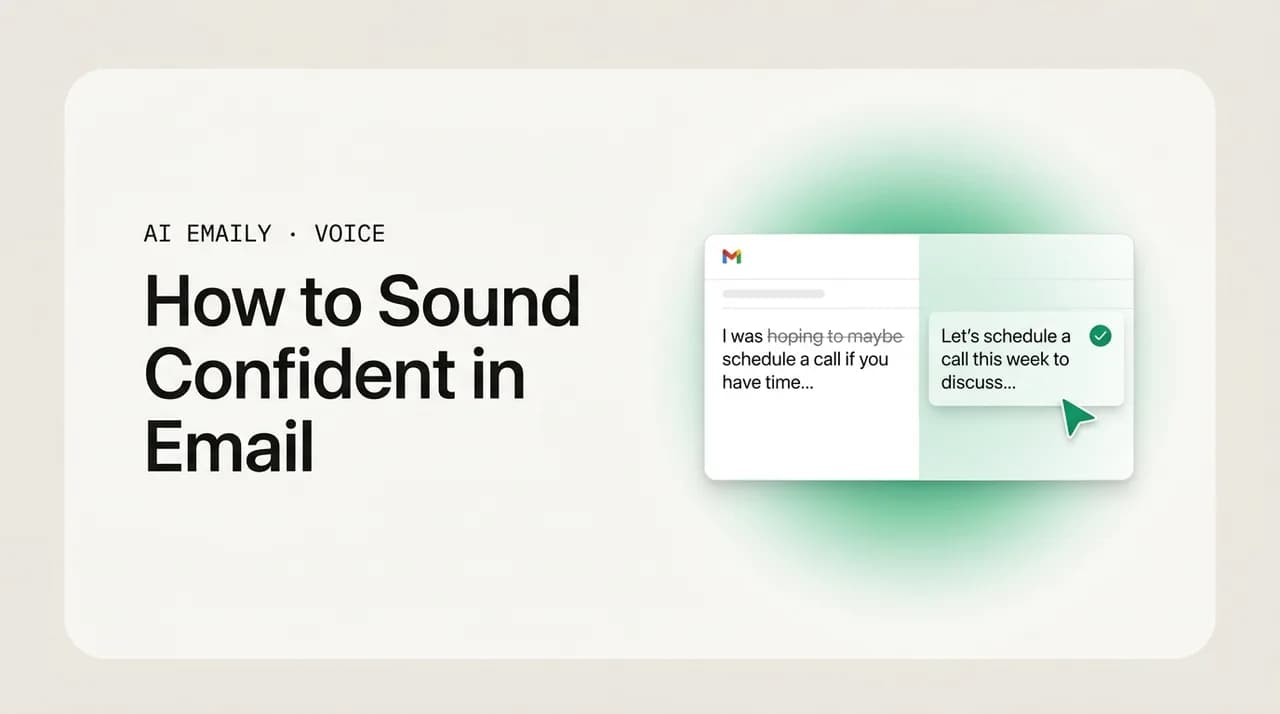
How to sound confident in email: cut hedges and qualifiers ("just," "I think," "sorry to bother," "maybe"), make one direct ask with a specific date, and state your position instead of apologizing for it. Confidence is clarity, not volume — say what you mean once, plainly, and stop. AI can flag the hedges and firm up the tone while keeping it yours.
How to sound confident in email: cut the hedges and qualifiers, make direct asks, own your position, and use AI to firm up tone without crossing into pushy — with a weak-to-confident phrase table and before/after rewrites.
On this page
- 01What does it actually mean to sound confident in email?
- 02Why does hedging make your email sound weak?
- 03Which words and phrases should you cut to sound more confident?
- 04What is the weak-to-confident phrase table?
- 05What is the difference between confident and arrogant in email?
- 06How do you make a direct ask without sounding pushy?
- 07How do you own your position and disagree confidently?
- 08Which AI prompts firm up your email tone?
- 09How does AI Emaily help you sound confident in your own voice?
- 10The bottom line on sounding confident in email
You know the email. You needed an answer by Thursday, so you wrote: "Hi — so sorry to bother you, I know you're super busy! I was just wondering if maybe you might have a sec to possibly take a look at the deck when you get a chance? No rush at all, totally fine if not!" Then you read it back, felt vaguely embarrassed, and sent it anyway because rewriting it felt like more apologizing. The reader skims it, registers that you are unsure whether you are even allowed to ask, and files it under "later" — which, given how the email framed itself, is exactly what you told them to do.
Sounding confident in email is not about being louder, blunter, or more aggressive. It is about removing the small words and reflexive softeners that quietly tell the reader you do not fully trust your own request. "Just," "I think," "maybe," "sorry to bother," "if that's okay," "does that make sense?" — each one is a tiny hedge, and a sentence wearing five of them reads as someone bracing to be turned down. Strip them out and the same message lands as clear, direct, and easy to act on. Nothing about it gets ruder; it just gets surer.
This guide is the complete how-to. You will get the mechanics of why hedging undercuts you and what it costs in replies and respect, a deep section on the specific qualifiers to cut and what to say instead, a long weak-to-confident phrase table you can keep open while you write, the difference between confident and arrogant so you do not overcorrect, how to make a direct ask without sounding pushy, how to own a position and disagree cleanly, and the exact AI prompts that firm up a draft without flattening your voice. Then we look at the part that is genuinely hard — doing this on every email, all day, when hedging is a reflex — and what an AI-native email client does about it.
We will keep it concrete. Every principle comes with a before-and-after rewrite, because confidence in writing is a thing you see, not a thing you describe. By the end you should be able to look at your own draft, spot the three or four hedges hiding in it, and cut them in ten seconds — or hand that job to a tool that does it for you while you keep final say over every word.
What does it actually mean to sound confident in email?#
Confidence in email is clarity plus ownership. A confident email says one clear thing, makes one clear ask, and stands behind it without apologizing for existing. It does not hedge, it does not over-explain, and it does not bury the point under a pile of softeners. The reader finishes it knowing exactly what you want, by when, and that you expect a reasonable answer. That is the whole feeling — not force, not volume, just sureness.
It helps to name what confidence is not, because the fear of sounding arrogant is exactly what drives most people to over-hedge. Confident is not aggressive: "Send me the file now" is not confident, it is rude. Confident is not cold: warmth and confidence live together fine. Confident is not certain-about-everything: you can be genuinely unsure of a fact and still sound confident about your ask. The line is ownership — a confident writer owns their request, their opinion, and their time, without claiming to own the reader's.
The mechanism that kills confidence is the hedge: a word or phrase that softens a statement to pre-empt rejection. "I just wanted to check," "I think maybe we should," "this is probably a dumb question, but." Each one is a small flinch, a way of saying "please do not be annoyed that I am asking." Used once, a hedge is polite. Stacked three deep, it reads as someone who does not believe they have the standing to take up the reader's time — and readers respond to that signal, usually by deprioritizing the request. The fastest way to sound more confident is not to add anything; it is to delete the flinches.
There is a second, quieter dimension: position. Confident email does not only ask clearly, it states clearly. "I recommend option B" reads as someone with a view; "I feel like option B could maybe be worth considering, but I'm honestly not sure" reads as someone hoping to be told what to think. You are allowed to have a recommendation. You are allowed to disagree. Owning your position — stating it plainly, then giving your reasons — is half of what makes writing sound confident, and it is the half people most often hedge away because they are afraid of being wrong in writing.
The core idea in one line
Why does hedging make your email sound weak?#
Hedging is the reflex of softening a statement so it cannot be rejected too hard — and the irony is that it makes rejection more likely, not less. When you write "I was just wondering if maybe you could possibly take a look," you have wrapped a simple ask in four layers of permission-seeking. The reader's takeaway is not "how considerate"; it is "this person is not sure they should be asking, so this probably is not important." You have handed them a reason to wait, and many will take it.
There is a real psychology under this. Linguists call these features "hedges" and "tag questions" — "sort of," "kind of," "I think," "right?", "does that make sense?" — and a long line of research, going back to Robin Lakoff's work on language and power, links heavy hedging to perceived lower status and lower assertiveness. The reader may not consciously notice a single "just," but a draft thick with them reads, in aggregate, as tentative. And tentative requests get tentative responses: lower priority, slower replies, more "let me get back to you."
Hedging also costs you in a way that compounds. Each softener adds words without adding meaning, so your real ask sinks further down the message and the reader has to dig for it. A confident two-line email respects the reader's time; a hedged five-line version of the same ask wastes it and signals that you were not sure enough to be brief. Over months of email, the colleague who writes clearly reads as more capable than the one who writes apologetically — not because they are, necessarily, but because clear writing is the visible signal of clear thinking.
None of this means warmth is the enemy. The fix for hedging is not to strip your email of all humanity and fire off commands. It is to separate two things people blur together: politeness and hedging. "Could you send the report by Thursday? Thanks" is polite and confident. "Sorry to bug you, would it maybe be possible to perhaps get the report at some point if you have a chance?" is hedged and, oddly, less polite — because making your reader decode a buried request is its own small discourtesy. Keep the manners. Cut the flinches.
Politeness vs. hedging
Which words and phrases should you cut to sound more confident?#
Most hedging comes from a small set of repeat offenders. Learn to spot these and you can clean up almost any draft in one pass. They fall into a few families: minimizers that shrink your ask, qualifiers that undercut your statements, apologies for things that need no apology, and permission-seekers that ask whether you are allowed to ask. Here is the field guide.
Minimizers shrink the thing you are saying so it takes up less space — and less of the reader's attention. "Just" is the worst of them: "I just wanted to check," "I'm just following up," "just a quick question." It is almost always deletable, and the sentence gets stronger the instant it goes. "Quick" and "little" do the same job ("a quick favor," "one little thing"), pre-shrinking your request so the reader knows it is not really important. Cut them and let the ask stand at its actual size.
Qualifiers undercut your own statements by hedging your certainty: "I think," "I feel like," "maybe," "perhaps," "sort of," "kind of," "probably," "it seems like." There is a place for genuine uncertainty — if you truly are not sure, say so honestly. But most of these are reflexive, not real. "I think we should ship Tuesday" is weaker than "We should ship Tuesday," and you mean the second one. Apologies are the next family: "sorry to bother you," "sorry for the long email," "apologies for the delay" when there was no real delay. Reserve a genuine apology for a genuine mistake; do not open with one as a reflex, because it frames you as already in the wrong.
Permission-seekers ask whether you are allowed to make your request: "if that's okay," "if it's not too much trouble," "whenever you get a chance," "no rush at all," "feel free to ignore this." "No rush" in particular is a trap — you usually do have a timeframe, and pretending you do not just produces a slower reply and a second follow-up. Finally, the soft close: "does that make sense?", "let me know your thoughts maybe?", "hopefully that works?" — trailing questions that invite the reader to find the plan unclear. State the plan and stop. The table in the next section gives you the direct swap for each of these.
A caution before you go scorched-earth on every softener: the goal is to cut reflexive hedges, not to delete all nuance. Some of these words do real work in the right spot. "I think" is fine when you are genuinely flagging an opinion as yours rather than fact. "Maybe" is honest when an outcome really is uncertain. A real apology for a real mistake is exactly right. The skill is telling the reflexive hedge from the meaningful one — and the test is simple: does the word carry information, or is it just bracing for impact? If deleting it changes nothing except making you sound surer, delete it.
One more pattern worth naming, because it hides in plain sight: hedging by volume. Some emails have no single weak word but are weak because they over-explain — three paragraphs of context and justification before the ask, as if the writer has to earn the right to make it. Confidence often means trusting the reader. Lead with the ask, give the one reason that matters, and stop. The reader can ask for more if they need it. A short, direct email is not curt; it is a sign you respect both your request and their time.
Don't overcorrect into blunt
What is the weak-to-confident phrase table?#
This is the part to bookmark. Below is a direct map from the hedged phrasing most people reach for by reflex to the confident version that says the same thing without the flinch. Notice that the confident column is almost always shorter — confidence is usually subtraction. Keep this open while you draft, and when you catch a left-column phrase in your own writing, swap it.
| Weak / hedged | Confident | Why it works |
|---|---|---|
| I just wanted to check in on… | Checking in on… / Where does X stand? | "Just" shrinks the ask; the direct version treats it as legitimate |
| I was wondering if you might be able to… | Could you… / Please… | Cuts three layers of permission-seeking down to one clear request |
| I think we should probably go with B | I recommend B / Let's go with B | States a position instead of floating one and hoping for agreement |
| Sorry to bother you, but… | Quick question: / A favor: | Removes the reflexive apology that frames you as intruding |
| Maybe we could possibly look at… | Let's look at… / I'd like to look at… | Replaces stacked qualifiers with a single clear proposal |
| No rush at all, whenever you get a chance | Could you get to this by Thursday? | Gives a real deadline instead of inviting an indefinite delay |
| Does that make sense? / Let me know your thoughts? | Happy to talk it through if useful. | Ends with an offer, not a question that invites the reader to find it unclear |
| I'm not really an expert, but… | From what I've seen, … | Drops the self-disqualifier and grounds the point in your experience |
| If that's okay with you | (delete) / Works for me — confirm by Friday? | Permission is implied; asking for it weakens the statement |
| I feel like this might be a problem | This is a problem because… | Owns the observation and adds the reason, which is what persuades |
| Apologies for the long email | (delete, or) The short version: … | Don't apologize for length; just lead with the point |
| Hopefully we can find a time that works | Here are two times — which suits you? | Replaces a hope with a concrete, easy-to-answer choice |
| I might be wrong, but it seems like… | I'd push back on this: … | Signals a real, ownable disagreement instead of pre-conceding it |
| Just following up again, so sorry! | Following up on my note from Monday. | Removes the apology spiral; a follow-up needs no apology |
| Would it be at all possible to maybe… | Can you… by [date]? | Strips the conditional pile-up down to a direct, dated ask |
Read down the right-hand column and you will notice it does not sound aggressive — it sounds normal. That is the point. Confident phrasing is just plain phrasing with the apology removed. None of these swaps make you ruder; they make you legible. The reader gets the ask immediately, knows what you want, and can act. The hedged versions, by contrast, make them work to find the request and then guess at how much it matters.
If you only internalize three swaps from this table, make them these: delete "just" everywhere it appears; replace "I was wondering if you could" with "Could you"; and replace "no rush" with an actual date. Those three changes alone will rewrite the majority of weak professional email into confident professional email, because those three patterns account for most of the hedging people do without noticing.
What is the difference between confident and arrogant in email?#
This is the fear that keeps people hedging: that if they drop the softeners, they will come across as arrogant, demanding, or full of themselves. It is a reasonable worry, and the line is real — but it is clearer than it feels. Confident and arrogant differ on a few specific axes, and once you can see them, you can sit firmly on the confident side without drifting over.
Confidence owns your side; arrogance claims the reader's. "I recommend we ship Tuesday" is confident — it owns your view. "Obviously we're shipping Tuesday, I don't see what there is to discuss" is arrogant — it claims the decision and dismisses the reader's input. Confidence respects the reader's time and agency; arrogance assumes it. "Could you get to this by Thursday?" asks. "I need this on my desk by Thursday" commands. The first is a confident request; the second treats the reader as staff.
Confidence is open to being wrong; arrogance is not. You can state a firm position and still write "if I'm missing something, tell me" — that is confident, because owning a view does not require pretending you are infallible. Arrogance forecloses the conversation. Tone matters here too: confidence keeps the warmth (a greeting, a thanks, a human register), while the slide into arrogance usually drops them, because the writer has started to treat courtesy as beneath them. The presence of basic warmth is one of the clearest tells that you are still on the right side of the line.
There is also a register difference worth naming. Arrogance tends to over-claim — superlatives, absolutes, "obviously," "clearly," "any reasonable person." Confidence states plainly and lets the substance carry the weight. You do not need "this is clearly the only sensible option"; you need "I recommend this option because X." The reasons do the persuading. Adjectives that tell the reader how to feel about your point ("this is a genuinely brilliant idea") read as insecurity dressed up; the confident move is to state the idea and trust it to stand. The table below puts the two side by side.
| Situation | Confident | Arrogant |
|---|---|---|
| Making a recommendation | I recommend B — it's faster and cheaper. | We're obviously doing B. B is the only real option. |
| Asking for something | Could you send this by Thursday? Thanks. | I need this by Thursday. Don't be late. |
| Disagreeing | I see it differently — here's why. | That's just wrong. Let me explain how this works. |
| Following up | Following up on Monday's note — any update? | I've now asked three times. Why no reply? |
| Stating a fact | The numbers don't support that. | Anyone who's read the numbers knows that's nonsense. |
| Being uncertain | I'm not sure on the timing — let me confirm. | (hides uncertainty; over-claims to look decisive) |
The one-question test
How do you make a direct ask without sounding pushy?#
Most weak email is weak at exactly one point: the ask. People will write a clear, confident body and then bury the actual request under softeners because asking feels like the moment they might get rejected. So they wrap it: "if you have time," "no pressure," "whenever's good." The result is an ask the reader can easily not answer — which is the opposite of what you wanted. A direct ask is not pushy; it is a courtesy, because it tells the reader exactly what you need from them.
The anatomy of a confident ask has three parts: the specific action, the deadline, and the reason — in that order, and briefly. "Could you approve the budget by Wednesday? We need it locked before the vendor call Thursday." The action is concrete (approve the budget, not "take a look"), the deadline is real (Wednesday, not "soon"), and the reason is one line (the vendor call). That structure reads as confident because it treats the request as legitimate and gives the reader everything they need to say yes fast. Vagueness, not directness, is what makes asks feel awkward.
Deadlines are where people hedge hardest, and where it costs the most. "Whenever you get a chance" feels polite, but it produces no reply and forces a second email. The confident version names a time and, if it helps, why: "by Thursday" or "by Thursday, ahead of the client call." If the deadline is genuinely flexible, you can say "end of week is fine" — that is still a real boundary, not the open-ended "no rush" that quietly deprioritizes you. Naming a deadline is not pushy; it is the single kindest thing you can do for a busy reader, because it lets them plan.
The pushiness people actually fear comes from a different source: repetition without respect, and dictating instead of asking. You avoid it by keeping the request a request ("could you," "would you be able to") rather than a command, by asking once clearly instead of nagging, and by giving the reader an easy out where one genuinely exists ("if Thursday's tight, let me know and we'll find another way"). That is confident and considerate at once. The difference between assertive and pushy is not how clearly you ask — it is whether you respect the answer.
How do you own your position and disagree confidently?#
The hardest place to sound confident is when you have an opinion that might be unwelcome — a recommendation, a pushback, a disagreement with someone senior. This is where hedging gets heaviest, because the fear of being wrong in writing, on the record, is real. But a hedged disagreement does not protect you; it just makes your point easy to dismiss. "I might be totally wrong, but I sort of feel like maybe option A could have some issues?" gives the reader nothing to take seriously. Owning the position is what makes it land.
Owning a position means three things: state it plainly, give your reasons, and stop pre-apologizing for having it. "I'd go with option A. It's lower risk and we can ship it this quarter — option B is cleaner long-term but we don't have the runway for it now." That is a confident position. It states the recommendation, gives the trade-off honestly, and does not bury itself under "just my two cents, feel free to ignore." You can still be collaborative — "keen to hear if you see it differently" — without disowning your own view first.
Disagreeing confidently follows the same shape, with one addition: acknowledge the other side honestly, then state yours. "I see the case for shipping Friday — the demo would land well. I'd still push back: the auth bug isn't fully tested, and shipping it broken costs us more than a week's delay." That reads as confident and reasonable, not combative, because you showed you understood their view before disagreeing with it. The hedged alternative — "I don't know, maybe this is just me, but I'm a little worried about possibly shipping Friday?" — invites the reader to overrule a worry you have already half-retracted.
Disagreeing up the chain deserves a note, because that is where confidence and tone matter most. You can disagree with someone senior and still sound confident rather than insubordinate: own your view, anchor it in something concrete (data, a risk, a commitment you made), keep the warmth, and leave the decision with them. "I'd recommend we hold the launch a week — the testing isn't done and I don't want to put your name on something that might break. Your call, but that's my read." That respects the hierarchy without erasing your judgment. Confidence with a superior is not about winning; it is about being on record with a clear, reasoned view and letting them decide.
State, reason, stop
Which AI prompts firm up your email tone?#
If editing your own hedging in real time is hard — and for most people it is, because the softeners are automatic — AI is genuinely useful here. A general chatbot like ChatGPT, Claude, or Gemini can take a draft and tighten the tone, as long as you tell it precisely what to do. The trap is asking for "more confident," which tends to produce something louder and more corporate. The fix is to name the exact mechanics: cut these hedges, keep the meaning, keep my voice, do not make it aggressive.
Here is a prompt that reliably works for firming up a single email without overshooting into pushy. The key is the explicit hedge list and the explicit guardrail against arrogance — without that guardrail, models tend to overcorrect into something that reads like a demand.
A few prompt variations are worth keeping. To audit rather than rewrite: "List every hedge, qualifier, and apology in this email and rate the overall tone from tentative to confident — do not rewrite it." That is useful when you want to learn the pattern yourself rather than outsource it. To calibrate the strength: "Give me three versions — slightly firmer, clearly confident, and firm-but-still-friendly — so I can pick." To check you have not overshot: "Does this read as confident or as pushy/arrogant? If pushy, soften the tone but keep it direct." That last one is the safety check that keeps you on the right side of the confident/arrogant line.
But there is a structural limit to doing this in a chatbot, and it is the reason this approach gets tiring fast. The model does not know your voice — so unless you paste in samples of how you actually write every single time, it firms up the draft toward a generic confident-businessperson register, not toward you. It does not know the recipient — so it cannot tell that this email goes to your CEO and needs more care, while that one goes to a peer and can stay loose. And it lives in a separate tab — so every email becomes copy out, paste in, prompt, copy back, paste in. That round-trip is fine for the one email that really matters. It does not survive contact with a full inbox, which is exactly where the hedging happens most.
Name the mechanics, not the vibe
How does AI Emaily help you sound confident in your own voice?#
Here is the part nobody talks about. Cutting hedges from one important email is easy. Doing it on the thirtieth reply of the day, when "just wanted to check" is muscle memory and you are moving fast, is where it falls apart — and that is most of your email. The careful, confident draft is the exception; the reflexive, hedged one is the default. What you actually need is not a better prompt you run occasionally. It is the firm-up happening automatically, in your voice, on every email, without a second tab.
AI Emaily is an AI-native email client built to do exactly that. It learns your writing voice from the emails you have actually sent — your real register, your genuine warmth, the way you actually phrase things — so when it drafts a reply, it firms up the tone toward your confident self, not toward a generic businessperson. It cuts the reflexive "just," turns "I was wondering if you could" into a clear ask, replaces "no rush" with the deadline you actually mean, and states your position plainly — while keeping it unmistakably yours. The draft comes back confident and human, not blunt and corporate, because it is built from how you write at your best.
Because it lives in your inbox and not a separate tab, it also knows the context a chatbot cannot. It can match the register to the recipient — more care for a first email to a client or a note to your manager, looser for a teammate you message daily — so "confident" never tips into "pushy" with the wrong person. You can set a standing preference in its rules so it consistently drops hedges and keeps your asks direct across everything you send, instead of you re-explaining the same edit on every draft. And it works across every account you connect — Gmail, Outlook, and any IMAP provider — so your voice is the same confident one wherever you write.
You keep control the whole time. In its default Copilot mode, AI Emaily writes the confident, voice-matched draft and waits — nothing sends until you approve it, so you can soften a line, add a detail, or push it firmer before it goes out. It is private by design: your mail is used to draft for you, not to train models for anyone else. You can start free at app.aiemaily.com/signup — the Free plan is $0 and connects your inbox with AI drafting, and Pro is $12.42/month billed annually when you want it across everything. The point is not that AI makes you sound like someone braver than you are. It is that the hedges come out automatically, so the confident version of your own voice is the one that lands — on every email, not just the one you had time to fix.
Try it on your own inbox
The bottom line on sounding confident in email#
Sounding confident in email is mostly subtraction. You do not add force, volume, or bluntness — you remove the hedges, minimizers, reflex apologies, and permission-seekers that quietly tell the reader you do not trust your own request. Delete "just," turn "I was wondering if you could" into "could you," replace "no rush" with a real date, and state your opinions as plain recommendations. The same message lands clearer, surer, and easier to act on — without getting one degree ruder.
Keep the guardrails in view so you do not overcorrect. Confident is not arrogant: own your side of the table, not the reader's. Confident is not curt: keep the please and the thank-you. A direct ask — specific action, real deadline, one reason — is a courtesy, not a demand, as long as you respect the answer. And owning a position means stating it and giving your reasons, then stopping, rather than burying it under "feel free to ignore." Confidence with warmth is the target, and the two live together fine.
Doing this once is simple; doing it on every email, all day, against the reflex to hedge, is the hard part — and that is exactly what AI Emaily handles, firming up the tone toward your own confident voice, matched to each recipient, with you approving before anything sends. Whether you do it by hand with the phrase table above or let the tool do it for you, the principle holds: say what you mean once, plainly, and stand behind it. That is what confidence reads like on the page.
Frequently asked
See it in AI Emaily
Keep reading
Sources

Written by
Nafiul HasanNafiul Hasan is an entrepreneur and AI automation system builder with 10+ years of experience turning messy, manual workflows into reliable automated systems. He designs and ships AI enterprise solutions end-to-end — the agent logic, the data plumbing, and the product people actually use — and founded AI Emaily to give busy professionals their attention back. He writes here from the builder's seat: what works, what breaks, and how to put AI to work without giving up control.