How to Write Med Spa Client Emails: Examples, Etiquette & AI Shortcuts

The short answer
Great med spa client emails reassure a cash-pay prospect without making medical claims: reply fast, mirror their language, name a clear next step, and keep clinical detail and any personal health information out of writing. Lead with warmth, close with an easy booking path, and let a human handle anything clinical.
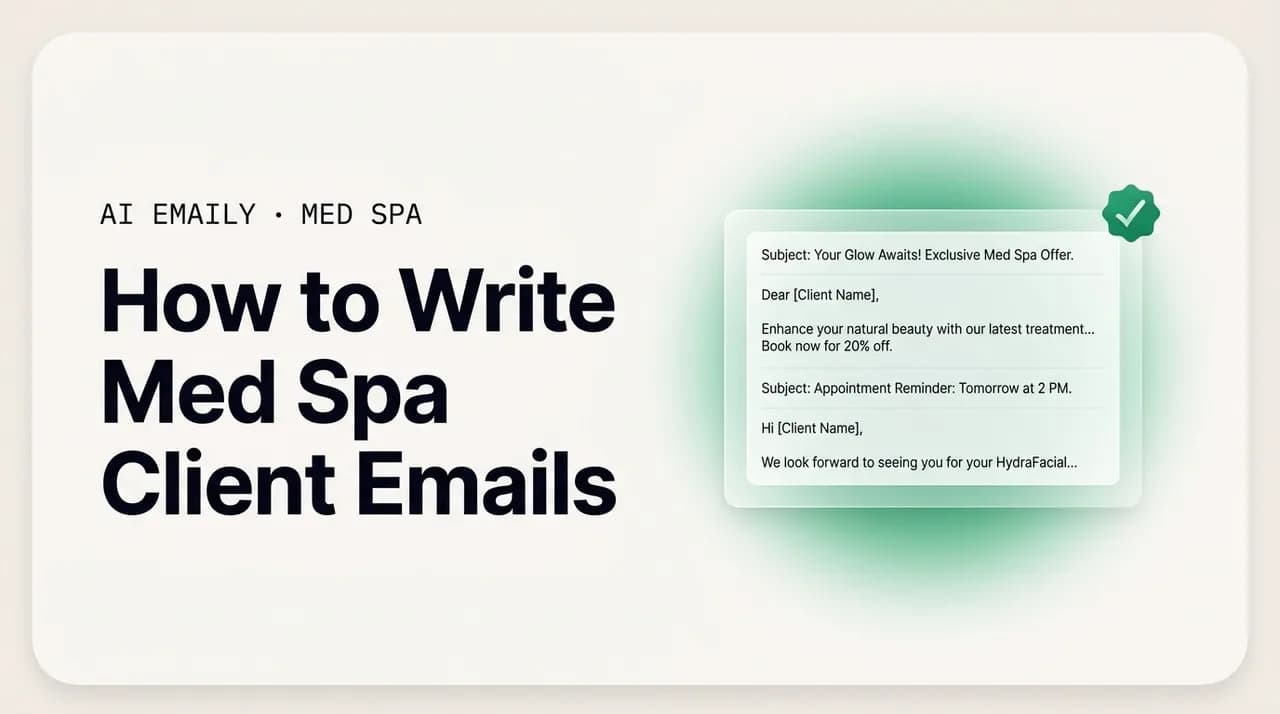
How to write med spa client emails that feel warm, professional, and reassuring — with copy-paste examples for inquiries, consults, pricing, rebooking, memberships, and win-backs, plus etiquette that avoids medical claims and protects privacy.
On this page
- 01Why knowing how to write med spa client emails is a revenue skill, not a soft one
- 02What are the core principles of a great med spa client email?
- 03How should you handle subject lines, discretion, and privacy?
- 04How do you reply to a new treatment inquiry?
- 05How do you book and confirm a consultation?
- 06How do you answer pricing questions without scaring people off?
- 07What should pre- and post-appointment emails say (without crossing the line)?
- 08How do you write rebooking, membership, review, and win-back emails?
- 09Which tone fits which scenario?
- 10What med spa email etiquette keeps you professional and compliant?
- 11What are the most common med spa email mistakes?
- 12How can AI Emaily help you write med spa client emails?
- 13Putting it all together
Why knowing how to write med spa client emails is a revenue skill, not a soft one#
Learning how to write med spa client emails is one of the highest-leverage things a clinic can do, because in aesthetics the email is often the entire first impression. A prospective client rarely walks in cold. They see an ad, they scroll a before-and-after, they screenshot a price, and then — nervous, curious, comparing three clinics at once — they send a message asking about a treatment they have never had. What you write back, and how fast, decides whether they book with you or with the clinic down the street that answered first.
This is a cash-pay, high-consideration purchase. Nobody needs to walk into a med spa; they choose to, with their own money, for something optional and personal. That changes the emotional temperature of every message. The reader is not just asking a logistics question, they are asking, quietly, "Can I trust these people with my face, my body, my time, and my money?" A reply that is warm, clear, and reassuring answers that question before you ever mention a price. A reply that is slow, clinical, or cagey answers it too — just the wrong way.
And the stakes are unusually literal here, because the leads are expensive. Aesthetic clinics pay real money for every inquiry, from single-digit dollars for a high-volume injectables lead to $45 or more for a body-contouring or laser consult. When you let a well-written reply sit in a drafts folder over the weekend, you are not just losing a message, you are burning the ad spend that bought it. Getting the writing right, and getting it out fast, is where a med spa's marketing budget either compounds or leaks.
There is one more reason this skill matters more in aesthetics than in almost any other service business: the tightrope between reassurance and regulation. Your clients want to hear that a treatment is safe, that results are great, that they will love it. But a med spa operates in a medical context, and that means there are things you cannot promise, claims you cannot make, and — above all — personal health information you must never handle carelessly in email. The whole art of med spa client emails is learning to sound genuinely reassuring while staying scrupulously careful. Warmth without overclaiming. Confidence without a diagnosis. Personal without oversharing.
This guide covers the principles that make a med spa email land, a full set of copy-paste examples for the situations that repeat every week — the inquiry reply, the consult booking, the pricing question, general pre- and post-appointment notes, rebooking, memberships, review requests, and win-backs — and the etiquette that keeps you on the right side of both good taste and good compliance. A standing caveat before we start: the examples below are deliberately generic and contain no personal health details, no diagnoses, and no medical or treatment claims, and nothing here is medical, legal, or compliance advice. Treat every template as a starting frame to adapt with your own licensed team, not a script to send blind.
A note on privacy and claims, up front
What are the core principles of a great med spa client email?#
Before any template, it helps to internalize the handful of principles that separate an email a nervous prospect trusts from one they scroll past. Every good med spa message is doing several jobs at once — reassuring, informing, and gently moving the person toward a booking — and it does them in a specific order. Get the principles right and you can write a strong email for almost any situation without a template at all.
- 1
Lead with warmth, then get to the point
Open like a person, not a form: "Thanks so much for reaching out" or "So glad you're considering us." One warm line signals that a real, friendly human is on the other end — which is exactly what an anxious cash-pay prospect is scanning for — and then you move straight to their actual question. Warmth first, substance immediately after.
- 2
Reassure without making a medical claim
You can absolutely make someone feel comfortable without promising an outcome. Reassure the process, the people, and the experience — "our licensed providers will walk you through everything at your consultation" — rather than the result. Avoid words that promise or guarantee a clinical effect. Confidence about your care is fine; guarantees about someone's body are not.
- 3
Be clear and specific about the next step
Every email should end with one obvious action: book a consult, pick a time, reply with a question. Vague endings ("let me know if you're interested") lose people. A specific, low-friction next step ("here's my booking link — grab any time that works") converts them. One clear ask per email.
- 4
Mirror the client's language and energy
If they wrote three excited sentences with an emoji, don't reply with a stiff paragraph. If they asked a crisp one-line question, don't bury the answer. Matching tone builds rapport fast and makes the reader feel heard rather than processed.
- 5
Protect privacy and discretion by default
Assume anyone might glance at a phone screen. Keep subject lines and message bodies free of anything that reveals a person's specific treatment, condition, or concern. Discretion is part of the service in aesthetics, and clients notice when you handle it well — and when you don't.
- 6
Keep it short, skimmable, and mobile-first
Most aesthetic clients read email on a phone. Short paragraphs, one idea each, a clear next step near the top and again at the bottom. If your reply needs scrolling, it needs trimming.
Those six principles interact in a useful way. Warmth buys you the reader's attention; clarity respects it; reassurance-without-claims keeps you safe; discretion earns trust; and a specific next step converts all of that goodwill into a booking. When an email feels "off" — too cold, too pushy, weirdly clinical, faintly nervous — it is almost always because one of these is missing. Run a draft past them like a checklist and most problems surface immediately.
It is worth dwelling on the reassurance principle, because it is the one that trips up even experienced clinics. The instinct, when someone is nervous, is to comfort them with promises: it won't hurt, you'll look amazing, results last forever. Those are exactly the sentences to avoid in writing. They can wander into territory that regulators treat as unsupported claims, and they set expectations you cannot control. The reassuring move is to shift the promise from the outcome to the experience: we'll take great care of you, our team is licensed and experienced, your consultation is where we'll answer all of this properly for your situation. You are promising attentiveness and expertise — things you can actually deliver — not a specific result on a specific body.
The reassurance swap
How should you handle subject lines, discretion, and privacy?#
Subject lines do more work in aesthetics than most people realize, because they are the one part of your message that is visible before the reader has decided to trust you — and sometimes visible to other people entirely. A phone lighting up on a shared kitchen table, a laptop preview pane at an open-plan desk, a smartwatch notification glanced at by a coworker: your subject line can be read by someone the client never intended. That makes discretion a subject-line discipline, not just a body-copy one.
The rule of thumb is that a subject line should say enough to get opened and nothing that reveals a person's specific concern, condition, or treatment. "Following up on your visit with us" is warm and safe. "Your acne scarring results" is neither. Keep them friendly, useful, and vague about the clinical specifics. The same goes for the from-name and any preview text your email client generates from the first line — lead with a neutral, welcoming sentence rather than diving straight into anything sensitive.
- Good, discreet subject lines: "Thanks for reaching out to [Clinic]" · "Your consultation — a few time options" · "Following up from your recent visit" · "A little thank-you from the [Clinic] team."
- Subject lines to avoid: anything naming a specific concern, body area, condition, or result. If you would not want it read aloud in the client's office, don't put it in the subject.
- Keep the first line of the body neutral and welcoming too, since many apps show it as preview text next to the subject.
- Never put anything that could be personal health information — a treatment name tied to a person, a condition, a medication — in a subject line or an automated marketing message.
- For anything genuinely sensitive or specific to a person's care, move it out of standard email entirely and into whatever secure, compliant channel your clinic uses, handled by a human.
Privacy in aesthetics is not only a compliance obligation, it is a core part of the product. People come to a med spa for things they may not discuss with anyone, and the discretion you show in how you communicate is part of what they are paying for. A clinic that emails carefully — neutral subject lines, no clinical specifics in writing, human handling of anything personal — signals competence and respect in a way that price and decor cannot. It is quietly one of the strongest trust signals you have.
The practical boundary to hold is simple to state and worth repeating: marketing, booking, and logistics can live in email; clinical detail and personal health information should not. An appointment reminder, a general pre-visit note, a thank-you, a membership offer, a review request — all fine in ordinary email. A person's diagnosis, their specific treatment plan, their before-and-after, their intake answers, their concerns about their own body — those belong in a private, secure, human conversation. When you are unsure which side of the line a message sits on, treat it as the sensitive kind and route it to a person. You will almost never regret being too careful here; you can very much regret the opposite.
The line that keeps you safe
How do you reply to a new treatment inquiry?#
The inbound inquiry is the most important email a med spa sends, and the one most often fumbled. A prospect has just raised their hand — nervous, curious, and almost certainly messaging other clinics at the same time. Speed matters enormously here: industry research on online leads has long found that responding within minutes rather than hours dramatically increases the odds of connecting and converting, and in aesthetics, where someone can book a competitor from their couch in the time it takes you to notice the message, that window is brutal.
So the inquiry reply has two jobs, and both must happen fast: reassure the person that they reached a warm, competent team, and hand them a frictionless way to take the next step. Answer the spirit of their question, don't quote a firm price or make any promise about their specific situation, and route them toward a consultation where the real, personalized conversation can happen with a licensed provider.
Notice what that reply does and does not do. It does not name a price, promise a result, or diagnose anything — all of which would be premature and some of which would be risky. Instead it validates the person's interest, offers a low-pressure path (the consult), and makes booking a single tap. If the inquiry asked a specific factual question you can safely answer — hours, location, whether you offer a category of service, parking — answer it plainly and then still steer to the consult. The consultation is your conversion event and your compliance safety valve at once: it is where personalized, clinical conversation belongs.
For higher-consideration treatments, one warm reply is rarely enough. Someone weighing a several-hundred- or several-thousand-dollar decision often needs two or three gentle touches before they book, and most clinics quietly give up after one. A short, no-pressure follow-up a day or two later — "just checking you got my note, happy to answer anything" — recovers a meaningful share of leads that would otherwise go cold, without ever feeling pushy.
How do you book and confirm a consultation?#
Once a prospect is willing to come in, the consult-booking email should remove every remaining reason to hesitate. This is a logistics message with an emotional undertone: you are confirming a time, but you are also, once more, reassuring someone who is a little nervous about walking through your door. Keep it concrete — date, time, location, what to expect — and keep it warm.
A good booking confirmation answers the practical questions before they are asked (where do I go, how long will it take, what should I bring or know) while staying carefully general about anything clinical. You are describing the visit, not the person's treatment.
The consult confirmation is also your first, best defense against a no-show, and no-shows are a real and expensive problem in aesthetics — a meaningful share of appointments are missed when there is no reminder cadence at all. A confirmation on booking, a friendly reminder a day or two out, and a short nudge the morning of together dramatically cut that leakage. The reminders can be almost entirely templated and automated, because they carry no clinical content: they are pure logistics and warmth.
How do you answer pricing questions without scaring people off?#
"How much is it?" is the question every med spa gets and the one many answer badly. Refuse to give any number and you feel evasive and lose price-shoppers who would happily have booked. Fire back a bare figure with no context and you turn a personal decision into a transaction and often talk yourself out of the sale. The skilled reply threads the needle: it gives enough of a range to be genuinely helpful, frames it around value and personalization, and moves the real number to the consultation where it belongs.
The reason pricing belongs at the consult is not just sales strategy, it is accuracy and compliance. Real pricing in aesthetics depends on the individual — what they actually need, how much, over what plan — and quoting a firm price by email, sight unseen, is both often wrong and edges toward promising a specific treatment for a specific person before a provider has assessed anything. A starting-from range plus a warm invitation to talk specifics is the honest, safe, and effective answer.
A few etiquette notes on pricing emails specifically. Give a real range, not a dodge — "it depends" alone reads as a brush-off, but "it depends, and here's roughly where things start" reads as honesty. Frame the consult as a benefit to them (a personalized, accurate quote) rather than a hoop to jump through. If you offer financing or memberships that make the number more approachable, one gentle mention is fine, but don't lead with it; lead with care. And never, ever attach a firm promise to the price — no "this is all you'll ever need," no guaranteed outcome for the money. You are quoting a starting point for a conversation, not a warranty.
What should pre- and post-appointment emails say (without crossing the line)?#
Pre- and post-appointment emails are where the privacy line gets real, because this is the moment your writing brushes up against actual care. The instinct to be helpful — "here's how to prepare," "here's how to look after yourself afterward" — is exactly right, but it has to stay general and non-clinical in any templated or automated message. Specific, personalized instructions tied to what a particular client had done belong with a provider, in a compliant channel, not in a mass template. The safe pattern: send warm, general, logistical notes by email, and make it unmistakable that anything specific comes from their care team directly.
A general pre-visit email can cover the universally-true, non-clinical basics — arrive a few minutes early, bring your ID, where to park, how to reach you — and then explicitly hand off anything treatment-specific to the provider. Notice how the example carries zero clinical instruction.
The post-appointment email follows the same discipline. You want the person to feel cared-for after they leave, and to know how to reach a human if they need one — but a templated "thanks for coming in" email is not the place for aftercare instructions specific to what they had done. Keep it to warmth, a general well-wish, and a clear, human point of contact. The actual aftercare guidance should come from the provider, tailored to the individual, through the clinic's proper channel.
Aftercare is a human, not a template
How do you write rebooking, membership, review, and win-back emails?#
Beyond the first visit, most of a med spa's revenue lives in the relationship — clients who come back on a cadence, join a membership, refer friends, and return after a lapse. These lifecycle emails are almost entirely marketing and logistics, which means they are safe to templatize and, with care, automate. They still deserve the same warmth and discretion as everything else, and the same discipline about claims: you are inviting someone back and thanking them, not promising results.
Start with rebooking, the gentle nudge that keeps a happy client on a regular rhythm. The tone is friendly and low-pressure, framed as a helpful reminder rather than a sales push, and it stays completely general about what they had done.
A membership or package invitation works best when it leads with the client's benefit — savings, convenience, priority — rather than the clinic's revenue goal. Keep the offer clear and honest, avoid any implied promise about outcomes, and make joining a single easy step.
Review requests are pure gold when timed well and asked simply. Send them a day or two after a positive visit, make it effortless, and never pressure or incentivize in a way that pushes for a particular rating. A genuine, low-friction ask converts far better than a needy one — and keep it general, never referencing what the person specifically had done.
Finally, the win-back — the email to someone who hasn't been in for a long stretch. The right tone is welcoming and a little humble, never guilt-trippy. You are opening the door, not demanding they walk through it. A small, honest incentive can help, but the warmth does most of the work.
Which tone fits which scenario?#
Tone is the dial you adjust for each situation, and getting it right is most of what makes an email feel human rather than automated. The table below maps the common med spa scenarios to the tone that suits them, the one non-negotiable to remember, and a claims-and-privacy watch-out for each. Use it as a quick gut-check before you send.
| Scenario | Tone | Must include | Watch out for |
|---|---|---|---|
| New inquiry reply | Warm, fast, welcoming | A thank-you and a one-tap path to a consult | Don't quote firm prices or promise results; steer to the consult |
| Consult booking / confirmation | Reassuring, concrete | Date, time, location, what to expect | Keep it about the visit, not the person's specific treatment |
| Appointment reminder | Friendly, light | When, where, and an easy reschedule link | No clinical detail; pure logistics and warmth |
| Pricing question | Honest, value-forward | A real starting range and a consult invite | Never a firm quote or a guarantee tied to the price |
| Pre-visit note | Helpful, general | Logistics and a handoff to the provider for specifics | No treatment-specific prep in a templated email |
| Post-visit thank-you | Caring, sincere | Warmth and a human contact for questions | No templated aftercare; route clinical follow-up to a human |
| Rebooking nudge | Gentle, low-pressure | An easy booking link and zero guilt | Stay general about what they had done |
| Membership / package | Benefit-led, honest | The plain-language client benefit and easy sign-up | No outcome promises; keep the offer transparent |
| Review request | Light, appreciative | A simple link and a genuine thank-you | No pressure or incentives that push a specific rating |
| Win-back | Welcoming, humble | An open door and an easy way back | Never guilt-trip; keep any offer honest and general |
What med spa email etiquette keeps you professional and compliant?#
Med spa email etiquette is really a blend of hospitality manners and clinical caution. The hospitality side is intuitive — be prompt, be warm, be helpful, make people feel welcome. The caution side is what distinguishes aesthetics from a restaurant or a salon, and it is worth spelling out because the mistakes here are the ones with real consequences. The overarching etiquette rule: write like the warm host you are, but handle information like the medical-adjacent business you are.
On the hospitality side, a few habits mark a clinic as professional. Reply fast — speed is itself a courtesy and, given the lead economics, a business necessity. Use the person's name and reference their actual question rather than sending obvious boilerplate. Keep messages short and mobile-friendly. Proofread, because typos in an aesthetics email — a business built on precision and polish — undercut trust more than they would elsewhere. And always end with a clear, easy next step so the reader never has to figure out what to do.
- Respond quickly and acknowledge every inquiry, even if the full answer comes later; a fast "got your message, here's the next step" beats a slow perfect reply.
- Personalize with the person's name and their real question; avoid emails that are visibly one-size-fits-all.
- Never make medical claims or promise specific results — reassure the care and the process, not the outcome.
- Keep personal health information out of email entirely; move anything clinical or individual-specific to a compliant, human channel.
- Use neutral, discreet subject lines and opening lines, assuming a screen might be seen by someone other than the client.
- Get consent before adding anyone to marketing sends, honor unsubscribes immediately, and follow the messaging rules that apply to your clinic.
- Let a licensed human own anything clinical; automate only marketing, booking, and logistics.
- Proofread every send — names, dates, links, and prices especially — because precision is part of your brand.
On the caution side, three lines are worth memorizing. First, the claims line: you can talk warmly about your team, your experience, and the care someone will receive, but you cannot promise medical outcomes, and health-related claims in advertising are held to a real evidence standard. Keep the promises about experience and expertise, not results. Second, the privacy line: personal health information does not belong in ordinary or automated email, full stop; anything specific to an individual's health, treatment, or results goes to a human in a compliant channel. Third, the consent line: marketing email is governed by rules about permission and opting out, so get consent to send, make unsubscribing easy, and honor it instantly. None of this makes your emails cold — it just keeps the warmth from wandering into territory that creates risk. The whole skill is being genuinely lovely and genuinely careful at the same time.
Warm host, careful clinic
What are the most common med spa email mistakes?#
Most med spa email failures are not exotic; they are the same handful of avoidable habits, repeated. Knowing them by name makes them easy to catch in a draft before it goes out. Here are the ones that cost clinics the most bookings and the most goodwill, with what to do instead.
- Replying too slowly. The single most expensive mistake: an inquiry that sits for hours or over a weekend while the lead books elsewhere. Acknowledge fast, even with a short holding reply, and follow up more than once for higher-consideration treatments.
- Sounding clinical or cold. Leading with policies, forms, or jargon instead of warmth makes a nervous prospect feel like a case number. Open like a person; get to the substance immediately after.
- Making medical claims or promising results. "You'll love how it turns out," "this will fix that," or any guarantee about someone's body is both risky and something you can't control. Reassure the care and process, never the outcome.
- Putting sensitive detail in email. Naming a person's concern, condition, or treatment in a subject line or body — or in an automated send — is a privacy failure. Keep it neutral; route the specific and personal to a human.
- Quoting firm prices sight unseen. A flat number by email is often wrong and can imply a treatment plan before anyone has assessed the person. Give a starting range and steer to the consult.
- Templating aftercare or clinical instructions. Personalized care guidance does not belong in a mass email. Send warm, general logistics; hand clinical detail to the provider.
- Vague or missing next steps. "Let me know if you're interested" loses people. End every email with one clear, low-friction action — usually a booking link.
- Ignoring consent and unsubscribes. Adding people to marketing without permission, or making it hard to opt out, is both bad manners and a compliance problem. Get consent; honor opt-outs instantly.
- Typos and wrong details. A misspelled name, a broken booking link, or a stale date undercuts a business built on precision. Proofread every send.
How can AI Emaily help you write med spa client emails?#
If everything above sounds like a lot to get right on every message, at speed, while you are also running treatments and a front desk — that is exactly the gap an AI email client is built to close. AI Emaily is an AI-native email client that connects to Gmail, Outlook, and any provider you already use, and it acts like a chief of staff for your inbox: it drafts replies in your voice, triages what comes in, and handles the repetitive marketing-and-logistics writing that eats a clinic's day, so a warm, fast, well-formed reply is ready the moment an inquiry lands instead of hours later.
The point that matters most for a med spa is how the control works. AI Emaily has three modes — Manual, Copilot, and Autopilot. The instinct for aesthetics is exactly right: let it autosend the safe, repetitive things (an inquiry acknowledgment, a booking confirmation, an appointment reminder, a review request) while keeping a human firmly in the loop for anything that touches clinical detail or a specific person's care. In Copilot mode, the AI writes the draft and you approve it before it sends — one tap to review, so the warmth and the fast turnaround are there but nothing goes out without a human glance. Because it learns how you actually write, the drafts come back sounding like your clinic, not like generic boilerplate, and every action has undo and a full audit trail so you always know what was sent and can reverse it.
The guardrail is the part worth underlining, because in aesthetics it is not optional. The right way to use automation here is to keep it on the marketing-and-logistics side of the line — inquiries, bookings, reminders, thank-yous, offers, win-backs — and to keep the clinical side human. AI Emaily is designed for exactly that split: automate the fast, repetitive, non-clinical writing that decides whether you win the five-minute window, and route anything specific to a person's health to a licensed human in a compliant channel. It never needs to touch personal health information to do its job, because the job is the reassuring, well-timed, on-brand front-of-house writing — not the care itself.
In practice that means the moment a lead messages at 9 p.m. on a Friday, a warm, discreet, claim-free reply with your booking link can be waiting for them before they've opened a competitor's tab — with you reviewing it in Copilot if you'd rather, or letting it fly for the truly routine stuff. You can try it free at app.aiemaily.com/signup, with a Free plan at no cost and Pro at $12.42 per month on the annual plan. Nothing in this section, or this article, is medical, legal, or compliance advice; how you configure automation and where you draw the clinical line is a decision to make with your own licensed and compliance team.
The safe automation split for a med spa
Putting it all together#
Writing great med spa client emails comes down to a repeatable balance: be warm enough that a nervous, cash-pay prospect trusts you, careful enough that you never overclaim or mishandle personal information, and clear enough that every message ends with one easy next step. Lead with warmth, reassure the care and the process rather than the outcome, keep clinical detail and personal health information out of email, protect discretion in your subject lines, and always point the reader toward a consultation or a booking.
The scenarios repeat, which is good news — once you have a strong inquiry reply, a booking confirmation, a pricing answer, general pre- and post-visit notes, a rebooking nudge, a membership invite, a review ask, and a win-back, you have covered most of a clinic's week. Adapt the examples above to your own voice and your own licensed team's guidance, hold the claims-and-privacy line without letting it make you cold, and reply fast, because in aesthetics speed is a courtesy and a competitive advantage at once.
And when the volume of all that outpaces the hours in the day, let your email client carry the repetitive, non-clinical load — drafting in your voice, sending the safe things, surfacing the rest for your review — so a warm, on-brand reply is always ready the moment it matters, and your team's attention stays where it belongs: on the people in the chair.
Frequently asked
See it in AI Emaily
Keep reading
Sources

Written by
Nafiul HasanNafiul Hasan is an entrepreneur and AI automation system builder with 10+ years of experience turning messy, manual workflows into reliable automated systems. He designs and ships AI enterprise solutions end-to-end — the agent logic, the data plumbing, and the product people actually use — and founded AI Emaily to give busy professionals their attention back. He writes here from the builder's seat: what works, what breaks, and how to put AI to work without giving up control.