24 Med Spa Email & Consult Templates That Book Appointments (2026)

The short answer
These med spa email templates cover the whole client journey: inquiry replies, consult booking, pricing, pre- and post-treatment notes, reminders, rebooking, memberships, win-back, and review requests. Copy one, swap the brackets, keep clinical details and PHI out of anything automated, and reply to new inquiries within about five minutes.
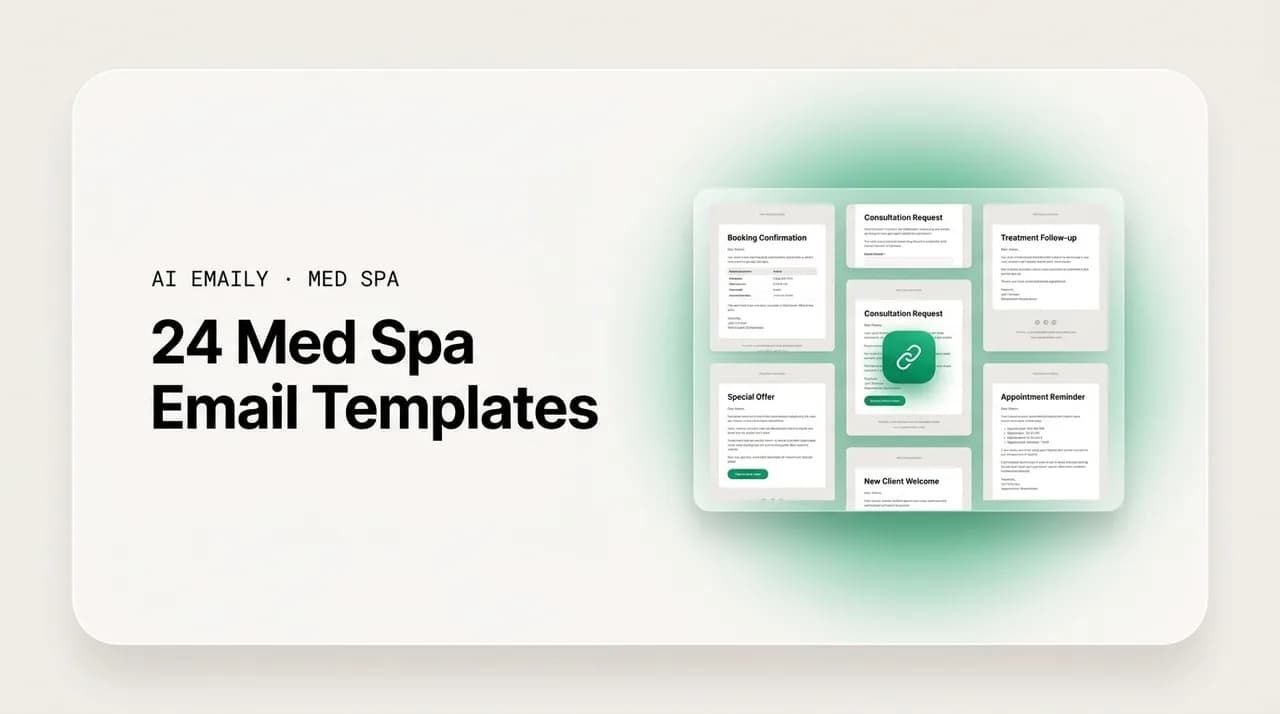
24 copy-paste med spa email templates for consult inquiries, pricing, pre-treatment prep, reminders, post-treatment check-ins, rebooking, memberships, win-back, and reviews — with a HIPAA guardrail so you keep clinical detail and PHI out of the automated ones.
On this page
- 01Why med spa email templates are worth building before your next busy week
- 02How to use these med spa email templates (and the bracket rules)
- 03Inquiry reply templates: win the five-minute window
- 04Consultation booking templates: confirm, prepare, remind
- 05Pricing inquiry templates: answer without underselling the consult
- 06Pre-treatment templates: prepare without prescribing
- 07Appointment reminder templates: cut no-shows
- 08Post-treatment check-in templates: care without clinical claims
- 09Rebooking templates: fill the calendar on a rhythm
- 10Membership and package templates: grow lifetime value
- 11Win-back templates: bring lapsed clients home
- 12Review request templates: turn happy clients into proof
- 13Event and promotion templates: fill the calendar for a launch
- 14Which med spa emails can you automate — and which stay human?
- 15How AI Emaily helps med spas send these faster (and keep clinical work human)
- 16Putting your med spa email templates to work
Why med spa email templates are worth building before your next busy week#
A med spa lives or dies by two moments most clinics handle badly: the minute a new inquiry lands, and the days between someone saying "I'm interested" and actually sitting in your chair. Both are email problems. And both are the reason a good set of med spa email templates is one of the highest-return things you can build for the front desk, whether that front desk is a coordinator, a receptionist, or you between injections.
Here is the pattern that quietly drains revenue. Someone sees your ad on Instagram at nine on a Friday night, fills out the form, and asks about Botox pricing or a consultation for a laser package. Nobody is at the desk. The message sits. Over the weekend that same person opens two or three competitor sites, and whichever clinic replies first tends to win the booking. By Monday the lead is cold or already scheduled elsewhere. The inquiry was never a bad lead; the timing of the reply killed it.
The research on this is blunt. Analysis of thousands of online leads found that firms responding within an hour were far more likely to have a meaningful conversation than those that waited even a little longer, and that the odds fall off a cliff as the minutes pass. For aesthetics, where cost-per-lead can be a few dollars for injectables and the average visit is worth hundreds, letting a weekend go by on a fresh inquiry is expensive in a way that compounds: you paid for the click, and then you let the click go stale.
Templates fix the timing problem because they remove the blank page. When the reply is already written, warm, and on-brand, sending it takes seconds instead of the several minutes of "how should I word this" that never happen at nine on a Friday. This guide gives you 24 of them, grouped by moment in the client journey, from the first inquiry all the way through win-back a year later. Copy the one you need, swap in the brackets, and send.
One thing to say up front, because it governs everything below. Med spas sit under HIPAA, and that changes what an email template may and may not contain. The templates here are deliberately built as marketing and scheduling messages: confirming a consult, sharing a price range, reminding someone about an appointment, inviting them to rebook. They intentionally avoid clinical detail and protected health information (PHI). We will come back to this several times, because it is the line that separates an email you can safely automate from one a human should write by hand.
This article is educational, not medical or legal advice. HIPAA and state rules on patient communication are specific, and a compliance professional or your practice attorney should sign off on how your clinic handles messaging. Treat the templates as starting points for marketing and scheduling copy, then adapt them to your own policies.
The HIPAA line, in one sentence
How to use these med spa email templates (and the bracket rules)#
Every template below uses [bracketed placeholders] for the parts you swap. Before you save any of them into your email client or your booking software, do a quick pass and replace all of them. The classic template mistake is sending a message that still says [First name] or [Treatment] because you copied fast and skipped a line.
A few conventions used throughout, so you know what each bracket means:
- [First name] — the client's first name only, warmer than the full name and safer than assuming a title.
- [Clinic name], [Provider name] — your brand and the person they'll see; keep the provider name consistent with how your booking system shows it.
- [Treatment / service] — the service in general terms ("your consultation," "your appointment"), not a clinical description of a condition.
- [Price range] — a range, not a bespoke quote, and never tied to a specific person's clinical situation in an automated send.
- [Booking link], [phone], [address] — your live scheduling link, a working number, and your location, checked before you save the template.
- [Date], [Time] — pulled from your calendar; double-check these are correct for the recipient's appointment, not a leftover from the last edit.
Two habits make templates work at a med spa. First, keep them short. A client reading on a phone wants the answer and the next step, not three paragraphs. Second, keep one clear call to action per email, usually "book" or "reply to confirm." When a message asks for two or three things, people do none of them.
Personalize one line, not the whole email
Inquiry reply templates: win the five-minute window#
This is the most important template you will ever build. When a new inquiry lands, your only job is to acknowledge it fast, sound like a real, warm clinic, and move the person toward booking a consultation. Speed matters more than polish here; a friendly reply in five minutes beats a perfect one in five hours. The instant acknowledgment is exactly the kind of message that should go out immediately, day or night, because the alternative is the weekend-long silence that loses the booking.
Start with the all-purpose instant reply. This is what someone should get within minutes of submitting a form or emailing your general inbox, regardless of what they asked.
If the inquiry came in after hours, a small acknowledgment of the timing makes the automatic-feeling reply land as thoughtful rather than robotic. It still routes them to booking, and it sets the expectation that a human will follow up.
For a specific, high-intent inquiry — someone who named the exact treatment and sounds ready — a slightly more tailored reply can carry more warmth and a firmer nudge to book, while still staying on the safe side of the HIPAA line by talking about the consultation rather than their clinical situation.
Consultation booking templates: confirm, prepare, remind#
Once someone books a consultation, a short sequence of emails keeps them warm and cuts the no-show rate. Aesthetic consults are a considered purchase, and the gap between booking and arrival is where nerves and second thoughts creep in. A confirmation, a gentle what-to-expect note, and a reminder do most of the work of getting people through the door.
First, the confirmation. Send it immediately after they book. It reassures them the appointment is real and sets the essentials in one glance.
A short "what to expect" note, sent a day or two before, calms first-time nerves and sets a warm, professional tone. Keep it about the experience — parking, timing, the feel of the visit — rather than clinical instructions, which vary by person and belong with a human.
The consultation reminder is the workhorse. Sent the day before or the morning of, it meaningfully lowers no-shows. Keep it tight and give one easy path to reschedule so a conflict becomes a moved appointment rather than a silent no-show.
Pricing inquiry templates: answer without underselling the consult#
Pricing questions arrive constantly, and how you answer them shapes whether someone books or bounces. The trap is either dodging the question entirely, which frustrates people, or quoting an exact number over email for a treatment that genuinely depends on the person, which oversells certainty and can veer into clinical territory. The reliable middle path is an honest range plus a clear invitation to the consultation, where a real plan and price can be built.
Here is the standard pricing reply, giving a range and steering to the consult.
When someone specifically asks about packages, memberships, or financing, lead with the value and the range, then route to a conversation. Keep any specifics about affordability general and inviting rather than pushy.
Pre-treatment templates: prepare without prescribing#
Once a treatment (not just a consult) is booked, a pre-treatment email reduces cancellations and helps the visit go smoothly. This is a careful category, because genuine pre-treatment instructions — what to avoid, medications, aftercare precautions — are clinical and person-specific. Those belong in a message a provider writes or reviews, not in a blanket automated send.
The safe, automatable version confirms the appointment and covers the logistical, non-clinical basics, then explicitly points the person to their provider for anything specific.
Why the pre-treatment note routes to a human
Appointment reminder templates: cut no-shows#
No-shows are pure lost revenue, and reminders are the cheapest fix there is. Industry data on aesthetic bookings consistently shows a meaningful share of appointments are missed when no reminder goes out, and that a simple nudge recovers a large chunk of them. Reminders are also one of the clearest cases of a message you can safely automate: they are scheduling, not clinical. Note that a reminder confirming an existing appointment is generally treated differently from marketing under communication rules — but keep the content to the appointment itself, not the reason for it.
Here is the standard day-before reminder for a booked treatment.
A same-day reminder a few hours before the appointment catches the people who booked far in advance and lost track of the date. Keep it to one line of substance and the essentials.
For no-show-prone slots, a confirmation-request reminder that asks for a one-word reply turns a passive reminder into a small commitment, which further lowers the miss rate.
Post-treatment check-in templates: care without clinical claims#
A check-in a day or two after a visit does two things at once: it makes people feel looked after, and it opens the door to a review and a rebooking later. But this is another category to handle carefully. A message that references someone's specific treatment and how they are healing edges toward PHI, and detailed aftercare is clinical. The automatable version is a warm, general "how are you doing" that invites a reply, with any real clinical follow-up handled by a person.
Here is the safe, general post-visit check-in.
Don't put the treatment in the subject line
If your clinic wants to gently point clients to aftercare resources, do it by pointing to where the guidance lives (a page, a handout given in person) rather than restating clinical instructions in an automated email. This keeps the message helpful without turning a marketing send into medical advice.
Rebooking templates: fill the calendar on a rhythm#
Most aesthetic results are maintained on a cycle, which makes rebooking one of the most valuable and most under-used email moments in a med spa. The clinic already knows roughly when someone should think about coming back; a timely, friendly nudge captures repeat revenue that would otherwise leak. Keep these focused on the invitation to book again, not on a clinical claim about what the person "needs."
The standard rebooking nudge, timed to your typical maintenance window.
For clients who like a bit of structure, an offer to pre-book their next appointment before they leave (or shortly after) locks in the rhythm. This version frames it as a convenience rather than a sales push.
Membership and package templates: grow lifetime value#
Memberships and packages turn one-off visitors into predictable, recurring revenue, and email is the natural place to introduce them — to happy existing clients especially. These are straightforwardly marketing messages, so they are comfortable to send, but they still fall under commercial email rules, which means honesty about terms and a working way to opt out.
An introduction to a membership, aimed at clients who already visit.
A package offer works well right after a consultation or first treatment, when someone is deciding how to commit to a series. Lead with the value and keep the terms plain.
Win-back templates: bring lapsed clients home#
Every med spa has a list of clients who came once or twice and then drifted. Winning even a fraction of them back is cheaper than acquiring new leads, and a warm, low-pressure email is the way to do it. The tone that works is "we miss you," not "you disappeared" — friendly, a little generous, and easy to say yes to. As with all marketing email, honor opt-outs and keep it honest.
The core win-back message.
For clients who have been gone a long time, a simpler, no-offer check-in can work better — it feels less transactional and gives you a read on who is still interested before you spend an incentive on them.
Review request templates: turn happy clients into proof#
Reviews are the currency of local aesthetics, and the best time to ask is right after a positive visit while the good feeling is fresh. The template just needs to make it easy — one clear link, one gentle ask, and gratitude. Keep it general rather than naming the specific treatment, both to stay on the right side of the PHI line and because a broad request reads better publicly.
The standard post-visit review request.
If you want a softer version that also catches unhappy clients before they post publicly, give people a private path to raise a concern first. This protects your reputation and gives you a chance to make things right.
Event and promotion templates: fill the calendar for a launch#
Product launches, seasonal specials, open-house evenings, and new-treatment announcements all live in email, and they are pure marketing, so they are comfortable to send to your list — with the usual honesty and opt-out. The key is a clear reason to act now and one obvious next step. Avoid making promotions feel like a firehose; a med spa's list gets tired fast if every email is a sale.
An event invitation, for an open house or launch evening.
A seasonal or limited-time promotion works when the deadline is real and the offer is easy to understand. Keep it to one offer and one link.
Promotional email has rules too
Which med spa emails can you automate — and which stay human?#
The single most useful mental model for a med spa inbox is a two-bucket sort. Bucket one is marketing and scheduling: acknowledgments, confirmations, reminders, rebooking, promotions, review requests. These are safe to automate and are exactly where speed wins you bookings. Bucket two is clinical and PHI: specific pre-treatment instructions, aftercare tied to a person, anything referencing a diagnosis, condition, or treatment detail. These stay human, drafted or reviewed by someone qualified.
The table below sorts the templates in this guide so you can see the line at a glance. "Automate?" means whether the message can safely go out on a rule or schedule; the HIPAA note explains the guardrail.
| Message | Automate? | HIPAA / PHI note |
|---|---|---|
| Instant inquiry acknowledgment | Yes | Marketing/scheduling only; talk about the consult, not the person's condition. |
| Consultation confirmation & reminder | Yes | Scheduling; keep the subject and body general, not treatment-specific. |
| Pricing range reply | Yes | Give a range, never a person-specific clinical quote in an automated send. |
| Pre-treatment logistics | Partly | Automate parking/timing; route real prep instructions to a human. |
| Appointment reminder | Yes | Scheduling; confirm the appointment, not the reason for it. |
| Post-treatment check-in | Partly | Automate a general 'how are you'; keep the subject non-clinical, hand off specifics. |
| Detailed aftercare instructions | No | Clinical and person-specific — a provider writes or reviews it. |
| Rebooking nudge | Yes | Marketing; invite them back, don't assert a clinical 'need.' |
| Membership & package offers | Yes | Marketing; follow commercial-email rules (opt-out, address). |
| Win-back | Yes | Marketing; keep it general and honor unsubscribes. |
| Review request | Yes | Keep it general; don't name the specific treatment received. |
| Event & promotion | Yes | Marketing; truthful subject, physical address, working unsubscribe. |
| Any reply with clinical detail or a diagnosis | No | PHI — must be handled by a person on secure, compliant channels. |
How AI Emaily helps med spas send these faster (and keep clinical work human)#
Templates solve the blank page. The thing they don't solve is presence — being at the desk at nine on a Friday to actually send the reply. That gap between "we have a good template" and "someone sent it in five minutes" is where an AI email client earns its place, and it's the specific problem AI Emaily is built for.
AI Emaily is an AI-native email client that connects to Gmail, Outlook, iCloud, Fastmail, Proton, and any IMAP account, and it acts as an autonomous chief of staff for your inbox. For a med spa, the most useful piece is instant inquiry acknowledgment: when a new consult request or pricing question lands, AI Emaily can recognize it and get a warm, on-brand reply out within minutes — the exact five-minute window that decides whether the lead books with you or with the clinic down the road — instead of letting it sit until Monday.
Because it learns how your clinic actually writes, the drafts come back in your voice rather than stiff template boilerplate, so a reply feels like it came from your front desk, not a robot. You stay in control through its three modes. In Manual you write with AI assistance. In Copilot, AI Emaily drafts the reply — the inquiry ack, the reminder, the rebooking nudge — and holds it for you to approve before it sends, which is the right default for a clinic that wants a human eye on every message. In Autopilot, you can let it handle the most routine, clearly non-clinical sends on its own, always with undo and a full audit trail of what it did.
The guardrail is deliberate and matches everything above: AI Emaily is built to speed up the marketing and scheduling messages — acknowledgments, confirmations, reminders, rebooking, promotions — while keeping clinical detail and PHI out of the automated path. When a message needs real clinical content or references a specific patient's treatment, that stays with a qualified human on your team; the AI handles the scheduling shell around it. (You are still responsible for configuring your clinic's messaging to meet HIPAA and your own compliance policies; AI Emaily is a tool, not legal advice.)
The result is a front desk that never misses the five-minute window, follow-up that actually happens instead of stopping after one attempt, and reminders that quietly cut your no-shows — with you approving the important ones and the clinical work staying exactly where it belongs. You can try it free at app.aiemaily.com/signup, with a Free plan at no cost and Pro at $12.42 per month on the annual plan.
Putting your med spa email templates to work#
Great med spa email is not about clever copy; it's about being fast, warm, and consistent at the two moments that decide revenue — the fresh inquiry and the gap before someone arrives. The 24 templates above cover the whole journey so you never start from a blank page: acknowledge instantly, book the consult, answer pricing honestly, prepare and remind, check in kindly, then rebook, upsell a membership, win back the lapsed, and ask happy clients for proof.
Save the ones that fit your clinic into your email client or booking software today, swap the brackets for your real details, and hold the line that runs through all of them: automate the marketing and scheduling, keep the clinical and the PHI human. Then make speed the habit. A reply in five minutes, sent from a template you already trust, is worth more than the most beautiful email that arrives on Monday.
And if being present for that five-minute window is the part you can't guarantee, let your email client cover it — drafting the reply in your voice, holding it for your approval, and keeping the clinical work exactly where it belongs, with your team.
Frequently asked
See it in AI Emaily
Keep reading
Sources
- Harvard Business Review — The Short Life of Online Sales Leads (the five-minute window)
- American Med Spa Association (AmSpa) — Legal & Compliance Blog
- eCFR — HIPAA Privacy, Security & Breach Rules (45 CFR Part 164)
- Federal Register — HIPAA Omnibus / HITECH Modifications (2013)
- FTC — CAN-SPAM Act: A Compliance Guide for Business

Written by
Nafiul HasanNafiul Hasan is an entrepreneur and AI automation system builder with 10+ years of experience turning messy, manual workflows into reliable automated systems. He designs and ships AI enterprise solutions end-to-end — the agent logic, the data plumbing, and the product people actually use — and founded AI Emaily to give busy professionals their attention back. He writes here from the builder's seat: what works, what breaks, and how to put AI to work without giving up control.