How to Write Mortgage Client Emails That Get Replies (Loan Officer Guide + Examples)

The short answer
To write mortgage client emails that get replies, lead with one clear point, use plain language instead of jargon, set expectations on timing, and end with a single next step. Match tone to the moment: fast and reassuring for new leads, calm and specific for delays, warm for clear-to-close. Never promise a rate you can't lock, and keep client data secure.
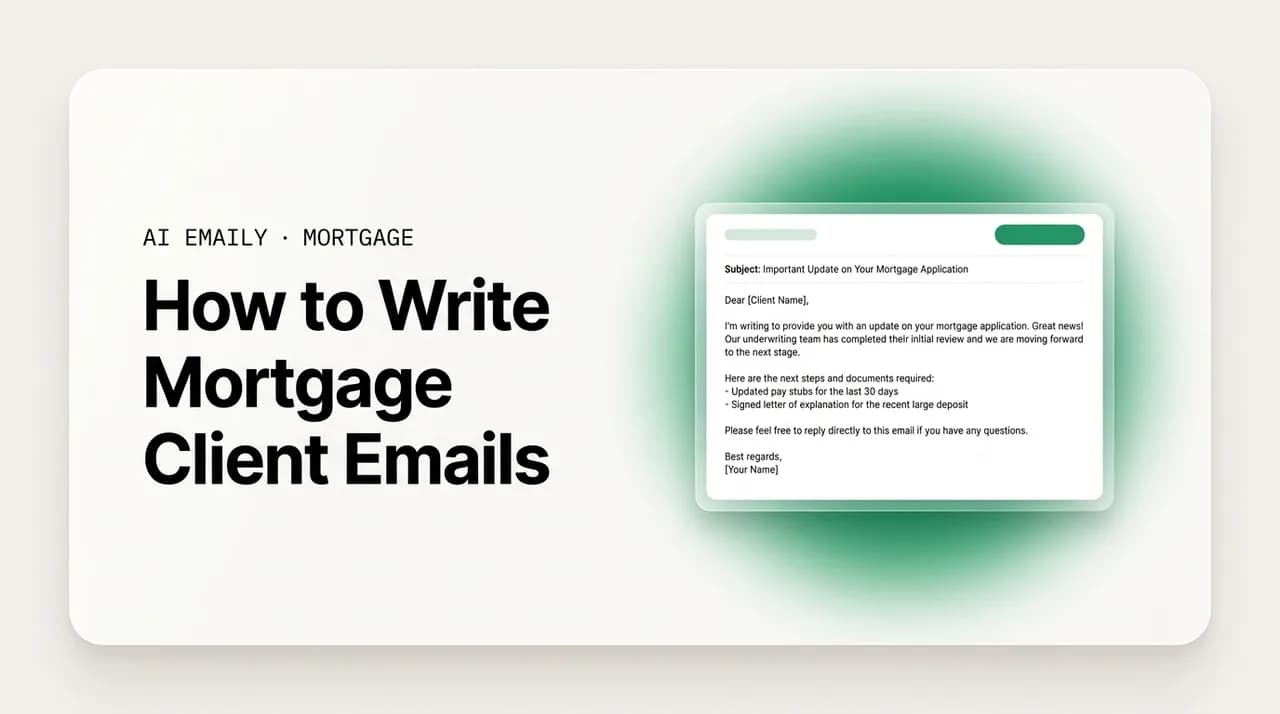
How to write mortgage client emails that get replies: the principles, tone by scenario, subject lines, and copy-paste examples loan officers can use for leads, pre-approvals, doc requests, delays, and clear-to-close.
On this page
- 01Why mortgage client emails are hard to get right
- 02The principles of a great mortgage client email
- 03How to write mortgage email subject lines that get opened
- 04New lead: the first reply that wins the deal
- 05Pre-approval: deliver the good news clearly
- 06Explaining a rate or product without the jargon
- 07Asking for documents so they actually get sent
- 08Delivering a delay or bad news
- 09Clear-to-close: celebrate and prepare
- 10Post-close and refi check-ins that keep the relationship
- 11Tone and approach by scenario, at a glance
- 12Etiquette and compliance-awareness you can't skip
- 13Common mortgage email mistakes to avoid
- 14How AI Emaily helps loan officers write better client emails
- 15Putting it all together
Why mortgage client emails are hard to get right#
If you want to know how to write mortgage client emails that actually get replies, start by remembering who is on the other end. Your borrower is making the largest financial decision of their life, often for the first time, and they are doing it in a language of acronyms they never learned: LTV, DTI, PMI, escrow, LE, CD, PITI. They are anxious. They are comparing you against three or four other lenders who got the same shared lead. And they are reading your email on a phone, between meetings, while a real estate agent texts them about a showing. Every email you send lands in that emotional and practical context, whether you account for it or not.
Most loan officer emails fail for boring, fixable reasons. They bury the one thing the borrower needs under three paragraphs of throat-clearing. They lean on jargon that makes the borrower feel dumb instead of informed. They ask for six documents in one wall of text, so the borrower sends none. They promise a rate that moves before the borrower can act on it. Or they simply arrive too late, because the note sat in a drafts folder while a competitor already called, emailed, and pre-qualified the same person.
The good news is that great mortgage emails are not a talent. They are a small set of habits, applied consistently across a handful of predictable moments in every loan. This guide walks through the principles first, then the tone and an example email for each scenario a loan officer faces, from the first response to a shared lead all the way through clear-to-close and the post-close refi check-in. It closes with the etiquette and compliance you cannot skip, the mistakes that quietly cost you deals, and an honest look at where an AI email client helps and where a human still has to sign off.
The principles of a great mortgage client email#
Before any template, internalize the principles. Scenario scripts change; these do not. Get these right and a plain email outperforms a polished one that ignores them.
- 1
One email, one point
Decide the single thing this email must accomplish before you type a word. Acknowledge the lead. Request the pay stubs. Explain the rate lock. Deliver the delay. When an email tries to do four things, the borrower does none of them. If you genuinely have four things to say, that is a signal to send fewer, tighter emails, not one longer one.
- 2
Plain language over jargon
Every industry term you drop untranslated is a small tax on the borrower's confidence. Say "the amount you owe compared to the home's value" before, or instead of, "LTV." Plain-language guidance is blunt about this: write for your reader, use everyday words, and keep sentences short. Jargon does not make you sound expert; a clear explanation of a hard thing does.
- 3
Calm, specific reassurance
Anxious borrowers do not calm down when you say "don't worry." They calm down when you show them you know exactly what happens next and when. Replace vague comfort with concrete steps and dates. "This is normal at this stage, here is what I'm doing today, and you'll hear from me by Thursday" does more for a nervous first-time buyer than a paragraph of warmth.
- 4
Set expectations every time
The single biggest source of borrower frustration is silence they can't interpret. Tell them what happens next, roughly how long it takes, and when they'll hear from you again, on every email. Even "nothing is needed from you right now, I'll update you Friday" is a gift, because it stops them refreshing their inbox and calling your cell.
- 5
End with exactly one next step
Close every email with a single, unambiguous ask or action, and make it easy. "Reply with a good time Tuesday or Wednesday and I'll call you." "Upload your two most recent pay stubs using the secure link below." One clear next step gets done. A menu of options gets deferred.
- 6
Write like a human, sign like a person
Borrowers reply to people, not to lenders. Use their name, use your name, keep the tone conversational, and drop the corporate stiffness. A short, warm, direct email from "Maria" gets answered; a formal one from "The Lending Team" gets ignored. This matters more, not less, when the news is bad.
Notice how much of this is about the reader's experience rather than your polish. That is the whole game. A borrower comparing lenders can't judge your rate sheet or your underwriting skill from an email; they can only judge how it feels to work with you. Clear, calm, prompt, and specific reads as competent and trustworthy, which is exactly what someone hands their biggest financial decision to.
The one-glance test
How to write mortgage email subject lines that get opened#
None of your careful writing matters if the email never gets opened, and in a shared-lead world your subject line is competing against three other lenders in the same inbox. The rule is simple: the subject line should tell the borrower exactly what the email is and, ideally, whether they need to do something. Clever loses to clear every time.
Good mortgage email subject lines are specific, personal where possible, and honest about the ask. Compare a few:
- Weak: "Following up" — tells the borrower nothing and looks like every other salesperson's email.
- Weak: "Your mortgage" — vague, and slightly ominous for an anxious borrower.
- Strong: "Your pre-approval is ready, Sarah, here's your letter" — names the payoff and the person.
- Strong: "Two documents to finish your application (5 minutes)" — names the ask and the effort.
- Strong: "Quick update on your closing date" — signals a status change without alarming.
- Strong: "Rates moved, worth a 10-minute call?" — for a warm past client, honest and low-pressure.
Say what's inside
New lead: the first reply that wins the deal#
The new-lead email is the highest-stakes email you send, and the one most often fumbled. In a shared-lead scenario the borrower filled out the same form for several lenders, and whoever responds first, fastest, and most helpfully usually earns the conversation. Speed is most of the battle, but the content matters too: this email has to feel personal, competent, and easy to reply to, in about four sentences.
Do not try to pre-qualify, quote a rate, or explain your process in this first email. Its only jobs are to prove a real human saw their request, establish you as helpful and human, and make it frictionless to take the next step, usually a quick call. Keep it short, warm, and fast.
Two things make this email win. First, it went out in minutes, not hours, so it may be the first real human reply the borrower saw. Second, it asks for exactly one easy thing, a short call at a specific time, rather than dumping a document checklist or a rate table on someone who has not even decided to work with you yet. Save the substance for the call. This email's job is only to earn it.
Speed is the strategy
Pre-approval: deliver the good news clearly#
A pre-approval email is a happy one, and you should let it feel that way, but it still has to do real work. The borrower is excited and about to go house-hunting, so this email should celebrate the milestone, state plainly what the pre-approval means and does not mean, and set expectations for what comes next. First-time buyers in particular often confuse pre-approval with a final loan guarantee, so a sentence of plain-language framing here prevents a hard conversation later.
Clarify pre-approval vs. commitment gently
Explaining a rate or product without the jargon#
Explaining a rate, a lock, or a product choice is where plain language earns its keep, and where loan officers most often lose borrowers to a competitor who simply made it easier to understand. The goal is not to teach a finance course; it is to give the borrower enough clarity to feel confident in a decision. Lead with what it means for them, in dollars and in plain terms, then offer the detail for those who want it.
This is also the scenario with the sharpest compliance edge, so precision matters. Frame rates as current and subject to change, never as a guaranteed promise, and if you quote numbers, tie them to the assumptions and disclosures they depend on.
Never promise a rate you can't lock
Asking for documents so they actually get sent#
Document requests are the workhorse email of the whole loan, and the one most likely to stall the file. The failure mode is always the same: you ask for everything at once, in a dense paragraph, with no clear instructions, and the overwhelmed borrower does nothing. The fix is structure. Make the list scannable, explain briefly why each item is needed, tell them exactly how to send it securely, and give a gentle deadline tied to their own goal.
Route sensitive documents to a secure channel
When a document is still outstanding, resist the urge to send a guilt-tinged nudge. A short, friendly reminder that repeats the exact ask and the secure link, and reconnects it to the borrower's deadline, works far better than "just following up again." Keep the tone on their side: you and the borrower want the same thing, which is their loan closing on time.
Delivering a delay or bad news#
This is the email that separates loan officers borrowers rave about from ones they warn their friends against. Something will go wrong on some files: an appraisal comes in low, underwriting asks for a condition, a rate lock is about to expire, the closing slips. Borrowers can handle bad news. What they cannot handle is silence, spin, or being surprised. The email that preserves the relationship is prompt, honest, specific about the cause, clear about what you are doing to fix it, and explicit about the next update.
The structure that works: acknowledge the situation plainly, explain what happened in plain language, take ownership of the plan, and give a concrete next step and timeline. Do not over-apologize, do not hide behind passive voice ("a delay has occurred"), and never go quiet hoping it resolves itself before they notice.
The worst move is going silent
Clear-to-close: celebrate and prepare#
Clear-to-close is the payoff, and your email should feel like it, while still doing the practical work of preparing the borrower for closing day. After weeks of stress, the borrower has earned a genuinely warm, congratulatory note. Let the good news lead, then give them a short, clear rundown of what to bring and expect, so the finish line is as smooth as the celebration.
Wire fraud warning belongs in this email
Post-close and refi check-ins that keep the relationship#
The loan closing is not the end of the relationship; it is the start of the referral and repeat-business engine that top originators live on. Post-close, your emails shift from transactional to relational. A short thank-you and a promise to stay in touch right after closing, a helpful check-in on the loan anniversary, and a genuinely useful (never pushy) note when rates move enough to matter, keep you top of mind for the next purchase, the refi, and the friend who asks "who did you use?"
The refi rate-drop email deserves special care because it is easy to get wrong. It should be helpful and specific, not a mass blast that reads like spam. Reference the borrower's actual situation, be honest about whether it's worth their time, and make the next step a low-pressure conversation, not a hard sell.
When rates drop enough to genuinely benefit a past client, the refi outreach should feel like a favor, not a pitch. Lead with the specific reason it's relevant to them, be honest that it may or may not make sense, and offer a quick, no-pressure look at the numbers.
Tone and approach by scenario, at a glance#
Every scenario above shares the same principles but calls for a different tone and a different single next step. Here is the whole guide compressed into a quick reference you can scan before you write. Match the tone to the moment and the borrower will feel understood, which is most of what earns the reply.
| Scenario | Tone | One next step |
|---|---|---|
| New lead | Fast, warm, human, low-pressure | Book a short call at a specific time |
| Pre-approval | Celebratory but clear; manage expectations | Share the letter with the agent; send the address |
| Explaining a rate or product | Plain-language, honest, no promises | Book a call to walk through the numbers |
| Requesting documents | Structured, helpful, deadline tied to their goal | Upload the listed items via the secure link |
| Delay or bad news | Prompt, honest, calm, ownership of the plan | One concrete action + a promised update date |
| Clear-to-close | Warm, congratulatory, practical | Prepare for closing day; watch for final numbers |
| Post-close | Grateful, relational, no ask beyond referrals | Keep the door open; remember me for referrals |
| Refi check-in | Helpful, specific, genuinely no-pressure | Reply "yes" for a no-obligation comparison |
Etiquette and compliance-awareness you can't skip#
Mortgage is a regulated business, and your emails are part of the regulated conversation. You do not need to be a compliance officer to write safely, but you do need a handful of habits that keep you and your borrower out of trouble. This is not legal advice, always follow your own company's compliance policies, but these principles hold broadly across loan officer communication.
- Don't make unqualified rate or approval promises. Describe rates as current and subject to change, tie any quoted number to its assumptions, and never state a firm "I can get you X%" without the lock and disclosures behind it. Advertising rules treat rate and payment claims as serious representations.
- Put binding terms in disclosed documents, not casual email. The Loan Estimate and other required disclosures exist for a reason. If a borrower needs official numbers or terms, point them to the proper disclosed document rather than an off-the-cuff email figure.
- Include required disclosures where your compliance team requires them. NMLS ID, equal-housing language, and any state or company-mandated disclaimers belong on the emails your policy covers. Build them into your signature and templates so you never forget.
- Protect borrower data as a default, not an afterthought. Route pay stubs, statements, and tax forms to a secure portal; never request full SSNs or account numbers by email; and warn borrowers about wire fraud before closing. Safeguarding customer financial information is a legal obligation, not just good manners.
- Say what's true and only what's true. Don't overstate what a pre-approval guarantees, don't imply an approval that hasn't happened, and don't promise a closing date you can't reasonably hit. Accuracy protects the relationship and keeps you clear of misrepresentation.
- Keep a record. Because these communications can matter later, favor channels your company can archive and audit. Off-the-record texts and personal email are where compliance problems hide.
This is awareness, not a substitute for your compliance team
Common mortgage email mistakes to avoid#
Most loan officer emails that fail do so in the same handful of ways. Scan this list against your own sent folder; fixing even two or three of these will visibly lift your reply rate.
- Being too slow on new leads. A thoughtful email that arrives two hours after three competitors already called is a wasted email. Speed to the first reply is the single biggest lever on a shared lead.
- Burying the point. If the borrower has to read three sentences to find out what you need, many won't. Lead with the one thing, then support it.
- Drowning the reader in jargon. LTV, DTI, PITI, and escrow are your language, not theirs. Translate first, abbreviate second, and only if it helps.
- Asking for everything at once. A ten-item document dump in one paragraph gets ignored. Make it a short, scannable list with a secure link and a deadline.
- Vague or clever subject lines. "Following up" and "Your mortgage" underperform "2 documents to finish your application." Say what's inside.
- Going silent when there's a problem. The delay email nobody wants to send is the one that saves the relationship. Silence reads as hiding.
- Over-promising rates or approvals. A rate stated as a promise, or a pre-approval framed as a done deal, creates disappointment and compliance risk. Be accurate and current.
- No clear next step. An email that ends without a single, easy ask leaves the borrower unsure what to do, so they do nothing.
- Sending sensitive data over plain email. Requesting or accepting pay stubs, statements, or SSNs by email exposes your client and you. Always route to a secure channel.
- Sounding like a corporation. Borrowers reply to people. A stiff, templated wall of text from "the team" gets ignored; a short, warm note from you gets answered.
How AI Emaily helps loan officers write better client emails#
Everything above is learnable, but doing it consistently, on every lead and every file, while you're mid-closing and the next shared lead just landed, is the real challenge. This is exactly the gap an AI-native email client is built to close. AI Emaily is an AI email client that connects to Gmail, Outlook, and any IMAP account, learns how you actually write, and drafts replies in your voice, so the clear, calm, on-brand email you'd write on your best day is the one that goes out every time, not just when you have a spare ten minutes.
For a loan officer, the most valuable part is that it drafts per relationship. It reads the thread and the context and produces the right email for the moment: a fast, human first reply to a new lead; a plain-language rate explanation; a scannable document request with the deadline reconnected to the borrower's goal; a careful, honest delay update. Because it learns your voice, it sounds like you and not like generic boilerplate, which is the difference between an email that gets a reply and one that gets deleted. It also helps you win the speed-to-lead race, because an instant, personal-sounding acknowledgment can go out the moment a lead arrives, before a competitor gets to the phone.
The reason a regulated professional can actually trust this is the control model. AI Emaily runs in Manual, Copilot, and Autopilot modes, and for a loan officer the sweet spot is Copilot: it drafts the email and waits for you to approve before anything sends, so a human always signs off on anything sensitive, a rate explanation, a bad-news email, anything touching approvals or disclosures. The routine, low-risk categories, an instant lead acknowledgment or a standard document reminder, are the cleanest candidates to let it handle more autonomously, and even then every action has undo and a full audit trail. You get the speed and consistency of automation with a human firmly in the loop exactly where it matters, which is what mortgage compliance and borrower trust both require.
The bigger idea is that the app works as an autonomous chief of staff for your inbox, drafting, triaging, and handling the busywork so you spend less time typing the same pre-qual, doc-request, and status email for the hundredth time, and more time actually talking to borrowers and agents. You can try it free at app.aiemaily.com/signup, with a Free plan at no cost and Pro at $12.42 per month on the annual plan.
Putting it all together#
Learning how to write mortgage client emails that get replies comes down to remembering who's reading. Your borrower is anxious, comparing lenders, and making the biggest purchase of their life in a language they don't fully speak. Every email you send should make that easier: one clear point, plain language instead of jargon, calm and specific reassurance, expectations set on timing, and exactly one easy next step. That's the whole formula, applied consistently across the predictable moments of every loan.
The tone shifts with the moment, fast and human for a new lead, plainspoken for a rate, structured for documents, honest and prompt for a delay, warm for clear-to-close, relational after, but the principles never do. Layer in the compliance habits (no unqualified rate promises, disclosures where required, secure handling of client data) and you protect both the relationship and your license. Avoid the handful of common mistakes and your reply rate climbs on its own.
Grab the example for whatever email you're about to send, swap in your borrower's details and your own voice, and you're most of the way there. And when doing this well on every lead and every file starts to outrun the hours in your day, let an AI email client draft it in your voice and hold each sensitive message for your approval, so being fast, clear, and human stops being something you have to find time for and becomes simply how your inbox works.
Frequently asked
See it in AI Emaily
Keep reading
Sources
- PlainLanguage.gov — Be concise (federal plain-language guidelines)
- PlainLanguage.gov — Write for your audience
- eCFR — Title 12, Part 1026 (Regulation Z / Truth in Lending): mortgage advertising and disclosure rules
- FTC — Gramm-Leach-Bliley Act (safeguarding customer financial information)
- Nielsen Norman Group — How Users Read on the Web

Written by
Nafiul HasanNafiul Hasan is an entrepreneur and AI automation system builder with 10+ years of experience turning messy, manual workflows into reliable automated systems. He designs and ships AI enterprise solutions end-to-end — the agent logic, the data plumbing, and the product people actually use — and founded AI Emaily to give busy professionals their attention back. He writes here from the builder's seat: what works, what breaks, and how to put AI to work without giving up control.