The Mortgage Document Request Email Template Workflow That Stops the Chasing

The short answer
Loans stall on documents, not on rates. A good mortgage document request email template names each item in plain language, explains why you need it, gives a clear deadline, and points the borrower to a secure upload link, never plain email for sensitive files. Pair the initial request with a fixed reminder cadence (day 3, day 6, day 9) and short status updates at each conditions milestone, so borrowers always know what is outstanding and what happens next. Never collect Social Security numbers, bank statements, or IDs over unencrypted email; direct borrowers to a secure portal. AI Emaily can draft the requests, reminders, and status updates from your templates and send routine ones within rules you set, with undo and a full audit trail, while sensitive-document handling stays human and secure.
7 templates from initial checklist to clear-to-close and the day-3/6/9 reminder cadence. Sensitive documents go to your secure portal — never as email attachments.
On this page
- 01Why document collection is where mortgages actually stall
- 02The anatomy of a document request email that actually works
- 03Building the workflow: from initial request to clear to close
- 04Template 1: The initial document request and checklist
- 05Template 2: The specific-item request
- 06Templates 3–5: The reminder cadence (day 3, 6, and 9)
- 07The reminder cadence at a glance
- 08Template 6: The conditions and underwriting update
- 09Template 7: Status updates and the clear-to-close
- 10Data security: never collect sensitive documents over plain email
- 11Keeping borrowers moving without nagging
- 12How AI Emaily helps with document collection
- 13Putting the workflow together
Why document collection is where mortgages actually stall#
Ask any loan officer where their pipeline really gets stuck, and almost nobody says the rate lock or the appraisal. They say documents. The loan was approved, the borrower is excited, the file is moving, and then it just sits, waiting on two pay stubs, a bank statement with the deposit sourced, or a signed letter of explanation that the borrower keeps meaning to write and never does. The rate is fine. The property is fine. The borrower is qualified. The loan is stalled on paperwork that lives in someone else's email or their kitchen drawer.
This is not a small problem. Document collection is the single most repeatable, most controllable part of the mortgage process, and it is also the part that quietly eats the most time. Every file needs roughly the same categories of paperwork, income, assets, identity, and property, and yet loan officers rebuild the request from scratch every time, chase the same missing items with the same one-off emails, and manually type status updates so the borrower and the referring agent do not go silent-treatment anxious. It is death by a thousand small emails, and none of them require judgment. They require a system.
The good news is that because doc collection is so repeatable, it is the most improvable. A well-built mortgage document request email template, backed by a fixed reminder cadence and clear status updates, does most of the work that loan officers currently do by hand and memory. This guide walks through why borrowers stall, how to build the workflow end to end, and gives you copy-paste templates for every stage, from the initial checklist to the moment you get to say the words every borrower wants to hear: you are clear to close.
It helps to name the three failure modes that turn a two-day document exchange into a two-week chase, because the templates in this guide are built specifically to defeat each one.
The first is borrower confusion. A request that says "please send your income and asset documentation" means something precise to you and almost nothing to a first-time buyer. They do not know that "assets" means every page of a two-month bank statement, blank pages included, or that a large deposit needs a paper trail. Vague requests produce vague, incomplete responses, and then you are back in the inbox asking for the parts they missed.
The second is missing items and conditions. Underwriting rarely asks for everything up front. It approves the loan with conditions, and each condition is a fresh, specific document request, often triggered weeks after the borrower thought they were done sending things. The borrower has mentally moved on. Your job is to pull them back in without making it feel like the goalposts moved.
The third is momentum decay. The longer a request sits, the less urgent it feels to the borrower and the more awkward it feels to you to chase. A single follow-up gets ignored; a second one feels like nagging. Without a planned cadence, loan officers either give up too early or over-email until they sound desperate. A workflow removes the emotion and just runs the schedule.
The anatomy of a document request email that actually works#
Before the templates, it is worth being explicit about what separates a request that gets a same-day response from one that gets ignored. Every strong mortgage document request email template does the same six things, in roughly this order. Miss one and you create the exact confusion or delay you are trying to avoid.
Here is the anatomy, piece by piece.
- 1
A subject line that says exactly what you need
"Action needed: 3 documents to keep your loan moving" beats "Following up" every time. The borrower should know from the notification alone that this is theirs to act on and roughly how big the ask is. Number the items in the subject when you can, so "3 documents" sets a finite, doable expectation.
- 2
A one-line reason this matters right now
Lead with why, briefly. "To finish your pre-approval, underwriting needs a few items from you." Borrowers move faster when the request is tied to a milestone they care about, being pre-approved, clearing conditions, closing, rather than to your internal process.
- 3
A numbered checklist, one item per line
Never bury the list in a paragraph. A scannable, numbered list of exactly what you need, with the specific form and time period, is the single biggest driver of a complete response. "1) Your two most recent pay stubs (covering 30 days)" leaves no room for a partial answer.
- 4
A plain-language explanation for anything non-obvious
Next to each item that a normal person would not understand, add a short human translation. "All pages of your last two bank statements, even the blank ones, because underwriting reviews the full statement." This one habit eliminates most back-and-forth.
- 5
A clear deadline framed around their goal
Give a specific date, not "as soon as possible." Frame it around their outcome: "If we have these by Friday, June 12, we can keep your closing date on track." A deadline tied to something the borrower wants beats a deadline tied to your queue.
- 6
A single, secure way to send it back
Point to one place, your secure upload portal, and make it the obvious next click. Do not offer "reply with attachments or upload or text me a photo," which scatters sensitive files across insecure channels and creates version chaos. One secure link, one instruction.
Notice how much of this is about reducing decisions for the borrower. A great document request does not ask them to figure anything out. It tells them exactly what, exactly why, exactly by when, and exactly how, in a format they can act on from their phone in five minutes. Every ounce of ambiguity you remove from the request is an hour of chasing you remove from your week.
The five-minute-from-a-phone test
Building the workflow: from initial request to clear to close#
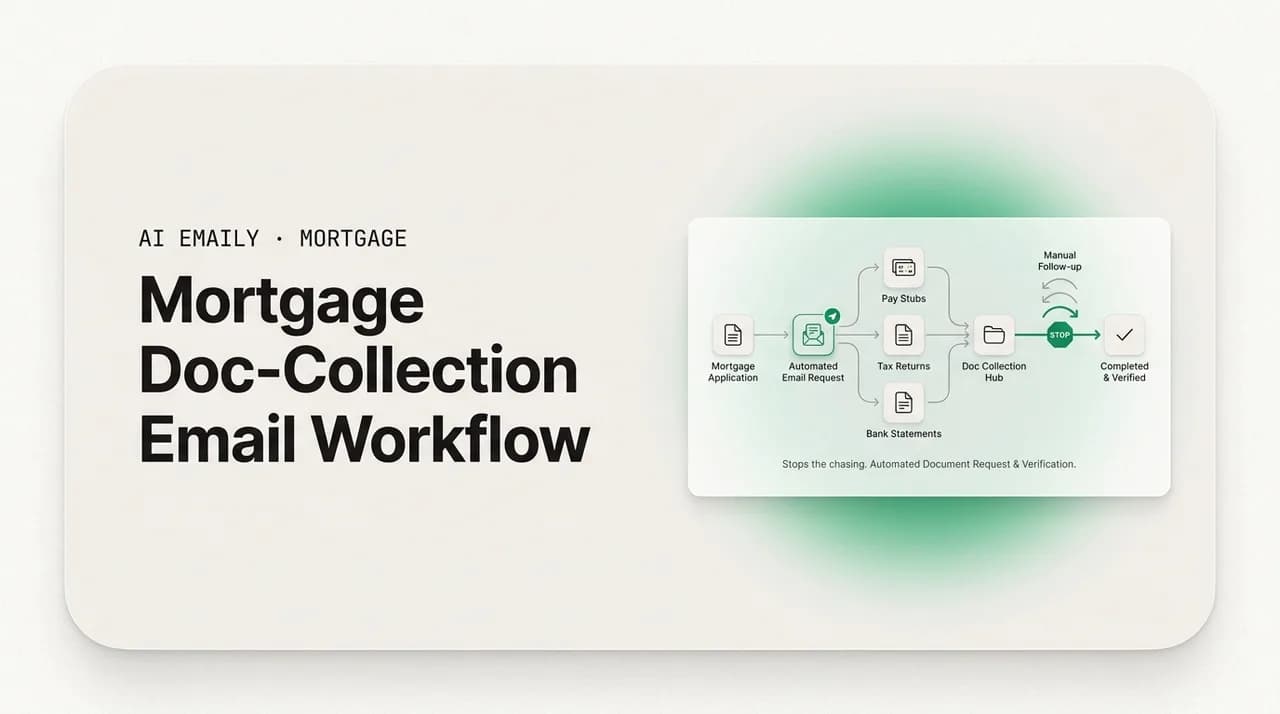
A single good email is not a workflow. What stops the chasing is a repeatable sequence that carries a file from application to closing with the borrower never wondering what is outstanding and you never wondering whether it is time to follow up again. The workflow has five stages, and each one has a template you will reuse on every single loan.
Think of it as a track the borrower rides, not a series of one-off asks.
- 1
Stage 1 — The initial document checklist
Sent the moment you take the application. This is the master list of standard items, income, assets, identity, and property, sent once, complete, in plain language, with the secure upload link. Getting this right up front prevents dozens of small follow-ups later. The CFPB even advises borrowers to assemble this loan-application packet before they shop, so a clear checklist meets them where they already are.
- 2
Stage 2 — The reminder cadence
A fixed schedule of gentle nudges for whatever is still outstanding, not random check-ins. Three touches over roughly nine days (detailed in the cadence table below) keeps momentum without tipping into nagging. Each reminder shows only what is still missing, so the borrower never re-sends what they already sent.
- 3
Stage 3 — Specific-item and conditions requests
As underwriting reviews the file, it asks for specific extras: a large-deposit explanation, an updated statement, a letter of explanation, a condition. Each becomes its own tightly scoped request, one or two items, explained plainly, so the borrower does not feel the goalposts moved.
- 4
Stage 4 — Status updates at every milestone
Short, proactive updates when the file moves: submitted to underwriting, conditional approval, conditions cleared. These are the messages borrowers say they never get and referring agents love most. They prevent the anxious "any update?" email by beating it to the inbox.
- 5
Stage 5 — The clear-to-close update
The payoff message that confirms the loan is clear and sets up the closing. It closes the loop, reinforces the relationship for future referrals, and gives the borrower and agent the certainty they have been waiting for.
Conditions are a feature of the process, not a failure
Template 1: The initial document request and checklist#
This is the workhorse. Sent at application, it sets the tone and does the heavy lifting, one complete, plain-language list that prevents most downstream chasing. Swap in your specific items and your portal link. Keep the plain-language notes; they are the part that gets you complete responses instead of partial ones.
Notice the structure: a reason up top, a numbered list with the why baked in, a goal-framed deadline, and a single secure destination.
A few deliberate choices in that template are worth calling out, because they are the difference between a list and a workflow-grade request. The plain-language note on bank statements ("even blank ones") single-handedly prevents the most common partial response in the business. The deadline is framed around the borrower's pre-approval, not your queue. And the security instruction is stated as a benefit to them ("for your protection"), not a rule you are imposing, which makes them more likely to actually use the portal instead of hitting reply with attachments.
Template 2: The specific-item request#
Not every request is the full checklist. Constantly, underwriting or your own review turns up one precise gap, a missing page, a large deposit that needs sourcing, a name mismatch. These deserve their own short, laser-focused email rather than being buried in a longer note. The tighter the ask, the faster the turnaround.
The key with specific-item requests is to explain the why in one line, because a borrower who understands the reason is far less likely to feel picked on or confused.
Templates 3–5: The reminder cadence (day 3, 6, and 9)#
Here is where most loan officers either drop the ball or overdo it. A single reminder is too easy to ignore; five reminders in a week make you sound frantic. The answer is a fixed, escalating cadence that runs on a schedule so you never have to decide, in the moment, whether it is "too soon" to follow up. Three touches over about nine days is the sweet spot: firm enough to create momentum, spaced enough to stay respectful.
Each reminder does two things: it shows only what is still outstanding (never re-asking for what they already sent), and it escalates gently in tone and specificity. Reminder one is a light nudge. Reminder two adds the stakes. Reminder three offers help and a phone option, because by then the delay usually means the borrower is stuck, not ignoring you.
Reminder two, a few days later, keeps the same list but reconnects the ask to the borrower's deadline and timeline. This is where you make the cost of waiting concrete without any hint of scolding.
Reminder three shifts from chasing to helping. By day nine, a borrower who has not sent something is almost always stuck, confused about what counts, unsure how to get a document, or intimidated by the portal, rather than ignoring you. Offer a call and remove the friction.
Always subtract what they have already sent
The reminder cadence at a glance#
Here is the whole cadence in one reference you can adapt to your average file. Adjust the day spacing to your loan speed, a tight purchase timeline may compress to day 2, 4, 6, while a longer refinance can stretch, but keep the escalation pattern: nudge, then stakes, then help.
| Touch | Timing | Tone | What it does |
|---|---|---|---|
| Initial request | Day 0 (at application) | Warm, complete | Sends the full checklist in plain language with the secure link and a goal-framed deadline. |
| Reminder 1 | Day 3 | Light nudge | Lists only outstanding items; assumes the borrower simply got busy. |
| Reminder 2 | Day 6 | Reconnect to the goal | Ties the missing items to the closing timeline; makes the cost of waiting concrete, kindly. |
| Reminder 3 | Day 9 | Offer help + phone | Shifts from chasing to helping; offers a call to remove whatever is blocking them. |
| Conditions request | As underwriting requires | Routine, reassuring | Tightly scoped ask for a specific condition, framed as a normal final step, not a setback. |
| Status update | At each milestone | Proactive, short | Beats the borrower's "any update?" email; keeps borrower and agent calm and informed. |
Template 6: The conditions and underwriting update#
Once the file goes to underwriting, the communication changes character. You are no longer collecting the standard packet; you are relaying decisions and requesting specific conditions. This is the stage borrowers find most confusing and most anxiety-inducing, because "conditional approval" sounds to a first-time buyer like they might get rejected, when it actually means they are almost there.
The conditions update does two jobs at once: it delivers the good news (approved, conditionally) and it hands over the specific list of conditions as a clear, finite checklist. Framing is everything here. "Conditions" reframed as "the final checklist" turns dread into momentum.
The reassurance in that template is not fluff; it is functional. A borrower who understands that conditions are routine responds calmly and quickly. A borrower who thinks conditions mean trouble panics, calls three times, loops in their agent, and sometimes freezes. One paragraph of plain-language framing prevents all of that. This is also the moment referring agents are watching most closely, a loan officer who keeps the borrower calm through conditions is a loan officer agents send more business to.
Template 7: Status updates and the clear-to-close#
The most underrated emails in the entire mortgage process are the ones you send when nothing is required from the borrower. Proactive status updates, "your file is now with underwriting," "your appraisal came back and looks great," "conditions are cleared", are the messages borrowers consistently say they wish they got and rarely do. They cost you two sentences and they buy you enormous goodwill, fewer anxious inbound calls, and a referring agent who trusts you with their next client.
A good status update is short, specific, and forward-looking. It says what just happened, what happens next, and whether anything is needed from the borrower (often nothing).
And then the message everyone is working toward. The clear-to-close update is the payoff, the confirmation that the loan is fully approved and the closing is set. Make it celebratory but clear, and use it to set up the final steps so there are no surprises at the closing table.
The Closing Disclosure has a legal timing rule
Data security: never collect sensitive documents over plain email#
Everything above depends on one non-negotiable rule, and it is worth stating as plainly as possible: the documents you are collecting are some of the most sensitive personal data that exists. Pay stubs, W-2s, bank statements, driver's licenses, and above all Social Security numbers are exactly what identity thieves and fraudsters want. Ordinary email is not a secure channel for any of it. A standard email travels across multiple servers, can sit unencrypted in inboxes and sent folders, and is a well-known target for interception and account compromise.
This means your entire document workflow must route sensitive files through a secure portal, never as email attachments, and never by asking a borrower to "just text me a photo" of their ID or type their SSN into a reply. The templates in this guide all point to a single secure upload link for exactly this reason. Your job in the email is to make the secure path the easy, obvious, only path, and to gently redirect borrowers who try to reply with an attachment out of habit.
- Never ask for a Social Security number, account number, or full date of birth in an email body, and never accept one that way. Collect these only inside your secure application or portal.
- Route every document, pay stubs, bank statements, IDs, tax forms, through your encrypted upload portal or secure document system, not as email attachments.
- If a borrower emails you a sensitive attachment anyway, do not continue the thread with it. Acknowledge receipt, ask them to re-upload through the secure link, and delete the attachment from your inbox per your company's policy.
- State the security instruction as a benefit to the borrower ("for your protection") so they cooperate, rather than a rule that feels like friction.
- Follow your company's and your regulators' written data-handling and privacy policies, and when in doubt, choose the more secure channel. This guidance is general; your compliance team's rules govern.
Sensitive documents belong in a secure portal, full stop
Keeping borrowers moving without nagging#
There is a real tension at the heart of doc collection: you have to follow up persistently, or loans die on the vine, but follow up wrong and you sound like a pest, which damages the relationship and the referral pipeline behind it. The workflow resolves this tension by moving the decision out of the emotional moment. When you follow a set cadence, you are not deciding "is it annoying to email again?" every time; you are simply running the schedule, and the schedule is designed to be respectful.
A few principles make the difference between persistent and pushy.
- Escalate tone, not frequency. Three well-crafted touches beat seven identical ones. Each touch should do something new, nudge, then connect to the goal, then offer help, rather than repeat the same ask louder.
- Always lead with the borrower's benefit. "To keep your closing on track" is on their side; "I need these documents" is on yours. Same request, completely different feeling.
- Make every action tiny. A five-minute, one-thumb, single-link upload gets done. A vague, multi-step request gets postponed. Reduce the ask to the smallest possible next click.
- Switch channels when email stalls. By the third touch, a phone call or text often unsticks in two minutes what three emails could not. The cadence should include an off-ramp to a human conversation.
- Send status updates even when nothing is needed. Proactive updates reduce anxious inbound and make your persistence feel like attentiveness rather than pressure. Borrowers forgive a lot of follow-up from someone who keeps them informed.
- Keep one source of truth for what is outstanding. If you and the borrower disagree about what is missing, you have already lost time and trust. The workflow only works if your reminders reflect the real, current state of the file.
How AI Emaily helps with document collection#
Everything in this guide is a system, and systems are exactly what software is good at running, right up to the point where judgment or sensitive data is involved, which is exactly where it should hand back to a human. That line is the whole design philosophy behind how AI Emaily approaches mortgage document collection.
AI Emaily is an AI-native email client that acts as an autonomous chief of staff for your inbox, with Manual, Copilot, and Autopilot modes so you decide how much it does on its own. For doc collection, that means it can draft your initial document requests, your specific-item asks, your reminder sequence, and your status and conditions updates from your own templates, in your voice, so you are not rebuilding the same checklist on every file. It recognizes a borrower asking "what do you still need from me?" and drafts the reply that lists exactly what is outstanding, ready for you to glance at and send.
The reminder cadence, the day 3, day 6, day 9 rhythm this guide lays out, is the kind of repeatable, low-judgment work that automation handles well. Within rules you set, AI Emaily can queue and send routine reminders and standard status updates so a busy loan officer never drops a follow-up mid-closing on another file. Templated document-request and reminder drafts, plus status-update automation within your rules, are among the cleanest things to hand off in the entire mortgage workflow, precisely because they are so repeatable.
What stays human is just as important as what gets automated. AI Emaily is built around the principle that sensitive data handling stays human and secure: it drafts the email that points a borrower to your secure portal, it does not collect Social Security numbers, bank statements, or IDs over plain email, and it does not send anything sensitive insecurely. Every automated action runs with undo and a full audit trail, so you can see exactly what went out, reverse anything, and keep the human approval step wherever it belongs, which for anything guideline-specific or sensitive is everywhere it matters.
That is the honest version of how AI helps here: it removes the mechanical chasing, the re-typing, and the dropped follow-ups, and it leaves the judgment, the compliance calls, and the handling of sensitive documents exactly where they should be, with you. You can try it free at app.aiemaily.com/signup, with a Free plan at no cost and Pro at $12.42 per month on the annual plan.
Putting the workflow together#
Document collection is the most controllable part of your pipeline, which means it is also the biggest opportunity to get time back and close loans faster. The loans that stall do not usually stall because the borrower is unqualified; they stall because a request was vague, a follow-up never happened, or a status update never went out and the borrower quietly lost momentum. Every one of those failures is fixable with a system.
The system is this: one complete, plain-language mortgage document request email template at application; a fixed, respectful reminder cadence for whatever stays outstanding; tightly scoped specific-item and conditions requests as underwriting works the file; and proactive status updates at every milestone through clear-to-close. Point every sensitive document to a secure portal, never plain email. Escalate tone rather than frequency, always lead with the borrower's goal, and switch to a phone call when email stalls.
Build these templates once, run them on every file, and the endless condition-chasing and manual status-typing that eats loan officers' weeks turns into a track your borrowers ride from application to closing. And when you want the mechanical parts, the drafting, the reminders, the routine updates, handled for you within rules you control and with a full audit trail, let your email client run the cadence so you can spend your time on the borrowers and agents who actually need you.
Frequently asked
See it in AI Emaily
Keep reading
Sources
- Consumer Financial Protection Bureau — Preparing to shop for your mortgage (gather your application documents)
- Consumer Financial Protection Bureau — What documents should I receive before closing on a mortgage loan?
- Fannie Mae Selling Guide — B3-1-01, Comprehensive Risk Assessment (underwriting and documentation)
- Freddie Mac Single-Family — Origination & Underwriting: Mortgage Products

Written by
Nafiul HasanNafiul Hasan is an entrepreneur and AI automation system builder with 10+ years of experience turning messy, manual workflows into reliable automated systems. He designs and ships AI enterprise solutions end-to-end — the agent logic, the data plumbing, and the product people actually use — and founded AI Emaily to give busy professionals their attention back. He writes here from the builder's seat: what works, what breaks, and how to put AI to work without giving up control.